12 Texas Birds With Yellow Bellies You May See
A yellow belly can narrow down a Texas bird, but it usually cannot identify the bird by itself.
Start with size. Then check the head, wings, bill, habitat, and time of year. A large yellow-bellied bird calling from a South Texas tree could be a Great Kiskadee, while a tiny yellow bird moving through shrubs during migration may be a warbler.
There is also a bird actually named the Yellow-bellied Flycatcher, plus the Yellow-bellied Sapsucker, so those names can add to the confusion.
This guide is designed to help you work from what you saw to the most likely match.
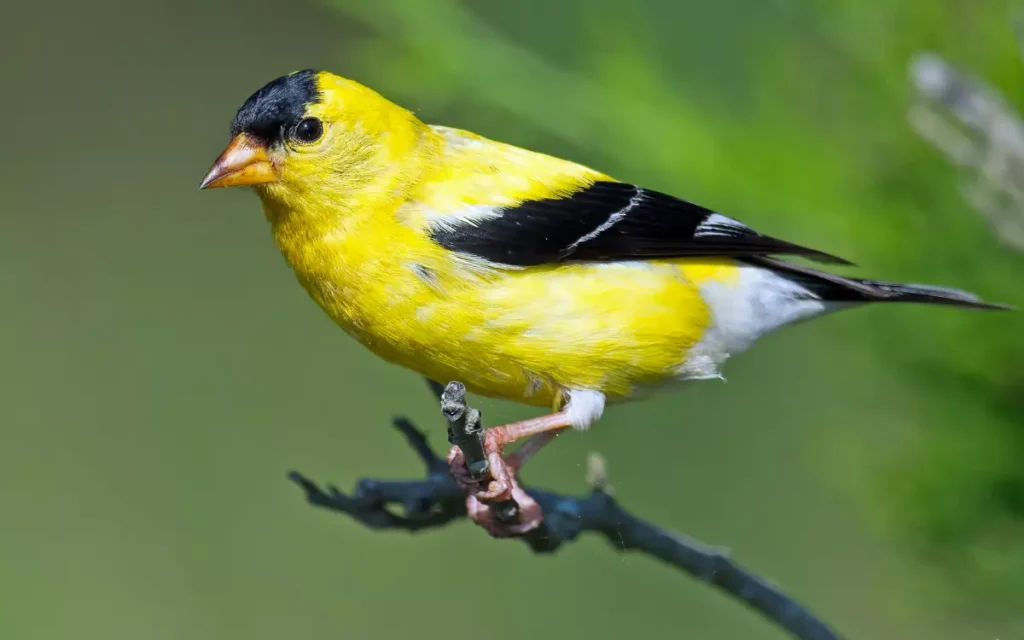
1. American Goldfinch
Scientific name: Spinus tristis
Texas pattern: Most widespread during the cooler months
Look first at: Black wings with white markings
American Goldfinches change appearance through the year.
Breeding males are bright yellow with a black forehead, black wings, and white wing markings.
Winter birds are much duller. They may appear brownish or olive with only traces of yellow.
That seasonal change causes plenty of identification confusion.
Where to Look
Check:
- Seed feeders
- Weedy fields
- Thistle patches
- Open woodland edges
- Gardens
Feeder Clue
A small yellowish bird eating seeds at a feeder is more likely to be a goldfinch than an insect-hunting warbler.
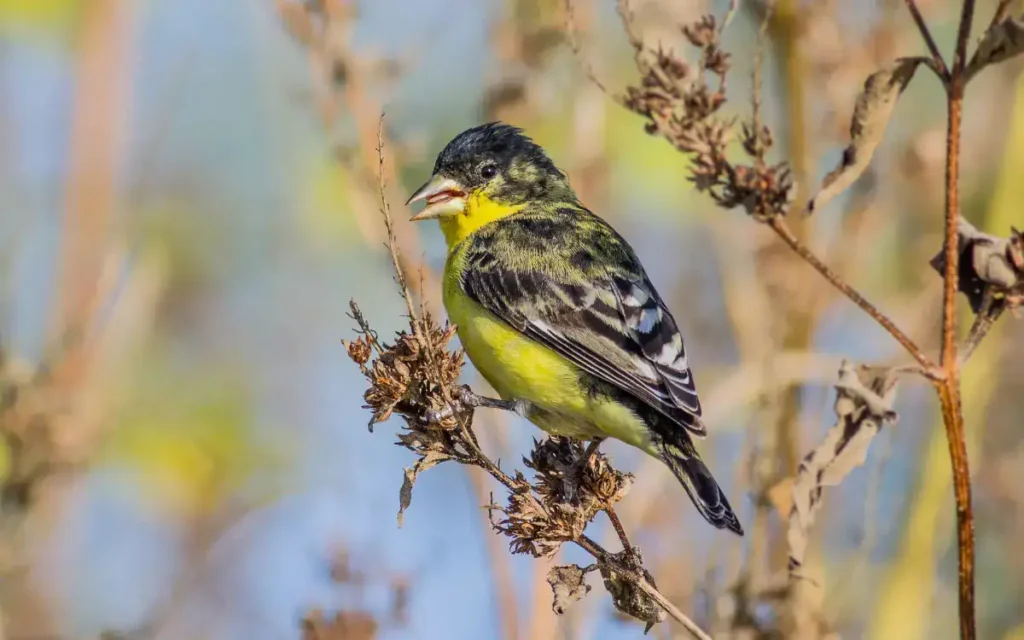
2. Lesser Goldfinch
Scientific name: Spinus psaltria
Texas pattern: Regular in much of western, central, and southern Texas
Look first at: Yellow underside with dark upperparts
Male Lesser Goldfinches have bright yellow underparts with dark upperparts.
Depending on location and individual variation, the back can appear black or greenish.
White markings in the wings become especially useful when the bird flies.
Females are duller, with olive-brown upperparts and muted yellow underneath.
Where to Look
Try:
- Seed feeders
- Parks
- Brushy areas
- Open woodland
- Weedy fields
Lesser vs American Goldfinch
Do not compare yellow brightness.
Look at the back, wing pattern, season, and location instead.
3. Common Yellowthroat
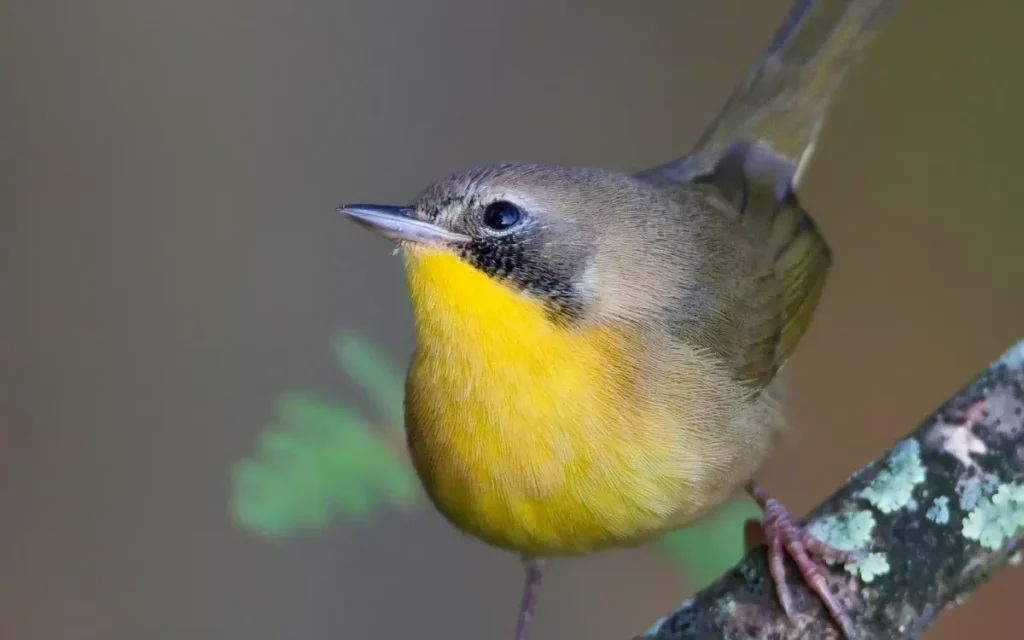
Scientific name: Geothlypis trichas
Texas pattern: Widespread, with numbers changing by season
Look first at: Black mask on adult male
An adult male Common Yellowthroat looks as though someone painted a black mask across its face.
Below that mask is a bright yellow throat and yellow chest, while the back is olive-brown.
Females do not have the black mask. They are much plainer, usually olive-brown above with yellow concentrated around the throat and undertail.
Where to Look
Go low rather than high.
Common Yellowthroats like:
- Marsh edges
- Reeds
- Wet brush
- Weedy fields
- Dense vegetation near water
They often remain hidden only a few feet above the ground.
Read also:
4. Western Kingbird
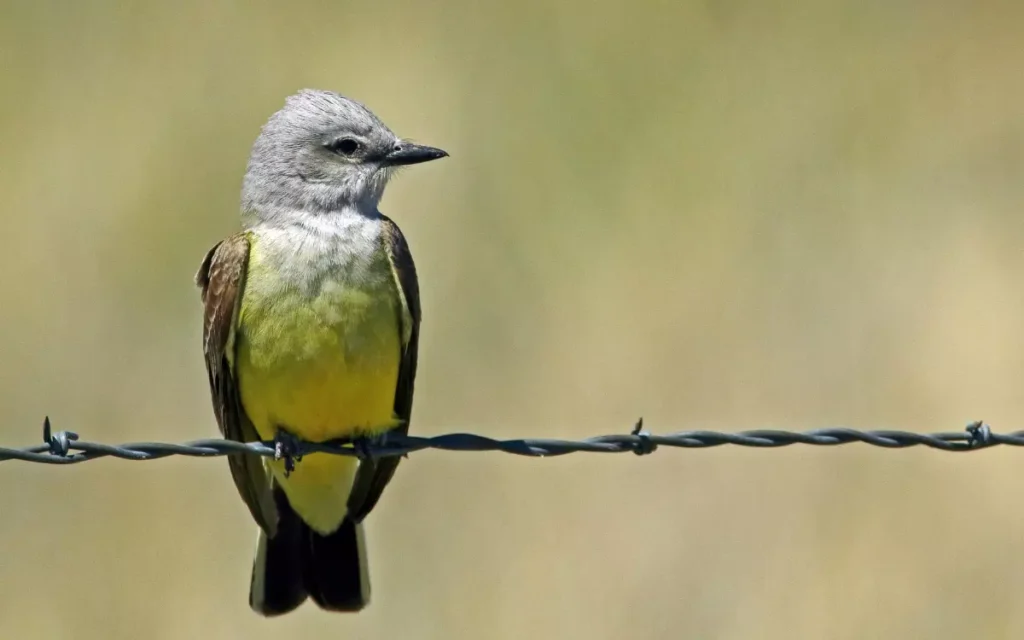
Scientific name: Tyrannus verticalis
Texas pattern: Mainly spring and summer
Look first at: Black tail edged with white
Western Kingbird is one of the easier yellow-bellied birds to notice along roads and open fields.
It has a pale gray head and chest, yellow belly, gray-green back, dark wings, and black tail.
One especially useful feature is the white edging along the outer tail feathers.
Where to Look
Watch exposed perches such as:
- Utility wires
- Fence posts
- Dead branches
- Roadside trees
- Ranches
- Open fields
If you see a medium-sized gray-and-yellow bird sitting upright on a roadside wire in summer, Western Kingbird is worth checking.
5. Great Crested Flycatcher
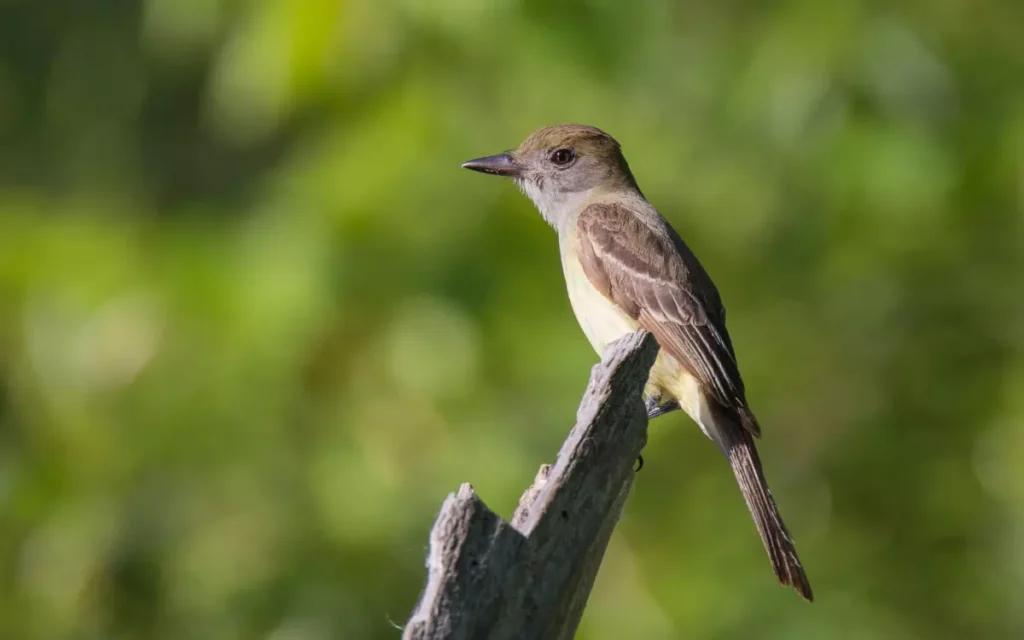
Scientific name: Myiarchus crinitus
Texas pattern: Spring and summer in much of eastern and central Texas
Look first at: Rust-colored tail
A Great Crested Flycatcher has a yellow belly, but its rusty wing and tail feathers often identify it faster.
The head is grayish, the upperparts are brownish-olive, and the throat and upper chest are gray.
It is larger and heavier-looking than the little yellow warblers found in the same trees.
Where to Look
Check:
- Mature woodland
- Forest edges
- Large parks
- Wooded neighborhoods
- Areas with large cavity-bearing trees
Quick Separation
If the bird has:
gray chest + yellow belly + reddish tail
check Great Crested Flycatcher before looking through the warblers.
6. Eastern Meadowlark
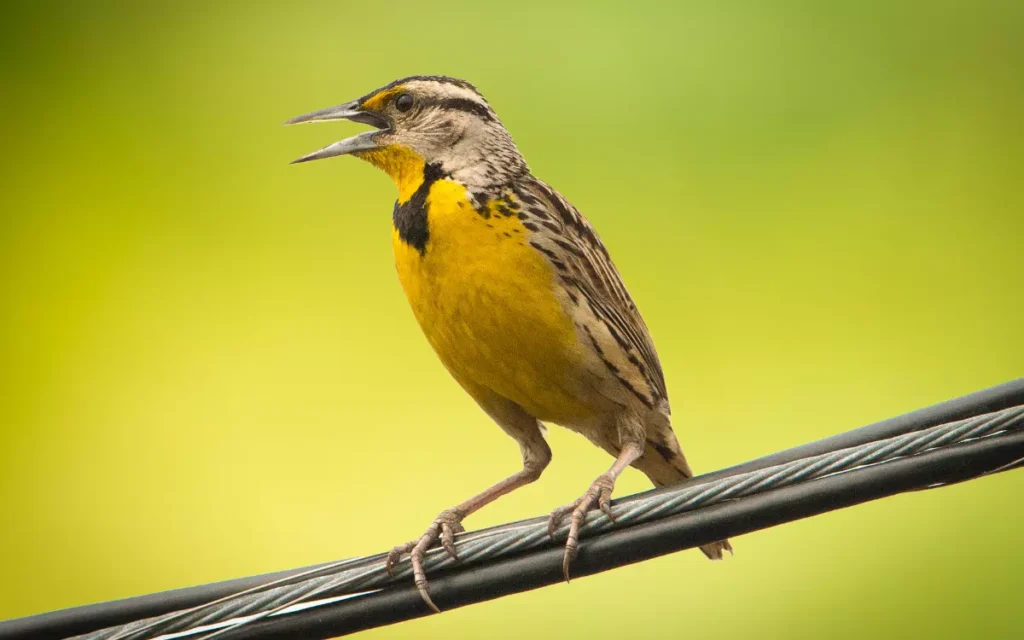
Scientific name: Sturnella magna
Texas pattern: Year-round in suitable grassland
Look first at: Black V across yellow chest
A meadowlark looks nothing like a tiny warbler even though both can show plenty of yellow underneath.
Eastern Meadowlark has a bright yellow throat and chest crossed by a bold black V.
The upperparts are heavily patterned brown, black, and tan, helping the bird disappear when it walks through grass.
Where to Look
Search:
- Pastures
- Prairies
- Hay fields
- Open ranchland
- Agricultural areas
Birds often perch on fence posts when singing.
Identification Warning
Western Meadowlark looks extremely similar.
Plumage alone is not always enough to separate the two. Voice and geographic range can be more useful.
7. Prothonotary Warbler
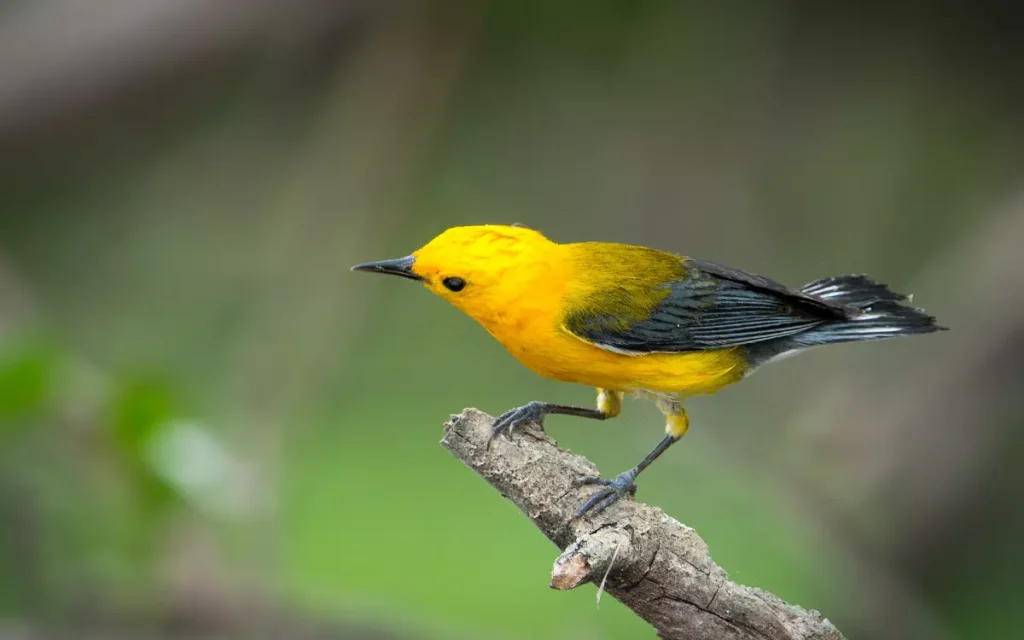
Scientific name: Protonotaria citrea
Texas pattern: Spring and summer in suitable eastern habitat
Look first at: Golden head with blue-gray wings
Few Texas warblers combine colors like the Prothonotary Warbler.
Adults have a rich golden-yellow head and underside with contrasting blue-gray wings and back.
Unlike many warblers, they are strongly associated with wet wooded habitat.
Where to Look
Search around:
- Swamps
- Flooded forests
- Wooded river edges
- Cypress habitat
- Slow-moving water
This makes habitat one of your best identification clues.
A golden bird moving through branches above swampy water is far more suggestive of Prothonotary Warbler than a goldfinch.
8. Yellow Warbler
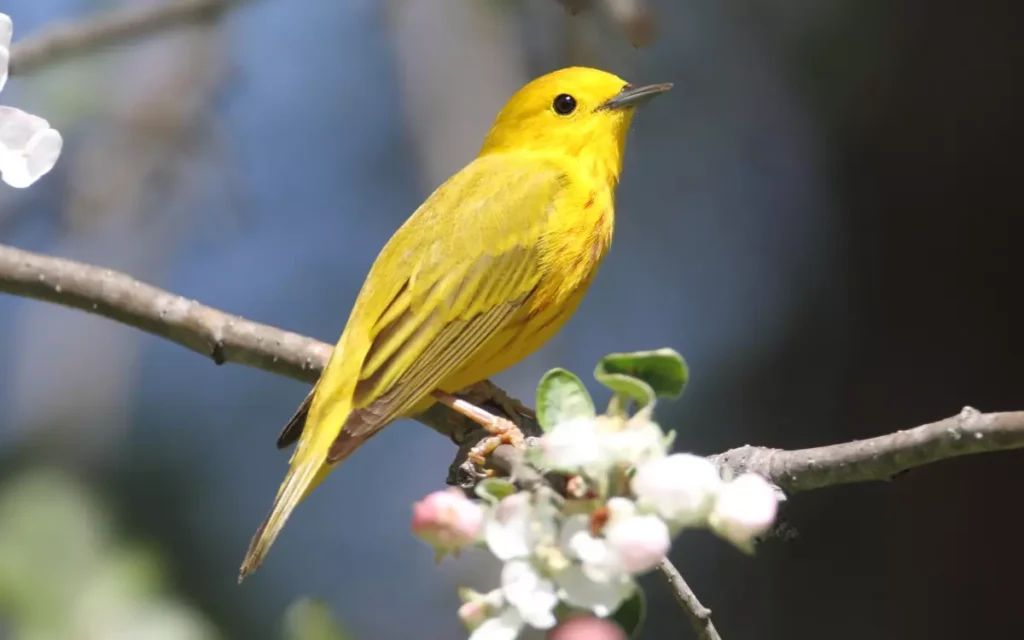
Scientific name: Setophaga petechia
Texas pattern: Most noticeable during migration
Look first at: Yellow almost everywhere
Sometimes the simplest answer really is a Yellow Warbler.
These small birds are yellow across the face, chest, belly, and much of the head. The wings appear darker olive-yellow.
Adult males may show thin reddish streaks across the chest.
Females and young birds can be duller and greener.
Where to Look
During migration, check:
- Willows
- Shrubby woodland edges
- Trees around wetlands
- Streamside vegetation
- Parks with dense shrubs
Don’t Stop at “Small and Yellow”
Several Texas warblers are yellow underneath.
A Yellow Warbler is unusual because so much of the entire bird looks yellow, not just the belly.
9. Great Kiskadee
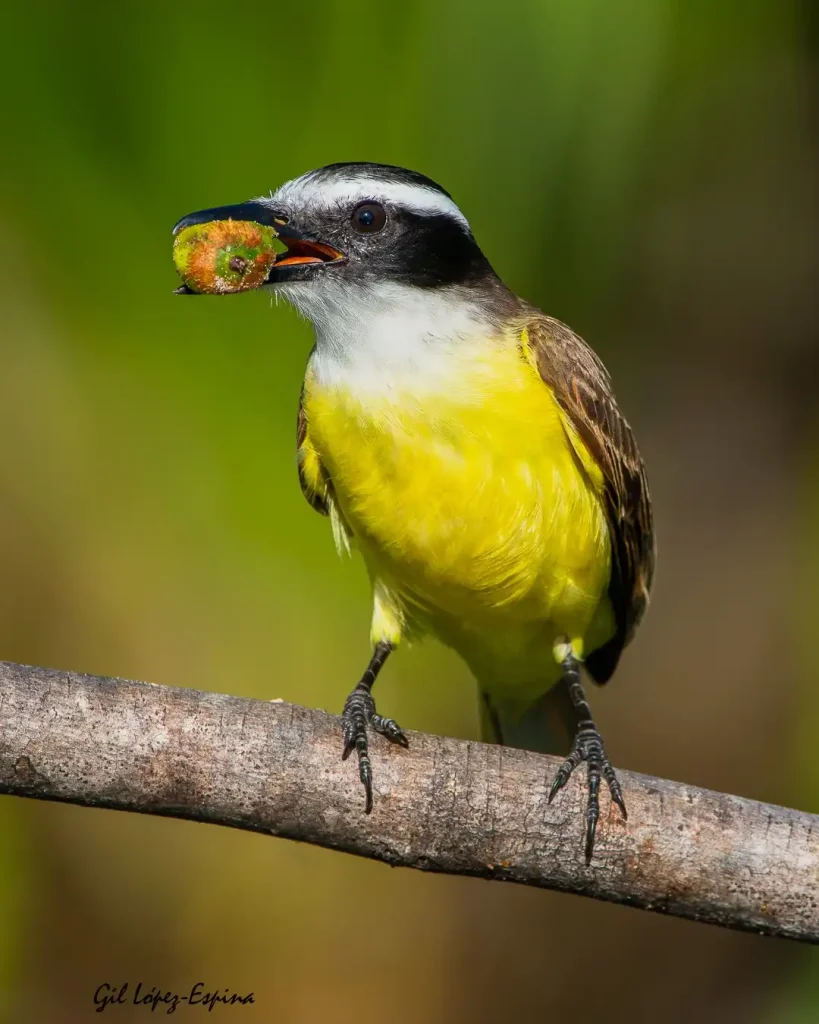
Scientific name: Pitangus sulphuratus
Texas pattern: Year-round in South Texas
Look first at: Black-and-white head
If your mystery bird was large, loud, and strongly patterned, start with the Great Kiskadee.
It has a bright yellow underside, brown wings and back, a white throat, and a bold black-and-white head pattern. Its heavy black bill also looks much stronger than the bills of warblers or finches.
Where to Look
The Great Kiskadee is strongly associated with South Texas, especially the Lower Rio Grande Valley.
Look around:
- Rivers
- Resacas
- Ponds
- Woodland edges
- Parks
- Trees near water
Fast ID
Think:
yellow belly + brown wings + striped black-and-white head
Few other Texas birds combine all three.
10. Couch’s Kingbird
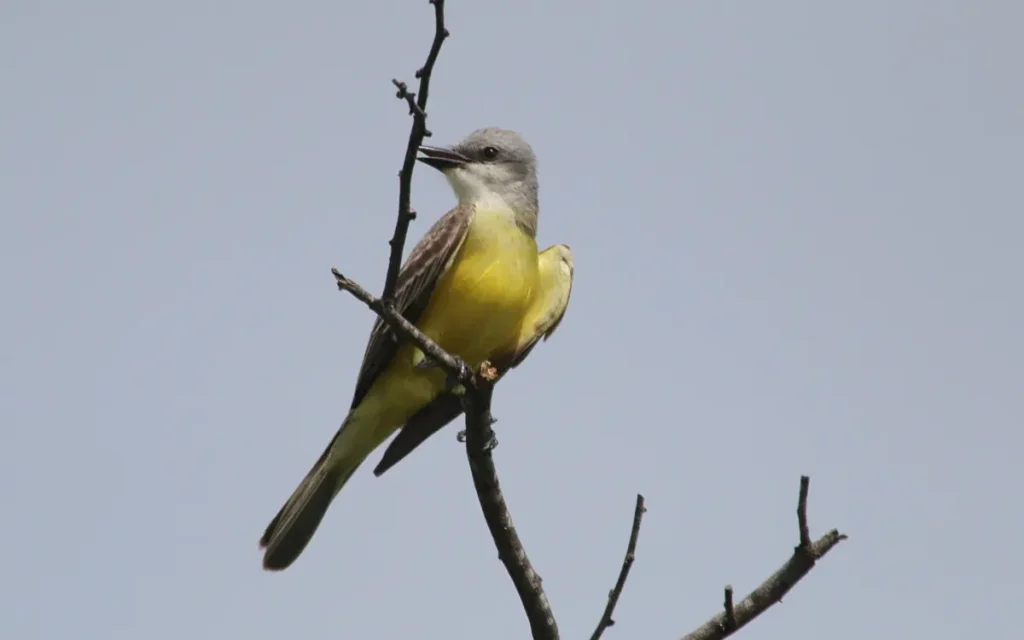
Scientific name: Tyrannus couchii
Texas pattern: Mostly South Texas
Look first at: Gray head above a strong yellow belly
Couch’s Kingbird is another South Texas bird with a lot of yellow underneath.
The head is gray, the throat is pale, the back has olive tones, and the belly is yellow. Its bill is fairly large and broad because it is a flycatcher.
These birds often perch openly and fly out after insects before returning to another visible perch.
Where to Look
Check:
- Woodland edges
- Roadsides
- Ranch country
- Open areas with scattered trees
- Parks in South Texas
Don’t Use Color Alone
Couch’s Kingbird can look similar to Tropical Kingbird, and voice is often one of the better ways experienced birders separate the two.
For a basic Texas identification, location is also useful. Couch’s Kingbird is the much more expected member of this pair in South Texas.
11. Western Kingbird
Scientific name: Tyrannus verticalis
Texas pattern: Mainly spring and summer
Look first at: Black tail edged with white
Western Kingbird is one of the easier yellow-bellied birds to notice along roads and open fields.
It has a pale gray head and chest, yellow belly, gray-green back, dark wings, and black tail.
One especially useful feature is the white edging along the outer tail feathers.
Where to Look
Watch exposed perches such as:
- Utility wires
- Fence posts
- Dead branches
- Roadside trees
- Ranches
- Open fields
If you see a medium-sized gray-and-yellow bird sitting upright on a roadside wire in summer, Western Kingbird is worth checking.
12. Western Meadowlark
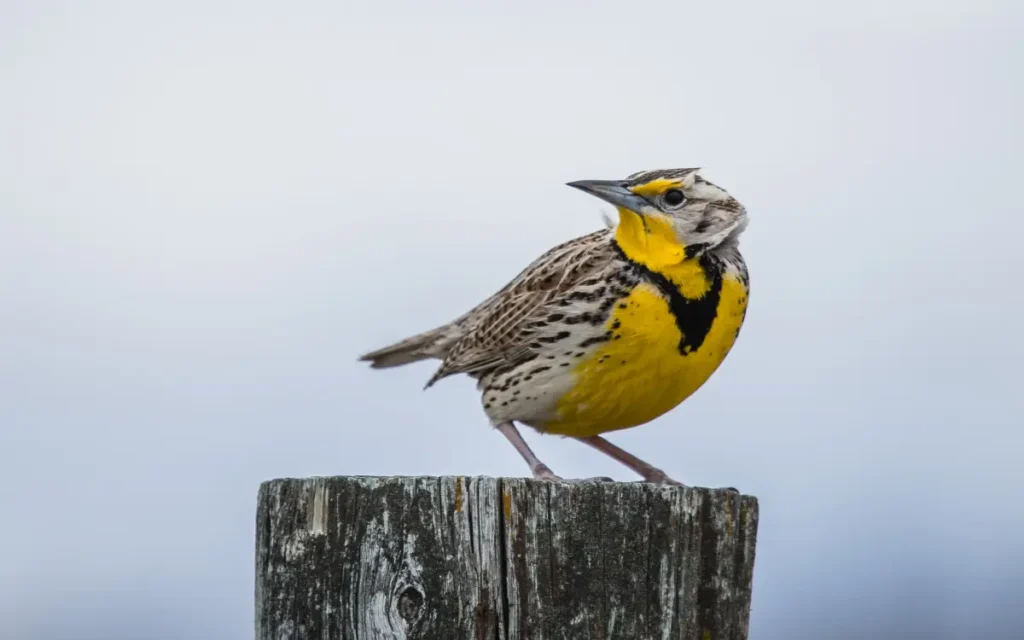
Scientific name: Sturnella neglecta
Texas pattern: Most associated with western and northern open country
Look first at: Yellow chest with black V
Western Meadowlark gives you the same basic first impression as Eastern Meadowlark:
brown patterned back + yellow front + black chest V
This is one of those bird pairs where the obvious features do not solve the identification.
Where to Look
Watch:
- Short-grass prairie
- Ranches
- Open farmland
- Fence lines
- Broad western landscapes
Eastern or Western Meadowlark?
Do not force an ID from one photograph of the chest.
Listen to the song when possible and consider where in Texas the bird was found.
If you cannot confirm the species, simply calling it an Eastern/Western Meadowlark is better than guessing.
FAQs
What Texas bird has a bright yellow belly?
Several do. Western Kingbird, Couch’s Kingbird, Great Kiskadee, Common Yellowthroat, Yellow Warbler, Lesser Goldfinch, and several other species can show bright yellow underparts.
Size, head pattern, habitat, and season are needed to narrow it down.
What Texas bird has a yellow belly and black head?
A male Lesser Goldfinch is one possibility, especially if the bird is small and feeding on seeds.
A male Common Yellowthroat also has black on the face, but its black forms a mask rather than covering the entire head.
What Texas bird has a yellow belly and gray head?
Western Kingbird and Couch’s Kingbird are two good possibilities for a medium-sized bird.
For a much smaller bird, Nashville Warbler has a gray head with yellow underparts.
What Texas bird has a yellow belly and red head?
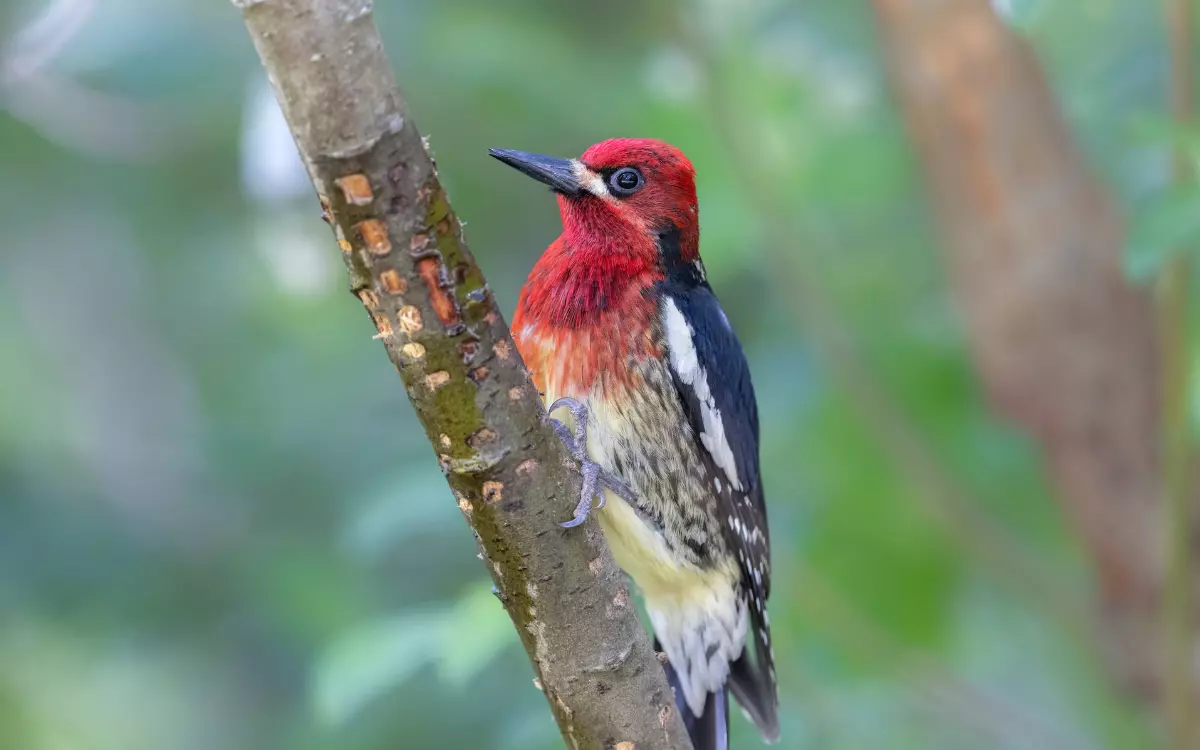
Check Yellow-bellied Sapsucker if the bird has a woodpecker shape and is climbing a tree trunk.
Adults can show red on the crown, while males also have red on the throat.
What small Texas bird has a yellow belly?
Possible matches include Common Yellowthroat, Yellow Warbler, Wilson’s Warbler, Nashville Warbler, Pine Warbler, American Goldfinch, and Lesser Goldfinch.
The face and wings are usually the next features to check.
What yellow bellied bird is common at Texas feeders?
American Goldfinch and Lesser Goldfinch are the two main birds to compare.
Which one is more likely depends partly on location and season.
Is the Yellow bellied Flycatcher found in Texas?
Yes. It passes through Texas during migration rather than being a typical year-round resident.
It is a small olive flycatcher with yellowish underparts, pale wing bars, and a noticeable eye ring.
What yellow bellied bird lives in South Texas?
Great Kiskadee and Couch’s Kingbird are two strong possibilities.
Great Kiskadee has the much bolder black-and-white head pattern. Couch’s Kingbird has a plainer gray head.