15 Mockingbird Facts That May Surprise You
Mockingbirds are best known for copying other birds, but mimicry is only one part of their story. These gray songbirds can learn new sounds throughout life, recognize people, defend fruit trees, sing after midnight, and even perform aerial displays.
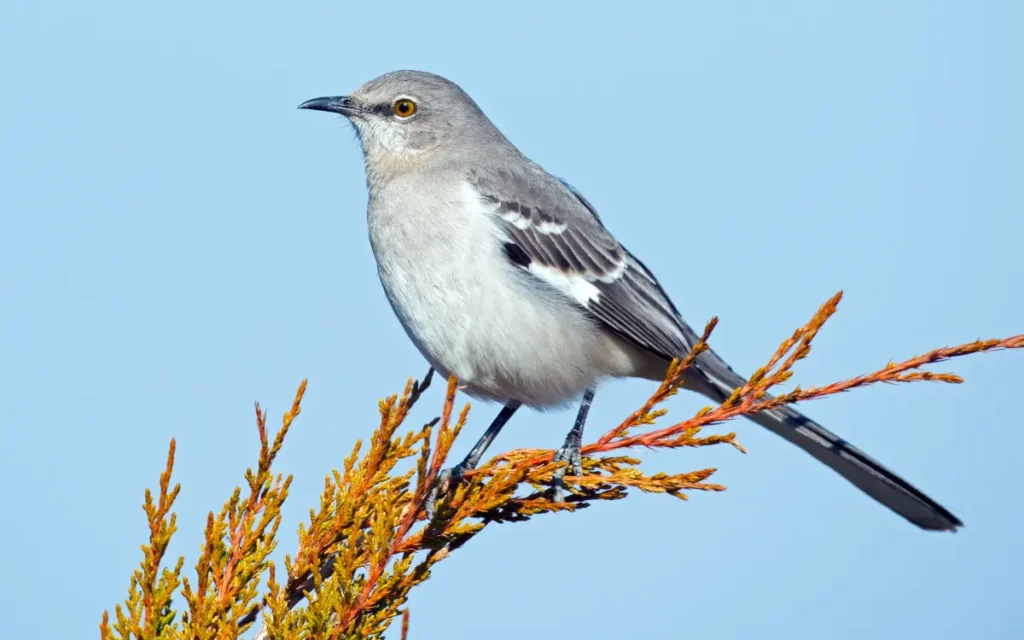
The Northern Mockingbird (Mimus polyglottos) is the species most people in North America know. Its scientific name roughly means “many-tongued mimic,” which suits a bird capable of building a huge and changing song collection.
Mockingbird Quick Facts
| Feature | Details |
| Common name | Northern Mockingbird |
| Scientific name | Mimus polyglottos |
| Family | Mimidae |
| Length | About 8–10 inches |
| Weight | Around 1.6–2 ounces |
| Wingspan | About 12–14 inches |
| Diet | Insects, spiders, berries, and fruit |
| Eggs | Usually 2–6 per brood |
| Habitat | Open woods, parks, suburbs, farms, and gardens |
| Range | United States, Mexico, the Caribbean, and parts of Canada |
| Conservation status | Least Concern |
1. A Mockingbird May Learn Around 200 Songs
A male Northern Mockingbird can build a collection containing as many as 200 different song types. It doesn’t sing every sound once and stop. Instead, it arranges the sounds into phrases and repeats each phrase several times before switching.
Its collection can include the calls of orioles, jays, hawks, blackbirds, killdeer, and many other birds living nearby.
This makes identifying a mockingbird by sound tricky. You might think several species are singing from the same tree when only one mockingbird is responsible.
2. Mockingbirds Keep Learning New Sounds
Many young songbirds learn most of their songs during a limited period. Mockingbirds are different because they can continue adding sounds as they grow older.
An adult male’s collection may become larger from one year to the next. This gives older males a richer song than many younger birds.
Females may pay attention to this variety when selecting a partner. A male with a large collection may appear older, more experienced, or better suited to the local habitat.

3. They Don’t Copy Every Sound They Hear
Mockingbirds are talented mimics, but they aren’t living voice recorders. Research has found that they may ignore unfamiliar sounds that don’t fit the pitch or rhythm of their own normal calls.
In one experiment, researchers played unfamiliar bird songs and computer-made sounds for several months. The local mockingbirds didn’t copy them, even though they heard the recordings many times.
A mockingbird seems to select sounds that work within its natural singing style. Its imitations are learned choices, not automatic recordings.
4. Both Male and Female Mockingbirds Sing
Male mockingbirds produce the longest and most varied songs, especially when attracting a mate or marking a territory. Females sing too, though their songs are usually quieter and less frequent.
A female may sing more during fall while setting up a winter feeding territory. She may also use calls to communicate with her mate or warn other birds.
This is easy to miss because people often assume every singing mockingbird is male.
5. Some Mockingbirds Sing Through the Night
If a loud bird has ever kept you awake with a changing set of whistles, chirps, and squeaks, a Northern Mockingbird may have been the singer.
Unpaired males are the most likely to sing after dark. Spring and early summer are especially noisy because males are trying to attract females.
Streetlights can make the behavior more noticeable. Artificial light may allow a bird to keep singing long after the surrounding area has become quiet.
6. They Can Copy Frogs and Mechanical Noises
Other birds provide much of a mockingbird’s material, but its collection isn’t limited to bird calls. Mockingbirds may imitate frogs and sounds they regularly hear around homes.
People have reported mockingbirds producing noises similar to:
- Car alarms
- Squeaky gates
- Whistles
- Sirens
- Ringing phones
- Barking dogs
Some reports are hard to confirm because a close bird imitation can already sound mechanical. Still, mockingbirds can learn certain environmental noises when those sounds suit their vocal range.
7. Mockingbirds Can Recognize Individual People
A mockingbird nesting near a busy path doesn’t treat every person as an equal danger.
Researchers found that urban mockingbirds could learn to recognize a person who repeatedly approached their nest. The birds began reacting sooner and behaving more aggressively toward that individual. They responded less strongly when a different person approached.
That’s a useful skill for a bird living near homes, sidewalks, and gardens. It can ignore people who pass without causing trouble while watching someone who previously came too close.
8. They May Dive at Cats, Dogs, and People
Mockingbirds are fearless when defending a nest. A parent may fly directly at a crow, hawk, cat, dog, or person that enters the nesting area.
The bird may call loudly, swoop close to the intruder’s head, and return for several passes. It rarely causes a serious injury, but the warning can feel rather personal.
The best response is to give the nest more room. Most attacks stop once the intruder leaves the guarded area, and the behavior fades after the young birds move away.
9. Their White Wing Patches May Have More Than One Use
A resting mockingbird looks mostly gray, but flight reveals broad white patches across its wings. The bird may also raise and open its wings while walking on the ground.
This action is called wing flashing. One possible explanation is that the sudden white movement startles insects and makes them easier to catch.
Another idea is that wing flashing helps communicate with other mockingbirds or warns rivals. Scientists haven’t settled on one answer, so the behavior remains one of the bird’s more curious habits.
10. Mockingbirds Guard Fruit as Personal Property
During the colder months, berries and fruit become a major part of a mockingbird’s diet. A bird may claim a holly bush, berry tree, or garden as its feeding territory.
Once it takes control, it may chase away robins, starlings, cedar waxwings, and other hungry visitors. This can make one mockingbird appear to “own” an entire fruiting shrub.
Its territorial nature is also why a mockingbird may take over part of a yard even when it shows little interest in a traditional seed feeder.
11. Their Diet Changes With the Seasons
Mockingbirds eat more animal prey during spring and summer. Beetles, grasshoppers, caterpillars, ants, spiders, and other small creatures give adults and growing chicks plenty of protein.
In fall and winter, the birds switch toward berries and soft fruit. They may eat dogwood berries, elderberries, blackberries, mulberries, grapes, and holly fruit.
This flexible diet helps mockingbirds live in many places, from dry scrubland to suburban gardens.
12. A Male May Build Several Nest Foundations
The male usually begins the nest by building a rough outer frame from twigs. He may start more than one frame within the territory.
The female inspects these possible sites and helps complete the selected nest. She adds softer materials such as grass, leaves, roots, and plant fibers to form the inner cup.
Mockingbirds commonly place nests in dense shrubs or low trees. Thorny plants can offer extra cover against some predators.
13. They Can Raise More Than One Family in a Season
Northern Mockingbirds often raise two or three broods during a single breeding season. In warm areas with enough food, a pair may attempt even more.
The female can begin preparing for another nesting attempt while the male continues caring for older fledglings. This overlap lets the pair fit several broods into a relatively short period.
Young mockingbirds leave the nest before they are fully independent. Their parents continue feeding and watching them while they learn to find food on their own.
14. Mockingbird Couples Divide Their Territory
A mated pair may share a breeding territory, but each bird can focus on a different part of it. Both help defend the nest, feed the chicks, and drive away threats.
Outside the main breeding period, males and females may guard separate feeding areas. This is especially useful when winter fruit is scattered and worth protecting.
Mockingbirds may keep the same mate through more than one breeding season, although partnerships don’t always last for life.
15. Young Mockingbirds Have Spotted Chests
Adult Northern Mockingbirds have plain pale underparts, but young birds look different. Juveniles have dark spots or streaks across the chest.
These markings offer a clue when a young mockingbird is hopping through a yard near its parents. Its shorter tail, softer feathers, and less confident movements can also help with identification.
As the bird molts into adult plumage, the chest markings disappear and the cleaner gray-and-white appearance takes over.
More Interesting Mockingbird Facts
Mockingbirds Have Local Song Collections
A mockingbird learns from the sounds around it, so birds living in different places won’t have identical collections. A city bird may hear different species and noises than one living near coastal scrub or farmland.
The result is a loose local sound pattern. Neighbors can share some phrases while still having personal variations.
Males Sing While Flying
A male doesn’t always remain on a branch while performing. During courtship, he may fly upward, flutter or circle, sing, and return to his perch.
The white wing patches become especially clear during these flights. The combined sound and movement make the display easier for nearby females to notice.
They Often Choose High Singing Posts
Utility wires, antennas, fence posts, treetops, and roof peaks are common mockingbird stages. A high post helps the song travel and gives the bird a clear view of its surroundings.
The singer may return to the same perch day after day. Finding that favorite post is one of the easiest ways to watch its singing behavior.
“Mockingbird” Refers to More Than One Species
The Northern Mockingbird is only one member of the genus Mimus. Other species include the Tropical Mockingbird, Chilean Mockingbird, Patagonian Mockingbird, and several mockingbirds found in the Galápagos Islands.
They belong to the Mimidae family, which also contains thrashers and catbirds. Mimicry is common across this family, though each species has its own voice and behavior.
Galápagos Mockingbirds Helped Shape Darwin’s Thinking
Mockingbirds, rather than finches alone, caught Charles Darwin’s attention while he visited the Galápagos Islands. He noticed that mockingbirds from different islands weren’t exactly alike.
Those differences helped him question whether closely related populations could change after becoming separated. The birds became an early piece of evidence behind his later thinking about how species develop.
Five US States Honor the Northern Mockingbird
The Northern Mockingbird is the official state bird of Arkansas, Florida, Mississippi, Tennessee, and Texas.
Few birds represent so many states. Its strong voice, wide range, and familiarity around homes probably helped make it a popular choice.
How to Attract Mockingbirds to Your Yard
A tray of sunflower seeds probably won’t draw many mockingbirds because they aren’t regular seed eaters. A yard with insects, fruit, water, and thick nesting cover is much more inviting.
Try planting native berry-producing plants suitable for your region. Dogwood, serviceberry, elderberry, blackberry, and native holly may provide food and shelter.
A shallow birdbath can also bring mockingbirds in for drinking and bathing. Keep it clean, place it where birds can watch for danger, and avoid using pesticides that remove the insects they eat.
Be prepared for territorial behavior. One mockingbird may guard a productive berry bush from other birds.
Mockingbird vs. Brown Thrasher vs. Gray Catbird
| Feature | Northern Mockingbird | Brown Thrasher | Gray Catbird |
| Main color | Gray and white | Rusty brown with a spotted chest | Slate gray with a dark cap |
| Wing pattern | Large white patches | Two pale wing bars | Mostly plain |
| Typical repeated phrases | Often 2–6 times | Usually twice | Less regular repetition |
| Tail | Long with white outer feathers | Very long and rusty brown | Long and dark |
| Common behavior | Uses exposed perches | Searches through leaf litter | Hides in thick shrubs |
| Mimics other sounds | Yes | Yes | Yes |
More Birds Fact to read
Mockingbirds rely on voice and bold behavior, while other birds use unusual feathers or flight skills. You may also enjoy these Bird Serenity guides:
- See how the Twelve-wired Bird-of-paradise uses its wire-like feathers during courtship.
- Meet the colorful Lesser Bird-of-paradise and learn about its display behavior.
- Read these Magnificent Riflebird facts to discover another unusual performer.
- Learn how frigatebirds spend long periods above the ocean.
FAQs
Why are mockingbirds called mockingbirds?
They received the name because they copy, or “mock,” the songs and calls of other birds. Their scientific name, Mimus polyglottos, also refers to their ability to produce many sounds.
How many sounds can a mockingbird copy?
A Northern Mockingbird may learn around 200 song types. The exact number varies with the bird’s age, experience, location, and the sounds available in its surroundings.
Do mockingbirds copy human voices?
There is little solid evidence that wild mockingbirds copy complete human words as clearly as parrots. They are better known for imitating bird calls, frogs, whistles, alarms, and other sounds with pitches that fit their natural voice.
Why do mockingbirds sing at night?
Night singing is most common among males without mates. They sing to advertise their presence and attract a female. Bright streetlights may allow the singing to continue longer.
Why does a mockingbird repeat each sound?
Repetition is part of its normal song pattern. A mockingbird usually repeats one phrase several times before changing to another. Brown Thrashers often repeat a phrase twice, which can help birdwatchers separate the two singers.
Are mockingbirds aggressive?
They can be very territorial, especially near a nest or dependable food source. They may chase birds, cats, dogs, and people, but the behavior is defensive rather than an attempt to hunt them.
Do mockingbirds remember people?
Research suggests they can recognize individual humans who repeatedly approach their nests. They may react more strongly to a person they have learned to view as a threat.
Do mockingbirds mate for life?
Some pairs remain together through several breeding seasons, but mockingbirds aren’t always lifelong partners. A pair may separate or choose different mates in a later season.
What do mockingbirds eat?
They eat insects, spiders, berries, and soft fruit. Insects form a larger part of their warm-season diet, while fruit becomes more useful during fall and winter.
Do mockingbirds visit bird feeders?
They rarely care much about seed feeders. They are more likely to visit yards offering berries, mealworms, suet, raisins, or a clean birdbath.
Are mockingbirds protected?
Yes. Native mockingbirds in the United States are protected under the Migratory Bird Treaty Act. Their nests, eggs, chicks, and adult birds shouldn’t be captured, harmed, or removed without legal authorization.