Blue Jay Identification
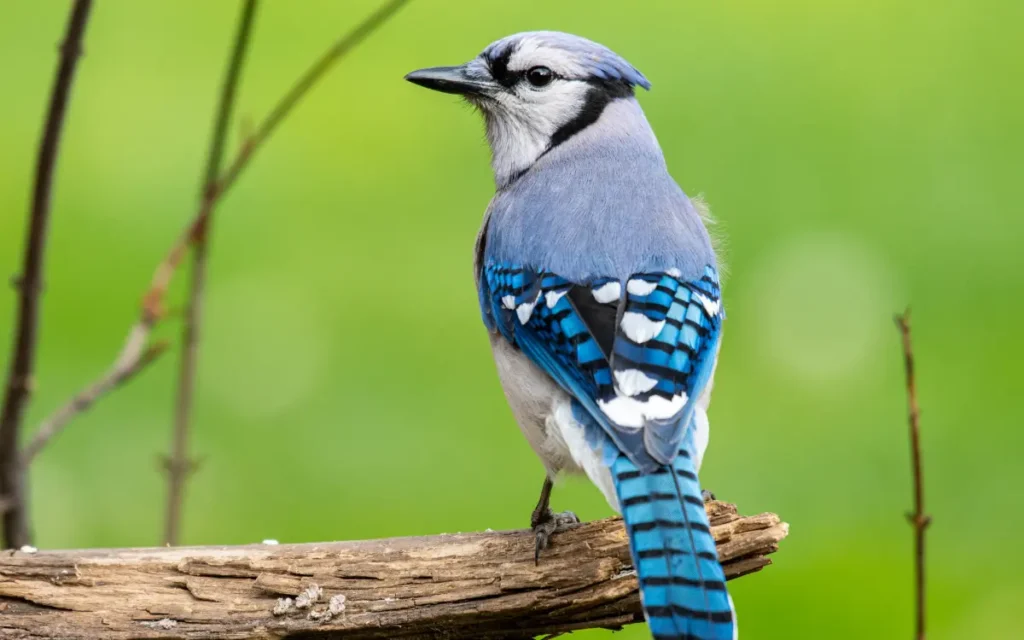
A Blue Jay is a large, crested songbird with blue upperparts, a white face and belly, a black necklace, and barred wings and tail. The bold white wing bars and white tail corners are especially useful identification marks.
You’ll usually hear a Blue Jay before you see it. Its loud “jeer” call carries through wooded neighborhoods, parks, and backyards. Once it lands, look for the pointed crest, heavy black bill, and long blue tail.
Blue Jays Call:-
Blue Jay Identification at a Glance
| Feature | Blue Jay Identification |
| Scientific name | Cyanocitta cristata |
| Length | 9–12 inches |
| Wingspan | 13–17 inches |
| Weight | About 2.5–3.5 ounces |
| Main colors | Blue, white, black, and gray |
| Bill | Thick, straight, and black |
| Crest | Tall and pointed; can be raised or lowered |
| Tail | Long, blue, and barred with black |
| Underparts | Pale gray to white |
| Main call | Loud “jeer” or “jay-jay” |
| Habitat | Forest edges, parks, suburbs, and wooded yards |
| Range | Eastern and central North America |
| Diet | Nuts, seeds, insects, fruit, and small animals |
What Does a Blue Jay Look Like?
A Blue Jay has a strong combination of blue, black, and white markings. Its back is soft blue-gray, while its wings and tail appear brighter blue with black bars and white patches.
The face is mostly white. A black line begins near the bill, passes around the sides of the head, and forms a necklace across the upper chest.
The underparts are pale gray or white. Its legs, eyes, and sturdy bill are black.
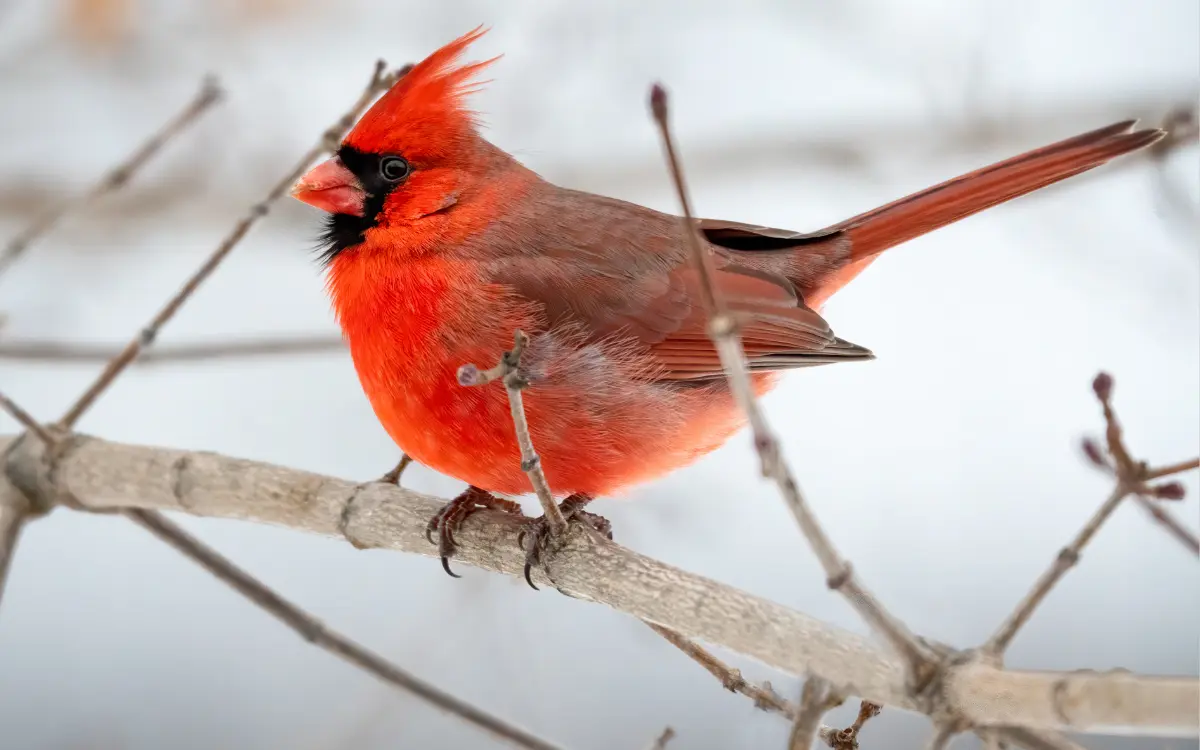
The pointed crest gives the head a tall, angular shape. Unlike a Northern Cardinal, however, the Blue Jay has a much longer bill, a larger body, and broad blue wings.
The easiest field marks are:
- Tall blue crest
- White face
- Black neckband
- White wing bars
- Black barring on the wings and tail
- White corners on the tail
- Pale belly
- Large black bill
The black necklace varies between individual birds. On some Blue Jays, it forms a thick, complete band. On others, it looks thinner or slightly broken.
Blue Jay Size and Shape
Blue Jays are larger than most backyard songbirds. They are close to the size of an American Robin, though their long tail and broad wings can make them appear bigger.
Their bodies are strong and fairly heavy for a songbird. The neck is short, the chest is full, and the bill is thick enough to open acorns, seeds, and hard nuts.
| Measurement | Typical Size |
| Body length | 9–12 inches |
| Wingspan | 13–17 inches |
| Weight | 2.5–3.5 ounces |
| Relative size | Larger than a cardinal; smaller than a crow |
A Blue Jay’s long tail may be nearly half the bird’s visible length. In flight, the combination of rounded wings and a long tail creates an easy-to-recognize outline.

Blue Jay Color Pattern
The upper surface of a Blue Jay is mostly blue. The brightest color appears on the wings, tail, and crest.
Black bars cross the blue wing and tail feathers. A broad white wing bar is visible when the bird is perched, while larger white patches appear when it opens its wings.
The face and throat are white. The belly can range from clean white to pale gray, with slightly darker gray along the sides.
Blue Jays don’t have blue pigment in their feathers. Their feathers contain tiny structures that scatter light and make them appear blue. A damaged feather viewed without the same light effect may look brownish rather than blue.
Blue Jay Wing Identification
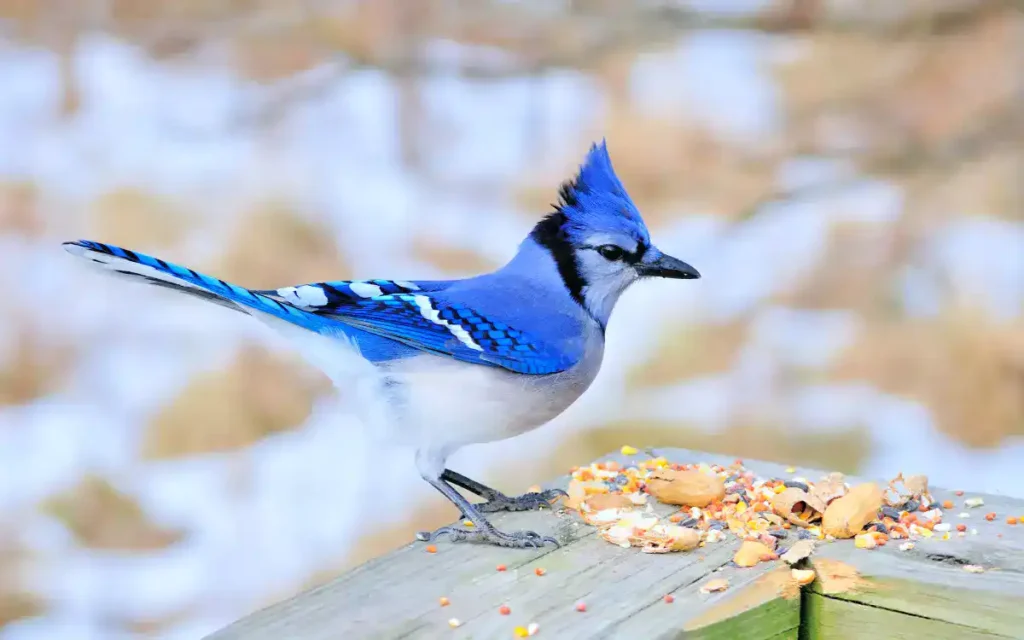
The wings provide some of the best clues for confirming a Blue Jay.
On a perched bird, look for a bold white wing bar against blue-and-black feathers. In flight, the white patches become larger and more noticeable.
The main wing pattern includes:
- Blue flight feathers
- Heavy black barring
- One broad white wing bar
- White patches across the open wings
- Darker outer flight feathers
Scrub-jays are also blue, but they don’t have the Blue Jay’s strong combination of black bars and large white wing patches. According to the Audubon field guide, this white wing-and-tail pattern is one of the clearest ways to separate Blue Jays from other blue-colored jays. Audubon Field Guide
Blue Jay Tail Identification
A Blue Jay has a long, rounded tail marked with blue, black, and white.
Black bands cross the blue tail feathers. White patches near the outer corners create a checkered appearance when the tail is spread.
In flight, the white tail corners can be seen from a distance. They are especially useful when the bird is flying away and its facial markings aren’t visible.
The tail is longer and more patterned than that of a bluebird. It is also quite different from the plain blue tail of most scrub-jays.
Blue Jay Crest Meaning
A Blue Jay can raise or flatten the feathers on top of its head. The crest’s position may offer clues about the bird’s mood, though it shouldn’t be read as a perfect emotional signal.
Raised Crest
A fully raised crest is often seen when a Blue Jay is alert, excited, aggressive, or watching a possible threat.
You may notice this posture when two jays argue over food or when the bird spots a cat, hawk, or snake.
Flattened Crest
The crest is often lowered when the bird is feeding calmly, resting, or moving around familiar flock members.
A relaxed Blue Jay can look surprisingly round-headed when the crest lies flat.
Bristled Crest
A frightened or highly alarmed bird may spread its crest outward, giving the head a rougher and wider appearance.
Body position, calls, and the surrounding situation should be considered along with the crest.
Male vs. Female Blue Jay Identification
Male and female Blue Jays look almost identical. Both have the same blue, black, white, and gray plumage.
Males are generally a little larger, but the difference is too small to be dependable unless two birds are standing together. Even then, body posture can make one appear larger.
| Feature | Male Blue Jay | Female Blue Jay |
| Plumage | Blue, black, white, and gray | Blue, black, white, and gray |
| Crest | Tall and pointed | Tall and pointed |
| Average size | Slightly larger | Slightly smaller |
| Reliable visual difference | None for normal field identification | None for normal field identification |
Behavior can sometimes offer a clue during courtship. Several males may follow one female through the trees, calling and performing short flights. Outside this setting, you usually can’t determine a Blue Jay’s sex by appearance.
Juvenile Blue Jay Identification
A young Blue Jay has the same basic pattern as an adult, but its colors may appear softer or duller.
Juveniles can have a shorter-looking crest, fluffier body feathers, and less tidy wing and tail markings. The black necklace may also look weaker.
Watch for these signs:
- Duller blue feathers
- Shorter or less tidy tail
- Softer black markings
- Fluffy body shape
- Pink or pale color near the corners of the bill
- Begging calls and wing fluttering near an adult
A recently fledged Blue Jay may sit quietly while its parents bring food. Although it can appear helpless, a fully feathered fledgling normally belongs outside the nest.
Keep pets away and watch from a distance. The parents are often nearby even when they aren’t immediately visible.
Why Do Some Blue Jays Have Bald Heads?
A bald Blue Jay can look sick or injured, but temporary feather loss is often connected to molting.
Some Blue Jays lose most of their head feathers at roughly the same time. This exposes the dark skin and makes the bird’s head look unusually small.
New pin feathers usually begin growing soon afterward. The bird may otherwise continue eating, flying, and behaving normally. The Cornell Lab notes that nearly featherless heads are commonly seen in Blue Jays during the late-summer molt. Cornell Lab
However, a bird that also has swollen eyes, crusty skin, trouble breathing, or poor balance may have a health problem rather than a normal molt.
Blue Jay Calls and Sounds
The most familiar Blue Jay call is a loud, rough “jeer.” It may sound like “jay,” “jaay,” or “thief.”
Blue Jays have a much larger sound collection than many people realize. Their calls include whistles, clicks, squeaks, rattles, gurgles, and softer notes used between nearby birds.
The “Jeer” Call
This loud call is used for contact, alarm, and communication over longer distances. Several jays may join together, producing a noisy series of calls.
Bell-Like Whistles
Blue Jays can make clear, musical notes that sound like “tool-ool,” “kloo,” or a small bell. These softer whistles may not sound like the same bird that produces the harsh jeer.
Whisper Song
A Blue Jay’s whisper song is quiet and easy to miss. It contains clicks, whines, soft whistles, liquid notes, and pieces of other calls.
A singing session can continue for more than two minutes, yet you may need to stand close to hear it.
Hawk Imitations
Blue Jays frequently copy hawks, particularly Red-shouldered Hawks. The imitation can be convincing enough to confuse people and other birds.
A jay may use a hawk-like call after spotting a real predator. It may also make the sound in other situations, including near a feeder. The exact reason can vary, so every hawk imitation shouldn’t automatically be treated as a trick to frighten other birds away. You can compare the calls on the Cornell Lab Blue Jay sound guide.
Blue Jay Flight Identification
A flying Blue Jay has broad, rounded wings and a long, rounded tail. Its flight usually combines steady wingbeats with short glides.
Look for flashes of white across the wings and tail. From below, the pale body contrasts with darker flight feathers.
Blue Jays crossing an open yard often fly one at a time. Migrating jays may travel in loose groups, especially along shorelines and other natural travel routes.
Key flight clues include:
- Broad, rounded wings
- Long blue tail
- White wing patches
- White outer tail feathers
- Direct, steady flight
- Several deep wingbeats followed by a short glide
Their flight can appear slower than expected for such a noisy, energetic bird.
Blue Jay Behavior That Helps With Identification
Blue Jays often move through trees by making short, purposeful flights between branches. They can be cautious at first, but they become bold once they feel safe.
At a feeder, a Blue Jay may land, take one peanut or seed, and immediately fly away. It may carry the food to a branch, hammer it open, or hide it for later.
On the ground, Blue Jays walk and hop while searching for acorns, insects, and fallen food. Their upright stance, long tail, and large bill remain easy to see.
Common behavior includes:
- Carrying whole peanuts away from feeders
- Hiding acorns and seeds
- Hammering nuts against a branch
- Chasing smaller birds
- Joining other jays to mob hawks or owls
- Moving through the trees in family groups
- Raising the crest during disputes
- Watching a feeder from cover before approaching
Their strong bill and food-caching habits reflect their place in the crow family, Corvidae.
Where Are Blue Jays Found?
Blue Jays live across much of eastern and central North America. Their range covers southern Canada and a large part of the eastern United States.
They are found from wooded parts of southern Canada south through Florida and toward the Gulf Coast. Their range extends west into parts of the central United States.
Blue Jays favor places that mix trees with open ground. Common habitats include:
- Oak and beech forests
- Woodland edges
- Suburban neighborhoods
- City parks
- Farms with scattered trees
- Large gardens
- College campuses
- Cemeteries
Yards with mature oak trees are especially attractive because acorns are a major food source.
Are Blue Jays Migratory?
Blue Jay migration is difficult to predict. Some remain in the same area all year, while others travel south during fall.
A bird that stays in one location one year may migrate in another. Younger jays seem to migrate more often, but adults can migrate as well.
Large movements are easiest to notice along shorelines, ridges, and other travel routes. Migrating flocks may contain dozens or even hundreds of birds.
Food supply, weather, age, and local conditions may all affect whether a Blue Jay moves.
Birds Commonly Mistaken for Blue Jays
Several North American birds have blue feathers, but the Blue Jay’s crest, black necklace, barred wings, and white patches form a unique combination.
Blue Jay vs. Steller’s Jay
A Steller’s Jay has a tall crest, but its head and upper chest are black or charcoal rather than white.
| Feature | Blue Jay | Steller’s Jay |
| Head | Mostly blue and white | Black or dark charcoal |
| Chest | White or pale gray | Dark upper chest |
| Necklace | Black band | No matching black necklace |
| Wing pattern | Blue, black, and white | Mostly blue with dark barring |
| Main range | Eastern and central North America | Western North America |
If the bird has a dark head, dark chest, and blue body, it is more likely a Steller’s Jay.
Blue Jay vs. California Scrub-Jay
A California Scrub-Jay is blue and gray but lacks a crest. It also doesn’t have the Blue Jay’s bold black-and-white barring.
| Feature | Blue Jay | California Scrub-Jay |
| Crest | Present | Absent |
| Wing bars | Bold black and white | No bold white wing bars |
| Neck marking | Black necklace | Blue breast band |
| Body | Heavier and rounder | Slimmer |
| Range | Eastern and central regions | Western regions |
Blue Jay vs. Woodhouse’s Scrub-Jay
Woodhouse’s Scrub-Jay has a blue head, wings, and tail with a gray back and belly. Its head is smooth rather than crested.
Its wing and tail feathers also lack the Blue Jay’s clear white patches and heavy black bars.
Blue Jay vs. Florida Scrub-Jay
Florida Scrub-Jays occur only in Florida’s scrub habitat. They have blue heads, wings, and tails, but their backs and bellies are gray.
A Florida Scrub-Jay lacks a crest, black necklace, and barred wing pattern. Its restricted habitat also helps with identification.
Blue Jay vs. Eastern Bluebird
An Eastern Bluebird is much smaller and has a rounded head without a crest. Adult males have rusty orange chests rather than white underparts.
| Feature | Blue Jay | Eastern Bluebird |
| Size | Large songbird | Small songbird |
| Crest | Present | Absent |
| Bill | Thick and heavy | Thin and short |
| Chest | White or gray | Rusty orange in males |
| Tail | Long and barred | Shorter and plain |
| Feeder food | Peanuts, nuts, and seeds | Mealworms and fruit |
Blue Jay vs. Belted Kingfisher
A Belted Kingfisher can look blue-gray from a distance, but it has a shaggy crest and a long, spear-shaped bill.
Kingfishers are normally found near rivers, lakes, and ponds. Their rattling call and fishing behavior quickly separate them from Blue Jays.
Know more about this bird:-
- Blue Jay vs Bluebird
- Blue Jay vs Cardinal
- Blue Jay vs Scrub Jay
- Blue Jay vs Mockingbird
- Robin vs Blue Jay
Blue Jay Identification in Different Seasons
Blue Jays don’t change into a separate breeding or winter plumage. Adults keep the same basic blue, white, and black pattern throughout the year.
Fresh feathers can look brighter after the molt. Older feathers may become worn and slightly faded by late summer.
Seasonal behavior changes are often more noticeable than color changes:
Spring
Pairs become more active around nesting sites. Courtship groups may chase through trees, with several males following a female.
Summer
Adults feed young birds, and fledglings begin appearing in yards. Late summer is also when some Blue Jays show temporary head feather loss during molt.
Fall
Loose migratory flocks may travel during the day. Jays also become busy gathering and hiding acorns.
Winter
Blue Jays visit feeders more regularly when natural food becomes harder to find. Their blue plumage is easy to spot against snow or bare branches.
How to Identify a Blue Jay at Your Feeder
Start with the bird’s size. A Blue Jay will be larger than chickadees, finches, nuthatches, and most woodpeckers visiting a typical feeder.
Next, check for the crest and black necklace. Finally, look at the wings for white bars and black barring.
A feeder visitor is probably a Blue Jay if it has:
- A body close to robin size
- A pointed blue crest
- A white face and underparts
- A black necklace
- Blue-and-black barred wings
- White wing and tail patches
- A large black bill
- A habit of carrying away whole peanuts
Black-oil sunflower seeds, peanuts, corn, and suet can attract Blue Jays. A platform feeder gives them enough space to land comfortably.
Blue Jay Nest Identification
A Blue Jay nest is a bulky open cup made from twigs, bark strips, roots, leaves, grass, and sometimes paper.
The nest is usually placed in the fork of a tree or large shrub. Both adults help build it, though their exact share of the work can vary.
Typical nest clues include:
- Rough outer cup made from twigs
- Softer lining of roots and plant material
- Placement in a tree fork
- Hidden among leaves or branches
- Often 10–25 feet above the ground
Finding a Blue Jay near a nest doesn’t mean the bird built it. Jays sometimes inspect nests while searching for food, so adult behavior should be watched from a safe distance.
Blue Jay Egg Identification
Blue Jay eggs can be pale blue, greenish, or buff with brown or gray spots. A typical clutch contains about two to seven eggs.
Egg color alone isn’t enough for identification because many birds lay similar-looking eggs. Nest shape, location, habitat, and the adults attending the nest are more dependable clues.
Never handle the eggs or move the nest. Blue Jays and their active nests are protected by federal law in the United States.
Frequently Asked Questions
What is the easiest way to identify a Blue Jay?
Look for a large blue bird with a pointed crest, white face, black necklace, barred wings, and white wing patches. No other common eastern jay has this full combination.
How can you tell a male Blue Jay from a female?
You generally can’t tell them apart by plumage. Males and females have nearly identical colors and markings. Males average slightly larger, but size isn’t dependable in the field.
What color is a Blue Jay’s belly?
The belly ranges from pale gray to white. The sides may appear slightly darker than the center of the belly.
Do young Blue Jays look different from adults?
Young Blue Jays have the same basic pattern but may look duller, fluffier, and less neatly marked. Their crest and tail may appear shorter while they are still growing.
What does a Blue Jay sound like?
Its best-known call is a loud, harsh “jeer.” It also makes bell-like whistles, clicks, rattles, squeaks, and quiet whisper songs. Blue Jays can imitate hawk calls as well.
What does a Blue Jay look like in flight?
It has broad, rounded wings, a long tail, white underparts, and large white patches on the wings and tail. Its flight is usually direct, with steady wingbeats and short glides.
Is a blue bird without a crest a Blue Jay?
Probably not. Adult and juvenile Blue Jays have crests, though a relaxed bird may flatten its crest until it becomes less obvious. A truly crestless blue bird may be a scrub-jay, bluebird, bunting, or another species.
Why does a Blue Jay raise its crest?
A raised crest often means the bird is alert, excited, frightened, or acting aggressively. A flattened crest is more common while the bird is calm or feeding.
Are Blue Jays blue all year?
Yes. Blue Jays keep the same general color pattern throughout the year. Their feathers may look brighter after molting and duller when worn.
Are Blue Jays rare?
Blue Jays are common across much of eastern and central North America. Their numbers and visibility can change locally because some individuals migrate while others remain year-round.