American Goldfinch vs Lesser Goldfinch: Key Differences
Goldfinches can be tricky because both birds are small, yellow, active, and fond of seeds. At a feeder or on a thistle plant, they may look almost the same for the first few seconds.
The fastest way to separate them is to check range, size, back color, and head pattern. American Goldfinches are slightly larger and more widespread across North America. Lesser Goldfinches are smaller, mostly western, and males often show either a black or greenish back with a black cap.
If you are birdwatching in the East, your yellow finch is probably an American Goldfinch. If you are in the West or Southwest, both species may be possible, so the details matter more.
American Goldfinch vs Lesser Goldfinch: Quick Comparison
| Feature | American Goldfinch | Lesser Goldfinch |
| Scientific name | Spinus tristis | Spinus psaltria |
| Size | Slightly larger | Smaller and more compact |
| Length | 4.3–5.1 in | 3.5–4.3 in |
| Wingspan | 7.5–8.7 in | 5.9–7.9 in |
| Breeding male | Yellow body, black forehead, black wings | Yellow below, black cap, black or green back |
| Female | Olive above, dull yellow below | Olive back, dull yellow below, smaller |
| Winter look | Brownish to gray, pale wingbars | Usually keeps more yellow tones |
| Range | Much of the U.S. and southern Canada | Western U.S., Mexico, Central America, and farther south |
| Voice | “po-ta-to-chip” or “per-chick-o-ree” flight call | Fast twittering, wheezy notes, mimicry |
| Feeder food | Nyjer and sunflower | Nyjer, sunflower-family seeds, small seeds |
Cornell lists American Goldfinches at 4.3–5.1 inches long, while Lesser Goldfinches are smaller at 3.5–4.3 inches.
Cornell also notes that breeding male American Goldfinches are yellow with a black forehead, while male Lesser Goldfinches have a black cap and either black or green backs.
Which Goldfinch Did You See?
If the bird is in the eastern U.S., it is almost certainly an American Goldfinch, because Lesser Goldfinches are mainly western birds.
If you are in the western U.S., look at the back and head:
| What You Notice | Likely Bird |
| Male has yellow back and black forehead | American Goldfinch |
| Male has black cap and black or green back | Lesser Goldfinch |
| Bird is slightly larger with bold white wingbars | American Goldfinch |
| Bird is very small with yellow underparts and dark cap | Lesser Goldfinch |
| Winter bird looks dull brown-gray | American Goldfinch |
| Bird gives fast twittering notes | Lesser Goldfinch |
American Goldfinch Overview
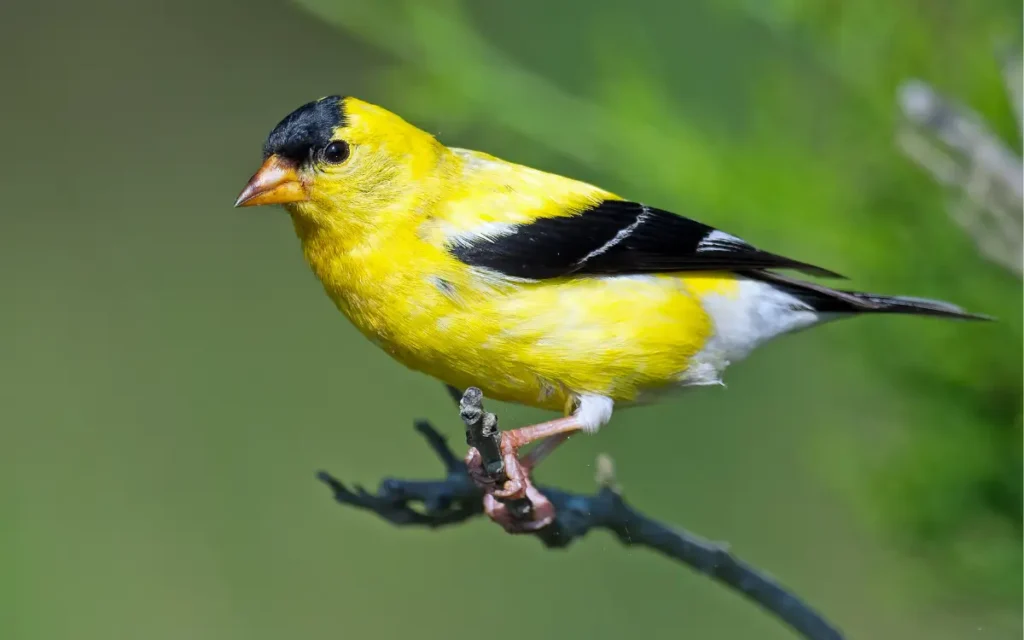
The American Goldfinch is the more familiar species for many backyard birders. It is common across much of North America and often visits feeders for sunflower and nyjer seed.
Cornell says American Goldfinches are common at feeders and are usually easy to find through much of North America, especially around weedy fields, thistle patches, and feeders.
In breeding season, the male is bright yellow with black wings, a black forehead, and white markings.
Females are duller, with olive upperparts and softer yellow below. In winter, both sexes look much plainer, often brownish or grayish with pale wingbars.
One thing that makes American Goldfinches confusing is their molt. A male that looks bold yellow in summer can look much duller later in the year.
So, if you see a plain-looking goldfinch in winter, do not rule out American Goldfinch too quickly.
Lesser Goldfinch Overview
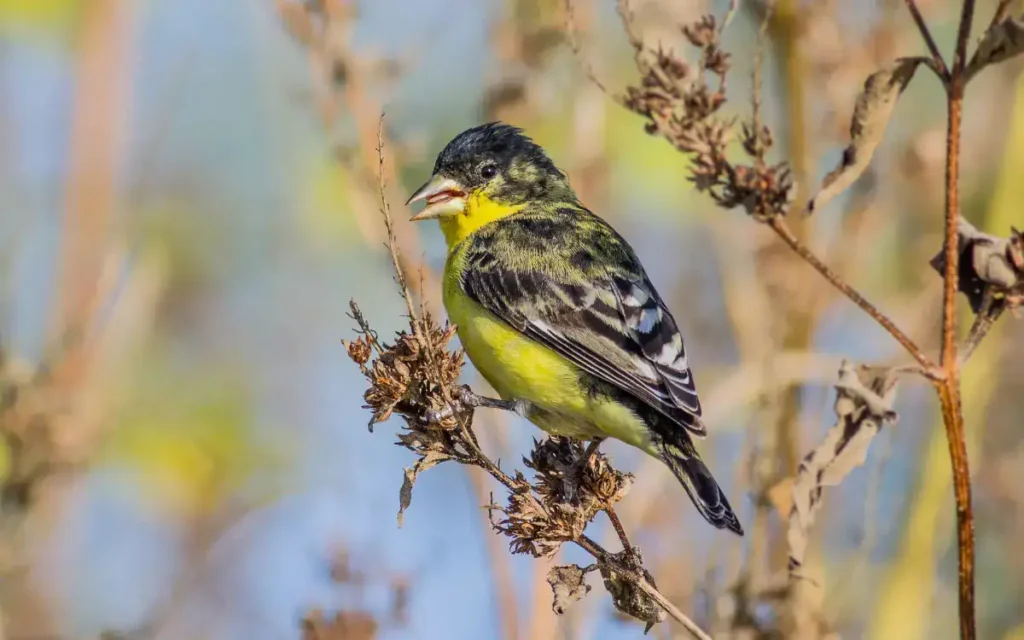
The Lesser Goldfinch is smaller and more tied to the West. It lives in scrubby areas, oak and cottonwood habitats, weedy fields, suburbs, and feeder stations.
Cornell describes Lesser Goldfinches as birds of the western U.S. that also occur far south into the Americas.
Male Lesser Goldfinches are yellow below with a glossy black cap. Their backs vary by region. In parts of the interior West, many males are black-backed. Along the West Coast, many males have green backs with only the cap black.
Cornell notes that males in the eastern part of their U.S. range tend to have black backs, while West Coast birds are often green-backed.
Females and young birds are more subtle. They usually show olive backs, dull yellow underparts, dark wings, and pale wingbars.
Size and Shape Differences
American Goldfinches are slightly larger, but the difference is not always obvious unless the birds are side by side.
| Bird | Length | Wingspan | Weight |
| American Goldfinch | 4.3–5.1 in | 7.5–8.7 in | 0.4–0.7 oz |
| Lesser Goldfinch | 3.5–4.3 in | 5.9–7.9 in | 0.3–0.4 oz |
The American Goldfinch has a short conical bill, small head, long wings, and short notched tail. The Lesser Goldfinch is tiny, stub-billed, with long pointed wings and a short notched tail.
In the field, Lesser Goldfinches can look more compact and delicate. American Goldfinches often look a bit longer and cleaner-winged.
Breeding Male American Goldfinch
A breeding male American Goldfinch is mostly yellow with black wings, white wing markings, a black forehead, and white patches around the tail area. The back is yellow, not black or green.
That yellow back is a strong clue when comparing it with a male Lesser Goldfinch.
Breeding Male Lesser Goldfinch
A male Lesser Goldfinch has yellow underparts, a black cap, white patches in the wings, and either a black or green back depending on region.
Audubon notes that most males from Colorado to Texas have black backs, while farther west many have green backs.
So, if you see a small yellow finch with a dark cap and dark or greenish back, think Lesser Goldfinch.
Female American Goldfinch vs Female Lesser Goldfinch
Females are harder, but not impossible.
A female American Goldfinch is usually larger and duller, with olive upperparts, soft yellow below, dark wings, and noticeable wingbars.
A female Lesser Goldfinch is smaller, with an olive back, dull yellow underparts, black wings, and two whitish wingbars. Cornell also notes that female and immature Lesser Goldfinches have olive backs, dull yellow underparts, and black wings with two whitish wingbars.
Range: Where You See Them Matters
Range is one of the easiest clues.
American Goldfinches are found across much of the United States and southern Canada. Audubon describes their migration as irregular, with more birds staying farther north in winters when food is available. Peak migration usually happens in mid-fall and early spring.
Lesser Goldfinches are mainly western. Audubon says they are permanent residents through much of their range, though some inland western areas have them mainly in summer. They are very rare east of their normal range.
| Region | More Likely Goldfinch |
| Eastern U.S. | American Goldfinch |
| Midwest | American Goldfinch |
| Southern Canada | American Goldfinch |
| California | American and Lesser possible |
| Arizona and New Mexico | American and Lesser possible |
| Texas | American and Lesser possible |
| Pacific Northwest | American and Lesser possible in some areas |
| Mexico | Lesser Goldfinch more likely in many areas |
Voice and Calls
American Goldfinches are famous for their bouncy flight call, often written as “po-ta-to-chip” or “per-chick-o-ree.” Audubon describes the call as bright and timed with the bird’s undulating flight.
Lesser Goldfinches sound faster and more jumbled. Their song is often a rapid medley of twittering notes, and they may include bits of other birds’ songs. Cornell also notes that Lesser Goldfinch songs can include snippets from other species.
A simple field rule:
American Goldfinch sounds more like a clear bouncing call in flight. Lesser Goldfinch often sounds quicker, thinner, and more mixed.
Behavior and Feeding
Both birds love seeds, especially from plants in the sunflower family. They cling to seedheads, visit feeders, and move in flocks outside the breeding season.
American Goldfinches feed acrobatically on weeds, shrubs, and seed socks. Cornell says they often cling to weeds and feeders, fly with a bouncy pattern, and call in flight.
Lesser Goldfinches also feed in flocks and visit feeders. They use weedy fields, budding treetops, brushy edges, and suburban yards.
Cornell notes that they feed on seeds and grains in weedy fields and at feeders, often mixing with other seed-eating birds.
Backyard Attraction
Both species may visit feeders if you offer the right food.
| Feeder Setup | Why It Works |
| Nyjer feeder | Small seed loved by goldfinches |
| Sunflower hearts | Easy to eat and less messy |
| Tube feeder | Good for small finches |
| Seed sock | Goldfinches can cling easily |
| Native seed plants | Keeps food available naturally |
| Shallow bird bath | Helps in dry or hot areas |
For American Goldfinches, Cornell recommends planting native thistles, composite plants, and native milkweed. It also says they are attracted to sunflower seed and nyjer.
For Lesser Goldfinches, Cornell notes that they readily come to feeders and eat many seeds from the sunflower family, including nyjer.
Good plants for goldfinches include:
| Plant | Why Goldfinches Like It |
| Sunflower | Seeds are easy to feed on |
| Coneflower | Seedheads attract finches |
| Thistle | Natural goldfinch favorite |
| Aster | Good late-season seed source |
| Milkweed | Useful native plant around bird-friendly yards |
| Coreopsis | Seedheads can attract small finches |
Common Mistakes to Avoid
Thinking the Lesser Goldfinch Has No Cap
Male Lesser Goldfinches usually have a black cap. The better difference is this: American Goldfinches have a black forehead in breeding plumage, while Lesser Goldfinches show a fuller black cap.
Using Yellow Color Alone
Both birds can show yellow. Look at the back, wing pattern, size, and range instead.
Forgetting American Goldfinches Change in Winter
American Goldfinches become much duller outside the breeding season. A winter American Goldfinch may look brown-gray instead of bright yellow.
Ignoring Location
In the eastern U.S., a Lesser Goldfinch would be very unusual. In the West and Southwest, both species may appear, so field marks matter more.
American Goldfinch vs Lesser Goldfinch: Fast ID Checklist
| Clue | American Goldfinch | Lesser Goldfinch |
| Slightly larger | Yes | No |
| Smaller and compact | No | Yes |
| Black forehead | Yes, breeding male | No, usually fuller black cap |
| Black cap | No, not like Lesser | Yes, male |
| Yellow back | Yes, breeding male | No, usually black or green |
| Green or black back | No | Yes, male |
| Brown-gray winter look | Common | Less dramatic |
| Found in East | Common | Very rare |
| Common in West | Yes | Yes |
| Fast twittering song | Less typical | Yes |
FAQs
What is the main difference between an American Goldfinch and a Lesser Goldfinch?
The main difference is size, range, and male plumage. American Goldfinches are slightly larger and widespread across much of North America. Lesser Goldfinches are smaller, mostly western, and males have a black cap with a black or green back.
Which goldfinch is smaller?
The Lesser Goldfinch is smaller. Cornell lists it at 3.5–4.3 inches long, while the American Goldfinch is 4.3–5.1 inches long.
Do American Goldfinches and Lesser Goldfinches live in the same area?
Yes, their ranges overlap in parts of the western United States, including areas of California, Arizona, New Mexico, Texas, and nearby regions.
Which goldfinch has a black cap?
The Lesser Goldfinch male has a black cap. The American Goldfinch male has a black forehead in breeding plumage, but not the same full cap pattern.
Which goldfinch has a black back?
Many male Lesser Goldfinches have black backs, especially from Colorado to Texas. Farther west, many males have green backs. American Goldfinch males have yellow backs in breeding plumage.
Do both birds come to feeders?
Yes. Both species may come to feeders, especially for nyjer and sunflower seeds. American Goldfinches are common feeder birds, and Lesser Goldfinches also visit feeders in their range.
Which one is brighter yellow?
A breeding male American Goldfinch often looks brighter and cleaner yellow overall. Male Lesser Goldfinches are yellow below, but the dark or green back changes the overall look.
Do American Goldfinches migrate?
Yes, but not always in a simple north-south pattern. Audubon describes American Goldfinch migration as irregular, with more birds staying north when food is good.
Are Lesser Goldfinches migratory?
They are permanent residents through much of their range, though some inland western populations are more seasonal.