19 Shorebirds in Georgia
Georgia is one of the best southeastern states for shorebirds because its coast has barrier islands, tidal flats, marsh edges, beaches, oyster beds, and shallow wetlands. You can see some shorebirds all year, while others pass through during spring and fall migration.
Shorebirds can be hard to identify at first because many are brown, gray, white, or sandy-colored. The best clues are bill shape, leg color, size, feeding style, and habitat. A small bird running with the waves may be a Sanderling, while a large black-and-white bird with an orange bill is almost always an American Oystercatcher.
1. Killdeer

The Killdeer is one of the most familiar shorebirds in Georgia, even though it is often seen far from the coast. It has a brown back, white belly, orange rump, and two bold black bands across the chest. Its loud call also makes it easy to notice.
In Georgia, Killdeer can be found in fields, lawns, gravel lots, mudflats, pastures, and open areas near water. It often runs along the ground, stops suddenly, then runs again. This bird is also famous for its broken-wing display, where it pretends to be injured to lead predators away from its nest.
Quick ID points:
- Brown and white shorebird
- Two black chest bands
- Loud, sharp call
- Often found away from beaches
- Runs and stops on open ground
Best places to see it in Georgia: Fields, farms, gravel lots, mudflats, open lawns, pond edges, and parking areas.
2. Black-necked Stilt
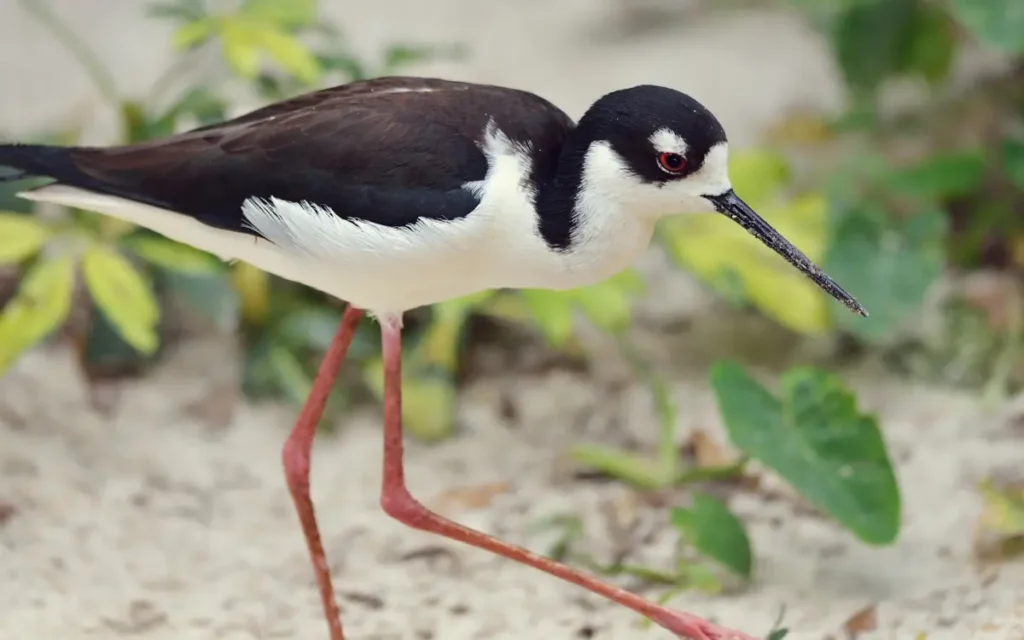
The Black-necked Stilt is one of the easiest shorebirds to recognize in Georgia because of its extremely long pink legs. It has a black back, white underside, thin black bill, and elegant walking style. The legs look almost too long for the body.
In Georgia, Black-necked Stilts are usually found in shallow wetlands, marsh pools, impoundments, and muddy edges. They walk through shallow water while picking small insects and aquatic animals from the surface. Their sharp calls and long-legged shape make them stand out from smaller sandpipers.
Quick ID points:
- Very long pink legs
- Black back and white belly
- Thin straight black bill
- Walks through shallow water
- Often seen in marshes and wetland pools
Best places to see it in Georgia: Coastal marshes, shallow ponds, wildlife refuges, wetland impoundments, and muddy flats.
Learn more 15 White Birds in Georgia
3. American Avocet

The American Avocet is a graceful shorebird with long legs and a thin bill that curves upward. In breeding plumage, it has a warm rusty head and neck. In winter, the head becomes pale gray or white, which can make it look softer and less colorful.
In Georgia, American Avocets are most often seen during migration or winter in shallow wetlands, tidal flats, and muddy pools. They feed by sweeping their upturned bills side to side through shallow water. This feeding style is one of the best ways to identify them, especially when they are in groups.
Quick ID points:
- Long upturned bill
- Long bluish-gray legs
- Rusty head in breeding plumage
- Pale gray-white head in winter
- Sweeps bill side to side while feeding
Best places to see it in Georgia: Mudflats, shallow wetlands, coastal impoundments, tidal pools, and refuge ponds.
4. American Oystercatcher

The American Oystercatcher is one of the most striking shorebirds on the Georgia coast. It has a black head, brown back, white underside, pinkish legs, yellow eye, and long bright orange bill. That orange bill is the main clue and makes this bird hard to confuse with anything else.
In Georgia, American Oystercatchers are found on beaches, sandbars, oyster beds, barrier islands, and tidal flats. They use their strong bills to open oysters, clams, and other shellfish. Because they nest on open sandy areas, they can be sensitive to disturbance from people, pets, and beach traffic.
Quick ID points:
- Large black, brown, and white shorebird
- Long bright orange bill
- Pinkish legs
- Often near oyster beds and beaches
- Loud, sharp calls
Best places to see it in Georgia: Barrier islands, oyster bars, sandbars, beaches, tidal creeks, and coastal flats.
5. Wilson’s Plover

The Wilson’s Plover is a small coastal plover with a thick black bill, pale brown upperparts, white underside, and single dark neck band. It looks sturdier than many other small plovers, mostly because of its heavy bill.
In Georgia, Wilson’s Plovers are usually found on sandy beaches, dunes, shell flats, and coastal areas with open sand. They feed on small crabs, insects, and other beach animals. Compared with the paler Piping Plover, Wilson’s Plover looks heavier-billed and a bit darker overall.
Quick ID points:
- Small sandy-colored plover
- Thick black bill
- Single dark neck band
- Usually near beaches and dunes
- Feeds on small crabs and insects
Best places to see it in Georgia: Sandy beaches, dunes, shell flats, barrier islands, and coastal nesting areas.
6. Semipalmated Plover

The Semipalmated Plover is a small plover with a brown back, white belly, orange legs, short orange-and-black bill, and a single black band across the chest. It looks similar to other small plovers, but the neat breast band and compact shape are good clues.
In Georgia, Semipalmated Plovers are mostly seen during migration and winter along beaches, mudflats, tidal flats, and sandy edges. They feed by running a short distance, stopping, and picking at tiny prey. This run-stop feeding style is common in plovers.
Quick ID points:
- Small plover with one black chest band
- Brown back and white belly
- Short orange-and-black bill
- Often runs and stops while feeding
- Seen on mudflats and beaches
Best places to see it in Georgia: Tidal flats, sandy beaches, mudflats, marsh edges, and coastal migration spots.
7. Piping Plover
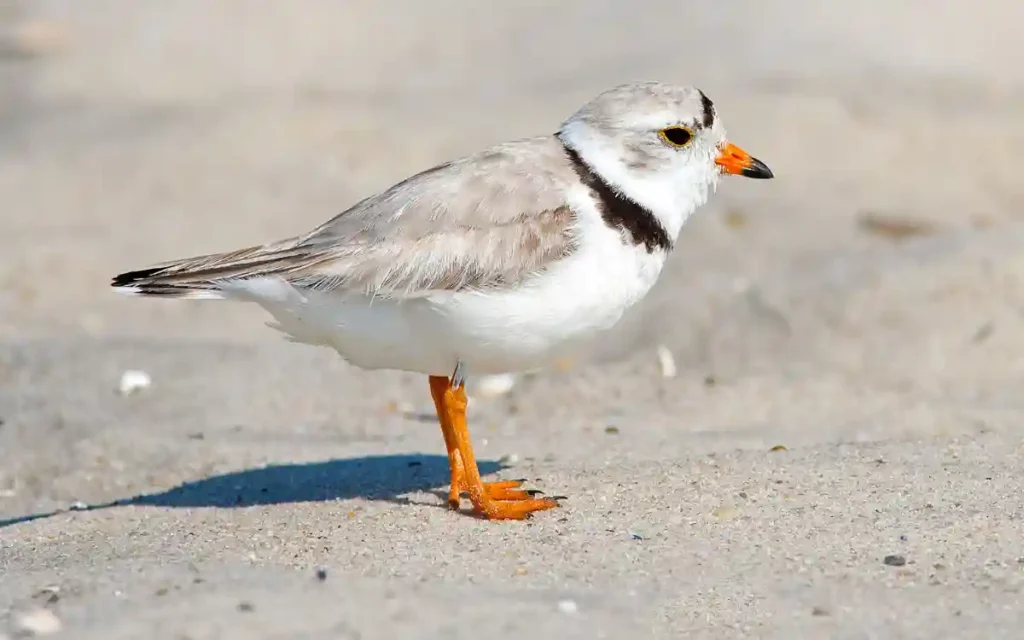
The Piping Plover is a small, pale shorebird that blends perfectly with sand. It has a round body, pale sandy upperparts, white underside, short bill, and orange legs. During breeding season, it may show a thin black collar and forehead mark, but winter birds look much plainer.
In Georgia, Piping Plovers are most often seen during migration and winter on quiet beaches, sand flats, inlets, and barrier islands. Because they are pale and small, they are easy to overlook. They often stand still or move slowly along open sand.
Quick ID points:
- Small pale sandy plover
- Orange legs
- Short bill
- Blends into beach sand
- Seen mostly in winter and migration
Best places to see it in Georgia: Quiet beaches, barrier islands, sand flats, inlets, and protected coastal areas.
8. Sanderling

The Sanderling is the classic small shorebird seen chasing waves along Georgia beaches. It is pale gray and white in winter, with a short black bill and black legs. In breeding plumage, it can look warmer and rustier, but many Georgia beach sightings are of pale winter birds.
Sanderlings feed right at the surf line. They run toward the water as a wave pulls back, grab tiny prey from the sand, then run away as the next wave comes in. This quick wave-chasing behavior is one of the easiest ways to identify them.
Quick ID points:
- Small pale sandpiper
- Black legs and short black bill
- Runs in and out with waves
- Often seen in small groups
- Common on beaches in winter and migration
Best places to see it in Georgia: Ocean beaches, surf lines, sandbars, inlets, and barrier island beaches.
9. Least Sandpiper

The Least Sandpiper is one of the smallest shorebirds in Georgia. It has a small body, brownish upperparts, pale underside, thin bill, and yellowish legs. The leg color helps separate it from many other tiny sandpipers that have black legs.
In Georgia, Least Sandpipers are often found on mudflats, pond edges, marsh pools, wet fields, and tidal flats. They usually feed by picking tiny insects and other small prey from mud. Their small size can make them hard to study, but their yellowish legs are a helpful clue when visible.
Quick ID points:
- Very tiny sandpiper
- Yellowish legs
- Brownish upperparts
- Thin slightly drooped bill
- Feeds on mud edges
Best places to see it in Georgia: Mudflats, wet fields, pond edges, marsh pools, tidal creeks, and shallow wetlands.
10. Western Sandpiper

The Western Sandpiper is a small gray-brown sandpiper often seen on Georgia mudflats during migration and winter. It has black legs and a thin bill that usually droops slightly at the tip. Breeding birds may show rusty color on the shoulder and crown, but many Georgia birds look plainer.
This species often mixes with other small sandpipers, which can make identification tricky. Compared with Semipalmated Sandpiper, Western Sandpiper usually has a slightly longer, more drooped bill. Checking bill shape, leg color, size, and flock behavior helps.
Quick ID points:
- Small gray-brown sandpiper
- Black legs
- Slightly drooped bill
- Often in flocks
- Common on mudflats during migration
Best places to see it in Georgia: Tidal flats, mudflats, marsh edges, coastal pools, and shallow wetland areas.
11. Semipalmated Sandpiper

The Semipalmated Sandpiper is a small, plain-looking shorebird that passes through Georgia mostly during migration. It has gray-brown upperparts, white underside, black legs, and a short straight bill. It is one of the classic “peep” sandpipers, a term birders use for tiny sandpipers.
This bird is often found in mixed flocks on mudflats and tidal edges. It can be difficult to separate from Western Sandpiper, especially at a distance. In general, Semipalmated Sandpipers tend to look shorter-billed and less droopy-billed than Western Sandpipers.
Quick ID points:
- Small gray-brown sandpiper
- Black legs
- Short straight bill
- Often in migration flocks
- Feeds on mudflats and tidal edges
Best places to see it in Georgia: Mudflats, tidal flats, marsh edges, coastal inlets, and wetland migration stopovers.
12. Spotted Sandpiper

The Spotted Sandpiper is a small shorebird with a brownish back, white underside, and constant tail-bobbing behavior. Breeding birds have clear dark spots across the white belly, while nonbreeding birds are plainer and may not show spots.
In Georgia, Spotted Sandpipers can be found along ponds, rivers, lakes, muddy edges, and shorelines. Unlike some shorebirds that gather in flocks, this species is often seen alone. The tail bobbing is the best clue, even when the bird does not show spots.
Quick ID points:
- Small shorebird with bobbing tail
- Brownish back and white belly
- Dark spots on breeding birds
- Often seen alone
- Common near freshwater edges
Best places to see it in Georgia: Pond edges, rivers, lakeshores, muddy banks, streams, and wetland edges.
13. Willet

The Willet is a larger shorebird with long gray legs, a straight bill, and plain gray-brown body. At rest, it can look simple and muted. In flight, though, it shows bold black-and-white wing patterns that make identification much easier.
In Georgia, Willets are common along the coast, especially around tidal creeks, marshes, beaches, mudflats, and sandbars. They feed on crabs, worms, insects, and other small animals. Their loud calls and sturdy body help separate them from smaller sandpipers.
Quick ID points:
- Medium-large gray-brown shorebird
- Long straight bill
- Long gray legs
- Bold black-and-white wings in flight
- Common along coastal marshes and beaches
Best places to see it in Georgia: Tidal creeks, salt marshes, beaches, mudflats, sandbars, and coastal flats.
14. Greater Yellowlegs
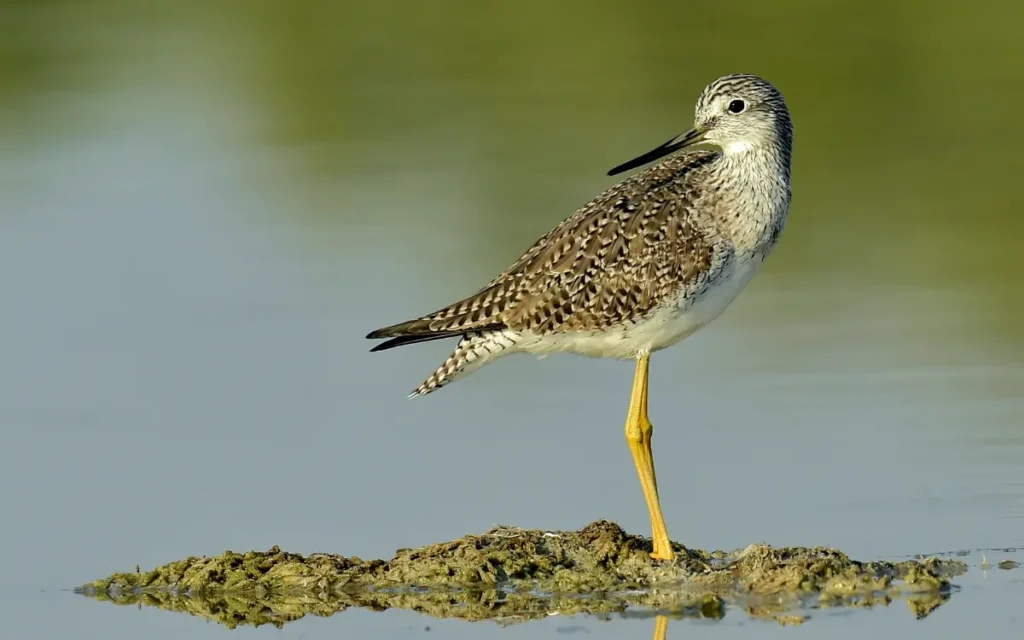
The Greater Yellowlegs is a tall shorebird with long bright yellow legs, gray-brown upperparts, white underside, and a long slightly upturned bill. It is larger and heavier-looking than the Lesser Yellowlegs.
In Georgia, Greater Yellowlegs are often seen during migration and winter in marshes, shallow ponds, wet fields, tidal flats, and mudflats. They walk through shallow water, picking prey with quick jabs. Their loud calls also help birders locate them.
Quick ID points:
- Long bright yellow legs
- Long slightly upturned bill
- Larger than Lesser Yellowlegs
- Gray-brown above, white below
- Often feeds in shallow water
Best places to see it in Georgia: Marsh pools, tidal flats, wet fields, pond edges, mudflats, and refuge impoundments.
15. Lesser Yellowlegs
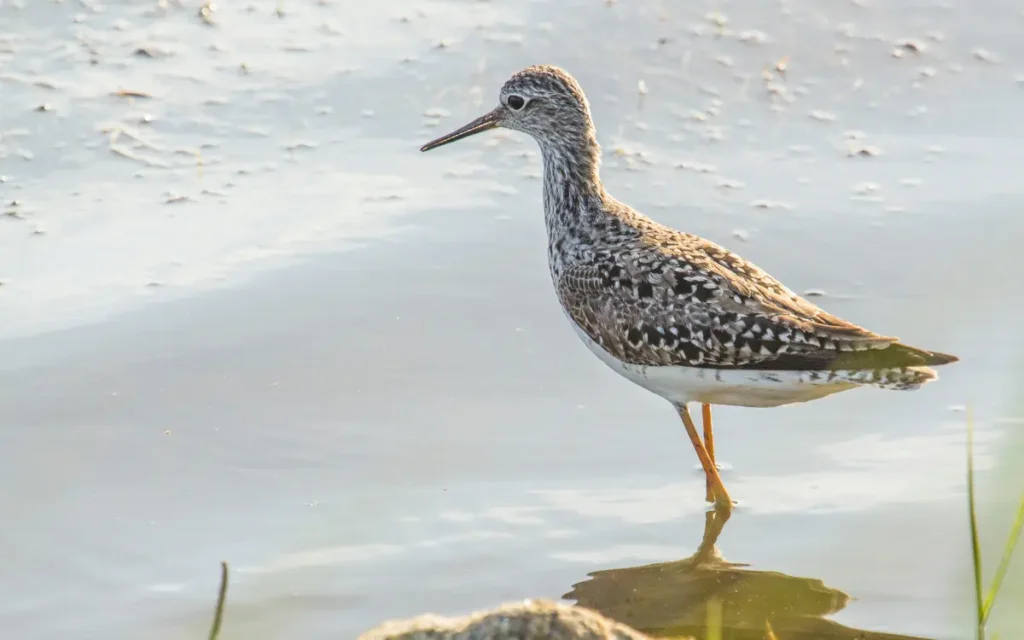
The Lesser Yellowlegs looks similar to the Greater Yellowlegs but is smaller, slimmer, and has a shorter, straighter bill. It still has bright yellow legs, gray-brown upperparts, and a white underside.
In Georgia, Lesser Yellowlegs are often found in shallow wetlands, muddy pools, marsh edges, and flooded fields during migration and winter. They may feed more lightly and quickly than Greater Yellowlegs. When both species are together, size difference becomes easier to judge.
Quick ID points:
- Bright yellow legs
- Smaller than Greater Yellowlegs
- Shorter, straighter bill
- Slimmer body
- Often feeds in shallow wetland areas
Best places to see it in Georgia: Shallow ponds, wet fields, marsh edges, mudflats, tidal pools, and wetland impoundments.
16. Ruddy Turnstone

The Ruddy Turnstone is a stocky shorebird with short orange legs, bold black-and-white patterning, and a slightly upturned bill. In breeding plumage, it has rich rusty coloring on the back. In winter, it looks duller but still has a sturdy, patterned appearance.
This bird gets its name from its feeding behavior. It flips over shells, seaweed, stones, and debris to find small animals underneath. In Georgia, Ruddy Turnstones are often seen along rocky areas, jetties, beaches, oyster beds, and shorelines with washed-up seaweed.
Quick ID points:
- Stocky shorebird
- Short orange legs
- Bold black-and-white pattern
- Rusty back in breeding plumage
- Turns shells, stones, and seaweed while feeding
Best places to see it in Georgia: Jetties, rocky shorelines, oyster beds, beaches, shell flats, and seaweed-covered shorelines.
17. Short-billed Dowitcher

The Short-billed Dowitcher is a medium-sized shorebird with a long straight bill, chunky body, and feeding motion that looks like a sewing machine. Despite its name, the bill is still long; the “short-billed” part mainly separates it from the very similar Long-billed Dowitcher.
In Georgia, Short-billed Dowitchers are often found on mudflats, marsh pools, tidal flats, and shallow wetlands during migration and winter. They probe deep into mud for worms and other small prey. Identification can be difficult, but habitat, season, call, and body shape help.
Quick ID points:
- Medium-sized chunky shorebird
- Long straight bill
- Probes mud rapidly while feeding
- Often in flocks
- Common on coastal mudflats during migration
Best places to see it in Georgia: Mudflats, tidal flats, marsh pools, coastal impoundments, and shallow wetland areas.
18. Marbled Godwit

The Marbled Godwit is a large shorebird with a long slightly upturned bill, warm brown body, and long legs. Its bill often shows a pinkish base with a darker tip, which is a helpful mark if you get a close view.
In Georgia, Marbled Godwits are usually found along tidal flats, beaches, sandbars, and shallow coastal areas during migration and winter. They feed by probing deeply into mud or wet sand. Their large size and long bill make them stand out from smaller sandpipers and plovers.
Quick ID points:
- Large warm brown shorebird
- Long slightly upturned bill
- Pinkish bill base with dark tip
- Long legs
- Feeds by probing mud or wet sand
Best places to see it in Georgia: Tidal flats, beaches, inlets, sandbars, coastal mudflats, and shallow shorelines.
19. Whimbrel

The Whimbrel is a large shorebird with a long downward-curved bill, brown streaky body, and striped head. It is smaller than some curlews but still large compared with sandpipers. The curved bill is the main clue.
In Georgia, Whimbrels are mostly seen during migration on beaches, marshes, tidal flats, and coastal fields. They use their curved bills to probe for crabs and other prey in mud or sand. If you see a large brown shorebird with a long curved bill on the coast, Whimbrel is a strong possibility.
Quick ID points:
- Large brown shorebird
- Long downward-curved bill
- Striped head pattern
- Often seen during migration
- Feeds on crabs and other coastal prey
Best places to see it in Georgia: Tidal flats, salt marshes, beaches, sandbars, coastal fields, and barrier islands.
FAQs
What is the most common shorebird in Georgia?
The Killdeer is one of the most familiar shorebirds in Georgia because it is found in many places, not just at the beach. You may see it in fields, lawns, gravel lots, mudflats, and open areas near water.
What shorebird runs along Georgia beaches?
The Sanderling is the small pale shorebird often seen running in and out with the waves on Georgia beaches. Its wave-chasing feeding style makes it one of the easiest beach birds to recognize.
What shorebird in Georgia has an orange bill?
The American Oystercatcher has a long bright orange bill. It is usually seen along beaches, oyster beds, sandbars, barrier islands, and coastal flats.
Are Piping Plovers found in Georgia?
Yes, Piping Plovers can be seen in Georgia, especially during migration and winter along sandy beaches, inlets, sand flats, and barrier islands. They are small, pale, and easy to miss.
What are the small sandpipers on Georgia mudflats?
Small sandpipers on Georgia mudflats may include Least Sandpipers, Western Sandpipers, and Semipalmated Sandpipers. Size, leg color, bill shape, and season are the best clues for telling them apart.
Where can I see shorebirds in Georgia?
Good places to see shorebirds in Georgia include Jekyll Island, Tybee Island, Cumberland Island, Altamaha Wildlife Management Area, Harris Neck National Wildlife Refuge, and Savannah National Wildlife Refuge.
What is the best time to see shorebirds in Georgia?
Spring and fall migration are often the best times to see a wider mix of shorebirds in Georgia. Winter can also be good for beach species such as Sanderlings, Piping Plovers, Willets, and some sandpipers.
What large shorebirds live along the Georgia coast?
Large shorebirds along the Georgia coast include American Oystercatcher, Willet, Marbled Godwit, Whimbrel, American Avocet, and Greater Yellowlegs.
What shorebirds have yellow legs in Georgia?
The main yellow-legged shorebirds in Georgia are Greater Yellowlegs and Lesser Yellowlegs. Least Sandpipers can also show yellowish legs, but they are much smaller.