Shorebird Identification Chart: 18 Common Shorebirds

If you have ever stood on a beach or mudflat and watched a group of small birds running around, you already know why shorebird identification can feel confusing. Many shorebirds are gray, brown, white, or sandy-colored, and several species look almost the same from a distance.

When I identify shorebirds, I do not start by trying to name the bird right away. I first look at a few simple clues: size, bill shape, leg color, habitat, feeding style, and season. These clues quickly narrow down the options.

This shorebird identification chart and guide will help you compare common shorebirds in a simple way. You can use it whether you are watching birds on a sandy beach, muddy shoreline, wet field, salt marsh, or freshwater pond edge.

On this page

How to Identify Shorebirds

The biggest mistake beginners make is trying to identify shorebirds by color alone. I used to do that too, and it quickly became frustrating because many shorebirds change color by season.

A better method is to look at shape and behavior first. These clues stay more useful even when the bird is in dull winter plumage.

Start With Size

Size is one of the fastest ways to narrow down a shorebird. Before looking at small markings, ask yourself if the bird is tiny, small, medium, large, or tall and slender.

A Least Sandpiper can look almost sparrow-sized. A Sanderling is small but usually looks a little larger and cleaner on open beaches. A Willet or Black-bellied Plover is much bigger and easier to notice from far away.

If several shorebirds are feeding together, compare them with each other. One bird may look plain on its own, but when it stands beside a larger Willet or a smaller sandpiper, its size becomes easier to judge.

Check the Bill Shape

Bill shape is one of the best shorebird identification clues. Shorebirds use their bills in different ways, so the shape often tells you what group the bird belongs to.

Plovers usually have shorter, thicker bills because they pick food from the surface. Sandpipers often have thin bills for probing or picking. Dowitchers have long straight bills, while avocets have a clear upcurved bill.

If you see a large shorebird with a long orange-red bill, you are likely looking at an American Oystercatcher. If you see a slim bird sweeping a thin upturned bill through shallow water, check American Avocet.

Notice Leg Color

Leg color can help, but I would not use it alone. Mud, shade, distance, and lighting can make legs look darker or duller than they really are.

Still, some leg colors are very useful. Bright yellow legs point you toward Greater Yellowlegs, Lesser Yellowlegs, or Least Sandpiper. Very long pink legs are a strong clue for Black-necked Stilt. Orange legs may suggest Ruddy Turnstone or some plovers.

Black legs are common in several small sandpipers, including Sanderling, Dunlin, and Semipalmated Sandpiper, so you will need bill shape and behavior too.

Watch Feeding Behavior

Behavior often gives away the bird faster than plumage.

A Sanderling usually runs with the waves, rushing forward as the water pulls back and running away as the next wave comes in. A plover often runs, stops, looks, then pecks. A dowitcher probes up and down quickly, almost like a sewing machine.

A Ruddy Turnstone does exactly what its name suggests. It flips stones, seaweed, shells, and debris while searching for food. An American Avocet often sweeps its bill side to side through shallow water.

If the bird is moving, watch it for a minute before trying to name it. That short pause can save you a lot of guessing.

Use Habitat and Season

Habitat matters a lot. Some shorebirds prefer open sandy beaches, while others spend more time on mudflats, marshes, rocky shores, or freshwater edges.

For example, Sanderlings are common on sandy beaches. Yellowlegs are often seen in marshes, ponds, and wetland edges. Ruddy Turnstones are often found around rocks, seaweed, and shell-covered shorelines.

Season also matters because many shorebirds look different in spring, fall, and winter. A Dunlin in breeding plumage may show a black belly, while a winter Dunlin can look much plainer. That is why shape, bill, legs, and behavior are so important.

Common Types of Shorebirds

Before learning individual species, it helps to understand the main shorebird groups. This makes identification much easier because you are not comparing every bird to every other bird.

Sandpipers

Sandpipers are one of the trickiest shorebird groups because many are small, brownish, grayish, or plain-looking. They often feed by picking or probing in wet sand, mud, or shallow water.

Common sandpipers include Sanderling, Least Sandpiper, Semipalmated Sandpiper, Western Sandpiper, Dunlin, and Spotted Sandpiper.

When I see a small shorebird with a thin bill feeding steadily on mud or wet sand, I usually start by asking, “Is this a sandpiper?” Then I look at leg color, bill length, size, and feeding style.

Plovers

Plovers usually look rounder and more upright than sandpipers. They often have short bills, bigger-looking heads, and a stop-and-run feeding pattern.

Common plovers include Killdeer, Semipalmated Plover, Piping Plover, Snowy Plover, and Black-bellied Plover.

A simple way to separate plovers from sandpipers is to watch how they feed. Plovers often run forward, stop suddenly, look around, then peck. Sandpipers usually probe or pick more steadily.

Yellowlegs

Yellowlegs are easier to notice because of their long bright yellow legs. The two main species are Greater Yellowlegs and Lesser Yellowlegs.

Greater Yellowlegs is larger and usually has a longer bill that may look slightly upturned. Lesser Yellowlegs is smaller, slimmer, and has a shorter, straighter-looking bill.

If you see a tall shorebird walking through shallow water with bright yellow legs, yellowlegs should be one of your first guesses.

Dowitchers

Dowitchers are medium-sized shorebirds with long straight bills. They can be hard to separate, especially Short-billed Dowitcher and Long-billed Dowitcher.

The feeding motion is often the easiest clue. Dowitchers push their bills into mud or shallow water repeatedly in a fast up-and-down motion.

Do not rely only on the names “short-billed” and “long-billed.” Bill length is not always enough. Habitat, call, season, and plumage can all help.

Oystercatchers

Oystercatchers are large, bold shorebirds that are much easier to recognize than most small sandpipers. The American Oystercatcher has a black head, white belly, and a long orange-red bill.

These birds are usually found along beaches, shell bars, tidal flats, and coastal areas where they feed on shellfish and other shoreline food.

Stilts and Avocets

Stilts and avocets are elegant, long-legged shorebirds usually found in shallow wetlands and open water edges.

The Black-necked Stilt has very long pink legs and a black-and-white body. The American Avocet has a long, thin, upcurved bill and often feeds by sweeping its bill through the water.

These birds are good beginner shorebirds because their shape is so different from most sandpipers and plovers.

Common Shorebirds You May See

This section is the heart of the guide. These are common or well-known shorebirds that birdwatchers often see on beaches, mudflats, marshes, and wetland edges.

1. Sanderling

Sanderling

The Sanderling is one of the easiest beach shorebirds to recognize once you know its behavior. It is a small, pale sandpiper often seen running in and out with the waves. When the water pulls back, it rushes forward to feed. When the next wave comes in, it quickly runs back up the beach.

In nonbreeding plumage, Sanderlings look pale gray and white with black legs and a short black bill. In breeding plumage, they can show warmer rusty tones.

Quick ID: Small pale shorebird with black legs that runs with ocean waves.

2. Least Sandpiper

Least Sandpiper

The Least Sandpiper is tiny, and that size is one of the best clues. It is the smallest shorebird in North America and often feeds on muddy edges, wet fields, marshes, and pond margins.

It has a small body, a thin bill, and yellowish legs. The yellow legs are helpful, but they may look dull if the bird is muddy or far away.

Least Sandpipers often feed with a steady picking motion, moving carefully along wet mud rather than chasing waves on open beaches.

Quick ID: Very small sandpiper with yellowish legs and a tiny body.

3. Semipalmated Sandpiper

Semipalmated Sandpiper

The Semipalmated Sandpiper is a small, plain-looking shorebird that often appears during migration. It can be difficult for beginners because it looks similar to other small sandpipers.

It usually has black legs, a short straight bill, and a compact body. In nonbreeding plumage, it may look grayish and simple, without bold markings.

This bird is often found on mudflats, sandy edges, and coastal stopover sites. When identifying it, compare bill length and body shape with nearby small sandpipers.

Quick ID: Small plain sandpiper with black legs and a short straight bill.

4. Western Sandpiper

Western Sandpiper

The Western Sandpiper is another small shorebird that can look very similar to the Semipalmated Sandpiper. The bill is often the best clue. Western Sandpipers usually have a slightly longer bill with a bit of a droop near the tip.

They are often found on coastal mudflats, beaches, and shallow wet areas. In breeding plumage, they may show warmer tones on the head and back, but in dull plumage they can look much plainer.

This is not always an easy bird to identify, so beginners should focus on bill shape, location, and comparison with nearby birds.

Quick ID: Small sandpiper with black legs and a slightly drooped bill tip.

5. Dunlin

Dunlin

The Dunlin is a medium-small sandpiper with a long drooped bill. In breeding plumage, it is easier to identify because it shows a black belly patch and rusty tones on the back.

In winter, Dunlins become much plainer, usually gray-brown above and pale below. Even then, the long drooping bill remains a strong clue.

Dunlins are often seen on mudflats, beaches, estuaries, and wet coastal areas. They may gather in flocks and feed by probing in mud or shallow water.

Quick ID: Medium-small shorebird with a long drooped bill; black belly in breeding season.

6. Killdeer

Killdeer

The Killdeer is a plover, but unlike many shorebirds, it is often found away from the coast. You may see it in fields, gravel lots, golf courses, pond edges, farms, and open ground.

It has two black chest bands, a brown back, white belly, and a loud call. The double chest band makes it much easier to recognize than many other plovers.

Killdeer are also known for their broken-wing display, where an adult acts injured to lead danger away from its nest or chicks.

Quick ID: Medium plover with two black chest bands and loud calls.

7. Semipalmated Plover

Semipalmated Plover

The Semipalmated Plover is a small plover with a single dark neck band. It looks compact and round-headed, with a short bill and orange-yellow legs.

It feeds in a typical plover style: run, stop, look, peck. This behavior helps separate it from small sandpipers that probe or pick more steadily.

You may see Semipalmated Plovers on beaches, mudflats, and tidal areas, especially during migration.

Quick ID: Small plover with one dark neck band and a short bill.

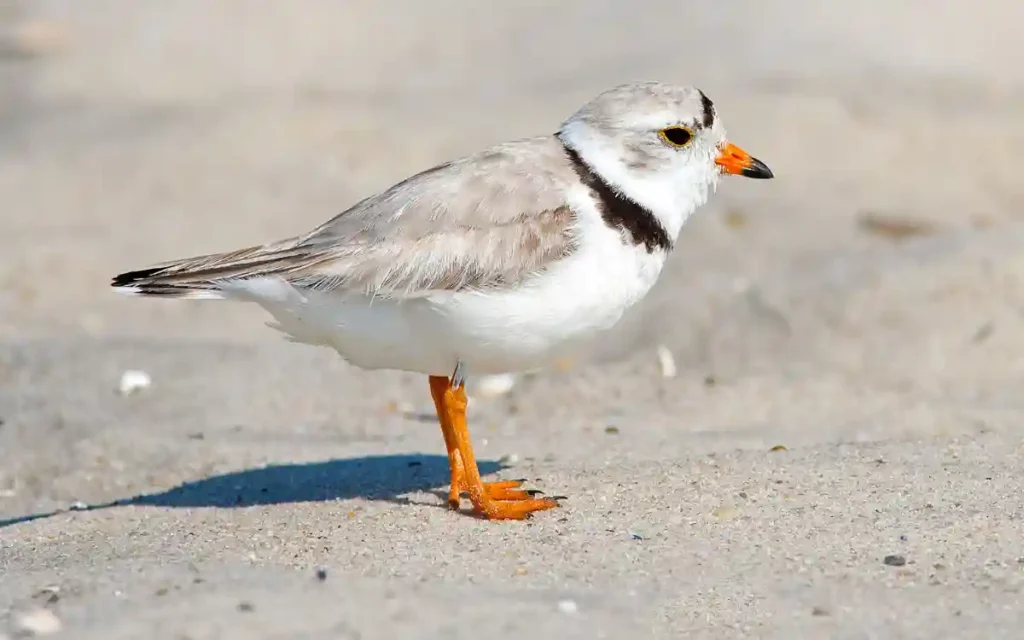
8. Piping Plover

Piping Plover

The Piping Plover is a small, pale shorebird that blends very well with sandy beaches. Its body is light and sandy-colored, with orange legs and a short bill.

Because of its pale color, it can be surprisingly hard to see unless it moves. It often nests and feeds on open beaches, sand flats, and shorelines.

Piping Plovers are sensitive to disturbance, especially during nesting season, so birdwatchers should keep a respectful distance and follow posted beach signs.

Quick ID: Pale sandy plover with orange legs and a soft, rounded look.

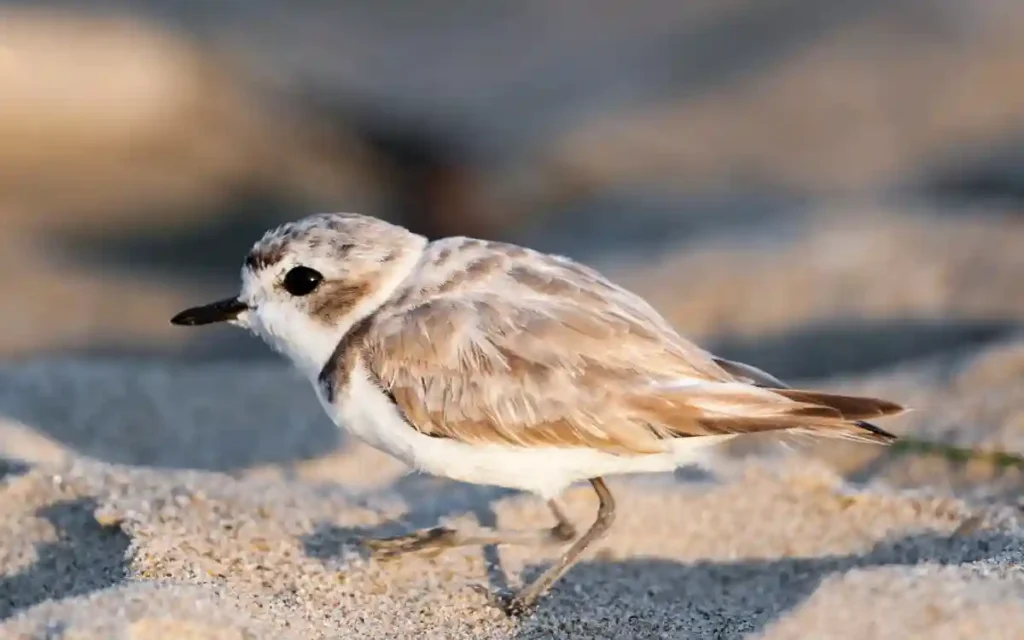
9. Snowy Plover

Snowy Plover

The Snowy Plover is another small pale plover found on sandy beaches, salt flats, and open shorelines. It is very light-colored, which helps it blend with sand.

Compared with some other plovers, it often looks delicate and low to the ground. It has a short dark bill and pale legs that may look grayish.

Snowy Plovers can be hard to spot because they often freeze or move quietly across open sand. Look for small movements rather than bold color.

Quick ID: Tiny pale beach plover with a short dark bill.

10. Black-bellied Plover

Black-bellied Plover

The Black-bellied Plover is one of the larger plovers. In breeding plumage, it has a bold black face, throat, and belly, which makes it easier to name.

In nonbreeding plumage, it becomes much grayer and less dramatic, but its large size, chunky body, and short bill still help.

You may see Black-bellied Plovers on beaches, mudflats, coastal fields, and estuaries. They often stand upright and alert, giving them a strong plover shape.

Quick ID: Large plover; black belly in breeding plumage and gray look in winter.

11. Willet

Willet

The Willet is a large gray shorebird that may look plain when standing. Its best field mark appears when it flies: bold black-and-white wing patterns.

Willets have long straight bills, gray legs, and a sturdy body. They are often seen on beaches, marshes, mudflats, and coastal wetlands.

When standing still, they can be easy to overlook. But once they open their wings, the strong wing pattern makes identification much easier.

Quick ID: Large gray shorebird with bold black-and-white wings in flight.

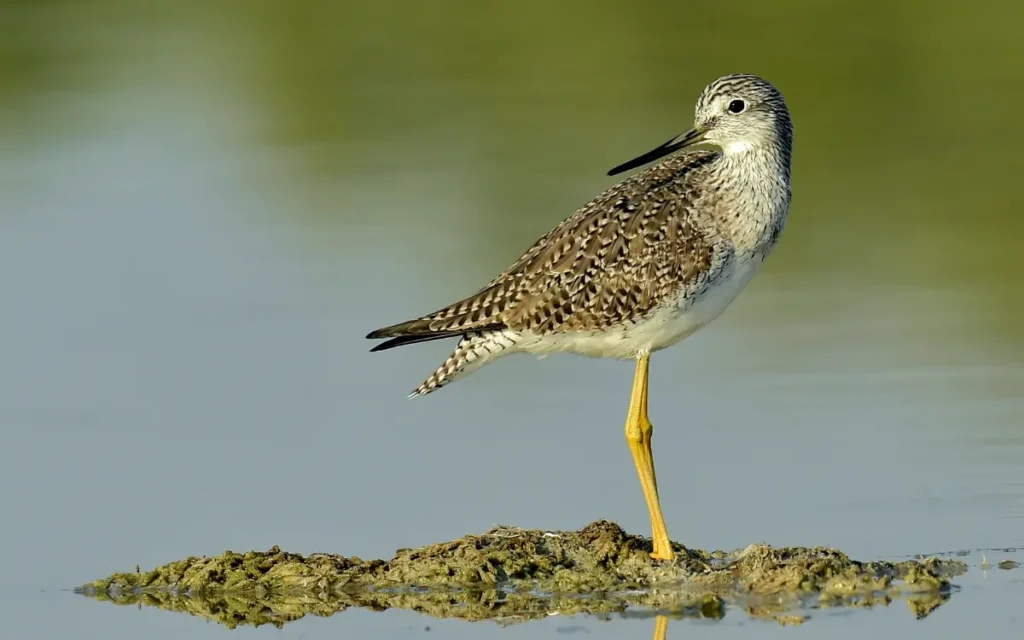
12. Greater Yellowlegs

Greater Yellowlegs

The Greater Yellowlegs is a tall shorebird with bright yellow legs and a long bill. It often walks through shallow water, marshes, ponds, and mudflats while searching for food.

Compared with Lesser Yellowlegs, it looks larger, heavier, and longer-billed. The bill may appear slightly upturned.

This bird is often active and vocal. If you see a tall shorebird with long yellow legs and a strong bill, Greater Yellowlegs is a good bird to check.

Quick ID: Tall yellow-legged shorebird with a long, slightly upturned bill.

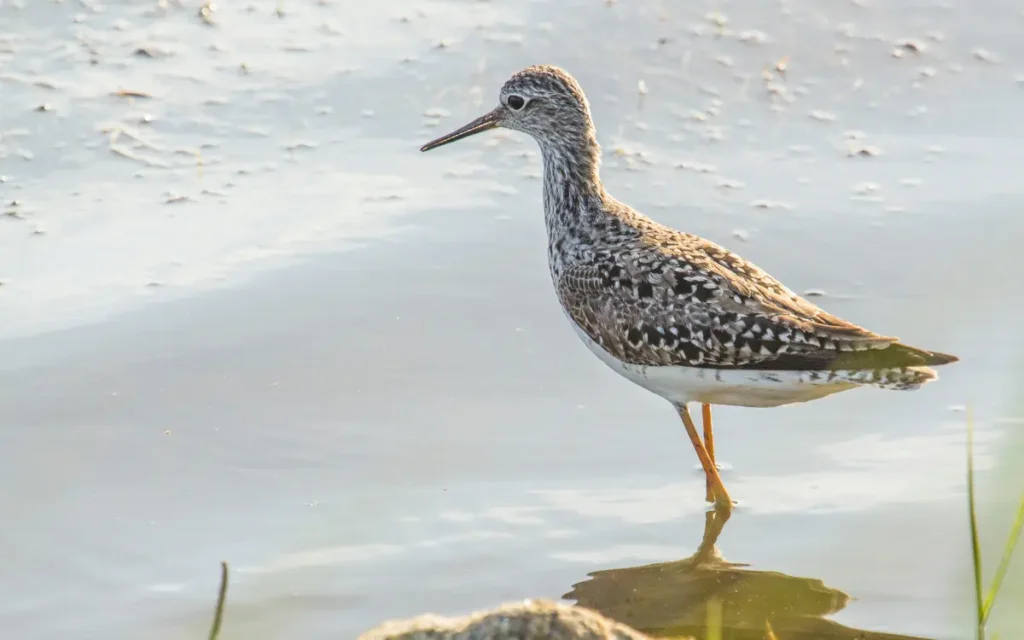
13. Lesser Yellowlegs

Lesser Yellowlegs

The Lesser Yellowlegs is similar to the Greater Yellowlegs but smaller and slimmer. Its bill is shorter, thinner, and usually straighter.

It also has bright yellow legs and is often found around marshes, wet fields, pond edges, and mudflats. When both yellowlegs species are present together, size comparison is very helpful.

If the bird looks delicate and slim with a fine straight bill, Lesser Yellowlegs may be the better fit.

Quick ID: Smaller yellowlegs with a thin, straight bill and slim body.

14. Short-billed Dowitcher

Short billed Dowitcher

The Short-billed Dowitcher is a medium shorebird with a long straight bill. Despite the name, bill length alone is not always the easiest way to identify it.

Its feeding style is one of the best clues. Dowitchers often probe mud quickly in an up-and-down motion that looks like a sewing machine.

Short-billed Dowitchers are often found along coastal mudflats and marshes, especially during migration. They can be difficult to separate from Long-billed Dowitchers, so habitat, voice, and season matter.

Quick ID: Medium shorebird with long bill and fast probing feeding motion.

15. Ruddy Turnstone

Ruddy Turnstone

The Ruddy Turnstone is a stocky shorebird with orange legs, a short strong bill, and bold patterning. It is often found on rocky shores, beaches, jetties, and seaweed-covered areas.

Its feeding behavior is a major clue. It flips stones, shells, seaweed, and other small objects to find insects, crustaceans, and other food.

In breeding plumage, Ruddy Turnstones show rich rusty, black, and white markings. In nonbreeding plumage, they look duller but still chunky and patterned.

Quick ID: Stocky shorebird with orange legs that turns stones and seaweed.

16. American Oystercatcher

The American Oystercatcher is one of the easiest large shorebirds to identify. It has a black head, white belly, brownish back, pinkish legs, and a long orange-red bill.

It is usually found along beaches, tidal flats, oyster beds, and coastal shorelines. Its bill is built for feeding on shellfish and other coastal food.

Because of its size and bright bill, it stands out much more than most small sandpipers and plovers.

Quick ID: Large coastal shorebird with black head and long orange-red bill.

17. Black-necked Stilt

Black-necked-Stilt

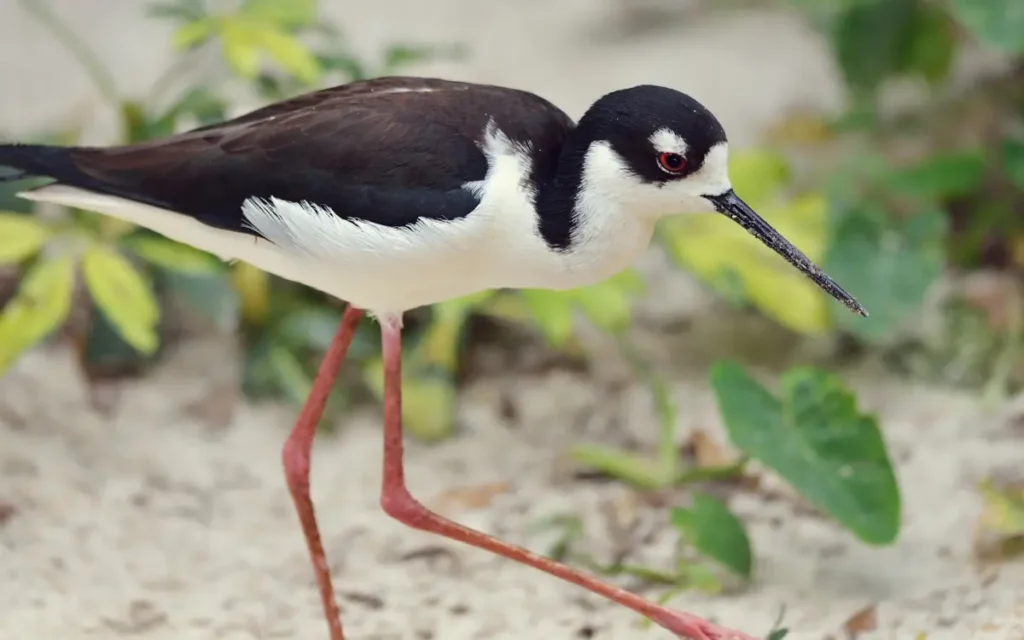
The Black-necked Stilt has one of the most noticeable shapes of any shorebird. It has very long pink legs, a thin black bill, and a black-and-white body.

It is often found in shallow wetlands, salt ponds, marshes, and flooded fields. Its long legs allow it to walk through deeper water than many smaller shorebirds.

The combination of pink legs and black-and-white plumage makes this bird fairly easy for beginners.

Quick ID: Black-and-white shorebird with very long pink legs.

18. American Avocet

American Avocet

The American Avocet is a large, graceful shorebird with long legs and a thin upcurved bill. It often feeds by sweeping its bill side to side through shallow water.

In breeding plumage, it shows a rusty head and neck. In nonbreeding plumage, the head and neck become paler gray or white.

American Avocets are often found in shallow wetlands, ponds, salt flats, and open water edges. The upturned bill is the key feature to look for.

Quick ID: Large shorebird with a long upcurved bill and sweeping feeding style.

Shorebirds by Habitat

Habitat is one of the easiest clues to use when you are still learning shorebirds. A bird’s location will not always give you the exact species, but it can remove many wrong options quickly.

A small bird running on open beach sand is not the same kind of clue as a small bird feeding slowly on a muddy pond edge. When I am unsure, I ask myself: Is this bird on sand, mud, rocks, marsh, or freshwater edge?

Sandy Beach Shorebirds

Sandy beaches are great places to find birds that blend into pale sand. Some of these birds run near the waves, while others feed higher up on the beach.

Common sandy beach shorebirds include Sanderling, Piping Plover, Snowy Plover, Willet, Black-bellied Plover, and American Oystercatcher.

Sanderlings are usually the easiest to notice because they run in and out with the waves. Piping Plovers and Snowy Plovers can be much harder to see because their pale bodies match the sand so well.

Willets are larger and gray, while American Oystercatchers stand out with their long orange-red bills.

Good ID clue: On sandy beaches, look for movement first. Pale birds may disappear into the sand until they run.

Mudflat Shorebirds

Mudflats can hold many shorebirds at once, especially during migration. This is where identification can become harder because several small sandpipers may feed together.

Common mudflat shorebirds include Dunlin, Semipalmated Sandpiper, Western Sandpiper, Least Sandpiper, Short-billed Dowitcher, Greater Yellowlegs, and Lesser Yellowlegs.

Mudflat birds often feed by probing, picking, or walking slowly through wet mud. If you see a bird pushing its bill up and down quickly, check dowitchers. If you see a tiny bird with yellowish legs, check Least Sandpiper.

Good ID clue: On mudflats, bill shape and feeding motion are often more useful than color.

Marsh and Wetland Shorebirds

Marshes, salt ponds, freshwater ponds, and wet fields can attract both small and large shorebirds. These places are especially good during migration, when birds stop to rest and feed.

Common wetland shorebirds include Black-necked Stilt, American Avocet, Greater Yellowlegs, Lesser Yellowlegs, Killdeer, dowitchers, and Least Sandpiper.

Black-necked Stilts are usually easy to pick out because of their long pink legs. American Avocets stand out because of their upcurved bills. Yellowlegs are also noticeable because they walk through shallow water on bright yellow legs.

Good ID clue: In wetlands, look for leg length. Tall birds are often easier to separate than tiny sandpipers.

Rocky Shore Shorebirds

Rocky shores, jetties, tide pools, and seaweed-covered areas attract different shorebirds than open sand or mud.

Common rocky shore shorebirds include Ruddy Turnstone, Black Turnstone, Purple Sandpiper, Surfbird, and sometimes Wandering Tattler depending on region.

Ruddy Turnstones are one of the most recognizable rocky shorebirds because they flip seaweed, shells, and small stones while feeding. Their chunky body and orange legs also help.

Good ID clue: If a shorebird is flipping things over, start with turnstones.

Shorebird Identification by Season

Shorebirds can look very different depending on the time of year. This is one reason beginners get confused. A bird in spring breeding plumage may look bold and colorful, while the same bird in winter can look gray, pale, or plain.

I like to use season as a support clue, not the only clue. Shape, bill, legs, habitat, and behavior should still come first.

Spring Shorebirds

Spring is when many shorebirds move toward breeding grounds. Some species become much easier to recognize because their colors and markings become stronger.

For example, Dunlin may show a black belly. Black-bellied Plover may have a black face and belly. American Avocet may show a rusty head and neck.

Spring can be exciting for birdwatchers because birds often look their best, but migration can also bring many similar species together in the same place.

Summer Shorebirds

Summer shorebird identification depends on where you live. Some birds may be nesting, while others may already be moving after breeding.

By mid to late summer, some adults can look worn. Their feathers may not look as clean as they did earlier in spring. This can make field marks less clear.

On beaches, summer is also nesting season for sensitive species like Piping Plovers and Snowy Plovers in some areas. If signs or fenced nesting zones are present, give the birds plenty of space.

Fall Shorebirds

Fall is one of the best seasons for shorebird watching. Many birds migrate south, and you may see adults, juveniles, and mixed flocks.

Juvenile shorebirds often look fresh and neatly patterned. This can make them attractive to watch, but also tricky if you are used to seeing adult field guide images.

Fall migration may also bring shorebirds to inland ponds, reservoirs, flooded fields, and muddy lake edges. You do not always need an ocean beach to find them.

Winter Shorebirds

In winter, many shorebirds look duller. Gray, white, brown, and pale sandy colors become common. This is when color-based identification becomes less reliable.

A winter Sanderling may look pale gray and white. A winter Dunlin may look gray-brown and plain. A Black-bellied Plover may lose the black belly and look much less obvious.

In winter, I rely more on size, bill shape, behavior, and habitat than bright markings.

Shorebirds That Look Similar

Some shorebirds are easy. American Oystercatcher, Black-necked Stilt, and American Avocet have strong features that stand out.

Others are much harder. Small sandpipers, plovers, yellowlegs, and dowitchers can confuse even experienced birdwatchers. The goal is not to guess fast. The goal is to compare the right clues.

Sandpiper vs Plover

This is one of the most useful beginner comparisons.

Sandpipers usually have slimmer bodies and thinner bills. They often feed by probing mud, picking along wet sand, or moving steadily while searching for food.

Plovers usually look rounder, with shorter bills and bigger-looking heads. Their feeding style is different. They often run, stop, look, then peck.

If the bird is constantly probing, think sandpiper. If it runs forward, pauses, then pecks, think plover.

Sanderling vs Least Sandpiper

Sanderlings and Least Sandpipers are both small, but they usually appear in different settings.

A Sanderling is often on open sandy beaches, running with waves. It has black legs and a clean pale look in winter.

A Least Sandpiper is smaller and often feeds on muddy edges, marshy spots, or pond margins. It has yellowish legs, though mud can hide this clue.

The easiest difference is habitat and behavior: Sanderling on wave-washed beach, Least Sandpiper on mud.

Greater Yellowlegs vs Lesser Yellowlegs

Greater and Lesser Yellowlegs both have bright yellow legs, grayish bodies, and long bills. When they are side by side, the size difference is easier.

Greater Yellowlegs is taller, heavier, and longer-billed. The bill often looks slightly upturned and longer than the head.

Lesser Yellowlegs looks slimmer and more delicate. Its bill is shorter, thinner, and straighter.

If the bird looks powerful and long-billed, think Greater. If it looks slim and neat, think Lesser.

Piping Plover vs Semipalmated Plover

Piping Plover and Semipalmated Plover are both small plovers, but they do not look exactly the same.

Piping Plover is usually paler and sand-colored. It often looks soft and washed-out, which helps it blend into beach sand.

Semipalmated Plover usually looks browner above and has a stronger single dark neck band. It can appear more clearly marked than Piping Plover.

If the bird looks very pale and blends into dry sand, check Piping Plover. If it has a stronger dark band and more contrast, check Semipalmated Plover.

Dunlin vs Western Sandpiper

Dunlin and Western Sandpiper can both show drooped bills, but Dunlin is usually larger and longer-billed.

In breeding plumage, Dunlin is much easier because of its black belly. In nonbreeding plumage, focus on size and bill length.

Western Sandpiper is smaller, with a shorter bill that may droop slightly at the tip. Dunlin usually looks heavier and more long-billed.

If you are looking at a medium-small bird with a clearly long drooping bill, Dunlin is more likely.

Short-billed Dowitcher vs Long-billed Dowitcher

This is one of the hardest shorebird pairs. The names make it sound simple, but bill length alone can be misleading.

Short-billed Dowitchers are often more coastal, while Long-billed Dowitchers are often more tied to freshwater wetlands. But this is not a perfect rule.

Voice, habitat, body shape, molt timing, and plumage can all help. For beginners, it is okay to write “dowitcher species” if you are not sure.

That is better than forcing a wrong ID.

Beginner Shorebird Identification Tips

Shorebirds become easier when you stop trying to identify every bird instantly. I like to slow down and build the ID step by step.

Do Not Rely Only on Color

Color changes with season, age, light, distance, and wet feathers. A bird may look warm brown in one light and gray in another.

Instead of asking, “What color is it?” ask, “What shape is it? How long is the bill? What is it doing?”

Watch Before You Decide

Give yourself at least 30 seconds to watch the bird. Behavior can answer questions that a still view cannot.

A bird running with waves, sweeping its bill, probing like a sewing machine, or flipping seaweed is giving you helpful information.

Use Nearby Birds for Size

Size is hard when a bird is alone. It becomes easier when there are other birds nearby.

If a bird is much smaller than a Willet but larger than a tiny peep, that already narrows your choices.

Learn the Easy Shorebirds First

Start with the shorebirds that have strong clues:

  • Sanderling
  • Killdeer
  • Willet
  • Ruddy Turnstone
  • American Oystercatcher
  • Black-necked Stilt
  • American Avocet

Once these become familiar, the smaller and more confusing birds become easier to compare.

Take Photos When Possible

Even a blurry photo can help you check bill length, leg color, body shape, and wing pattern later.

For shorebirds, photos are especially helpful because birds move quickly and often feed far away.

Check the Tide

On coastal mudflats and beaches, tide can change everything. Low tide often exposes feeding areas, while high tide may push birds closer to resting spots.

If you visit the same place at different tide levels, you may see different birds or get better views.

FAQs

What is the easiest way to identify shorebirds?

The easiest way to identify shorebirds is to look at size, bill shape, leg color, habitat, and behavior together. Color alone is not reliable because many shorebirds change plumage by season or look different in poor light.

What are the small birds running on the beach?

Small birds running in and out with the waves are often Sanderlings. They are small pale shorebirds with black legs and short black bills. Their wave-chasing behavior is one of the easiest shorebird clues to recognize.

How do you tell sandpipers and plovers apart?

Sandpipers usually have thinner bills and often probe or pick steadily while feeding. Plovers usually have shorter bills, rounder heads, and a run-stop-peck feeding style.

Are gulls shorebirds?

No, gulls are not usually considered shorebirds. Gulls are more often grouped with seabirds. Shorebirds include birds such as sandpipers, plovers, yellowlegs, dowitchers, avocets, stilts, and oystercatchers.

Can shorebirds be found away from the ocean?

Yes, many shorebirds can be found away from the ocean. They may appear around lakes, ponds, rivers, reservoirs, flooded fields, marshes, and muddy freshwater edges, especially during migration.

Which shorebirds have yellow legs?

Greater Yellowlegs, Lesser Yellowlegs, and Least Sandpiper are common shorebirds with yellow or yellowish legs. Greater and Lesser Yellowlegs are taller birds, while Least Sandpiper is very small.

What shorebird has a long orange bill?

The American Oystercatcher has a long orange-red bill. It also has a black head, white belly, brownish back, and pinkish legs. It is usually seen along beaches, tidal flats, and shellfish areas.

What shorebird has very long pink legs?

The Black-necked Stilt has very long pink legs, a thin black bill, and a black-and-white body. It is often found in shallow wetlands, marshes, salt ponds, and flooded fields.

Why are shorebirds so hard to identify?

Shorebirds are hard to identify because many species are small, fast-moving, and similar in color. Their plumage also changes by season, and juveniles may look different from adults. Shape, bill, legs, habitat, and behavior make identification easier.

What is the best time to see shorebirds?

Low tide is often best on coastal mudflats because feeding areas are exposed. Spring and fall migration are also great times because more shorebirds move through beaches, wetlands, and inland muddy areas.

Scroll to Top