19 Hummingbirds in Texas: Pictures, Size and ID Guide
Texas holds an unusual mix of eastern, western, desert, mountain, and tropical hummingbirds. Ruby-throated Hummingbirds fill gardens in East Texas, Black-chinned Hummingbirds breed across central and western regions, and Buff-bellied Hummingbirds remain in the Lower Rio Grande Valley during much of the year.
The state list also includes mountain species from the Trans-Pecos and rare visitors from Mexico. Some have been recorded only a handful of times, so seeing every species on this list would take years and plenty of luck.
Use the chart below to separate the regular hummingbirds from localized birds and exceptional visitors.
1. Ruby-throated Hummingbird
Scientific name: Archilochus colubris
Texas status: Common migrant and summer breeder in eastern Texas
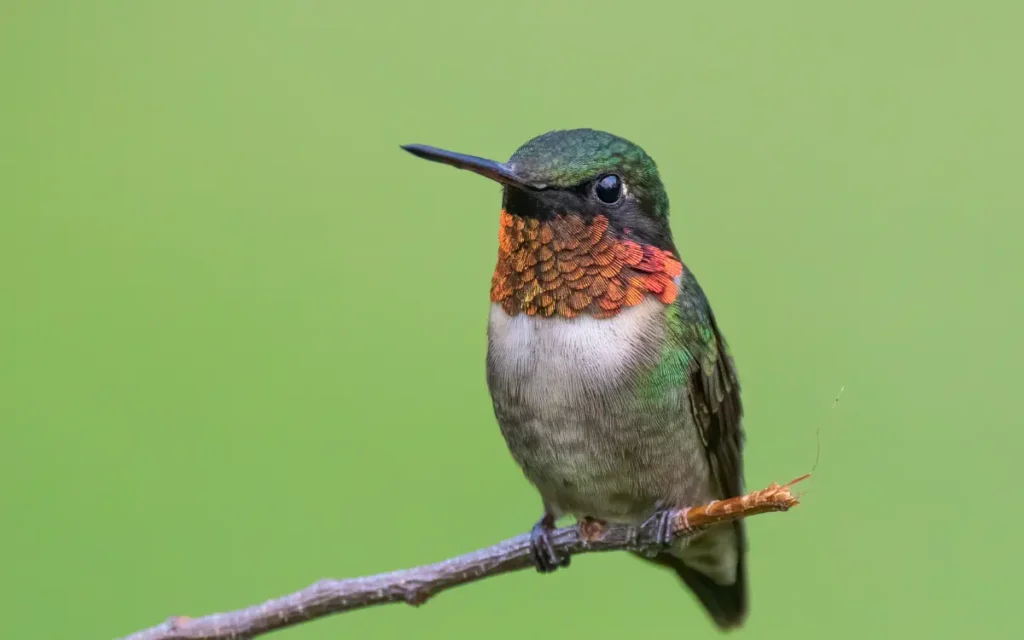
Male Ruby-throated Hummingbirds have green backs, pale underparts, forked tails, and iridescent red throats. The throat may look black when sunlight does not strike it directly. Females have white throats and rounded tails with pale tips on the outer feathers.
This is the hummingbird most people encounter around Houston, Dallas, East Texas, and the Gulf Coast. Large numbers pass through coastal areas during spring and fall migration.
Ruby-throated Hummingbirds visit sugar-water feeders and flowers such as Turk’s cap, coral honeysuckle, salvia, and trumpet creeper.
Do not confuse it with: Female and young Black-chinned Hummingbirds. A perched Ruby-throated usually has wingtips that stop short of the tail tip. Black-chinned wings often reach the tail tip or extend slightly beyond it.
2. Black-chinned Hummingbird
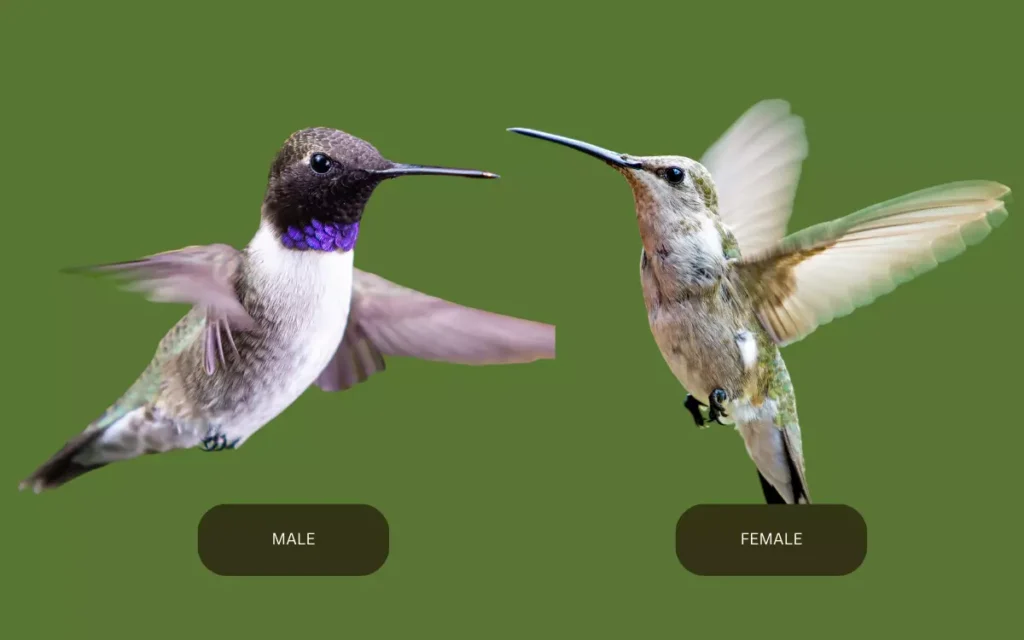
Scientific name: Archilochus alexandri
Texas status: Common spring and summer breeder in central and western Texas
A male Black-chinned Hummingbird has a dark head, black throat, and a narrow band of purple along the bottom of the throat. That purple band can disappear in poor light, leaving the entire head looking black.
Females and young birds are green above and pale below. They have white-tipped outer tail feathers but lack colorful throat feathers.
Black-chinned Hummingbirds occupy Hill Country gardens, desert washes, river corridors, towns, and mountain canyons. They readily use feeders and may repeatedly return to one exposed territorial perch.
Do not confuse it with: Ruby-throated Hummingbird. Male throat color helps when the light is good. Females often require close attention to wing length, tail shape, and location.
3. Rufous Hummingbird
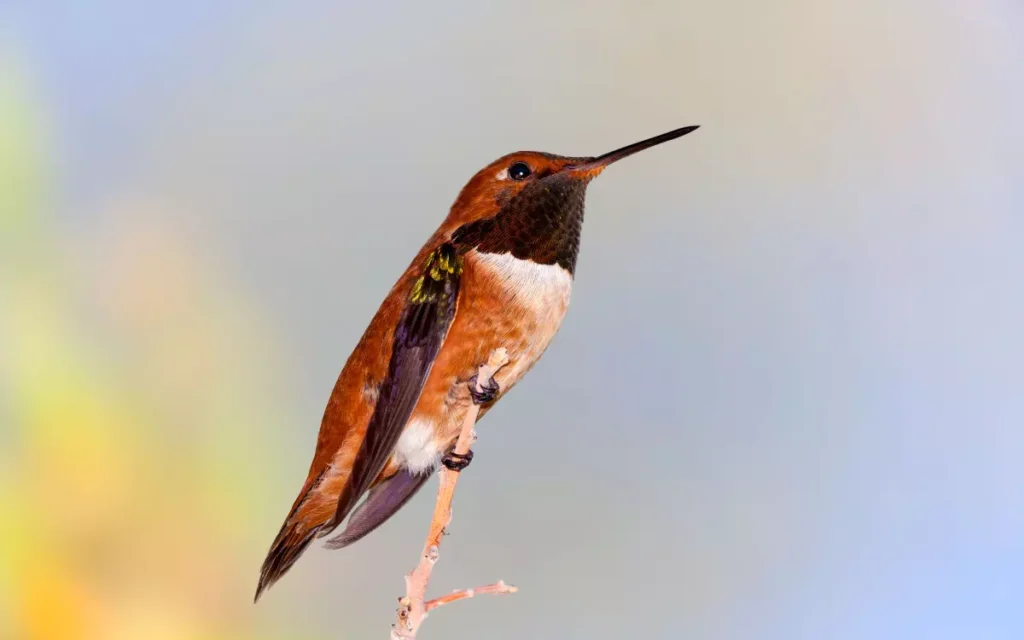
Scientific name: Selasphorus rufus
Texas status: Fall migrant and winter visitor
Adult male Rufous Hummingbirds are orange across the back, sides, and tail, with a glowing orange-red throat. Some males have green feathers scattered across the back. Females and young birds are green above with rusty coloring along their flanks and tail.
Many Rufous Hummingbirds begin reaching Texas in late summer. Some remain at feeders through winter, particularly along the Gulf Coast and in central or eastern parts of the state.
This small hummingbird can dominate a feeder despite being smaller than many of its competitors.
Do not confuse it with: Allen’s Hummingbird. Females and young birds may be impossible to separate safely in the field. Detailed photographs of spread tail feathers are often needed.
4. Buff-bellied Hummingbird
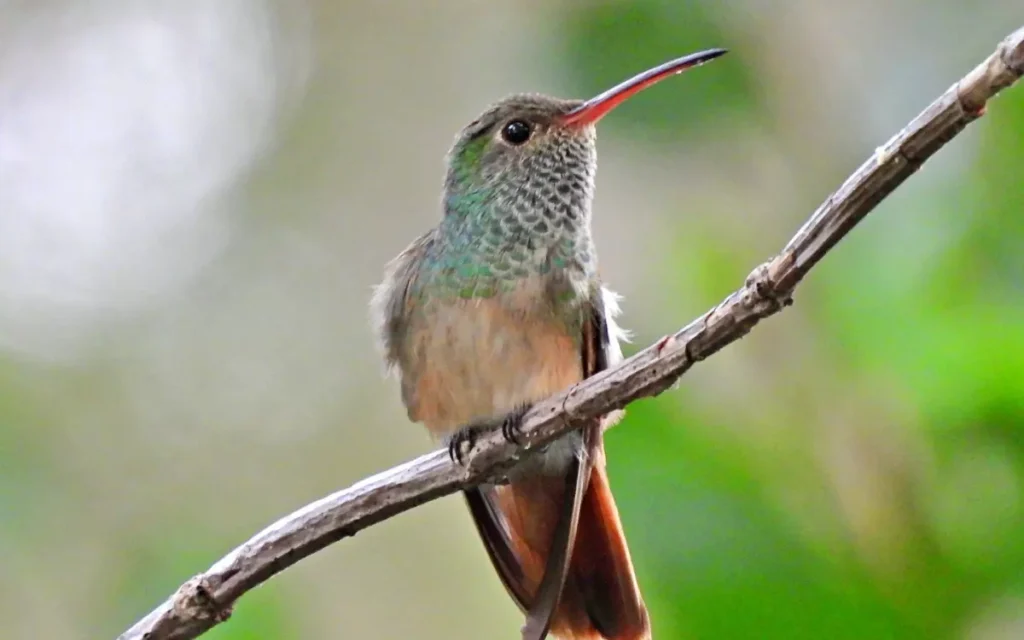
Scientific name: Amazilia yucatanensis
Texas status: Resident in South Texas; occasional visitor farther north
The Buff-bellied Hummingbird is one of the largest regularly occurring hummingbirds in Texas. It has a metallic green head and throat, warm buff-colored belly, red bill tipped with black, and a rusty tail.
This tropical species is closely associated with the Lower Rio Grande Valley and southern Gulf Coast. It lives in subtropical woodland, parks, gardens, citrus areas, and brush containing flowering plants.
Buff-bellied Hummingbirds sometimes move north along the Gulf Coast after breeding. A few reach Louisiana or even travel beyond the immediate coastal region.
Do not confuse it with: Broad-billed Hummingbird. Both can have red bills, but the Buff-bellied has a buff underside and rusty tail. Male Broad-billed Hummingbirds are much darker blue-green below.
5. Broad-tailed Hummingbird
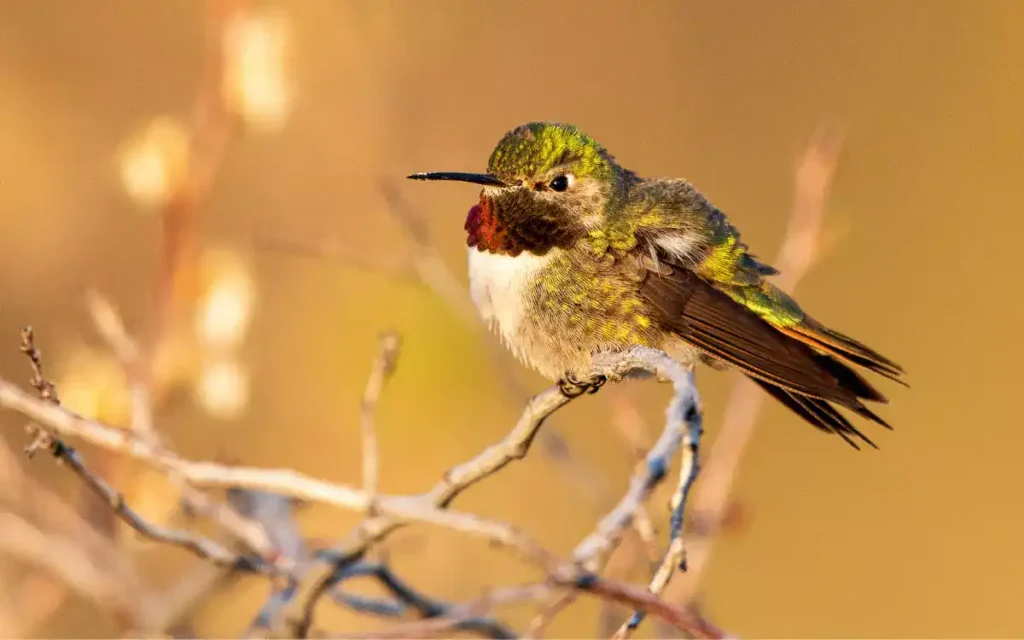
Broad-tailed Hummingbirds are summer breeders in the mountainous regions of West Texas. Males have a metallic rose throat and produce a distinct trilling sound with their wings in flight. These hummingbirds prefer cooler elevations Scientific name: Selasphorus platycercus
Texas status: Migrant and localized breeder in West Texas
Male Broad-tailed Hummingbirds have green backs, white chests, and rose-red throats. Females lack the colorful throat and have rusty coloring in their outer tail feathers.
The male’s flight sound is one of the best clues. Air moving through the outer wing feathers creates a high metallic trill that can be heard before the bird appears.
Most Texas records come from western migration routes and high-elevation habitat. Breeding is limited mainly to mountain areas where summer temperatures remain cooler.
Do not confuse it with: Ruby-throated Hummingbird. The ranges differ, and male Broad-tailed Hummingbirds produce a distinct wing trill. Females have more rusty coloring in the tail.
6. Anna’s Hummingbird
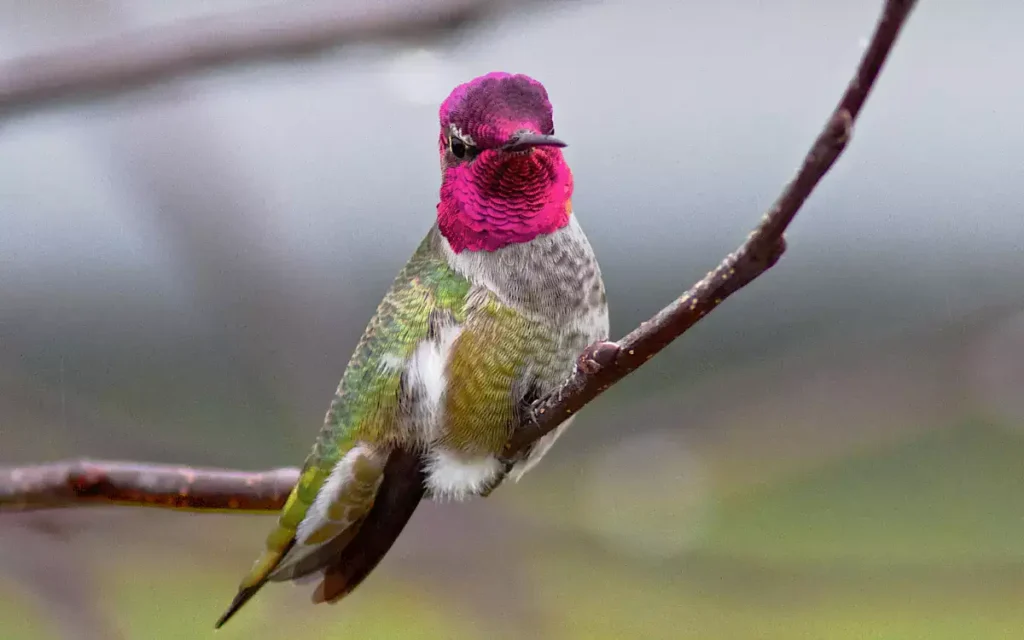
Scientific name: Calypte anna
Texas status: Uncommon winter visitor
Adult male Anna’s Hummingbirds have rose-red feathers covering both the throat and crown. The crown color separates them from male Ruby-throated Hummingbirds, whose red is limited to the throat.
Females have green backs, gray chests, and often a small red patch in the center of the throat. Their bodies look heavier and more upright than those of Ruby-throated Hummingbirds.
Texas records are scattered, with many occurring at feeders during fall and winter.
Do not confuse it with: Ruby-throated Hummingbird. A male Anna’s has color across the crown, a grayer chest, and a stockier shape.
7. Calliope Hummingbird
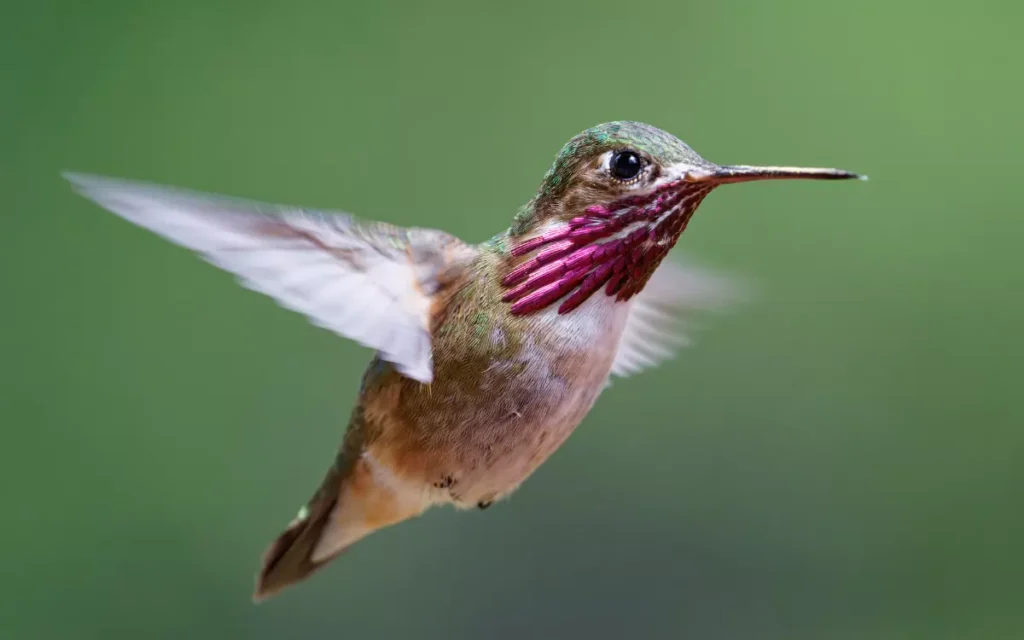
Scientific name: Selasphorus calliope
Texas status: Uncommon migrant and occasional winter visitor
The Calliope is the smallest bird found in the United States. Adult males have narrow magenta throat feathers that form separate rays rather than one solid patch.
Females and young birds are harder to recognize. They have short bills, compact bodies, pale buff sides, and rusty coloring near the base of the tail.
Calliope Hummingbirds may pass through western Texas during migration, but scattered birds can occur elsewhere, including at winter feeders.
Do not confuse it with: Rufous or Broad-tailed Hummingbirds. Calliopes look smaller and shorter-billed. Adult males have separated magenta throat rays.
8. Broad-billed Hummingbird
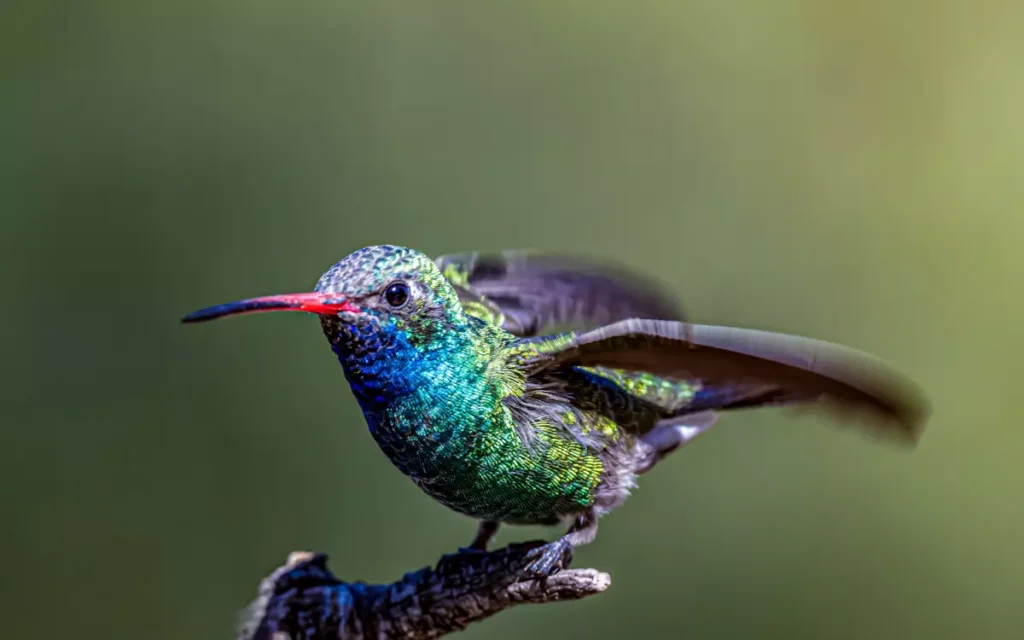
Scientific name: Cynanthus latirostris
Texas status: Uncommon visitor, mainly in western and southern Texas
Male Broad-billed Hummingbirds are blue-green below and green above, with a red-orange bill ending in a black tip. Females are much duller, with a pale underside, gray face, white line behind the eye, and dark cheek patch.
Texas sightings are concentrated in the Trans-Pecos, although individuals can appear elsewhere. Some remain at feeders for extended periods during winter.
The bird’s long red bill can be visible even when its metallic colors look dark.
Do not confuse it with: Buff-bellied Hummingbird. Broad-billed males are blue-green below and have dark tails. Buff-bellied Hummingbirds have pale buff bellies and rusty tails.
9. Lucifer Hummingbird

Scientific name: Calothorax lucifer
Texas status: Local breeder in the Trans-Pecos
The Lucifer Hummingbird is a genuine Texas breeding species, though its range is restricted to dry western canyons. It should be described as localized rather than simply rare.
Males have long, curved bills, narrow purple throats, green crowns, and deeply forked tails. Females are pale below with warm coloring along the sides and a shorter, rounded tail.
Big Bend and nearby desert mountain areas offer the best chance of finding one. Look around agaves, ocotillos, desert shrubs, and feeders placed near rocky slopes.
Do not confuse it with: Black-chinned Hummingbird. The Lucifer has a noticeably curved bill, longer purple throat feathers, and a more restricted desert range.
10. Green-breasted Mango

The Green-breasted Mango is a rare tropical hummingbird that occasionally wanders into South Texas from Mexico. These large hummingbirds have dark greScientific name: Anthracothorax prevostii
Texas status: Rare tropical visitor
The Green-breasted Mango is larger and longer-billed than most Texas hummingbirds. Males have a dark central line running from the throat down the chest, while females have pale underparts crossed by a dark stripe.
The bill is long and slightly curved. The tail can appear dark reddish or purplish depending on sex, age, and light.
Most Texas records have come from the southern part of the state, particularly the Lower Rio Grande Valley and nearby coastal areas.
Do not confuse it with: Mexican Violetear. The mango’s curved bill and central chest stripe are the best differences.
11. Violet-crowned Hummingbird

Scientific name: Ramosomyia violiceps
Texas status: Rare visitor to far West Texas
This hummingbird has a violet-blue crown, white throat and belly, green back, rusty tail, and red bill with a dark tip. Unlike many colorful male hummingbirds, it does not have a bright throat patch.
Most Texas records come from western canyons and feeders close to the Mexican border. Its pale underside makes it look unusually clean and white compared with most other hummingbirds.
Do not confuse it with: White-eared Hummingbird. The Violet-crowned has an extensively white underside and lacks the White-eared Hummingbird’s bold white facial stripe.
12. White-eared Hummingbird

Scientific name: Basilinna leucotis
Texas status: Rare visitor to West Texas
A broad white stripe behind the eye gives this species its name. Adults also have green bodies, dark heads, and red bills tipped with black. Males show purple and green on the crown and throat.
White-eared Hummingbirds normally live in Mexican mountain woodland. Texas appearances are usually associated with wooded canyons and feeding stations in the Trans-Pecos.
Any sighting outside known western locations deserves photographs and careful notes.
Do not confuse it with: Female Broad-billed Hummingbird. Both can show a pale facial line, but the White-eared has a broader, cleaner stripe and more green across the underside.
13. Allen’s Hummingbird
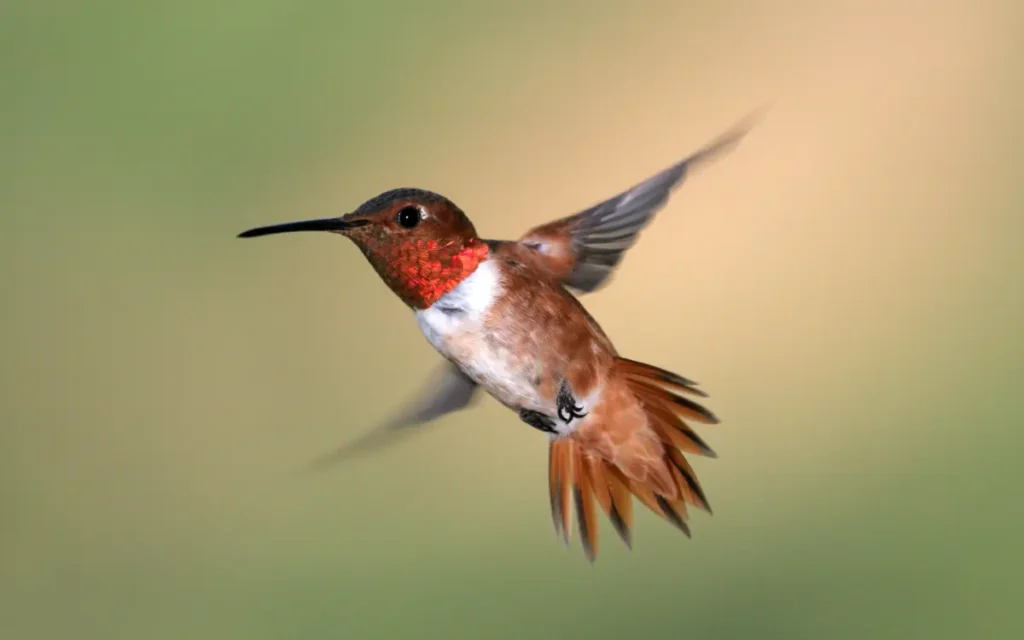
Scientific name: Selasphorus sasin
Texas status: Rare migrant and winter visitor
Male Allen’s Hummingbirds have orange throats, sides, tails, and lower backs, but the center of the upper back is normally green. Rufous males can also show green backs, making the distinction harder than many short guides suggest.
Females and immature Allen’s and Rufous Hummingbirds are extremely similar. Location alone does not confirm either species.
Photographs of spread tail feathers or examination by an experienced hummingbird bander may be needed for a defensible identification.
Do not confuse it with: Rufous Hummingbird. Do not identify a female or young orange-sided hummingbird as Allen’s without seeing the diagnostic tail-feather shape.
14. Mexican Violetear
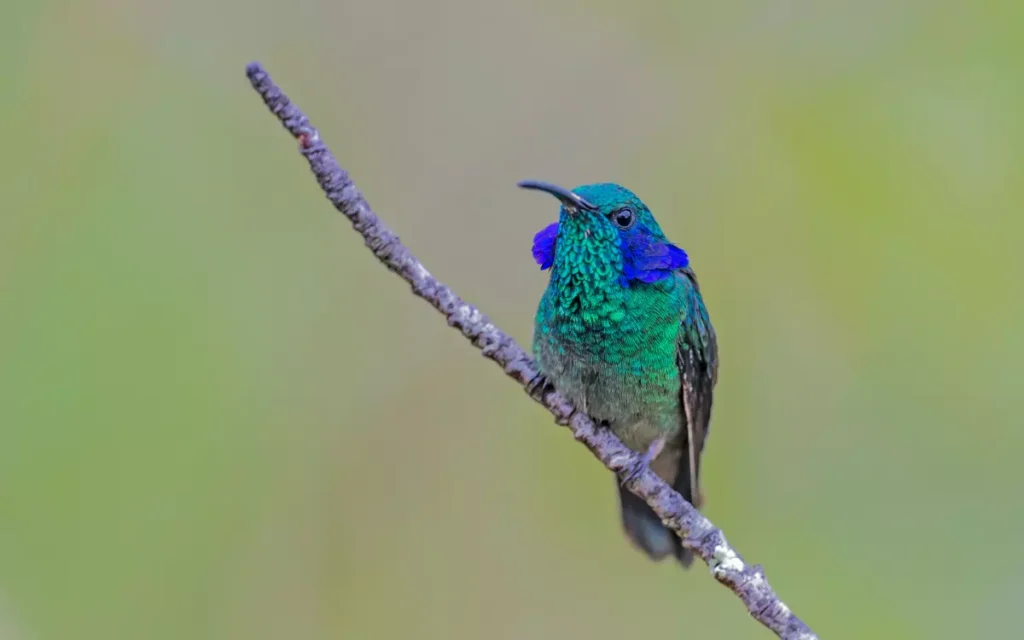
Scientific name: Colibri thalassinus
Texas status: Rare visitor requiring documentation
The Mexican Violetear is a large, dark green hummingbird with violet patches on the sides of the head and upper chest. The tail has a broad dark band and may spread widely during display or territorial encounters.
Texas sightings are unpredictable. Individuals have appeared at feeders in different parts of the state rather than following one dependable route.
Its repeated sharp or metallic calls may first draw attention to the bird.
Do not confuse it with: Green-breasted Mango. The violetear has a straighter bill and violet cheek patches. A mango has a longer curved bill and dark stripe down the chest.
15. Blue-throated Mountain-gem

Scientific name: Lampornis clemenciae
Texas status: Localized West Texas breeder and visitor
The Blue-throated Mountain-gem is the largest hummingbird likely to breed in Texas. Both sexes have long tails, broad white eyebrow stripes, white lines below the eyes, and large white tail corners.
Males have a deep blue throat, though it can look black in shade. Females have plain gray throats.
Look for this species around shaded oak and pine canyons in the Chisos, Davis, and Guadalupe mountain regions. Its slow wingbeats and heavy shape make it look different from smaller hummingbirds.
Do not confuse it with: Rivoli’s Hummingbird. Blue-throated Mountain-gems have bold white facial stripes and large white tail corners. Rivoli’s lacks those strong face marks.
16. Rivoli’s Hummingbird

Scientific name: Eugenes fulgens
Texas status: Localized mountain species in far West Texas
Formerly called the Magnificent Hummingbird, Rivoli’s is a large, long-billed hummingbird of high mountain woodland.
Adult males look dark until direct light reveals a purple crown and green throat. Females have green backs, gray underparts, and a pale mark behind the eye.
In Texas, Rivoli’s Hummingbirds are associated with pine-oak and mixed mountain woodland in the Trans-Pecos. They are far less widespread than Black-chinned Hummingbirds.
Do not confuse it with: Blue-throated Mountain-gem. Rivoli’s has a longer bill, darker male plumage, and no bold white stripe running behind the eye.
17. Costa’s Hummingbird
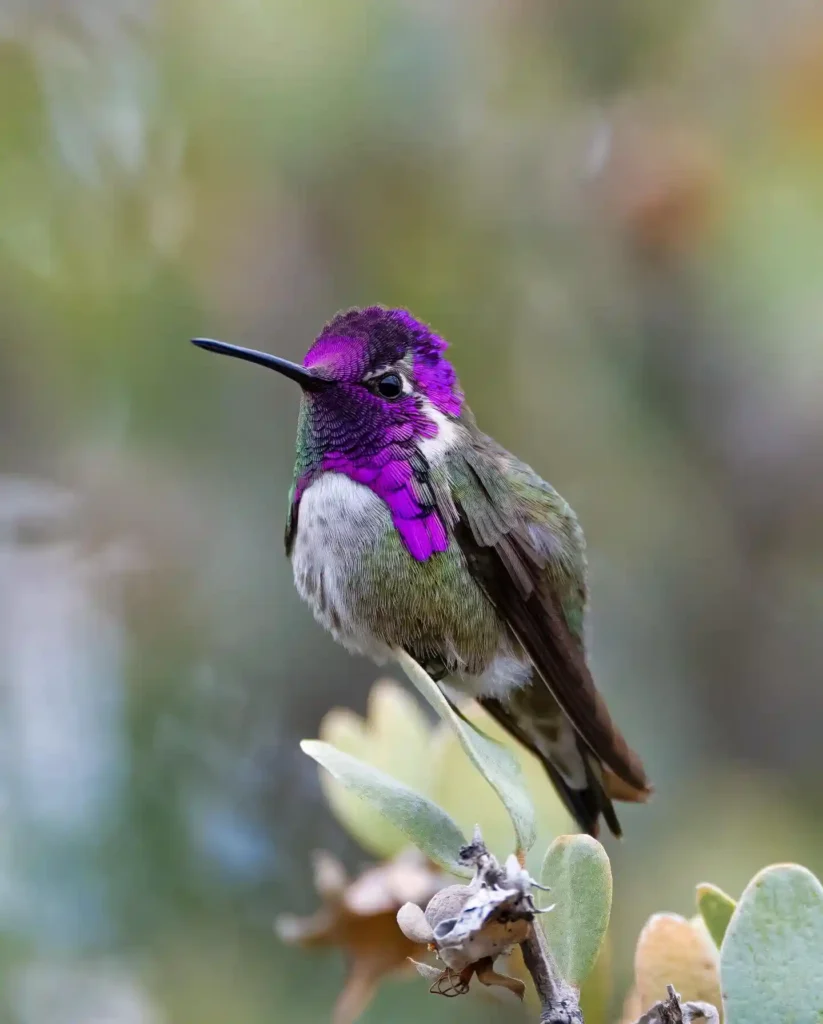
Scientific name: Calypte costae
Texas status: Rare visitor
Male Costa’s Hummingbirds have purple crowns and long purple throat feathers that extend outward along both sides of the neck. When spread, the throat creates a pointed, mustache-like shape.
Females are much less distinctive. They have pale underparts, green backs, compact bodies, and occasionally a small patch of violet throat feathers.
Costa’s is associated mainly with deserts farther west, and Texas records require careful documentation.
Do not confuse it with: Anna’s Hummingbird. A male Costa’s has longer side feathers on the throat and a more compact body. Anna’s has a fuller red-pink crown and throat.
Picture caption: Male Costa’s Hummingbird displaying its extended purple throat feathers.
18. Berylline Hummingbird
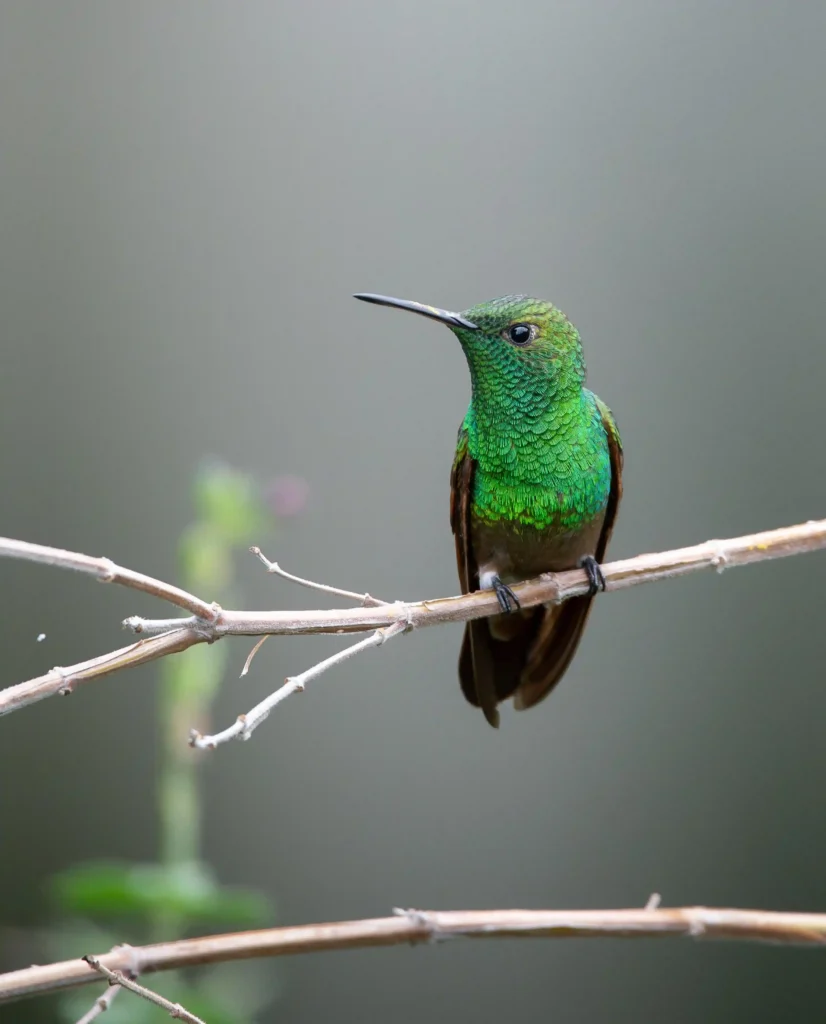
Scientific name: Saucerottia beryllina
Texas status: Rare visitor requiring documentation
The Berylline Hummingbird has a green head, throat, and chest, along with rusty coloring in the wings and tail. Its bill is red near the base and dark toward the tip.
This species normally occurs in Mexico and Central America. Texas records are exceptional, most often associated with far western or southern areas.
The rusty wings may be noticeable when the bird hovers, even when its green chest looks dark.
Do not confuse it with: Buff-bellied Hummingbird. The Berylline has a green belly and more rusty color in the wings. Buff-bellied Hummingbirds have pale buff underparts.
Picture caption: Berylline Hummingbird showing its green chest and rusty wings.
19. Amethyst-Throated Mountain-Gem
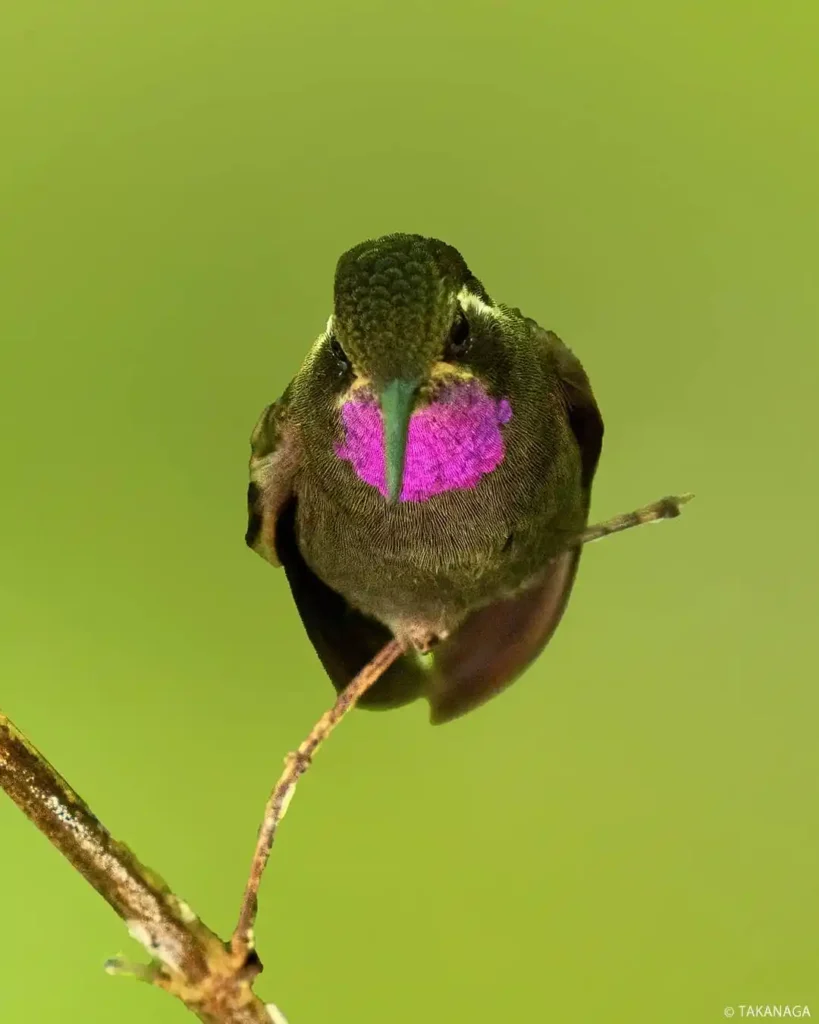
Scientific name: Lampornis amethystinus
Texas status: Accidental visitor
The Amethyst-throated Mountain-gem is one of the rarest hummingbirds documented in Texas. It belongs to the mountain forests of Mexico and northern Central America.
Adult males have a purple-pink throat, white eyebrow, dark face, green back, gray underside, and white markings in the tail. Females lack the colorful throat but retain the noticeable facial pattern.
A suspected bird should be photographed from several angles and reported to the Texas Bird Records Committee.
Do not confuse it with: Blue-throated Mountain-gem. The Amethyst-throated is smaller, has a purple throat, and lacks the Blue-throated Mountain-gem’s large white tail corners.
Picture caption: Male Amethyst-throated Mountain-gem showing its white eyebrow and purple throat.
Most Common Hummingbirds by Texas Region
| Texas Region | Hummingbirds Most Likely to Be Seen |
| East Texas | Ruby-throated |
| Gulf Coast | Ruby-throated, Rufous during migration or winter |
| Central Texas | Black-chinned, Ruby-throated where ranges meet |
| Hill Country | Black-chinned |
| West Texas | Black-chinned, Broad-tailed during migration |
| Trans-Pecos mountains | Lucifer, Black-chinned, Blue-throated and Rivoli’s |
| Lower Rio Grande Valley | Buff-bellied and Ruby-throated migrants |
When Hummingbirds Reach Texas
Spring
Spring migration begins during March. Ruby-throated Hummingbirds move through eastern Texas, while Black-chinned Hummingbirds return to central and western breeding areas. Numbers generally build through April.
Summer
Black-chinned and Ruby-throated Hummingbirds occupy their breeding ranges. Buff-bellied Hummingbirds remain in South Texas, while Lucifer, Blue-throated, and Rivoli’s Hummingbirds may be found in limited western mountain habitat.
Fall
Late summer and early fall produce the greatest hummingbird movement. Migration can begin during July, with activity becoming especially noticeable in August and September.
Winter
Rufous Hummingbirds are the most familiar winter visitors. Anna’s, Calliope, Black-chinned, and other species may also remain at individual feeders. Buff-bellied Hummingbirds can be present through winter in southern Texas.
Ruby-Throated vs Black-Chinned Hummingbird
| Feature | Ruby-Throated | Black-Chinned |
| Male throat | Red | Black with purple lower edge |
| Main Texas range | Eastern Texas | Central and western Texas |
| Perched wing length | Stops before tail tip | Reaches or passes tail tip |
| Male tail | Deeply forked | Slightly forked |
| Female identification | Shorter wings and longer-looking tail | Longer wings relative to tail |
Female and immature birds may require photographs. Do not depend on geography alone where their Texas ranges overlap.
Rufous vs Allen’s Hummingbird
Adult males can sometimes be separated by the back, but that feature is not foolproof. Most male Allen’s have a green upper back, while many Rufous males have an orange back. Some Rufous Hummingbirds also have green backs.
Females and young birds usually require a close view of individual tail feathers. If those feathers cannot be seen clearly, reporting the bird as “Rufous/Allen’s Hummingbird” is more accurate.
How to Attract Hummingbirds in Texas
Planting several nectar-producing species provides food across a longer season. Useful Texas plants include Turk’s cap, autumn sage, coral honeysuckle, standing cypress, red buckeye, flame acanthus, and native salvias.
Feeders can supply extra nectar during migration or periods with fewer flowers.
Use this recipe:
- Mix one part plain white sugar with four parts water.
- Do not add red dye, honey, brown sugar, or artificial sweeteners.
- Allow heated water to cool before filling the feeder.
- Make only as much nectar as the birds will use before it spoils.
Place feeders where they receive morning sun and afternoon shade. Several small feeders spaced apart may work better than one large feeder because territorial birds cannot guard every feeding point.
How Often Should You Clean a Hummingbird Feeder?
In hot Texas weather, sugar water can spoil quickly. Replace it every day or two during extreme heat. During cooler weather, changing it every three to five days may be enough, but cloudy liquid, mold, insects, or an unpleasant smell means it needs immediate cleaning.
Wash the feeder with hot water and a feeder brush. Pay close attention to ports and narrow seams where mold collects.
Best Texas Locations for Hummingbirds
Lower Rio Grande Valley
The Valley is the primary Texas range of the Buff-bellied Hummingbird. Parks, native gardens, woodland edges, and feeding stations can also attract Ruby-throated migrants and occasional tropical visitors.
Big Bend Region
Big Bend and nearby desert canyons are the best places to search for Lucifer Hummingbirds. Black-chinned, Broad-tailed, and several rare Mexican species may also occur.
Davis Mountains
Higher elevations support hummingbirds associated with pine-oak woodland, including Black-chinned, Broad-tailed, Blue-throated Mountain-gem, and Rivoli’s.
Upper Texas Coast
Coastal migration locations can hold large numbers of Ruby-throated Hummingbirds during favorable spring conditions. Rufous and other western hummingbirds may appear during fall or winter.
Texas Hill Country
Black-chinned Hummingbirds are widespread around gardens, wooded streams, ranches, and towns. Native salvias and other drought-tolerant flowers can keep them returning through summer.
Frequently Asked Questions
What is the most common hummingbird in Texas?
There is no single answer for the entire state. Ruby-throated Hummingbirds are the most familiar species in East Texas, while Black-chinned Hummingbirds are common across central and western regions.
How many hummingbird species have been recorded in Texas?
The 2025 Texas bird checklist contains 19 documented hummingbird species. It also lists Antillean Crested and Rufous-tailed Hummingbirds as historical or hypothetical rather than confirmed members of the main state list.
Are any hummingbirds found in Texas all year?
Buff-bellied Hummingbirds can remain throughout the year in South Texas. Rufous, Anna’s, and several other species may also spend winter at individual feeders, but their presence varies by location.
When should hummingbird feeders go out in Texas?
Feeders can be placed outside by early March for spring migrants. In South Texas, along the coast, or where winter hummingbirds occur, keeping a clean feeder available all year is reasonable.
Should feeders be removed to make hummingbirds migrate?
No. Migration is controlled mainly by changing daylight and natural seasonal cues. A clean feeder can help late migrants and will not stop healthy hummingbirds from leaving.
What is the largest hummingbird in Texas?
The Blue-throated Mountain-gem is generally the largest hummingbird regularly occurring in Texas. Green-breasted Mango and Rivoli’s Hummingbird are also much larger than Ruby-throated or Calliope Hummingbirds.
What is the smallest Texas hummingbird?
The Calliope Hummingbird is the smallest hummingbird recorded in Texas and the smallest bird found in the United States.
Which hummingbird has an orange body?
A strongly orange hummingbird is most likely a Rufous Hummingbird. Allen’s Hummingbird looks similar but is far rarer in Texas and may require tail photographs for confirmation.
Where can I report a rare Texas hummingbird?
Photograph the bird, note the date and exact location, and submit the observation to eBird. Species marked for review should also be documented for the Texas Bird Records Committee.