35 Yellow Birds You Might See: Easy Identification Guide
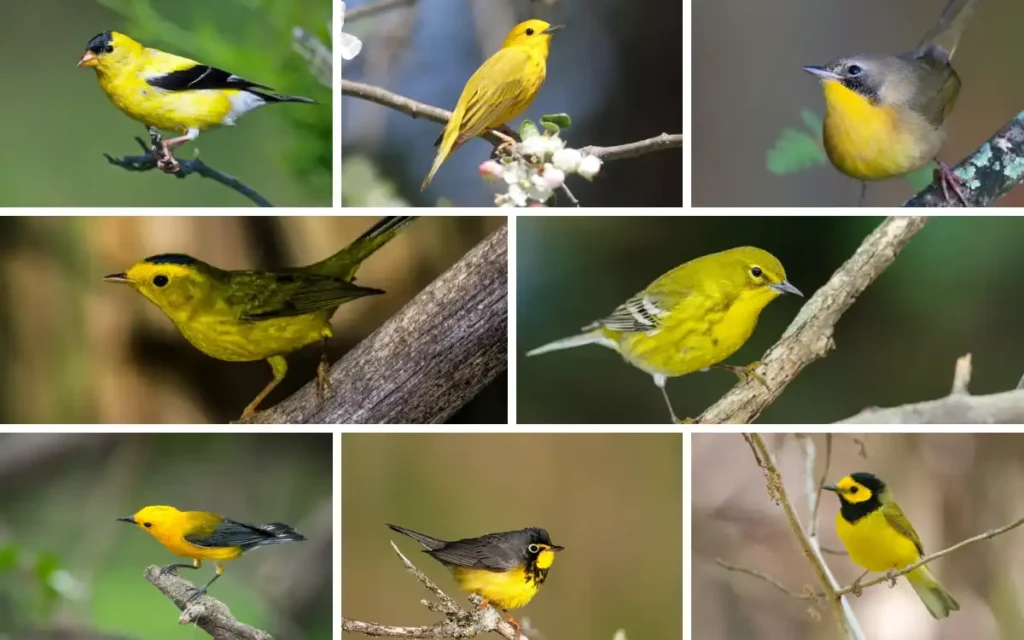
Seeing a yellow bird can feel exciting, but identifying it is not always simple. Not every yellow bird is a goldfinch. Some are warblers, tanagers, orioles, vireos, meadowlarks, grosbeaks, flycatchers, or blackbirds with yellow markings.
The easiest way to identify a yellow bird is to look beyond the color. Check the bill shape, wing markings, face pattern, tail, habitat, and behavior. A small yellow bird at a seed feeder may be an American Goldfinch, while a yellow bird moving through shrubs near water could be a Yellow Warbler or Common Yellowthroat. A larger yellow bird in tall trees might be a female oriole or tanager.
This guide covers 35 yellow birds you may see in North America, with simple field marks, where to find them, behavior clues, and tips to tell similar species apart. Use it as a quick bird identification guide when you spot a yellow bird in your backyard, garden, forest, wetland, field, or local park.
1. American Goldfinch
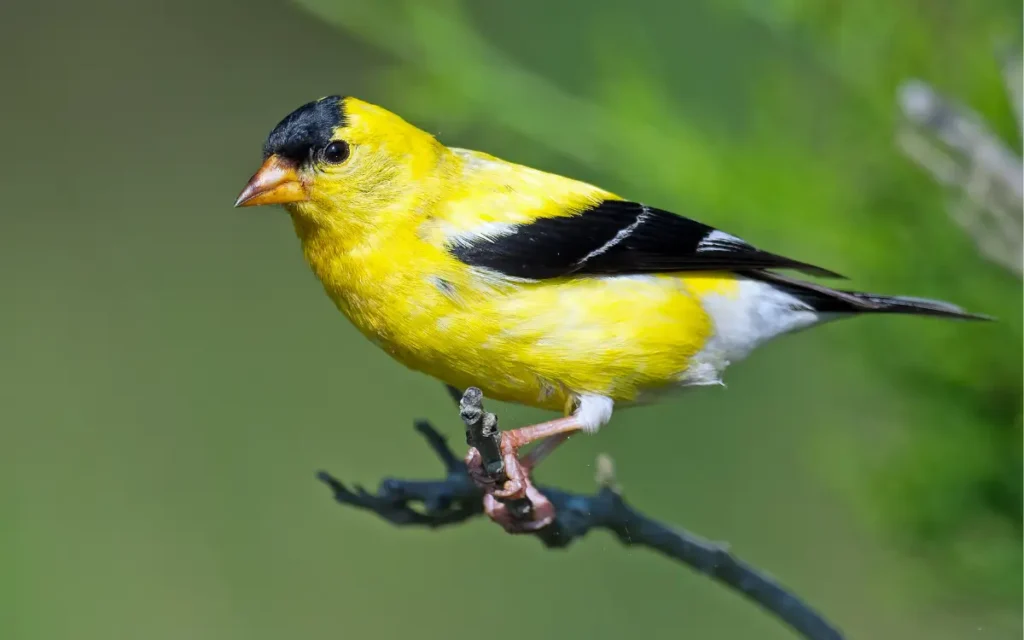
Quick ID: Bright yellow male with black wings, white wing markings, and a black cap during breeding season.
What It Looks Like:
The American Goldfinch is one of the easiest yellow birds to recognize in summer. Males turn bright yellow with black wings and a black forehead, while females look softer olive-yellow or brownish. In winter, both males and females become duller, so beginners often miss them unless they notice the wing pattern and small cone-shaped bill.
Where You’ll Find It:
Look for them in open fields, weedy roadsides, gardens, parks, and backyards. They are especially common around seed-producing plants.
Behavior Clues:
Goldfinches often fly with a bouncy up-and-down pattern. They also gather in small flocks and visit feeders for nyjer and sunflower seeds.
How to Tell It Apart:
A goldfinch has a short seed-eating bill and black wings. Yellow Warblers are slimmer, have thinner bills, and usually stay around shrubs or trees.
Best Time to See:
Spring and summer are best for bright yellow males, but they can be seen year-round in many areas.
Backyard Tip: Add nyjer seed, sunflower chips, coneflowers, black-eyed Susans, and native grasses.
2. Yellow Warbler
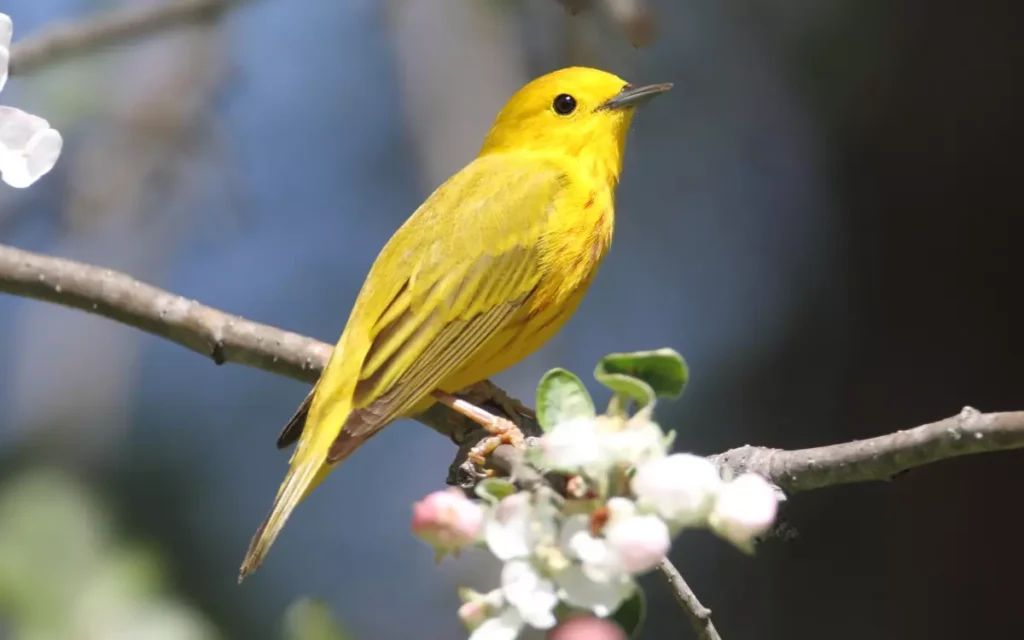
Quick ID: Small bright yellow warbler with a plain face and reddish streaks on the male’s chest.
What It Looks Like:
The Yellow Warbler is one of the most classic small yellow birds in North America. Males are bright yellow with warm reddish streaks across the breast, while females are usually softer yellow with fewer markings. Their wings are not black like a goldfinch, and their body looks slimmer and more delicate.
Where You’ll Find It:
Look for Yellow Warblers near wetlands, streams, willow thickets, shrubby edges, gardens, and young trees.
Behavior Clues:
They move quickly through shrubs and small branches, picking insects from leaves. They rarely sit still for long.
How to Tell It Apart:
Yellow Warblers have thin insect-eating bills, plain yellow faces, and no bold black wings. Goldfinches have thicker seed bills and stronger wing markings.
Best Time to See:
Spring and summer are best in breeding areas. They also pass through during migration.
Backyard Tip: Plant native shrubs and small trees that attract insects.
3. Common Yellowthroat
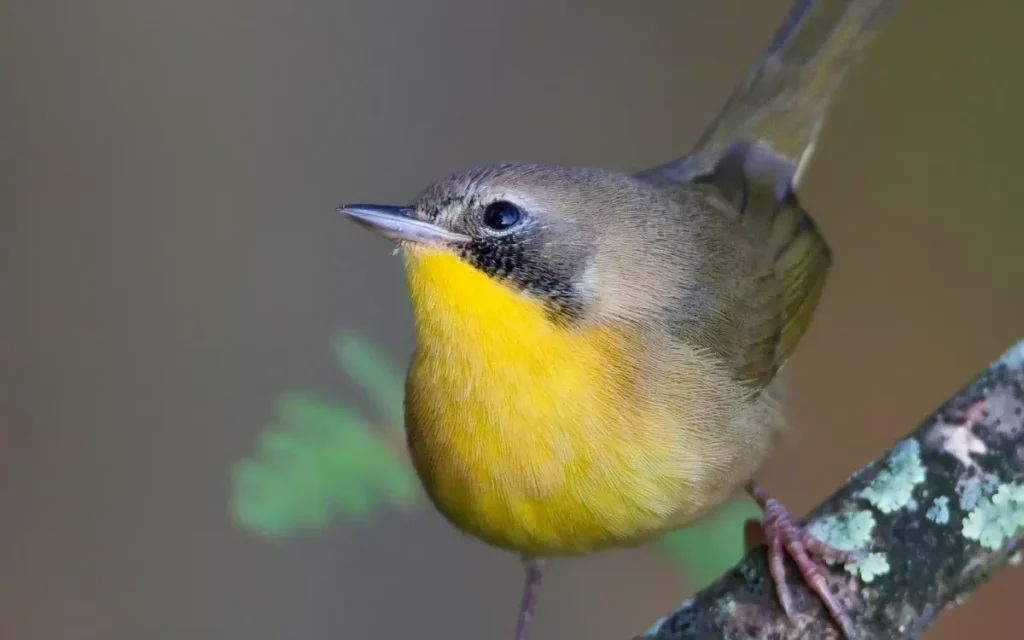
Quick ID: Small yellow-throated bird; males have a black mask across the face.
What It Looks Like:
The male Common Yellowthroat is easy to spot when seen clearly. It has a bright yellow throat and chest, olive-brown upperparts, and a bold black mask bordered by pale gray or white. Females are trickier because they lack the mask, but they still show yellow on the throat and lower body.
Where You’ll Find It:
Common Yellowthroats like marshes, wet fields, brushy ditches, pond edges, and thick weedy areas.
Behavior Clues:
They often stay low in reeds, grasses, and shrubs. You may hear them before seeing them.
How to Tell It Apart:
The male’s black mask is the strongest clue. Females are best identified by habitat, yellow throat, and secretive low movement.
Best Time to See:
Spring through fall in many areas.
Backyard Tip: Dense shrubs, native grasses, and brushy edges may attract them during migration.
4. Wilson’s Warbler
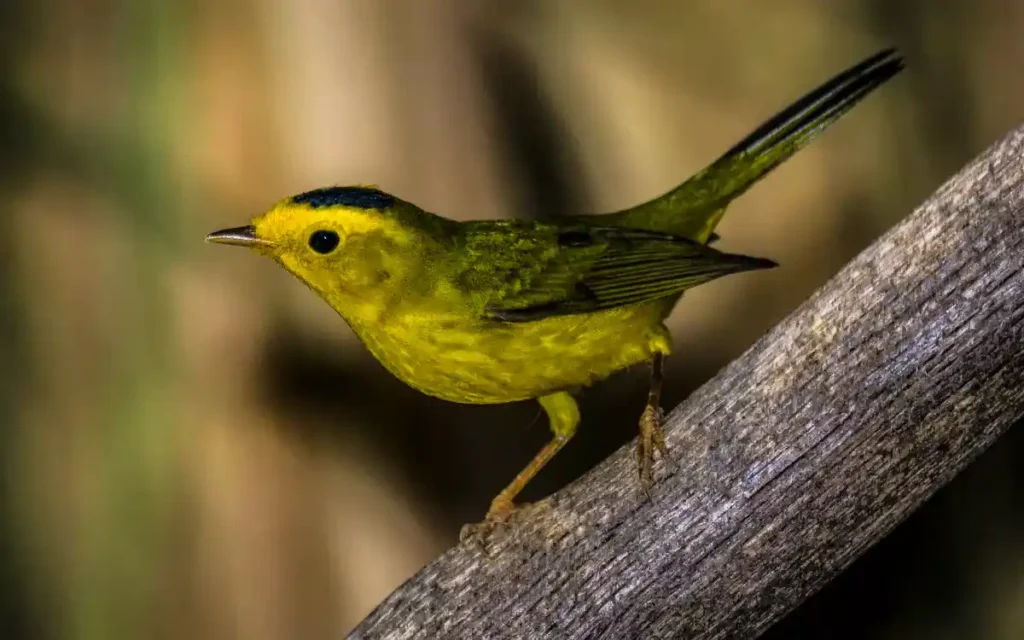
Quick ID: Tiny yellow warbler with a small black cap on males.
What It Looks Like:
Wilson’s Warbler is a small, active yellow bird with a bright yellow face and underparts. Males have a neat black cap on top of the head, while females may show a weaker cap or no obvious cap at all. The back is usually olive-yellow, giving the bird a softer two-tone look.
Where You’ll Find It:
Look for it in wet thickets, shrubby woods, streamside growth, mountain meadows, and migration stopovers.
Behavior Clues:
This bird moves fast through low branches and leafy cover. It often flicks around near eye level or below.
How to Tell It Apart:
The black cap on males is the best clue. It is smaller and thinner-billed than a goldfinch.
Best Time to See: Most people see it during spring or fall migration.
Backyard Tip: Native shrubs and water features can help attract migrating warblers.
Read also:
- 15 Common Yellow Birds Colorado With (ID & Images)
- 18 Famous Yellow Birds In Arizona
- Yellow Bird Symbolism: Spiritual Meaning
- 21 Yellow Birds In Alabama (ID, & Seasonal Guide)
- Red, Orange, And Yellow Birds In New Hampshire
5. Pine Warbler
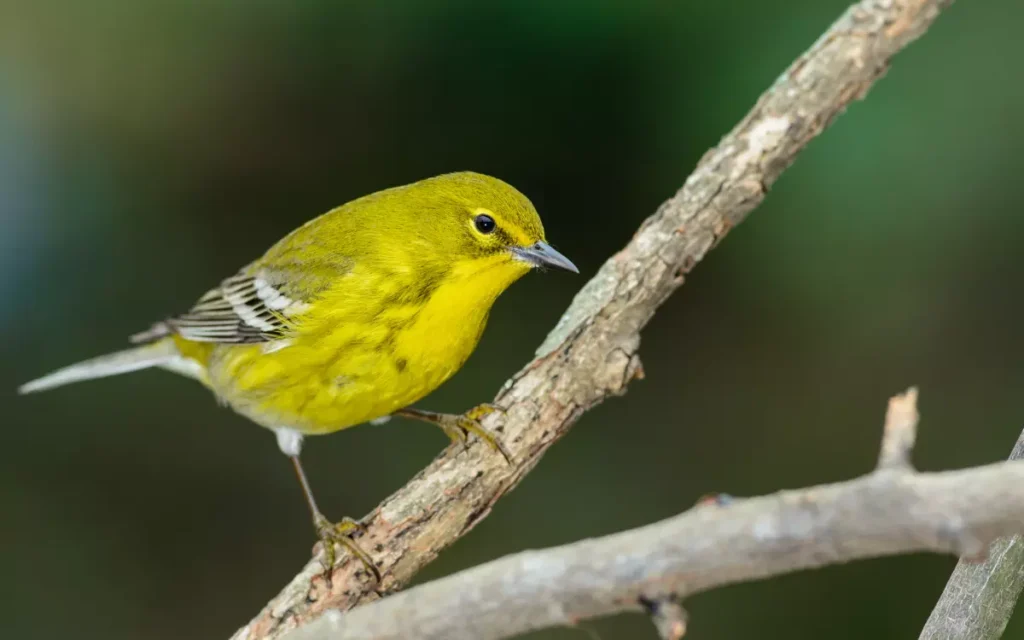
Quick ID: Yellowish warbler often seen in or near pine trees.
What It Looks Like:
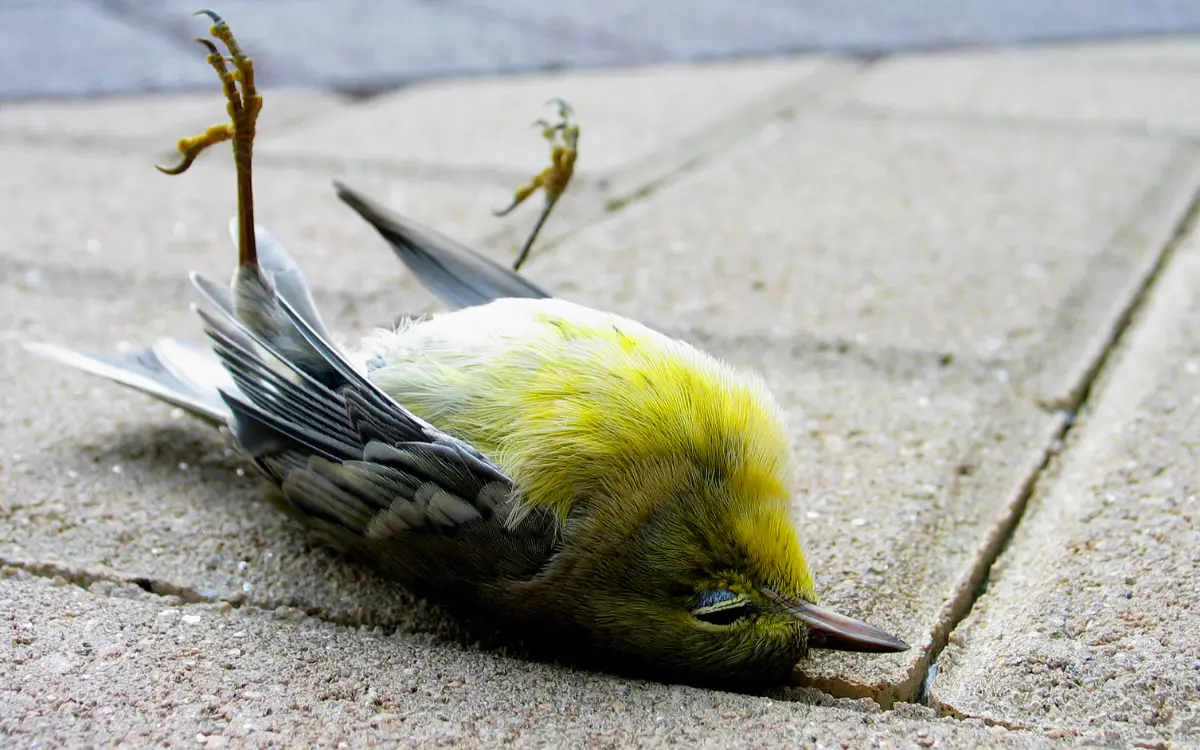
Male Pine Warblers are yellow on the throat and breast, with olive backs and soft streaking on the sides. Females and young birds are duller and may look grayish-yellow or olive. Compared with many warblers, Pine Warblers look a bit sturdier and less flashy.
Where You’ll Find It:
As the name suggests, Pine Warblers are strongly tied to pine forests, pine groves, mixed woods, and wooded neighborhoods with mature pines.
Behavior Clues:
They move more slowly than many warblers and often forage high in pine branches.
How to Tell It Apart:
Habitat is very important. If the bird stays in pine trees and has a thin bill, Pine Warbler is a strong match.
Best Time to See:
Year-round in parts of the Southeast; seasonal farther north.
Backyard Tip: They may visit suet, sunflower seeds, and mealworms, especially in cooler months.
6. Prothonotary Warbler
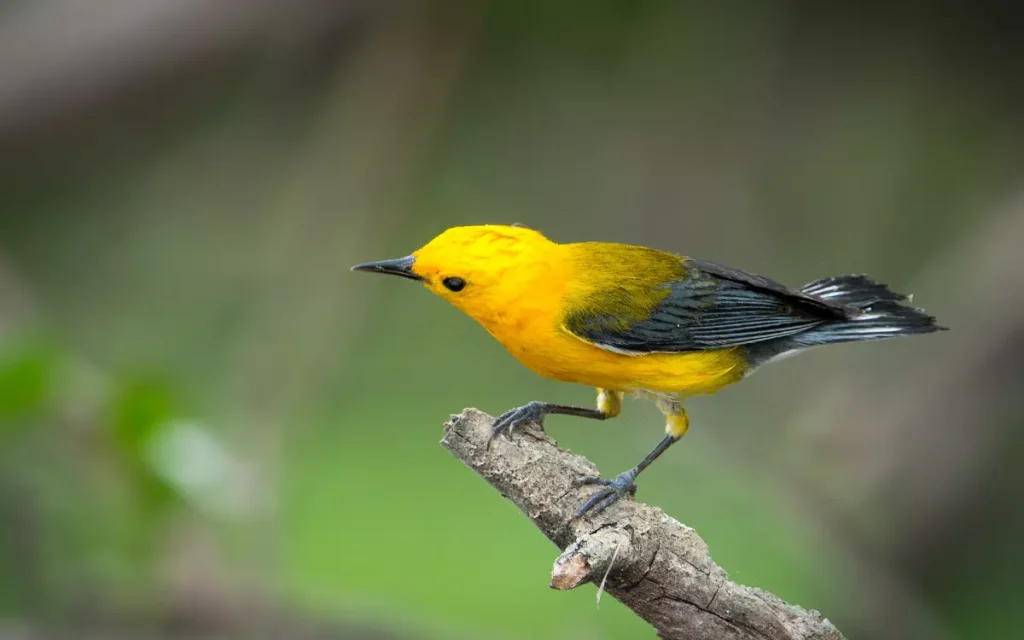
Quick ID: Golden-yellow warbler with blue-gray wings, often near swampy water.
What It Looks Like:
The Prothonotary Warbler has one of the richest yellow colors of any North American warbler. Its head and underparts are bright golden-yellow, while the wings and back are blue-gray. The dark eye stands out against the yellow face, giving it a clean, bold look.
Where You’ll Find It:
Look for this bird in wooded swamps, flooded forests, river bottoms, cypress areas, and wet woodland edges.
Behavior Clues:
It often stays close to water and may forage on low branches, tree trunks, or roots.
How to Tell It Apart:
The golden head, blue-gray wings, and swamp habitat make it easier to separate from other yellow warblers.
Best Time to See:
Spring and summer in breeding areas.
Backyard Tip: If you live near wet woods, nest boxes near water may help cavity-nesting birds.
7. Hooded Warbler
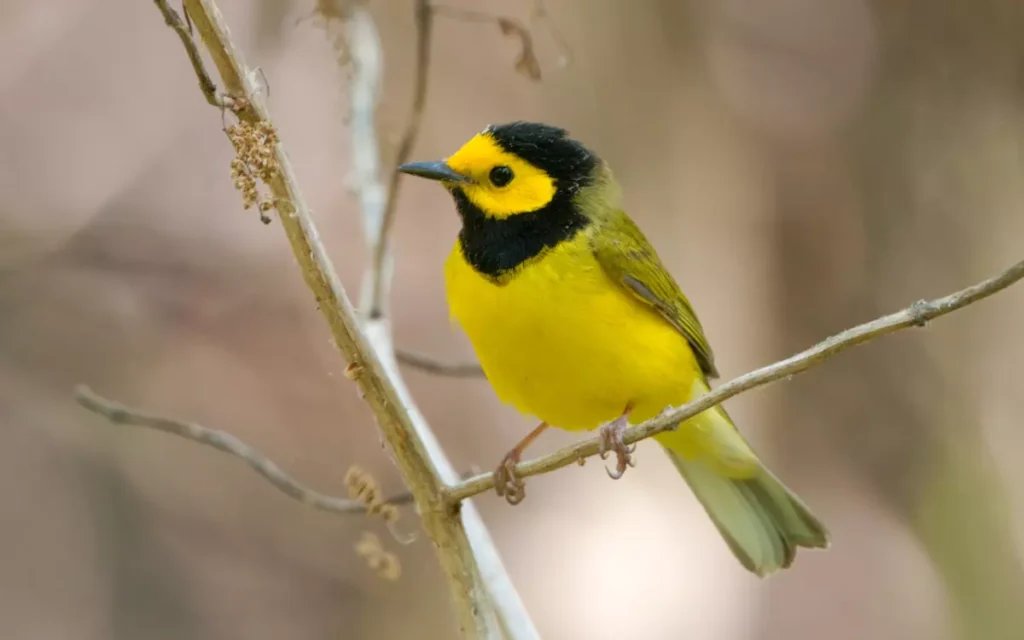
Quick ID: Yellow-faced warbler; males have a black hood around the head.
What It Looks Like:
Male Hooded Warblers have a bright yellow face surrounded by a black hood and throat, making them one of the easier yellow warblers to identify. The body is yellow below with olive-green upperparts. Females are similar but usually have a weaker hood or only partial dark markings.
Where You’ll Find It:
They prefer mature forests with thick understory, especially in the eastern United States.
Behavior Clues:
Hooded Warblers often stay low in shady vegetation, hopping through shrubs and saplings while searching for insects.
How to Tell It Apart:
A male is hard to confuse because of the black hood and yellow face. Females require closer attention to face pattern and habitat.
Best Time to See:
Spring and summer in breeding range; migration in other areas.
Backyard Tip: They need layered native plantings and insect-rich cover.
8. Canada Warbler
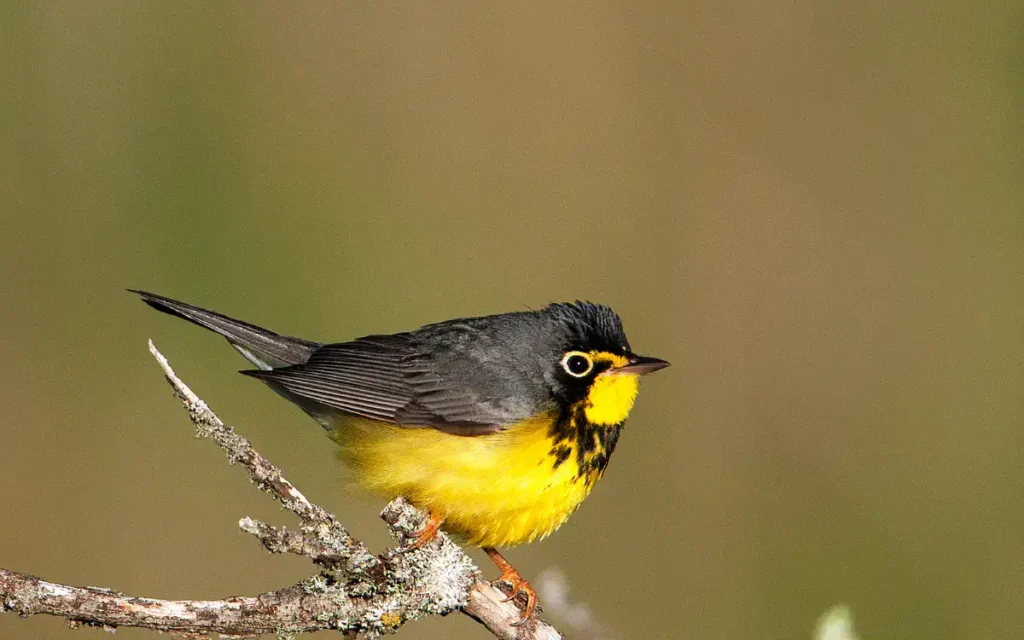
Quick ID: Yellow chest with a dark necklace-like band of streaks.
What It Looks Like:
Canada Warblers have bright yellow underparts, gray upperparts, and a marked face with a pale eye ring. The most useful clue is the dark streaking across the chest, often described as a necklace. Males show the necklace more strongly than females, but both can show this pattern.
Where You’ll Find It:
Look for Canada Warblers in moist forests, shrubby ravines, streamside woods, and dense migration stopovers.
Behavior Clues:
They move actively through low and middle vegetation, often flicking from branch to branch while feeding.
How to Tell It Apart:
The yellow chest with the dark necklace helps separate it from plain Yellow Warblers and Nashville Warblers.
Best Time to See:
Spring and fall migration, plus breeding season in northern forests.
Backyard Tip: Native shrubs and leaf litter support the insects migrating warblers need.
9. Magnolia Warbler
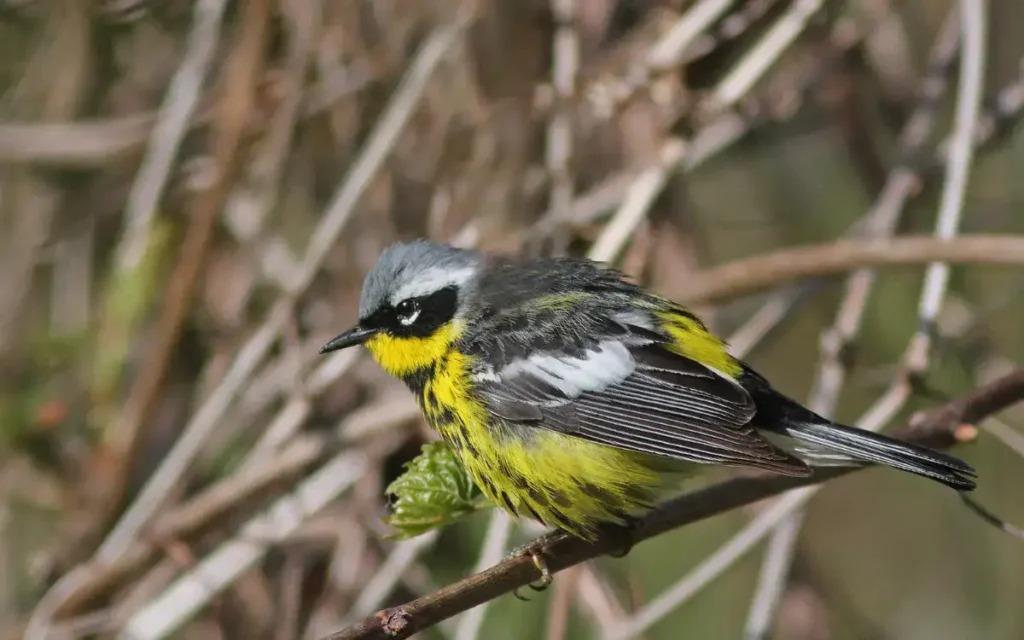
Quick ID: Yellow underparts with black streaking and bold white wing markings.
What It Looks Like:
The Magnolia Warbler is a small yellow bird with a patterned look. Breeding males show yellow underparts, black streaks, a dark face pattern, white wing patches, and a gray to black back. Females and nonbreeding birds are duller but usually still show yellow below and wing markings.
Where You’ll Find It:
During breeding season, it favors coniferous and mixed forests. During migration, it can appear in parks, woodland edges, and backyard trees.
Behavior Clues:
Magnolia Warblers often forage in shrubs and lower branches, making them easier to see than some canopy warblers.
How to Tell It Apart:
Look for the yellow belly, black streaking, and bold wing pattern.
Best Time to See:
Migration is often the best time for many birdwatchers.
Backyard Tip:Keep native trees and shrubs to support insect life during migration.
10. Prairie Warbler
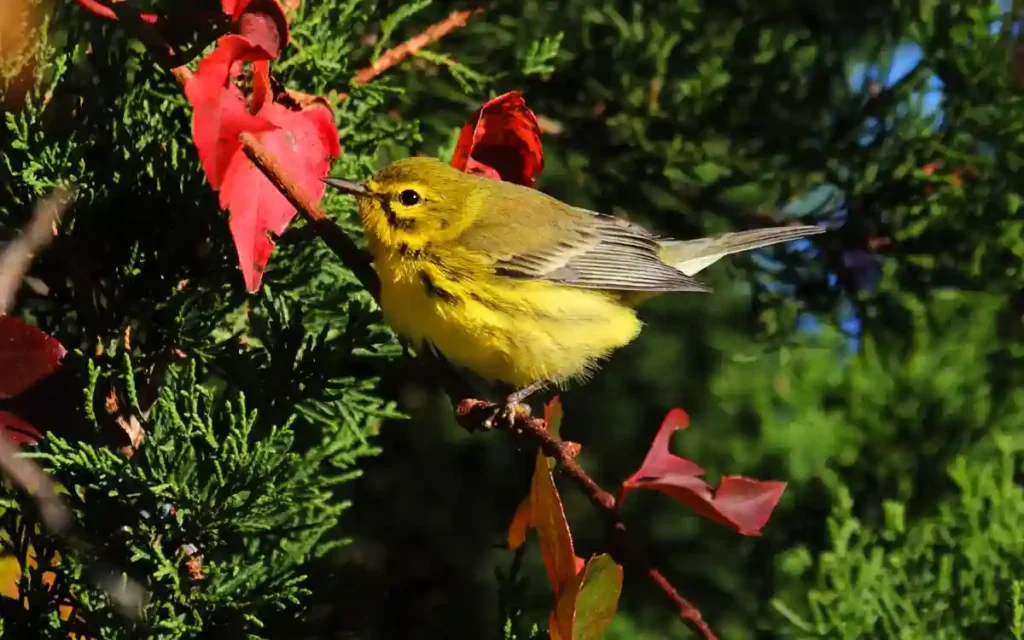
Quick ID: Yellow warbler with black side streaks and a habit of tail flicking.
What It Looks Like:
Prairie Warblers are yellow below with olive upperparts, dark streaks along the sides, and a patterned face. Males have stronger black marks near the eye and on the sides. Females are usually softer but still show the same general shape and yellow tone.
Where You’ll Find It:
Despite the name, Prairie Warblers often live in shrubby fields, young pine areas, open scrub, and early-growth woodland.
Behavior Clues:
One of the best clues is tail movement. Prairie Warblers often flick or wag their tails while moving through low vegetation.
How to Tell It Apart:
The black side streaks, face marks, and tail-flicking behavior help separate it from Yellow Warbler.
Best Time to See:
Spring and summer in breeding range.
Backyard Tip:Brushy native edges and low shrubs can help support this type of habitat bird.
11. Yellow-throated Warbler
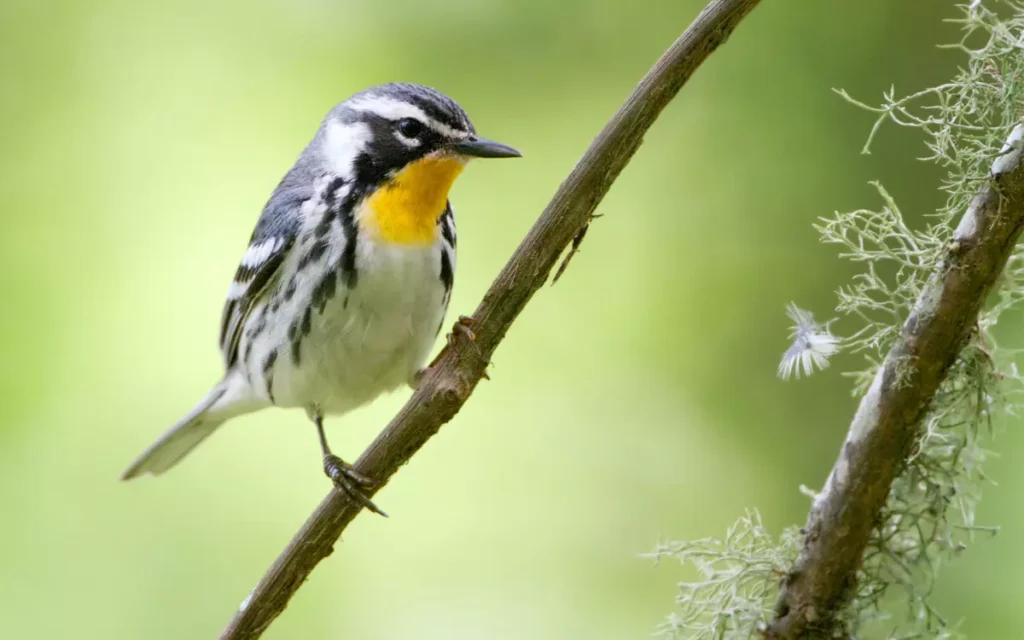
Quick ID: Yellow throat with black-and-white body pattern and gray upperparts.
What It Looks Like:
The Yellow-throated Warbler is not fully yellow, but its bright yellow throat makes it stand out. It has gray upperparts, black-and-white facial markings, a white belly, and dark streaking along the sides. The sharp face pattern gives it a cleaner look than many small yellow birds.
Where You’ll Find It:
Look for it in tall trees, especially sycamores, cypress, pines, and river woods.
Behavior Clues:
It often creeps along branches and trunks while searching for insects, sometimes acting a little like a nuthatch.
How to Tell It Apart:
The yellow is mostly on the throat, not the whole body. The black-and-white pattern is also a strong clue.
Best Time to See:
Spring and summer in breeding areas.
Backyard Tip:
Large native trees can attract insect-feeding birds during migration.
12. Nashville Warbler
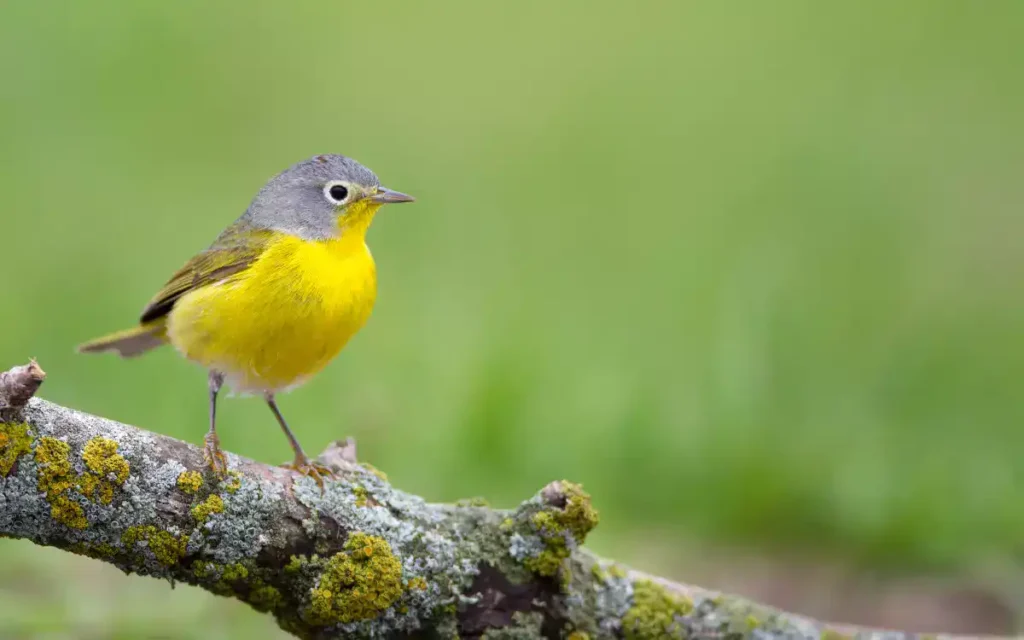
Quick ID: Yellow belly, gray head, olive back, and clean white eye ring.
What It Looks Like:
The Nashville Warbler has yellow underparts, an olive-green back, and a grayish head. A neat white eye ring is one of the easiest field marks. Males and females look similar, though males may appear brighter. It usually looks softer and less plain than a Yellow Warbler because of the gray head.
Where You’ll Find It:
Look in shrubby edges, open woods, young forests, and migration stopovers with plenty of leafy cover.
Behavior Clues:
Nashville Warblers are active birds that move through lower and middle branches while picking insects from leaves.
How to Tell It Apart:
The gray head and white eye ring help separate it from the more evenly yellow Yellow Warbler.
Best Time to See:
Spring and fall migration are common viewing times.
Backyard Tip:Native shrubs and small trees can make your yard useful for migrating warblers.
13. Orange-crowned Warbler
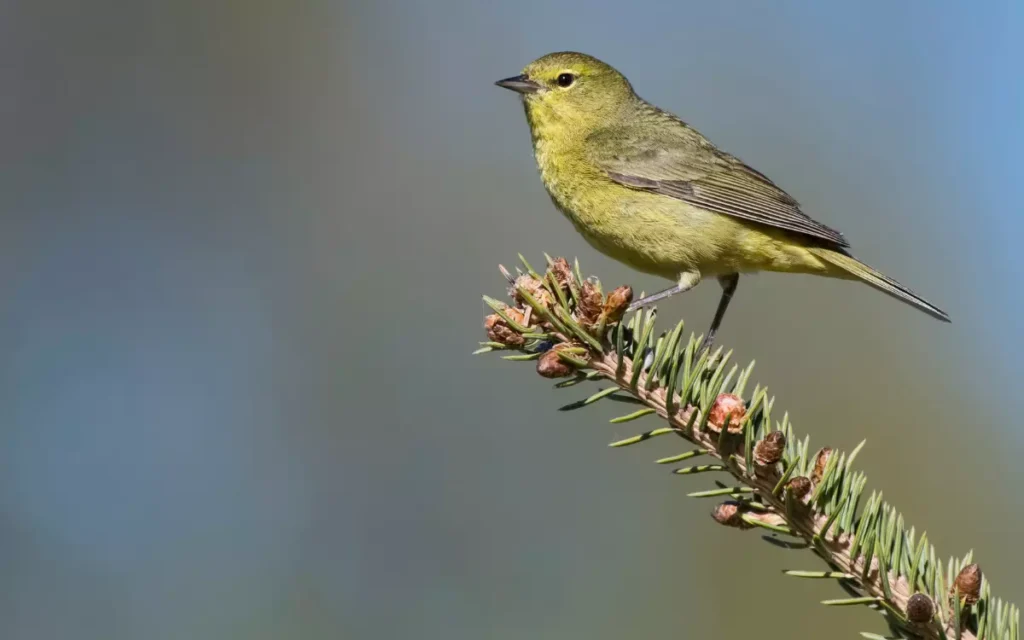
Quick ID: Plain olive-yellow warbler with faint markings and a hidden orange crown.
What It Looks Like:
The Orange-crowned Warbler is usually not bright yellow. It often looks olive, grayish-yellow, or greenish-yellow, depending on light and region. The orange crown is usually hidden, so don’t expect to see it clearly. Its plain face and soft yellow underside are better clues.
Where You’ll Find It:
It appears in brushy areas, woodland edges, shrubs, gardens, and wintering habitats in warmer regions.
Behavior Clues:
This bird moves quietly through low cover, picking insects from leaves and branches.
How to Tell It Apart:
It looks plainer than many warblers. No bold wing bars, no strong streaks, and no bright black markings.
Best Time to See:
Migration and winter in many areas.
Backyard Tip: Leave some natural shrub cover and avoid removing every leaf pile.
14. Western Tanager
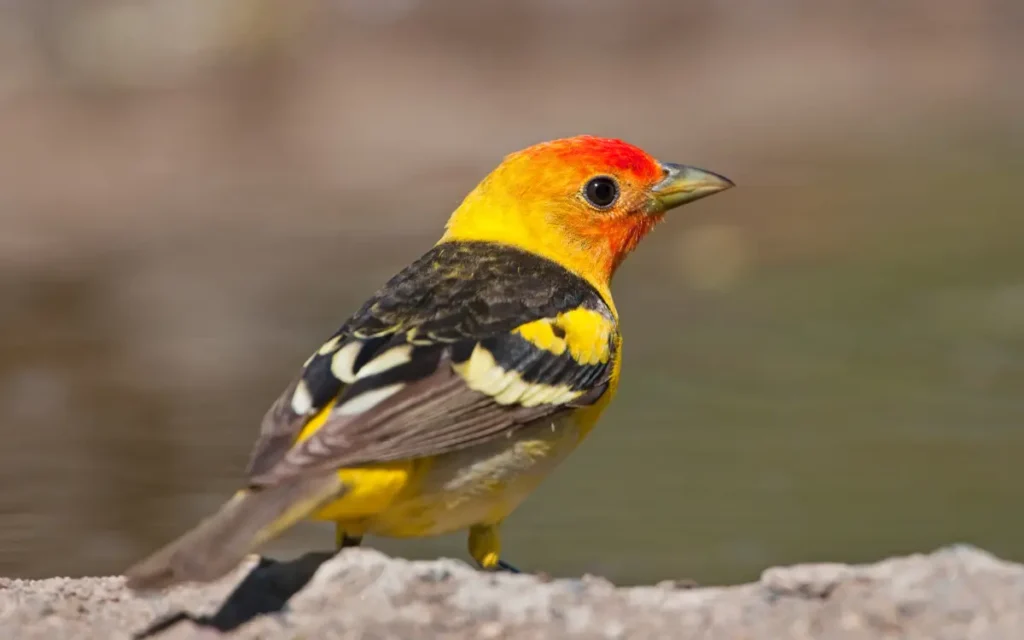
Quick ID: Yellow body with black wings and a red-orange head on males.
What It Looks Like:
Male Western Tanagers are bright yellow with black wings and a red-orange head during breeding season. Females are softer yellow-green with darker wings and may not show red on the head. Their body is larger and more solid than most warblers, with a thicker bill.
Where You’ll Find It:
They are found in western forests, mountain woods, parks, and wooded neighborhoods during migration.
Behavior Clues:
Western Tanagers often stay high in trees, feeding on insects and fruit. During migration, they may come lower.
How to Tell It Apart:
The male’s red-orange head and yellow body make it easy. Females are larger and thicker-billed than warblers.
Best Time to See:
Spring and summer in western breeding areas.
Backyard Tip: Fruit trees, native berries, and clean water may attract migrating tanagers.
15. Summer Tanager Female
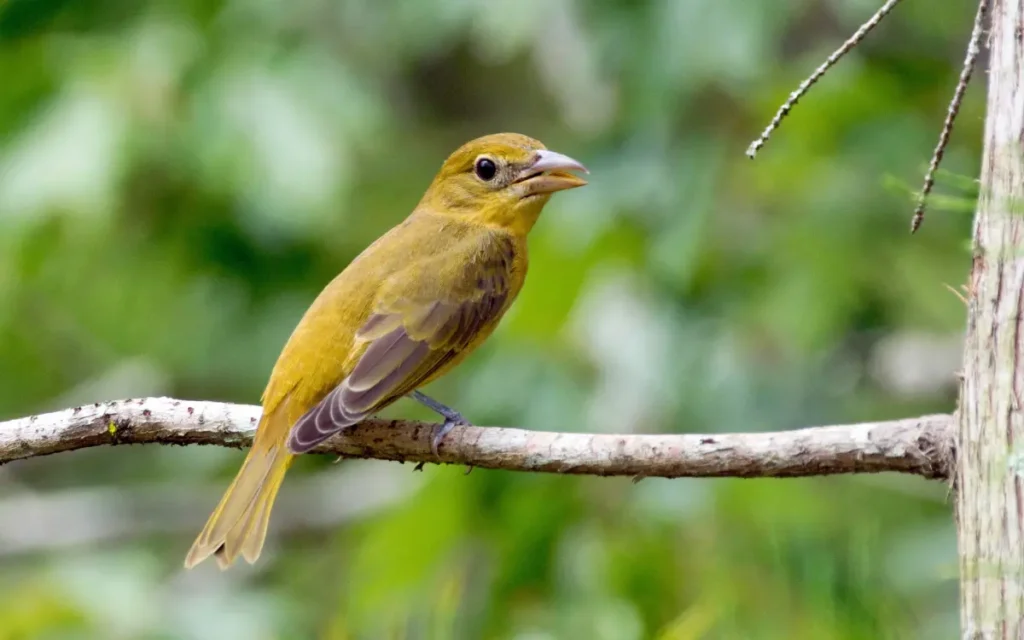
Quick ID: Yellow to yellow-green female with a thicker bill and tanager shape.
What It Looks Like:
Female Summer Tanagers are usually mustard-yellow, yellow-green, or olive-yellow. Males are red, so many people do not realize the female can look like a yellow bird. She has a thicker bill than a warbler and a longer, smoother body shape.
Where You’ll Find It:
Look for Summer Tanagers in open woods, forest edges, river groves, parks, and southern wooded areas.
Behavior Clues:
They often feed on bees and wasps, catching them from branches and removing the stingers before eating.
How to Tell It Apart:
A female Summer Tanager is larger than a warbler and has a heavier bill. It also moves more slowly.
Best Time to See:Spring and summer in breeding range.
Backyard Tip:Native trees and berry-producing plants can bring tanagers closer during migration.
16. Scarlet Tanager Female
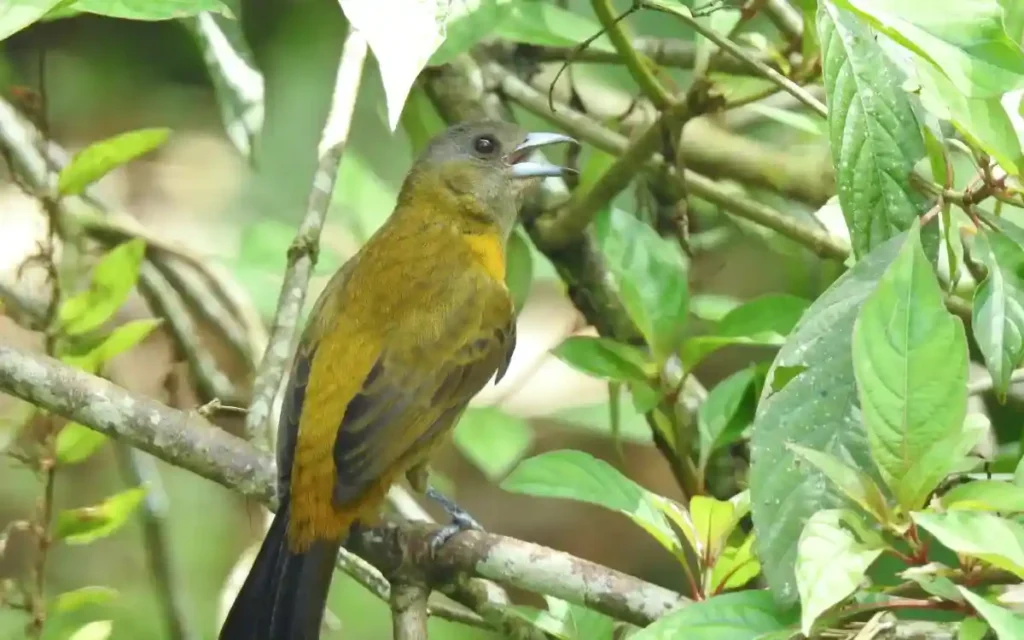
Quick ID: Olive-yellow female with darker wings and a forest-loving habit.
What It Looks Like:
Female Scarlet Tanagers are yellow-green or olive-yellow below with darker olive upperparts and dusky wings. Males are bright red with black wings, but females are much more muted. Their shape is larger and heavier than most warblers, with a thicker bill.
Where You’ll Find It:
They prefer mature deciduous forests, especially in the eastern United States. During migration, they may appear in parks and wooded yards.
Behavior Clues:
Scarlet Tanagers often stay high in the canopy, which can make them harder to see.
How to Tell It Apart:
Size, thicker bill, and forest canopy behavior help separate females from yellow warblers.
Best Time to See:
Spring and summer in breeding areas, plus migration.
Backyard Tip:Large native trees and berry shrubs can help attract them during migration.
17. Baltimore Oriole Female
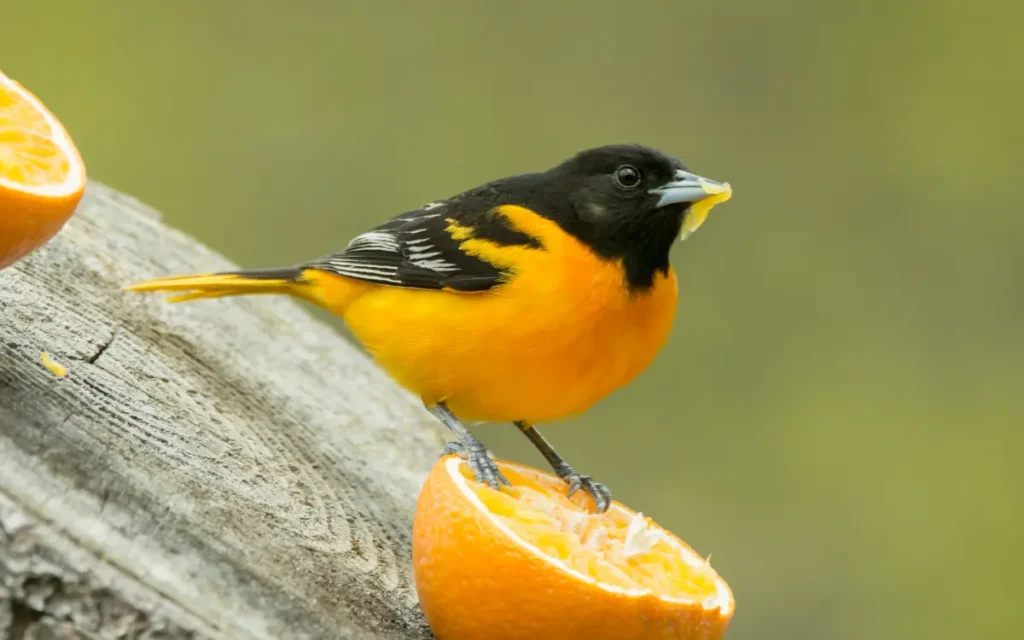
Quick ID: Yellow-orange body with white wing bars and a pointed bill.
What It Looks Like:
Female Baltimore Orioles are often yellow-orange underneath with grayish-brown or olive upperparts. They usually show clear white wing bars and a long, pointed bill. Some older females can become brighter orange, which makes them look closer to males but still softer overall.
Where You’ll Find It:Look for them in open woods, parks, orchards, river edges, and tall shade trees.
Behavior Clues:They move through treetops and may visit orange halves, grape jelly, nectar feeders, and flowering trees.
How to Tell It Apart:The pointed bill, wing bars, and longer body separate female orioles from tanagers and warblers.
Best Time to See:Spring migration and breeding season are best.
Backyard Tip:Offer orange halves early in spring and plant native fruiting trees.
18. Orchard Oriole Female
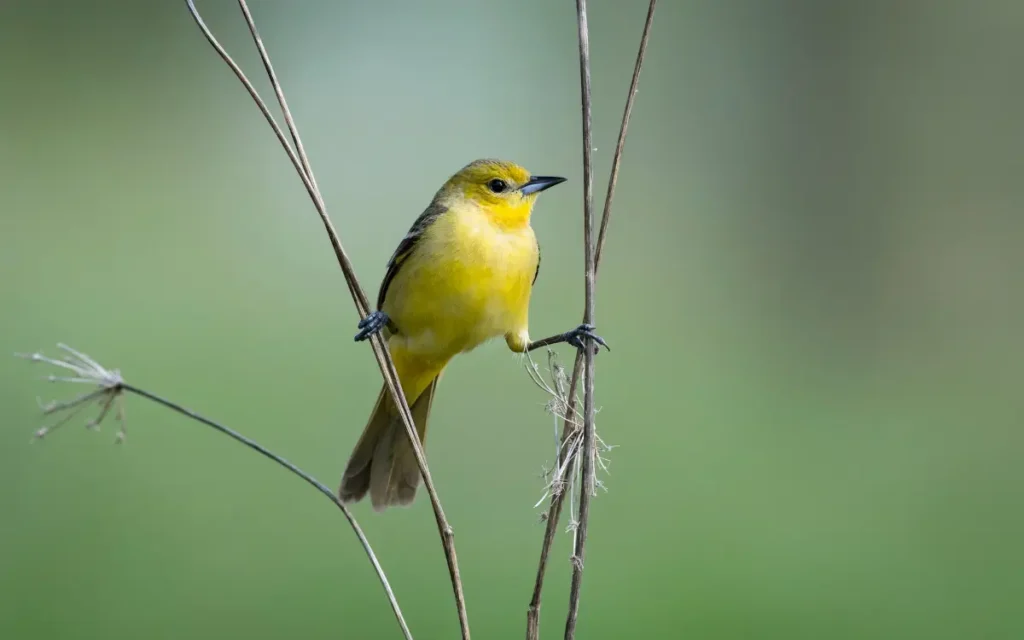
Quick ID: Small yellow-green oriole with a slim pointed bill.
What It Looks Like:
Female Orchard Orioles are yellow-green below with olive upperparts and darker wings. They are smaller and more delicate than female Baltimore Orioles, with a slim body and pointed bill. Young males can also look yellow-green before they develop darker adult colors.
Where You’ll Find It:
Look in orchards, open woods, parks, river edges, scattered trees, and brushy areas near fields.
Behavior Clues:
They often move through leafy treetops and flowering trees, searching for insects and nectar.
How to Tell It Apart:
Compared with female Baltimore Orioles, Orchard Orioles are smaller, greener, and less orange.
Best Time to See:
Spring and summer in breeding range.
Backyard Tip:Try orange halves, nectar, and native flowering plants, especially during migration.
19. Evening Grosbeak
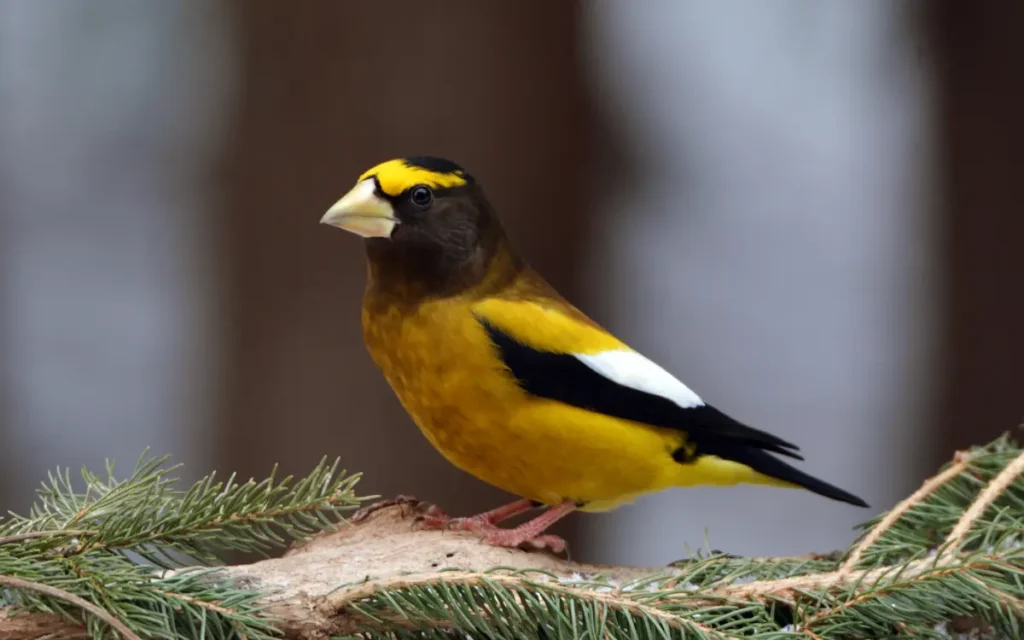
Quick ID: Large yellow bird with black wings and a huge pale bill.
What It Looks Like:
Male Evening Grosbeaks are chunky yellow birds with dark heads, black wings, white wing patches, and a large pale bill. Females are mostly gray with yellow on the neck, sides, or wings. Their thick body and oversized bill make them look very different from small yellow warblers.
Where You’ll Find It:
They are most often found in northern forests, mountain areas, and sometimes winter feeders farther south.
Behavior Clues:Evening Grosbeaks often travel in noisy flocks. When they visit feeders, they can be hard to miss.
How to Tell It Apart:The large size and thick bill are the main clues. No warbler or goldfinch has that heavy bill.
Best Time to See:Winter is often best outside their core northern range.
Backyard Tip:Offer black oil sunflower seeds on a sturdy platform feeder.
20. Lesser Goldfinch
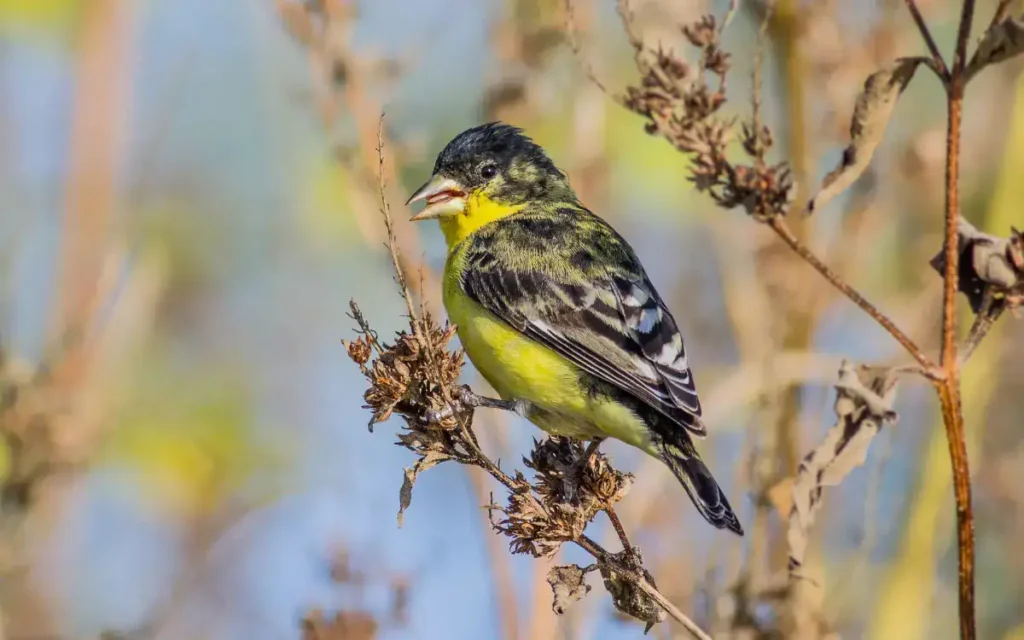
Quick ID: Small yellow finch with dark wings; males may have a black cap and dark back.
What It Looks Like:Male Lesser Goldfinches are bright yellow below with dark wings and either a black or greenish back, depending on region. Many males also have a black cap. Females are duller olive-yellow and may look plain at first. They are smaller than American Goldfinches.
Where You’ll Find It:They are common in the western and southwestern United States, often around open woods, gardens, weedy fields, and streamside trees.
Behavior Clues:Lesser Goldfinches move in small flocks and visit seed plants and feeders.
How to Tell It Apart:They are smaller and often darker-backed than American Goldfinches. Range is also a big clue.
Best Time to See:Year-round in many western areas.
Backyard Tip:Offer nyjer seed, sunflower chips, and native seed-producing flowers.
21. Lawrence’s Goldfinch
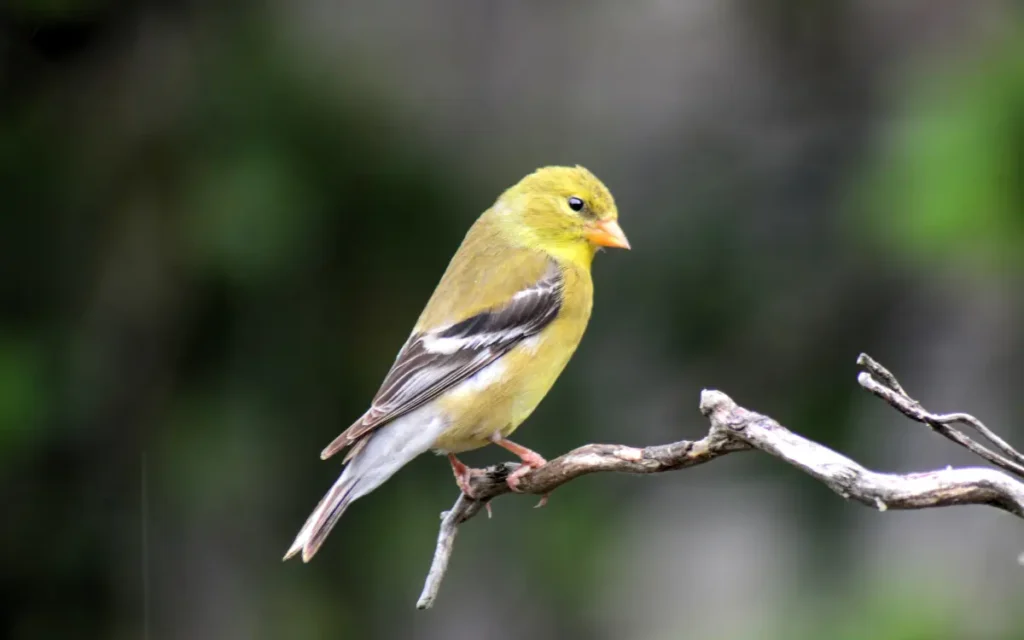
Quick ID: Gray-and-yellow finch with black face and yellow wing patches on males.
What It Looks Like:
Lawrence’s Goldfinch is less common than American or Lesser Goldfinch, but it is a beautiful yellow-accented bird. Males have a gray body, black face, yellow chest, and yellow patches in the wings. Females are duller but still show soft yellow wing markings.
Where You’ll Find It:
This bird is mostly found in California and parts of the Southwest, especially in dry open country, oak woodlands, weedy fields, and chaparral edges.
Behavior Clues:
They often move in flocks and may appear irregularly depending on food supply.
How to Tell It Apart:
The mix of gray body, black face, and yellow wing patches is very different from American Goldfinch.
Best Time to See:
Winter and breeding season can vary by area.
Backyard Tip:
Native seed plants and water sources can help attract finches in dry regions.
22. Yellow-rumped Warbler
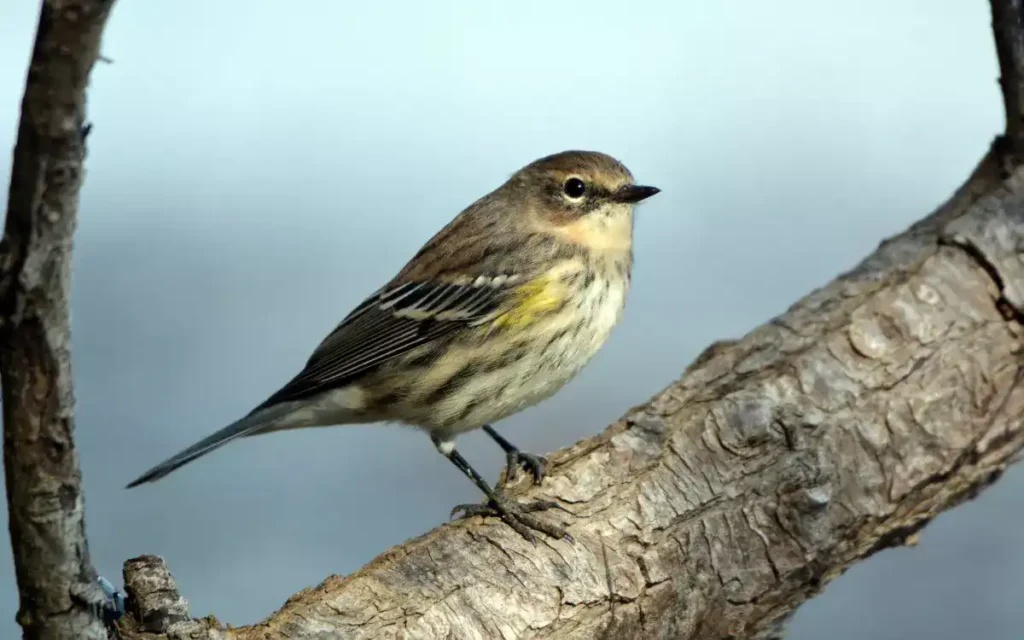
Quick ID: Grayish warbler with yellow patches on rump, sides, and sometimes throat.
What It Looks Like:
The Yellow-rumped Warbler is not fully yellow, but its yellow patches are easy to notice. It usually has a yellow rump, yellow side patches, and depending on type, a yellow or white throat. In winter, it can look brownish-gray with softer markings.
Where You’ll Find It:
Look for it in woods, parks, coastal shrubs, open forests, and backyard trees during migration and winter.
Behavior Clues:
They often flick through branches and may fly out to catch insects. In winter, they also eat berries.
How to Tell It Apart:
The yellow rump is the key clue. When it flies, the yellow patch can flash clearly.
Best Time to See:
Fall, winter, and spring migration in many areas.
Backyard Tip:
Plant native berry shrubs like bayberry, wax myrtle, or dogwood.
23. Cape May Warbler
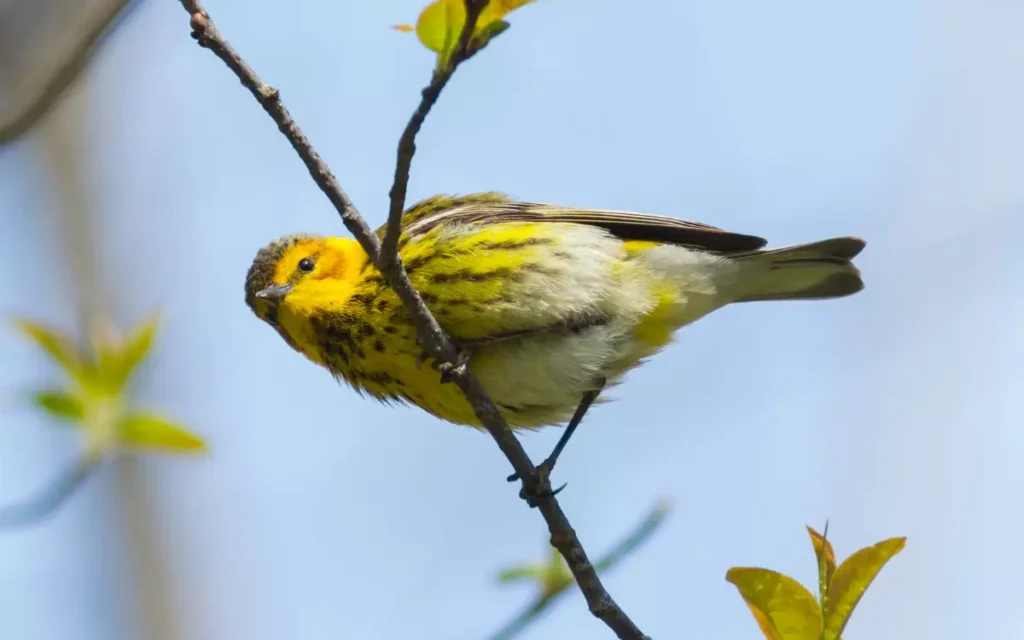
Quick ID: Yellow warbler with streaked underparts and a sharp, slightly curved bill.
What It Looks Like:
Male Cape May Warblers in breeding plumage show yellow underparts with heavy streaking, a chestnut cheek patch, and a patterned face. Females and fall birds are duller but still often show yellow tones and fine streaking. The bill is thin and slightly curved.
Where You’ll Find It:
They breed in northern spruce forests and pass through woods, parks, and gardens during migration.
Behavior Clues:
Cape May Warblers often feed on insects, nectar, and sometimes fruit. They may visit flowering trees during migration.
How to Tell It Apart:
Look for the streaked yellow body and slightly curved bill. It is more marked than a Yellow Warbler.
Best Time to See:
Migration is the best chance for most birders.
Backyard Tip:
Flowering native trees can attract migrating warblers looking for insects and nectar.
24. Blue-winged Warbler
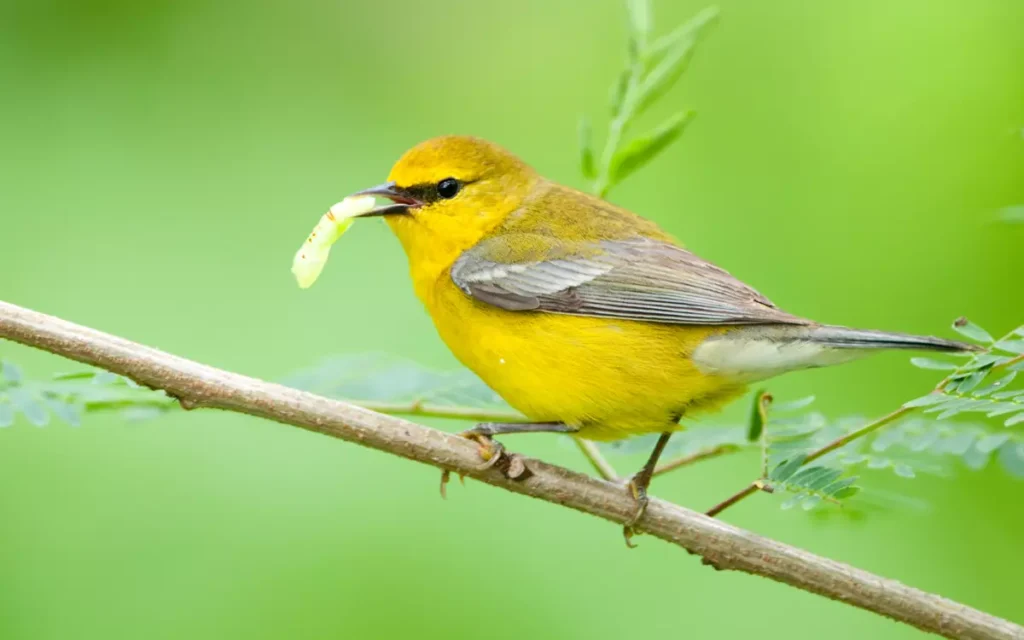
Quick ID: Yellow body, blue-gray wings, and a dark line through the eye.
What It Looks Like:
The Blue-winged Warbler is a small yellow bird with bright yellow underparts and head, blue-gray wings, and a thin dark eye line. The wings often show pale wing bars. Females are usually duller but still have the same basic pattern.
Where You’ll Find It:
Look in brushy fields, young forests, shrubby hillsides, and open woodland edges.
Behavior Clues:
It moves through low vegetation and often stays in tangled growth rather than high canopy.
How to Tell It Apart:
The dark eye line and blue-gray wings help separate it from Yellow Warbler and goldfinches.
Best Time to See:
Spring and summer in breeding range.
Backyard Tip:
This species likes early-growth habitat, so natural brushy edges are helpful.
25. Golden-winged Warbler
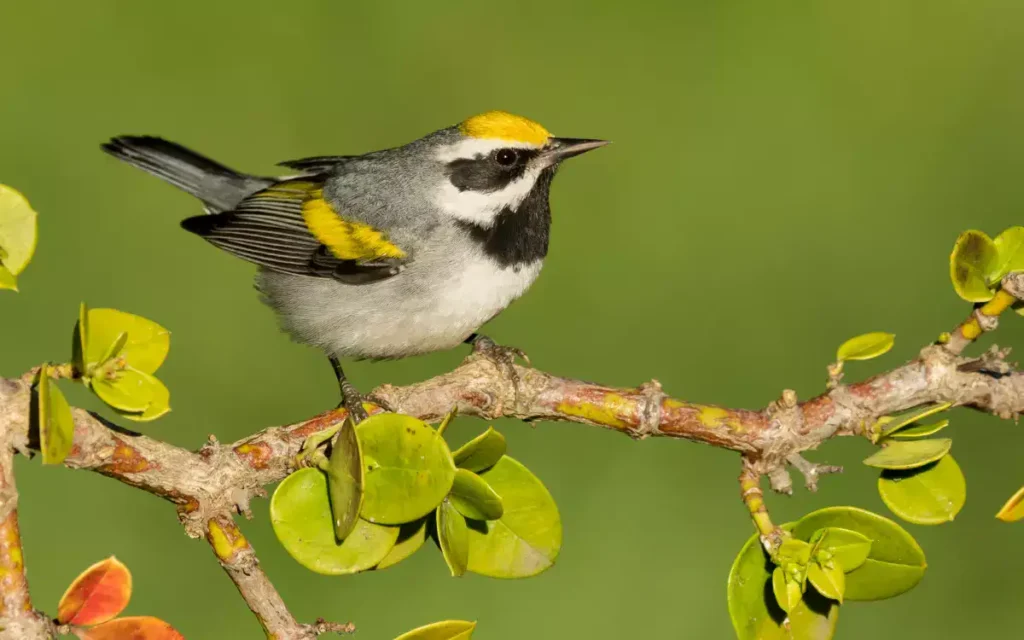
Quick ID: Gray warbler with yellow wing patch, yellow crown, and bold black face marks.
What It Looks Like:
Golden-winged Warblers are not fully yellow, but their yellow wing patch and yellow crown stand out. Males have gray bodies, black throat and face markings, and white underparts. Females are softer with less contrast but still show the yellow wing patch.
Where You’ll Find It:
They use shrubby young forests, regenerating clearings, and brushy edges near woods.
Behavior Clues:
They often forage low to mid-level, moving through leaves and branches for insects.
How to Tell It Apart:
The yellow wing patch, yellow crown, and black face pattern make males fairly distinct.
Best Time to See:
Spring and summer in limited breeding areas, plus migration.
Backyard Tip:
They are habitat-sensitive, so they are more likely in natural brushy woodland edges than typical yards.
26. Kentucky Warbler
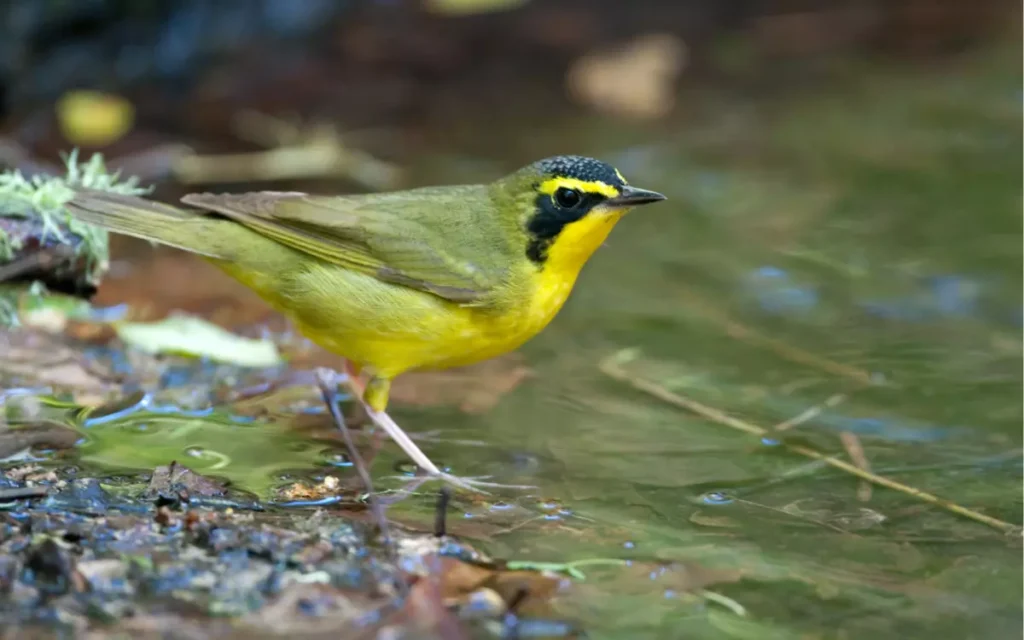
Quick ID: Yellow underside with olive back and bold black face pattern.
What It Looks Like:
The Kentucky Warbler has a bright yellow throat and underparts, olive upperparts, and strong black markings on the face. It also has a yellow eyebrow-like line that helps frame the dark face. Females may look slightly duller but still show the same general pattern.
Where You’ll Find It:
Look for it in moist deciduous forests with thick understory, especially in the eastern and southeastern United States.
Behavior Clues:
Kentucky Warblers spend much of their time low near the ground, walking or hopping through leaf litter and dense growth.
How to Tell It Apart:
The black face pattern and ground-level forest behavior are strong clues.
Best Time to See:
Spring and summer in breeding range.
Backyard Tip:
Leaf litter, native shrubs, and low plant layers support the insects these birds eat.
27. Yellow-breasted Chat
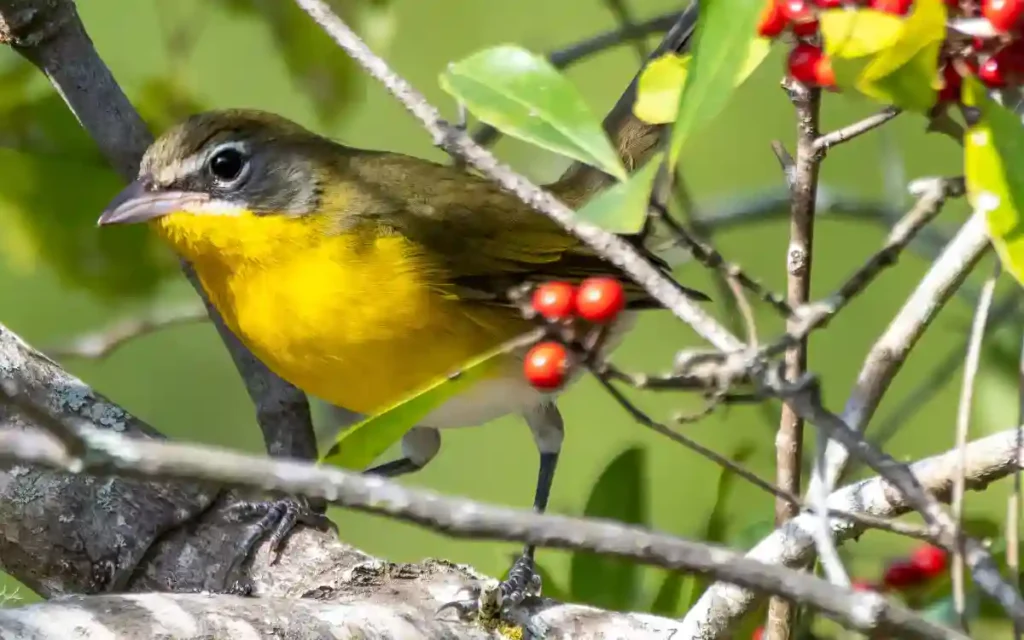
Quick ID: Large yellow-breasted bird with white spectacles and a thick bill.
What It Looks Like:
The Yellow-breasted Chat is bigger and bulkier than most warblers. It has a bright yellow throat and breast, olive upperparts, a white belly, and bold white markings around the eye. Its bill is thicker than a typical warbler’s bill.
Where You’ll Find It:
Look in dense thickets, brushy fields, overgrown edges, and shrubby areas near streams or open land.
Behavior Clues:
Chats are often heard before they are seen. They can make odd whistles, chuckles, and harsh calls from hidden cover.
How to Tell It Apart:
Its large size, thick bill, white spectacles, and secretive thicket behavior help identify it.
Best Time to See:
Spring and summer in breeding areas.
Backyard Tip:
Dense native shrubs and berry thickets can attract chats where habitat is suitable.
28. Great Crested Flycatcher
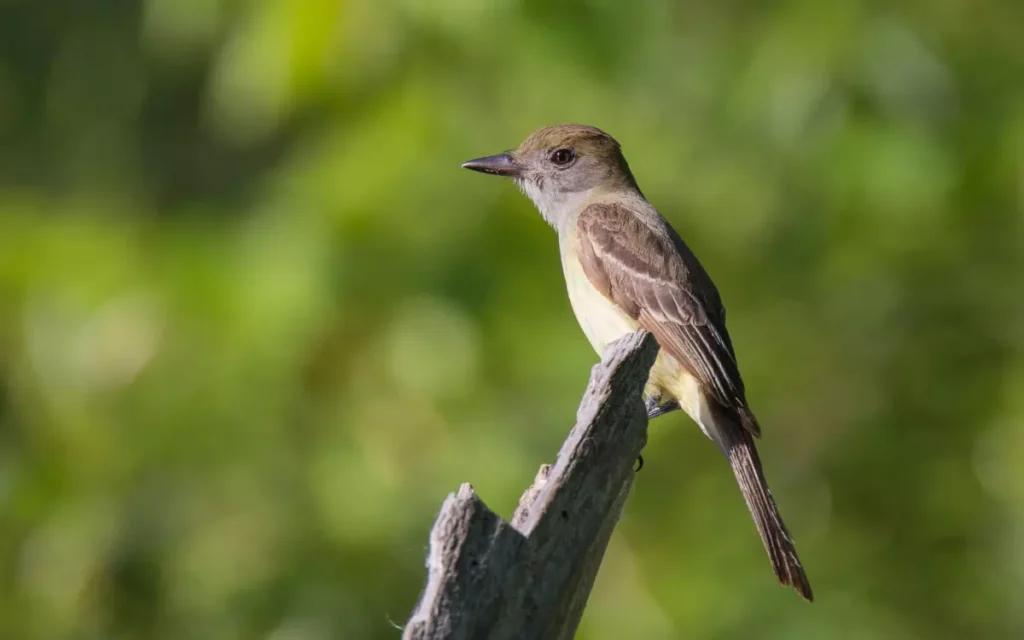
Quick ID: Brownish flycatcher with bright yellow belly and rusty tail.
What It Looks Like:
The Great Crested Flycatcher is not fully yellow, but its yellow belly is often easy to see. It has a brownish-olive back, gray throat, yellow underparts, and rusty tones in the wings and tail. The head can look slightly peaked or crested.
Where You’ll Find It:
Look in open woods, forest edges, parks, orchards, and large wooded yards.
Behavior Clues:
It often sits upright on branches, then flies out to catch insects before returning to a perch.
How to Tell It Apart:
The yellow belly, rusty tail, large flycatcher shape, and loud calls help separate it from warblers.
Best Time to See:
Spring and summer in much of the eastern United States.
Backyard Tip:
Mature trees and nest boxes may attract cavity-nesting flycatchers.
29. Western Kingbird
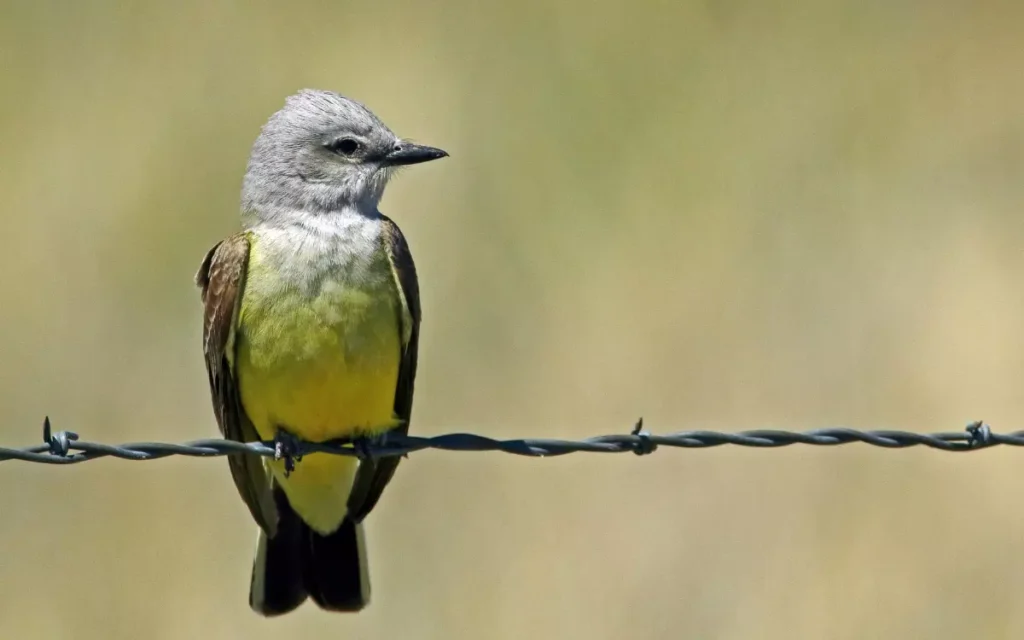
Quick ID: Gray-headed flycatcher with yellow belly and white-edged black tail.
What It Looks Like:
The Western Kingbird has a gray head and chest, bright yellow belly, and dark tail with white outer edges. It is larger than most yellow warblers and has a strong flycatcher shape with a fairly large head and upright posture.
Where You’ll Find It:
Look for Western Kingbirds in open country, farms, roadsides, towns, fences, utility wires, and scattered trees across the West.
Behavior Clues:
They often perch in the open and fly out to catch insects in midair.
How to Tell It Apart:
The gray upper body, yellow belly, open-country habitat, and flycatching behavior are the best clues.
Best Time to See:
Spring and summer in breeding areas.
Backyard Tip:
Open yards with scattered trees and insect-friendly planting can bring flycatchers nearby.
30. Eastern Meadowlark
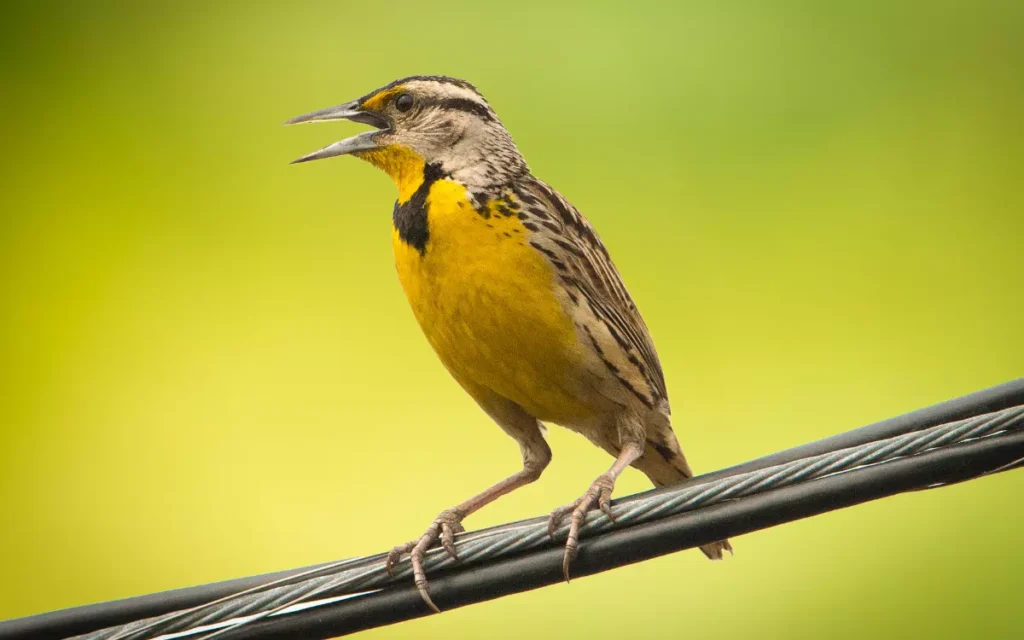
Quick ID: Yellow chest with a bold black V and brown streaked upperparts.
What It Looks Like:
The Eastern Meadowlark has a bright yellow throat and breast marked with a bold black V. The back is brown and heavily streaked, helping it blend into grasslands. In flight, you may notice white outer tail feathers.
Where You’ll Find It:
Look in grasslands, pastures, hayfields, prairies, and open rural areas.
Behavior Clues:
They often perch on fence posts or low shrubs to sing. On the ground, they can be hard to spot.
How to Tell It Apart:
The yellow chest with black V is the key clue. Habitat also helps because meadowlarks are open-field birds.
Best Time to See:
Spring and summer, especially when males are singing.
Backyard Tip:
They are not typical feeder birds. Grassland conservation helps them most.
31. Western Meadowlark
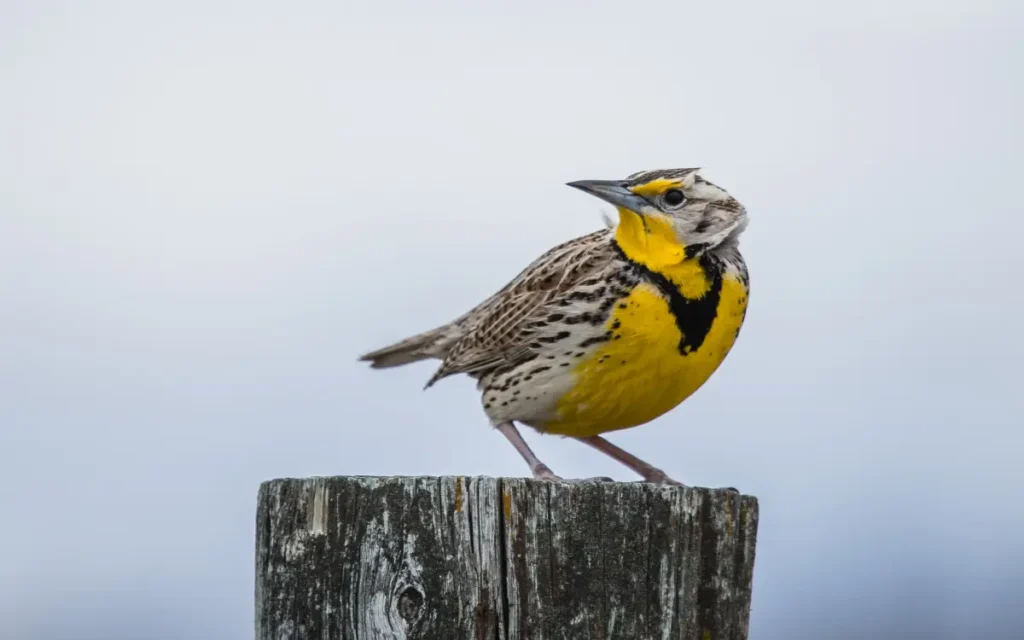
Quick ID: Yellow chest with black V, very similar to Eastern Meadowlark.
What It Looks Like:
The Western Meadowlark has bright yellow underparts, a bold black V on the chest, and brown streaked upperparts. It looks very similar to the Eastern Meadowlark, so range and song are often needed for confident ID. Its yellow may extend a bit farther onto the face in some views.
Where You’ll Find It:
Look across western grasslands, prairies, agricultural fields, and open country.
Behavior Clues:
Western Meadowlarks sing from fence posts, wires, or small rises. Their flute-like song is often the best clue.
How to Tell It Apart:
Visual ID from Eastern Meadowlark can be difficult. Location, song, and call are the safest clues.
Best Time to See:
Spring and summer when singing activity is highest.
Backyard Tip:
They need open grassland habitat, not typical backyard feeders.
32. Cedar Waxwing
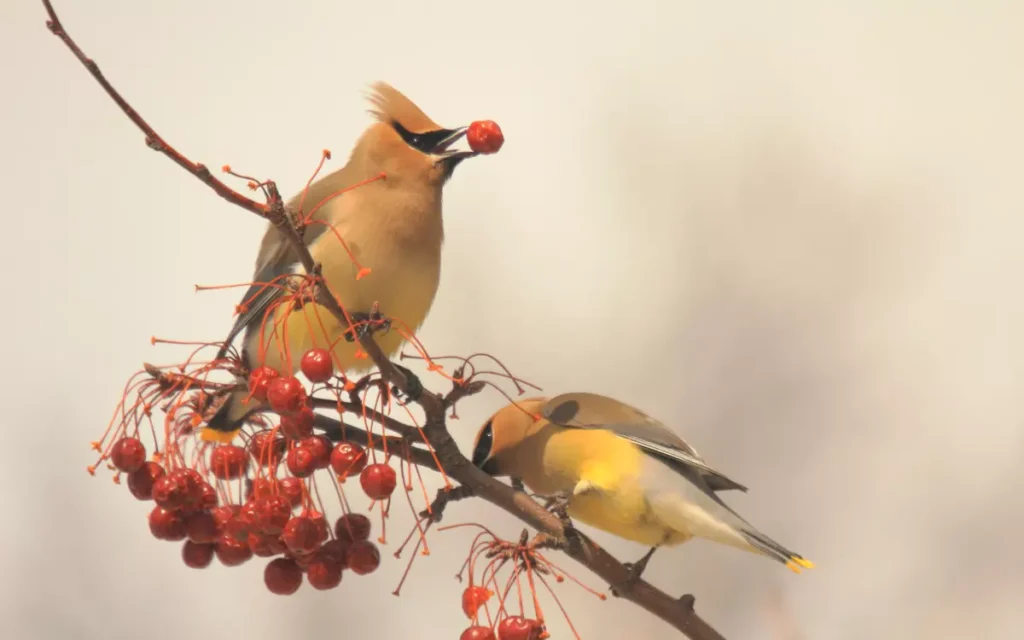
Quick ID: Sleek brown-gray bird with yellow belly wash and yellow tail tip.
What It Looks Like:
Cedar Waxwings are smooth-looking birds with a crest, black face mask, brownish head, gray body, and pale yellow belly. The tail usually has a bright yellow tip, which is one of the easiest marks to see. Some birds also show tiny red wax-like wing tips.
Where You’ll Find It:
Look in fruiting trees, parks, orchards, woodland edges, and neighborhoods with berry shrubs.
Behavior Clues:
They often travel in flocks and may suddenly appear when berries are ripe.
How to Tell It Apart:
The crest, black mask, silky body shape, and yellow tail tip make Cedar Waxwings distinct.
Best Time to See:
Year-round in many areas, but local movement depends on fruit supply.
Backyard Tip:
Plant native berry shrubs such as serviceberry, dogwood, juniper, and elderberry.
33. Yellow-headed Blackbird
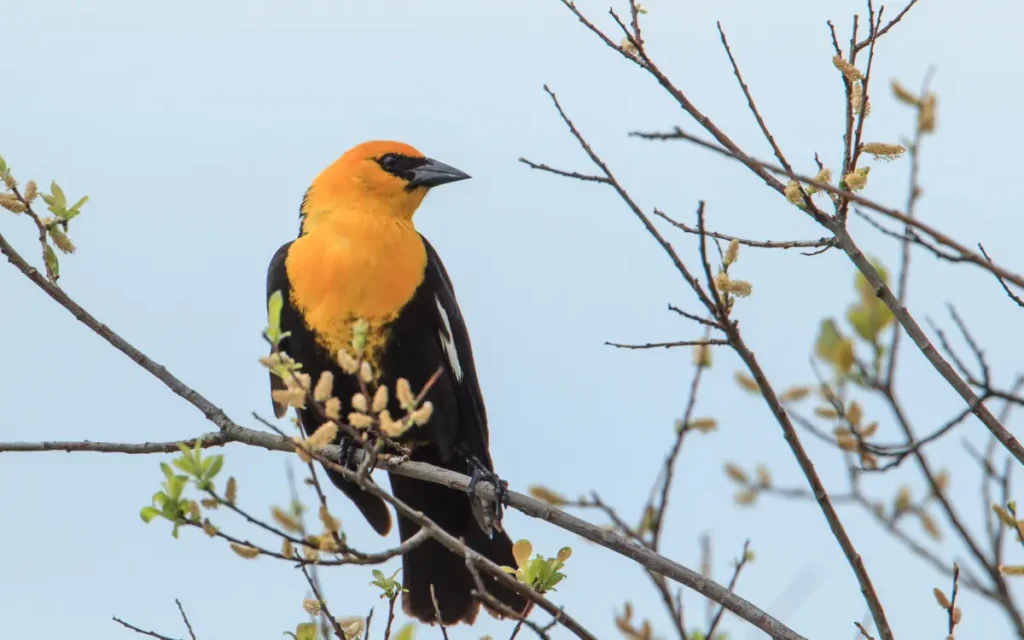
Quick ID: Black body with bright yellow head and chest on males.
What It Looks Like:
Male Yellow-headed Blackbirds are bold birds with black bodies, white wing patches, and a bright yellow head and chest. Females are duller brownish-black with softer yellow on the face and chest. They are larger and heavier than most small yellow birds.
Where You’ll Find It:
Look for them in freshwater marshes, cattail wetlands, wet meadows, and nearby fields, mostly in western and central North America.
Behavior Clues:
Males often perch on cattails and give rough, harsh calls.
How to Tell It Apart:
The yellow head on a black body is very clear in males. Females are duller but still larger and marsh-loving.
Best Time to See:
Spring and summer in breeding marshes.
Backyard Tip:
They are not typical feeder birds. Wetland habitat is key.
34. Dickcissel
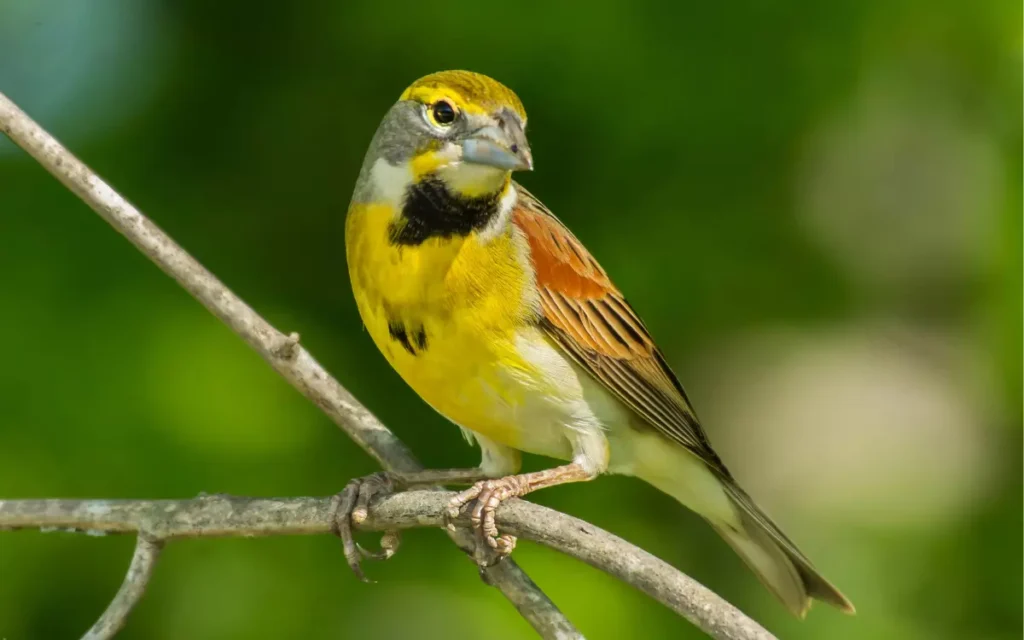
Quick ID: Sparrow-like grassland bird with yellow chest and black throat patch on males.
What It Looks Like:
Male Dickcissels have a yellow chest, grayish head, chestnut shoulder patch, and a black throat patch. Females are duller and may show softer yellow on the chest without the strong black bib. They look somewhat like chunky sparrows but with brighter color.
Where You’ll Find It:
Look in grasslands, prairies, hayfields, weedy fields, and agricultural edges, especially in the central United States.
Behavior Clues:
Males often sing from tall weeds, fences, or grass stems during breeding season.
How to Tell It Apart:
The yellow chest, grassland habitat, and male’s black throat patch help separate it from sparrows.
Best Time to See:
Spring and summer in breeding areas.
Backyard Tip:
They rarely visit feeders. Native grasslands and unmowed field edges help them most.
35. White-eyed Vireo
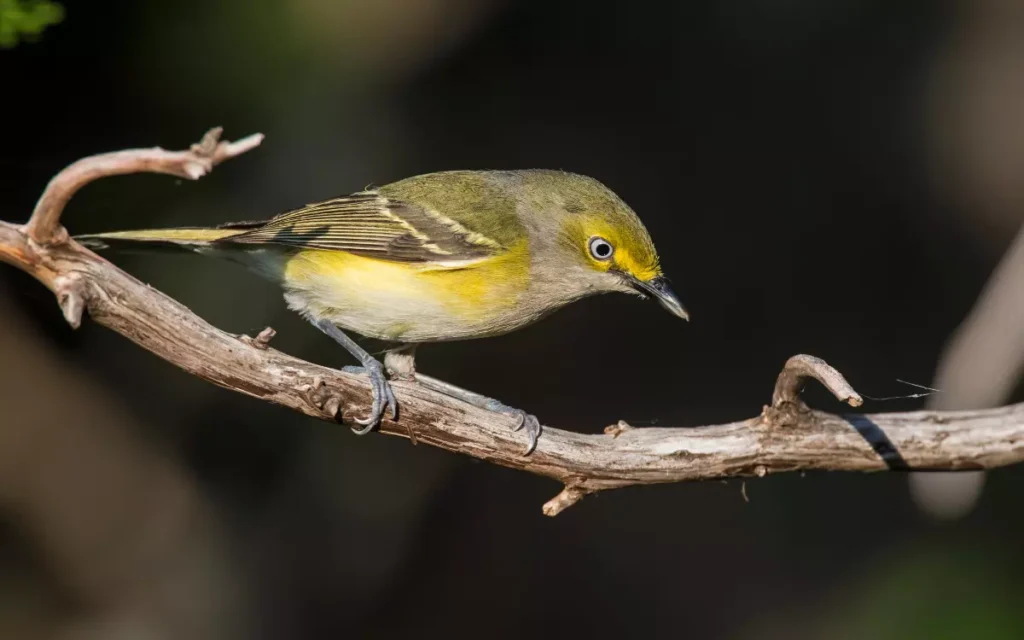
Quick ID: Olive-yellow songbird with yellow spectacles and pale white eyes.
What It Looks Like:
The White-eyed Vireo is not fully yellow, but it often shows yellow on the sides, flanks, and around the face. It has olive upperparts, a whitish throat, yellow spectacles, and pale eyes in adults. The bill is thicker than a warbler’s bill and slightly hooked at the tip.
Where You’ll Find It:
Look in dense shrubs, thickets, woodland edges, overgrown fields, and brushy areas.
Behavior Clues:
White-eyed Vireos often stay hidden in thick cover, but their sharp, varied song can reveal them.
How to Tell It Apart:
The pale eye, yellow spectacles, thicker bill, and thicket habitat help separate it from yellow warblers.
Best Time to See:
Spring and summer in breeding range; migration elsewhere.
Backyard Tip:
Dense native shrubs and berry-producing plants can make your yard more useful for vireos.
FAQs
What is the most common yellow bird?
The American Goldfinch is one of the most common yellow birds in North America. Males are bright yellow in spring and summer with black wings and a black cap. They often visit backyard feeders, especially when nyjer seed or sunflower chips are available.
What small bird is bright yellow?
A small bright yellow bird could be an American Goldfinch, Yellow Warbler, Wilson’s Warbler, Prothonotary Warbler, or Common Yellowthroat. The best way to narrow it down is to check the bill. Goldfinches have short seed-eating bills, while warblers have thin insect-eating bills.
What yellow bird has black wings?
The American Goldfinch is the most familiar yellow bird with black wings. Male Western Tanagers and Evening Grosbeaks can also show yellow bodies with dark or black wings. Look at the bird’s size, bill shape, and location to confirm the ID.
What yellow bird has a black mask?
The male Common Yellowthroat has a bright yellow throat and chest with a bold black mask across the face. It is often found in marshes, wet fields, brushy edges, and thick low vegetation.
Are yellow birds always goldfinches?
No, many yellow birds are not goldfinches. Yellow birds can also be warblers, orioles, tanagers, vireos, meadowlarks, grosbeaks, flycatchers, chats, and blackbirds. Goldfinches usually have a short cone-shaped bill, while many other yellow birds have thinner or longer bills.
What yellow birds come to backyard feeders?
The most common yellow birds at feeders include American Goldfinch, Lesser Goldfinch, Pine Warbler, Evening Grosbeak, and female Baltimore Oriole. Goldfinches like nyjer and sunflower seeds. Orioles may visit orange halves, jelly, and nectar feeders.
What yellow bird looks like a canary?
The American Goldfinch is often mistaken for a wild canary because breeding males become bright yellow. However, wild canaries are not native backyard birds in North America. If you see a small yellow bird with black wings at a feeder, it is more likely a goldfinch.
What yellow bird has a red or orange head?
The male Western Tanager has a yellow body with a red-orange head and black wings. Female Baltimore Orioles can also look yellow-orange, but they have a longer pointed bill and white wing bars.
What yellow bird is found near water?
Yellow birds near water may include Yellow Warblers, Common Yellowthroats, Prothonotary Warblers, and Yellow-headed Blackbirds. Habitat helps a lot. A yellow bird in reeds or marsh grass may be a Common Yellowthroat, while a golden-yellow bird in swampy woods may be a Prothonotary Warbler.
How do I attract yellow birds to my yard?
To attract yellow birds, offer nyjer seed, sunflower chips, clean water, native shrubs, berry plants, and seed-producing flowers. Goldfinches like coneflowers, black-eyed Susans, asters, and sunflowers. Orioles may come to oranges and jelly. Warblers are more likely to visit yards with insects, native shrubs, and small trees.
What is the difference between a Yellow Warbler and an American Goldfinch?
A Yellow Warbler has a thin insect-eating bill, a slimmer body, and often stays in shrubs or trees near water. An American Goldfinch has a short cone-shaped seed bill, black wings, and often visits feeders or weedy fields. Male Yellow Warblers may also show reddish streaks on the chest, while goldfinches do not.
Why do some yellow birds look dull in winter?
Some yellow birds change color after breeding season. Male American Goldfinches, for example, become duller olive-brown in winter. Young birds and females are also often less bright than breeding males. Season, age, and sex can all affect how yellow a bird looks.