18 Red Birds in Texas: Beautiful Species
Texas has several birds with red feathers, but they don’t all look alike. Some, such as the Northern Cardinal and Summer Tanager, are covered in red. Others have a red head, breast, belly, or wing patch.
Several species live in Texas throughout the year, while others appear only during migration or winter. A few are rare visitors that most birders may never encounter.
1.Northern Cardinal
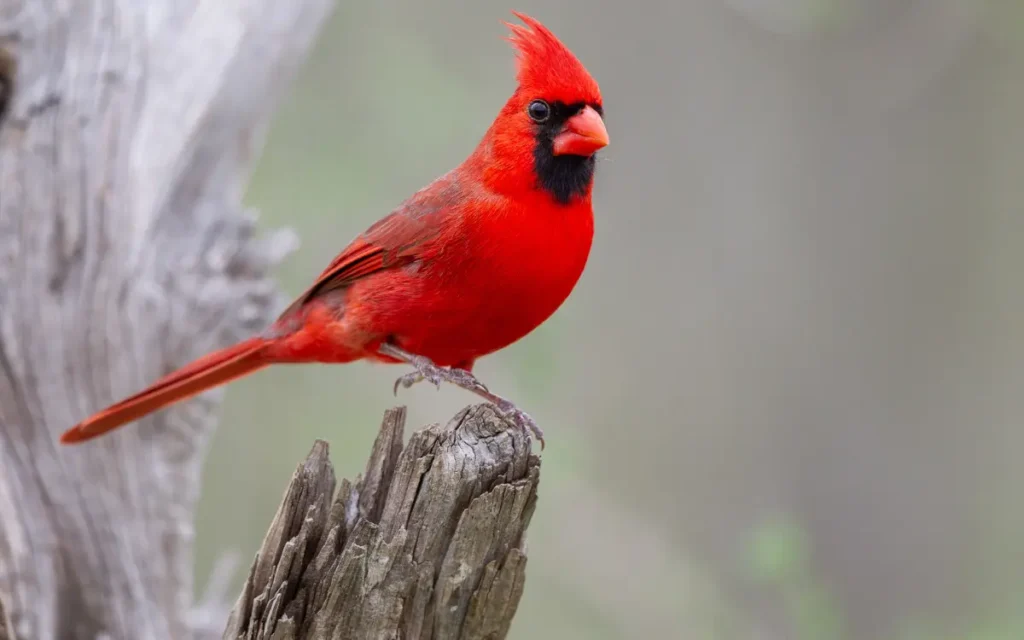
Scientific name: Cardinalis cardinalis
Texas status: Common year-round resident
Easy ID: Red body, pointed crest, black face, and thick orange-red bill
Sound: Clear whistled phrases, often described as “cheer-cheer-cheer”
The Northern Cardinal is the red bird most Texans are likely to see. Adult males are bright red with a black mask around the bill. Females are mostly warm brown but have red feathers on the wings, crest, and tail.
Cardinals live in backyards, woodland edges, parks, brushy fields, and dense roadside vegetation. They usually remain close to shrubs where they can retreat when disturbed.
They readily visit feeders containing black oil sunflower or safflower seeds. Unlike many migratory songbirds, Northern Cardinals can be found across Texas in every season.
2.House Finch
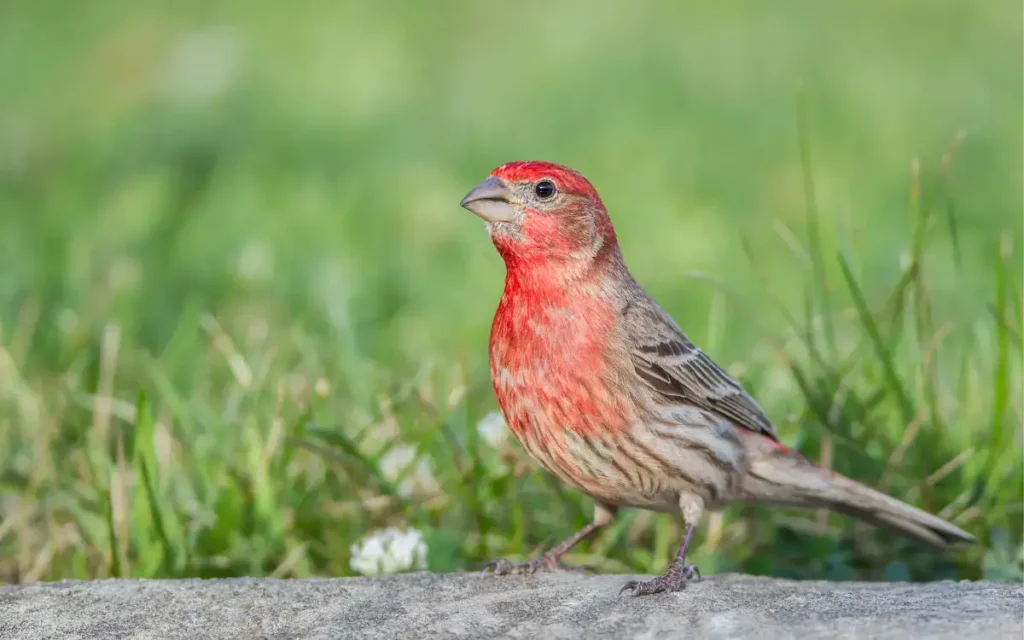
Scientific name: Haemorhous mexicanus
Texas status: Common year-round resident
Easy ID: Red forehead, throat, and upper breast with brown-streaked sides
Sound: Long, cheerful song ending in a rough note
Male House Finches have red around the face and upper chest. The exact shade varies and may appear orange, scarlet, or raspberry-red. Their brown backs and heavily streaked sides remain visible.
Females lack red plumage. They are gray-brown with blurry streaking across the body and a plain face.
House Finches are common around buildings, parking areas, farms, and backyard feeders. Their smaller size, lack of a crest, and streaked belly separate them from Northern Cardinals.
3.Summer Tanager
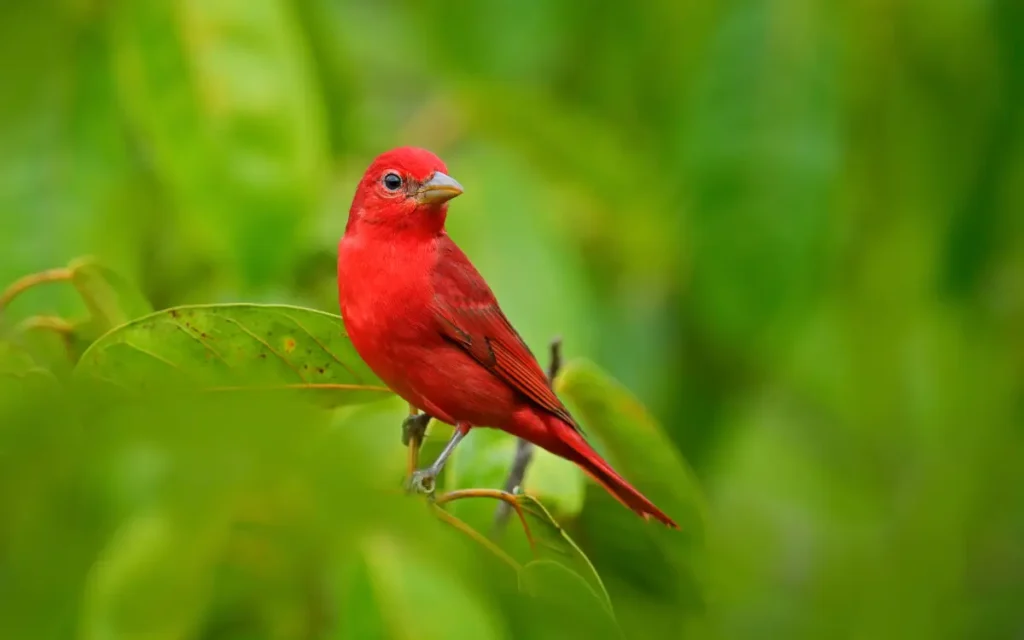
Scientific name: Piranga rubra
Texas status: Common spring and summer breeder
Easy ID: Adult male is red without dark wings
Sound: Robin-like song with sharp, repeated calls
An adult male Summer Tanager is almost completely red. Its wings are the same general color as its body, although they may look slightly darker in poor light. The bill is pale, thick, and pointed.
Females range from mustard-yellow to yellow-orange. Young males may show a mixture of yellow and red feathers as they molt into adult plumage.
Summer Tanagers live in mature woodland, river corridors, and wooded parks. They eat insects and are known for catching bees and wasps. Most leave Texas for the winter.
4.Painted Bunting
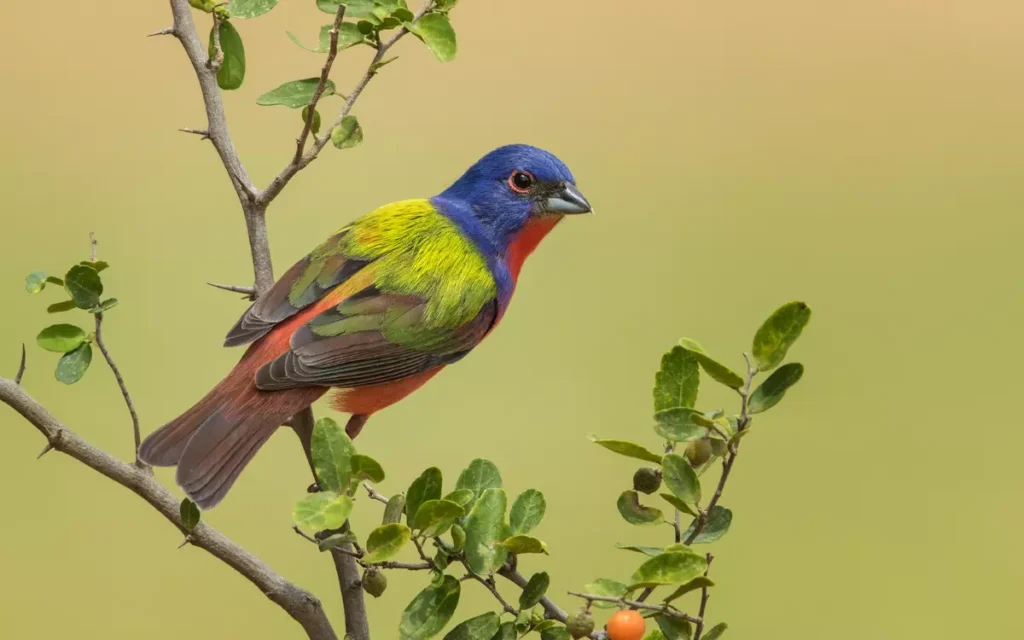
Scientific name: Passerina ciris
Texas status: Common summer breeder
Easy ID: Male has a blue head, green back, and red underparts
Sound: Bright, musical song delivered from thick cover
The male Painted Bunting is one of the easiest multicolored birds to recognize. Its head is blue, the back is green, and the belly and rump are red. Females and young males are yellow-green without red or blue plumage.
Painted Buntings arrive during spring and nest in brush, woodland edges, thickets, and overgrown fields. They are widely distributed across much of Central, South, and East Texas.
Despite the male’s colors, this bird can be difficult to find because it spends much of its time inside dense vegetation. Listen for its song before trying to locate it.
5.Vermilion Flycatcher
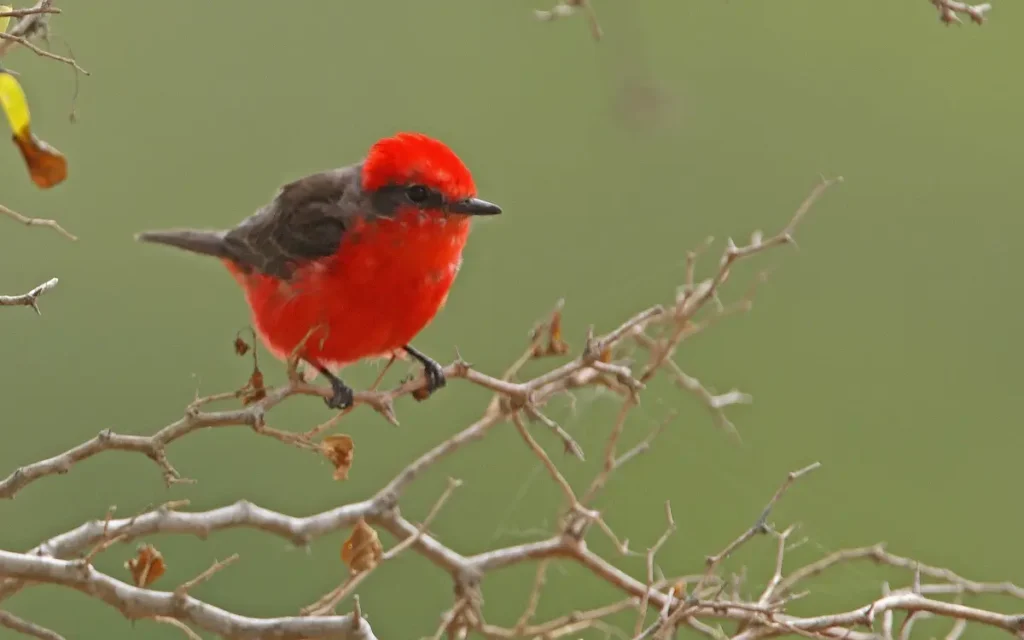
Scientific name: Pyrocephalus rubinus
Texas status: Resident in some areas; more widespread during warmer months
Easy ID: Red crown and underparts with a dark brown back and eye mask
Sound: Thin, rising series of sharp notes
Adult male Vermilion Flycatchers have glowing red crowns, throats, chests, and bellies. Their backs, wings, tails, and eye masks are dark brown.
Females are gray-brown with pale breasts and peach-colored or pinkish bellies. Young males may show scattered red feathers rather than the adult’s clean pattern.
Look for this species in open country with scattered perches. It often sits on fences, low branches, or utility wires before flying out to catch an insect and returning to the same perch. It is most expected in South and West Texas, though it occurs elsewhere locally.
6.Scarlet Tanager
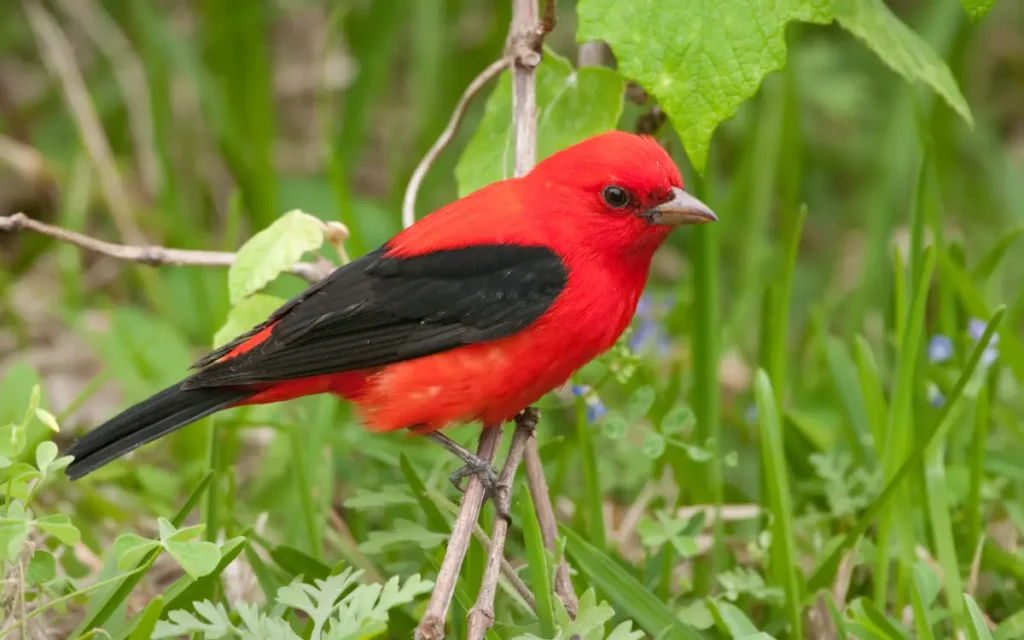
Scientific name: Piranga olivacea
Texas status: Uncommon spring and fall migrant
Easy ID: Breeding male has a red body with black wings and tail
Sound: Hoarse, robin-like song
Breeding male Scarlet Tanagers have bright red bodies set against jet-black wings and tails. This strong wing contrast separates them from male Summer Tanagers.
Females are yellow-green with darker wings. During fall, adult males replace their red body feathers with yellow-green plumage but retain their dark wings.
Scarlet Tanagers pass through East and Central Texas during migration. They usually stay high in leafy trees, so a bird may be heard before it is seen. Spring gives birders the best chance of finding a male in full red plumage.
7.Hepatic Tanager
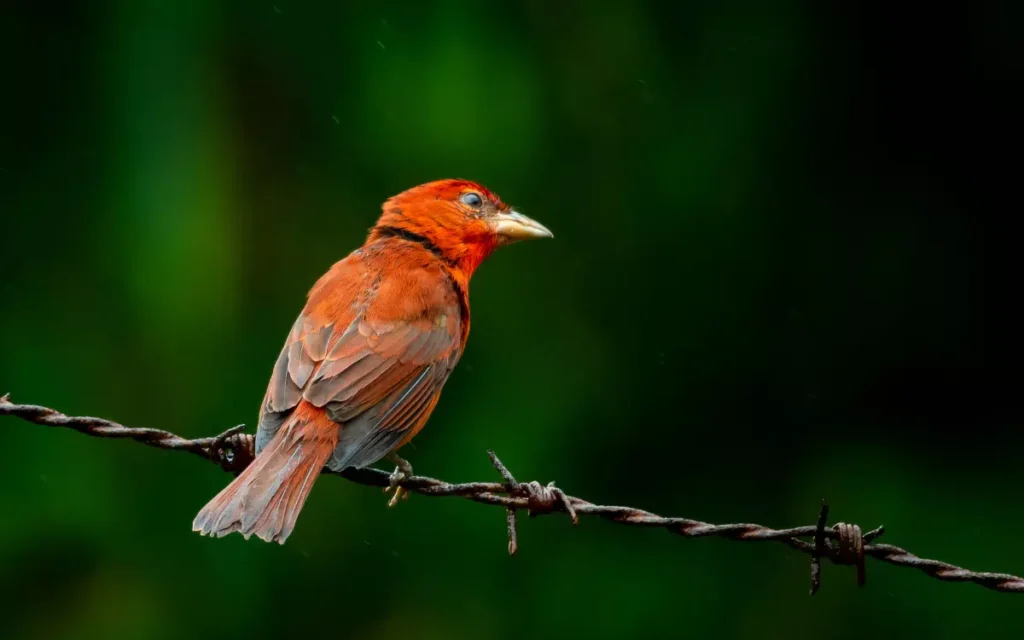
Scientific name: Piranga flava
Texas status: Local breeder and uncommon visitor
Easy ID: Dusky brick-red male with a grayish cheek and thick bill
Sound: Short, rough calls and a song resembling an American Robin
Male Hepatic Tanagers are brick-red rather than scarlet. Their backs can appear slightly darker, and the grayish cheek gives the face a less evenly red appearance than that of a Summer Tanager.
Females are yellow-olive with grayish cheeks. Both sexes have heavy bills suited for eating insects and fruit.
In Texas, Hepatic Tanagers are associated mainly with pine-oak woodland in the Davis and Guadalupe mountains. They are much less widespread than Summer Tanagers.
8.Pyrrhuloxia
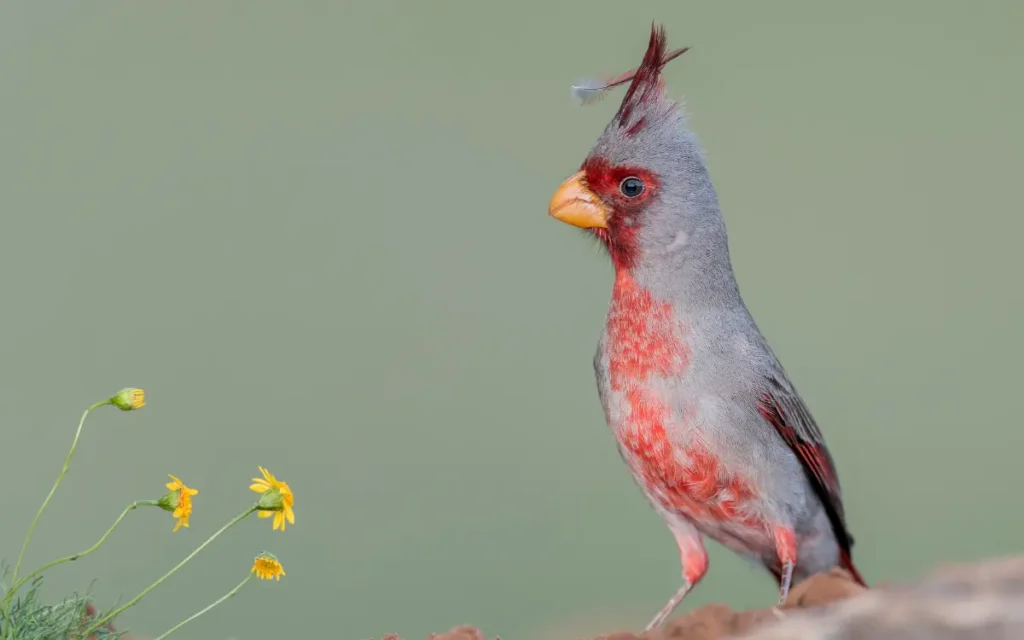
Scientific name: Cardinalis sinuatus
Texas status: Year-round resident
Easy ID: Gray cardinal-like bird with red patches and a yellow bill
Sound: Clear whistles similar to those of a Northern Cardinal
The Pyrrhuloxia is sometimes called the desert cardinal. Males have gray bodies with red on the crest, face, breast, belly, wings, and tail. Females are mostly gray-brown with smaller red patches.
Its short, curved yellow bill is one of the best identification marks. A Northern Cardinal has a straighter, orange-red bill and much more red across the body.
Pyrrhuloxias live in desert scrub, thorny brush, ranchland, and dry woodland across South and West Texas. During winter, they may gather in flocks and visit seed feeders.
9.Purple Finch
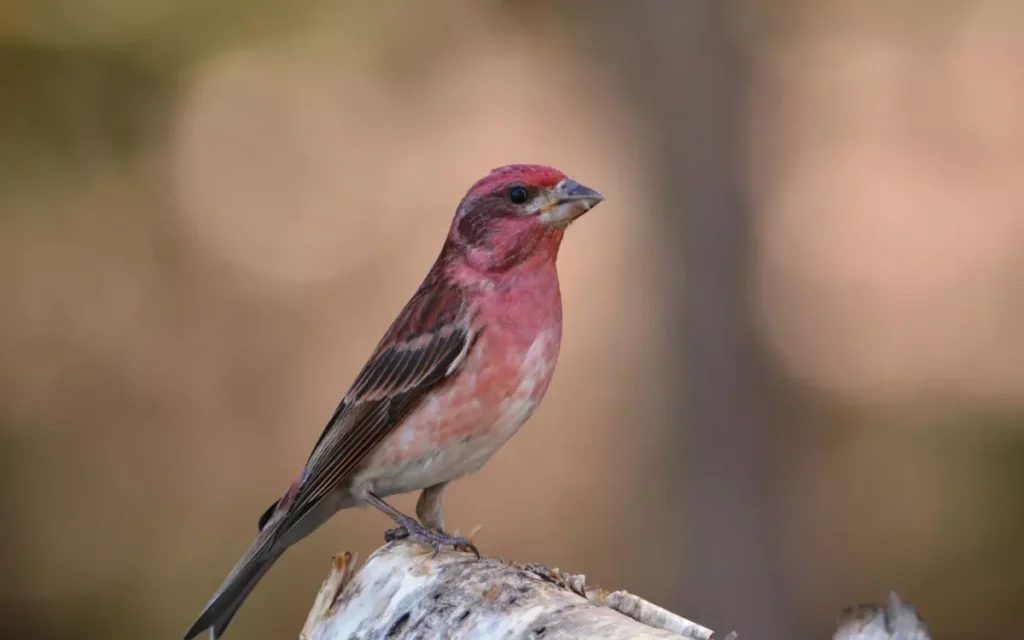
Scientific name: Haemorhous purpureus
Texas status: Irregular winter visitor
Easy ID: Male has a raspberry-colored wash across the head, breast, and back
Sound: Rich, warbling song
Despite its name, the male Purple Finch looks more raspberry-red than purple. The color spreads across the crown, face, upper breast, and back without the sharply separated red patches seen on many House Finches.
Females have strong facial patterns, including a pale eyebrow and darker cheek stripe. Female House Finches have plainer faces.
Purple Finches are uncommon and irregular in Texas. Most reports come from the eastern part of the state during winter, often at feeders or around mature woodland.
House Finch vs Purple Finch
| Feature | House Finch | Purple Finch |
| Male color | Red concentrated on head and breast | Raspberry wash extends onto back |
| Belly | Strong brown streaks | Fewer, softer streaks |
| Female face | Mostly plain | Bold eyebrow and cheek pattern |
| Bill | Smaller and more curved | Heavier and straighter |
| Texas status | Common year-round | Uncommon winter visitor |
10.Red-headed Woodpecker
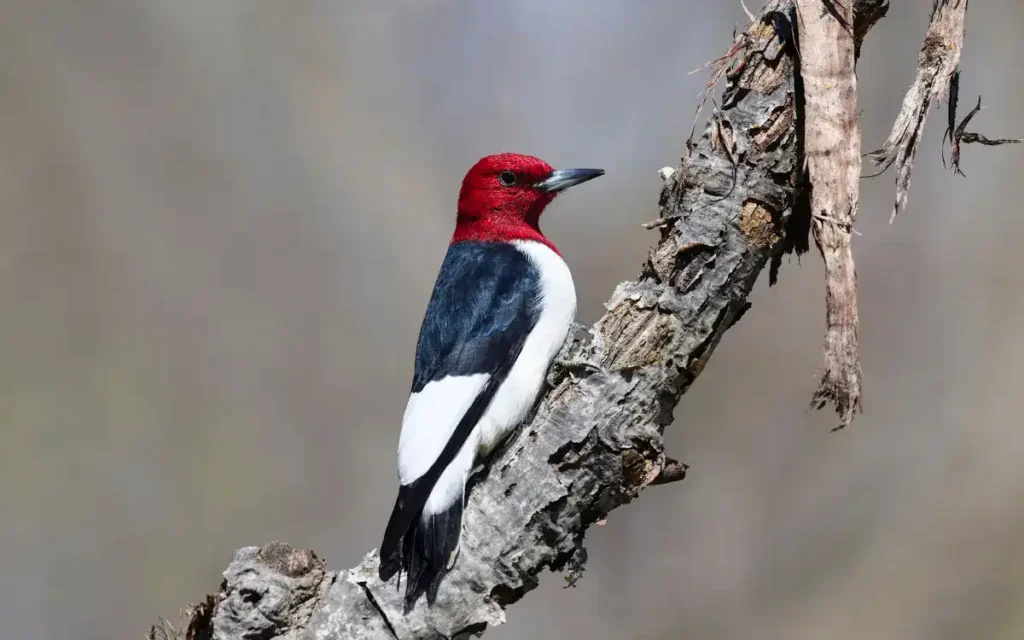
Scientific name: Melanerpes erythrocephalus
Texas status: Local resident and seasonal visitor
Easy ID: Entire red head, white belly, and black-and-white wings
Sound: Harsh, rolling “churr” call
Adult Red-headed Woodpeckers have red covering the full head and upper neck. Their clean black back, white belly, and large white wing patches make them easy to recognize in flight.
Young birds have brownish-gray heads and duller wing patterns. Their red head feathers appear as they mature.
This woodpecker prefers open woodland, burned areas, farms, groves, and places with dead trees. It catches flying insects and stores acorns, seeds, and other food inside cracks and tree cavities.
11. Red bellied Woodpecker
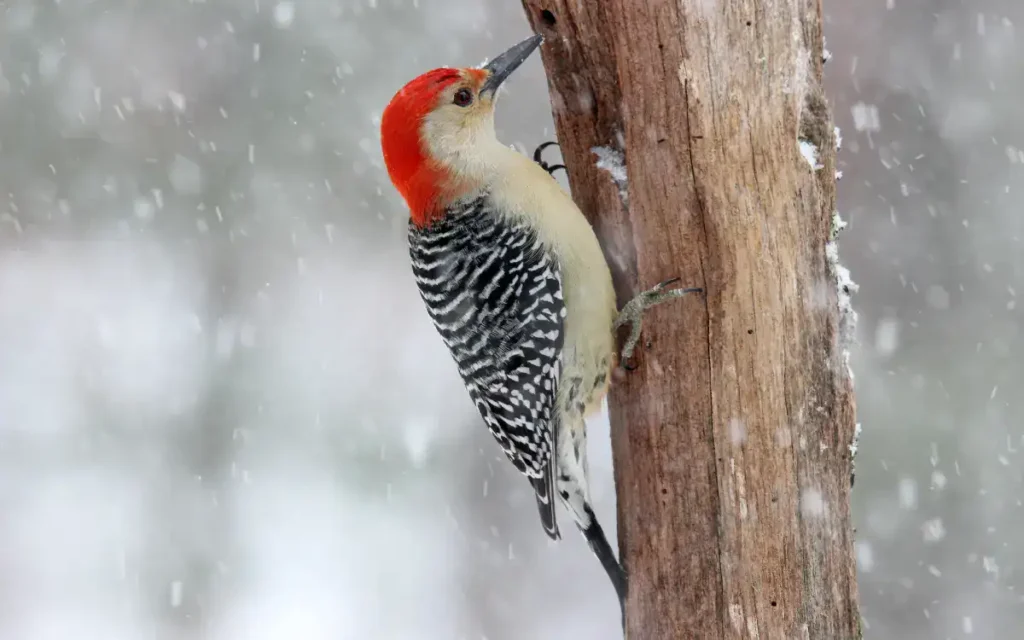
Scientific name: Melanerpes carolinus
Texas status: Common year-round resident
Easy ID: Black-and-white barred back with red on the head
Sound: Loud, rolling “churr” call
The name causes confusion because the red belly is often difficult to see. The more noticeable red is on the head. Males have red from the forehead to the back of the neck, while females have red mainly on the nape.
The back has narrow black-and-white bars, giving it a laddered appearance. The pale face and light underparts help separate it from the darker Red-headed Woodpecker.
Red-bellied Woodpeckers are common in forests, wooded neighborhoods, parks, and backyards across the eastern two-thirds of Texas. They visit suet and peanut feeders.
12. Yellow bellied Sapsucker
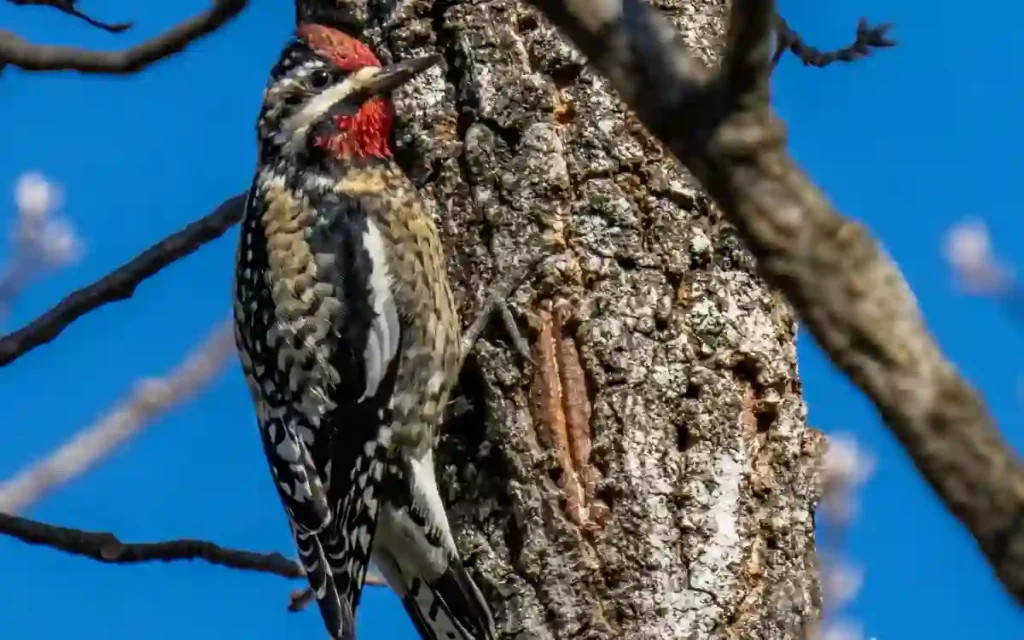
Scientific name: Sphyrapicus varius
Texas status: Common winter visitor
Easy ID: Red crown, striped face, white wing patch, and rows of holes in tree bark
Sound: Nasal, cat-like call
Adult males have red crowns and red throats. Females have red crowns but usually white throats. Both sexes have black-and-white faces and long white patches on their folded wings.
Yellow-bellied Sapsuckers drill orderly rows of shallow holes in tree bark. They return to these wells to drink sap and eat insects attracted to it.
They occur mainly during fall and winter in Central and East Texas. Most leave for northern breeding areas during spring.
13.Red Crossbill
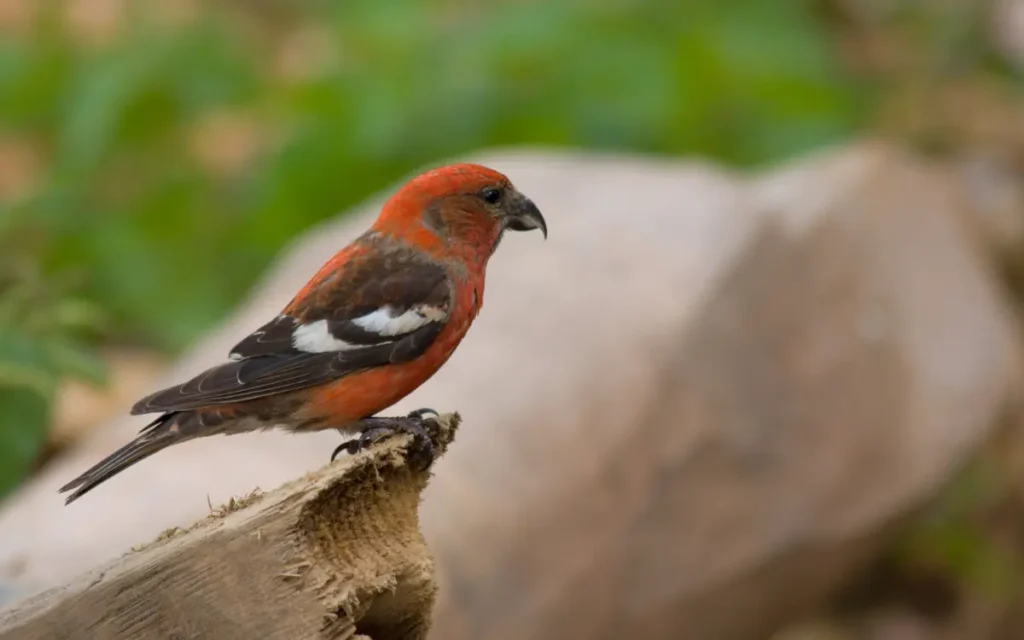
Scientific name: Loxia curvirostra
Texas status: Irregular and nomadic visitor
Easy ID: Crossed bill tips and reddish-orange male plumage
Sound: Repeated hard “jip-jip” flight calls
Male Red Crossbills range from orange-red to brick-red. Females are usually yellowish or olive. Both sexes have unusual bills with tips that cross over one another.
They use this specialized bill to open pine and other conifer cones. Crossbills travel according to cone production rather than following a simple annual migration route.
Texas sightings are unpredictable. They are most likely where conifers provide a strong seed crop, particularly in northern or western parts of the state. Cornell Lab notes that their movements follow changing conifer seed supplies.
14. White winged Crossbill
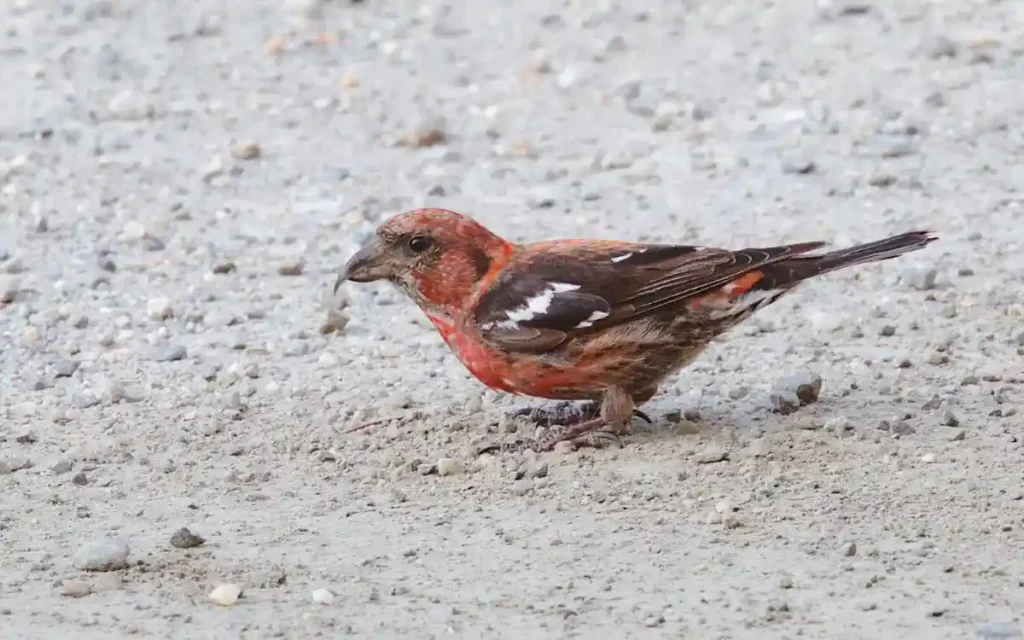
Scientific name: Loxia leucoptera
Former name: Two-barred Crossbill
Texas status: Accidental visitor
Easy ID: Crossed bill, reddish male, and two bold white wing bars
Sound: Dry, rapid trilling calls
The White-winged Crossbill resembles the Red Crossbill but has two clear white bars across each dark wing. Adult males are pinkish-red, while females are yellowish with darker streaking.
This is a northern conifer bird and is exceptionally rare in Texas. It may wander south when cone supplies fail across its usual range.
Because a Texas sighting would be unusual, photographs should show the crossed bill and white wing bars. The current North American name is White-winged Crossbill; “Two-barred Crossbill” is used for closely related Old World populations or in older naming systems.
15.Two-barred Crossbill
Even rarer than the Red Crossbill, the Two-barred Crossbill has white wing stripes and a reddish body. It is an irruptive species, meaning sightings in Texas are highly unusual and unpredictable.
- Extremely rare in Texas
- May appear during northern irruptions
- Identified by white wing bars and crossed bill
16.Flame-colored Tanager
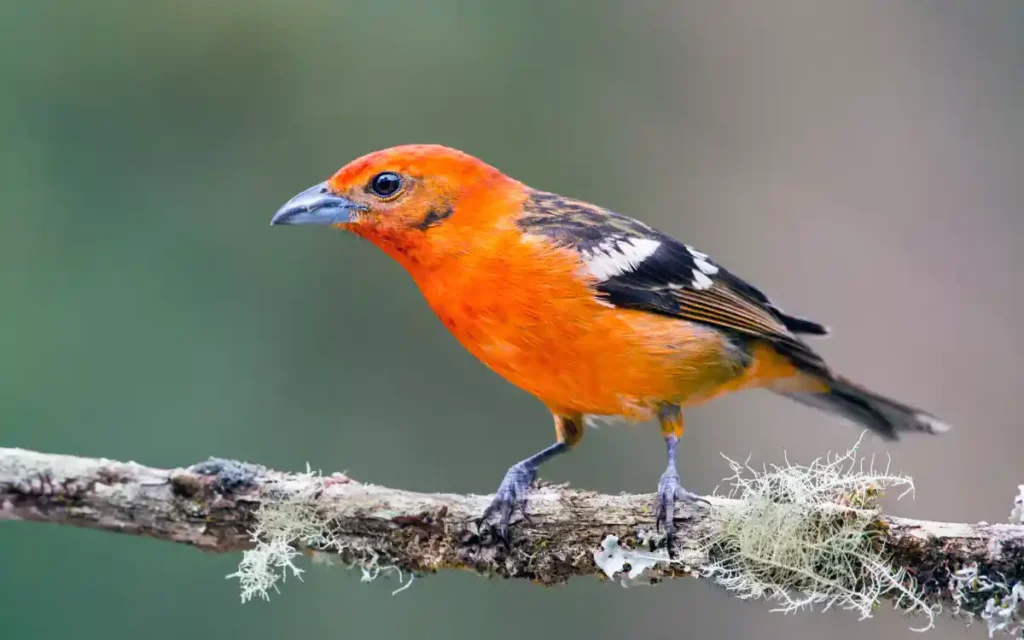
Scientific name: Piranga bidentata
Texas status: Very rare visitor
Easy ID: Orange-red body with dark wings marked by pale bars
Sound: Robin-like song with short, rising calls
A male Flame-colored Tanager has an orange-red head and body with dark wings. Pale wing bars help separate it from the evenly colored Summer Tanager. Females are yellowish-orange with darker wings.
This tropical species is mainly found in Mexico and Central America. Texas records are rare and usually come from the western mountains or areas near the Mexican border.
A reported bird should be checked against Western, Summer, and Hepatic Tanagers. The Texas Parks and Wildlife occurrence list treats Flame-colored Tanager as a vagrant rather than a regular Texas species. Texas Parks and Wildlife bird occurrence list
17.Painted Redstart
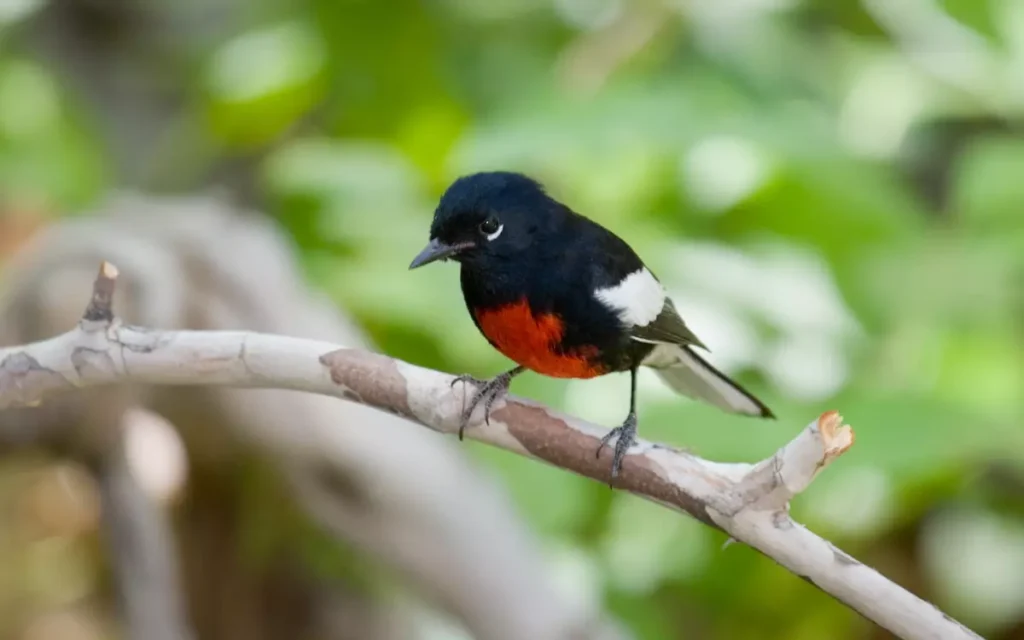
Scientific name: Myioborus pictus
Texas status: Rare and local in far West Texas
Easy ID: Black body, red belly, white wing patches, and white outer tail feathers
Sound: Clear, whistled phrases
Painted Redstarts are mostly black, but the bright red belly earns them a place in this guide. Their large white wing patches and white-edged tails become especially noticeable when the birds spread their wings.
They actively forage among branches while flashing their wings and fanning their tails. This behavior may startle insects into moving.
In Texas, they are tied to shaded mountain canyons and pine-oak forest in the Trans-Pecos. They are rare and local, so they should not be described as widespread West Texas birds. Recent Big Bend Ranch records list the species as exceptional rather than common. Big Bend Ranch State Park bird checklist
18. Rose breasted Grosbeak
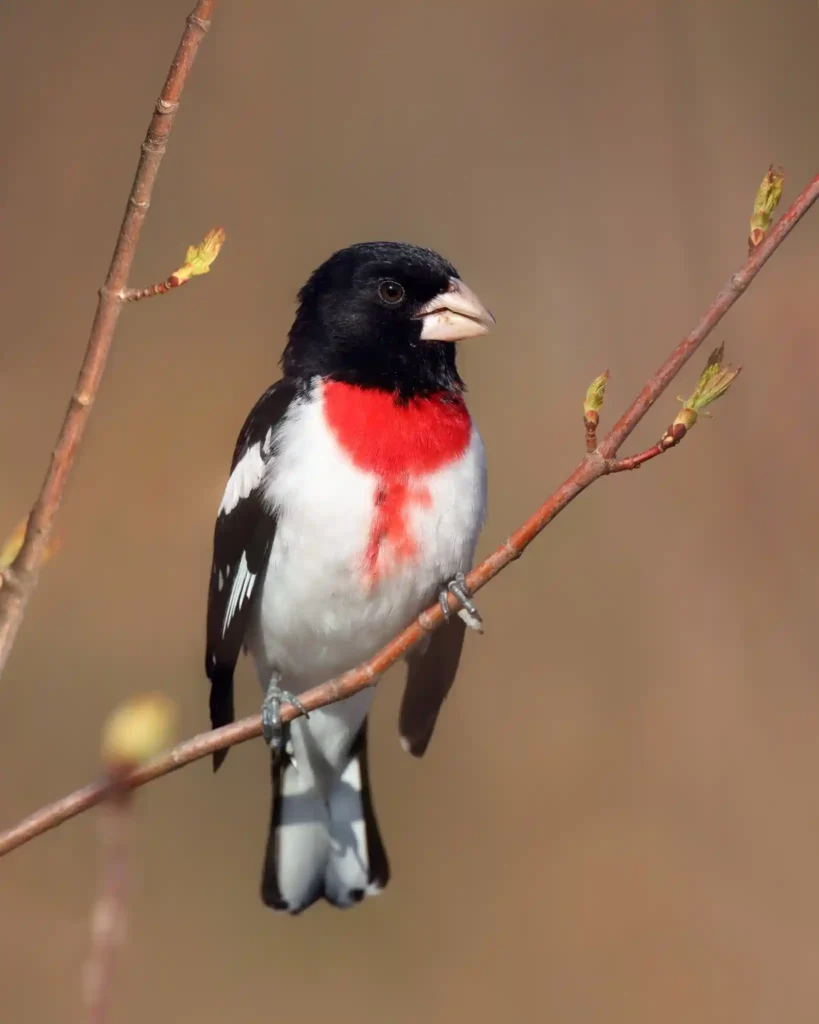
Scientific name: Pheucticus ludovicianus
Texas status: Spring and fall migrant
Easy ID: Male has a black head, white belly, and triangular red chest patch
Sound: Rich song resembling a smoother American Robin
Male Rose-breasted Grosbeaks have black heads and backs, white underparts, and a red patch across the upper chest. White markings are visible on the wings and rump.
Females are brown and heavily streaked with bold pale eyebrows. They can resemble large sparrows but have much heavier, pale bills.
Rose-breasted Grosbeaks pass through much of East and Central Texas during migration. They sometimes stop at backyard feeders, where they eat sunflower seeds before continuing north or south.
Common Red Birds by Region
East Texas
Northern Cardinals, House Finches, Red-bellied Woodpeckers, and Red-headed Woodpeckers are good possibilities. Scarlet Tanagers and Rose-breasted Grosbeaks pass through during migration, while Purple Finches may appear in winter.
Central Texas
Northern Cardinals and House Finches are common throughout the year. Summer Tanagers and Painted Buntings arrive for the breeding season. Vermilion Flycatchers and Pyrrhuloxias become more likely toward drier western areas.
South Texas
Look for Northern Cardinals, Pyrrhuloxias, Painted Buntings, and Vermilion Flycatchers. Flame-colored Tanagers are possible only as very rare visitors and should not be expected on an ordinary trip.
West Texas
Pyrrhuloxias and Vermilion Flycatchers are among the more regular choices. The Davis and Guadalupe mountains can hold Hepatic Tanagers, while Painted Redstarts occur only in limited mountain habitat.
How to Identify a Red Bird in Texas
Start by noting where the red appears.
| Red pattern | Possible bird |
| Entirely red with a crest | Northern Cardinal |
| Entirely red without a crest | Summer Tanager |
| Red body with black wings | Scarlet Tanager |
| Red face and chest with streaked belly | House Finch |
| Raspberry-red head, back, and chest | Purple Finch |
| Gray body with red patches | Pyrrhuloxia |
| Red head with black-and-white body | Red-headed Woodpecker |
| Red crown with barred back | Red-bellied Woodpecker |
| Red crown and throat with striped face | Yellow-bellied Sapsucker |
| Red belly with black body | Painted Redstart |
| Orange-red body with crossed bill | Red Crossbill |
| Red chest patch on black-and-white bird | Rose-breasted Grosbeak |
Shape is often more useful than the shade of red. Check whether the bird has a crest, a thick seed-eating bill, a crossed bill, a woodpecker-shaped bill, or a slim insect-catching bill.
How to Attract Red Birds in Texas
Black oil sunflower seeds can attract Northern Cardinals, House Finches, Rose-breasted Grosbeaks, and other seed-eating birds. Safflower is another good choice for cardinals.
Place feeders close enough to shrubs that birds have somewhere to hide, but avoid placing them directly inside dense cover where cats could wait.
Native berry-producing plants provide food and nesting cover. A shallow birdbath with clean water can also bring birds into view, especially during hot and dry Texas weather.
Flycatchers and tanagers usually don’t eat feeder seed. A yard with native plants and fewer insecticides gives these insect-eating birds a better reason to stop.
FAQs
What is the most common red bird in Texas?
The Northern Cardinal is the most widespread and familiar red bird in Texas. It lives in the state throughout the year and is common in cities, suburbs, farms, and woodland edges.
What Texas bird is completely red?
Male Summer Tanagers are almost entirely red without black wings. Male Northern Cardinals are also mostly red, but they have black masks and pointed crests.
What small Texas bird has red on its head and chest?
The House Finch is the most likely answer. Males have red foreheads, faces, and upper breasts with brown-streaked sides. Purple Finches look similar but are uncommon winter visitors.
Are Scarlet Tanagers found in Texas?
Yes. Scarlet Tanagers pass through East and Central Texas during spring and fall migration. They do not normally remain to breed or spend winter in the state.
Is the Vermilion Flycatcher rare in Texas?
It is not considered rare across all of Texas, but its distribution is uneven. It is most regular in southern and western parts of the state and becomes less common farther east and north.
What red bird looks like a cardinal but has a gray body?
A gray cardinal-like bird with red patches is probably a Pyrrhuloxia. Its yellow, curved bill helps separate it from a female Northern Cardinal.
Are there red woodpeckers in Texas?
Yes. The Red-headed Woodpecker has a completely red head. Red-bellied Woodpeckers and male Yellow-bellied Sapsuckers also have red on their heads.
When is the best time to see red birds in Texas?
Northern Cardinals, House Finches, Pyrrhuloxias, and several woodpeckers can be found throughout the year. Spring brings Summer Tanagers and Painted Buntings, while Scarlet Tanagers and Rose-breasted Grosbeaks appear mainly during migration.