12 Types of Herons in Texas (ID Guide with Pictures)
A tall gray bird standing beside a Texas pond is usually a Great Blue Heron. The smaller birds take more work. A white egret may be a Great Egret, Snowy Egret, juvenile Little Blue Heron, or even the uncommon white form of a Reddish Egret. Two brown night-herons can look nearly identical until you check the bill and spotting.
This guide covers the 12 herons, egrets, and bitterns regularly found in Texas. It explains the field marks that separate them, where they occur in the state, when they are present, and what their calls sound like.
The official Texas checklist contains one more member of the heron family: the Bare-throated Tiger-Heron. That tropical bird has only accidental status, so it is covered separately rather than presented as a species birders can normally expect to find.
1. Great Blue Heron
Scientific name: Ardea herodias
Length: 38–54 inches
Wingspan: 66–79 inches
Texas status: Common year-round
Call: A deep, rough “fraaank” or croak
Listen: Great Blue Heron calls
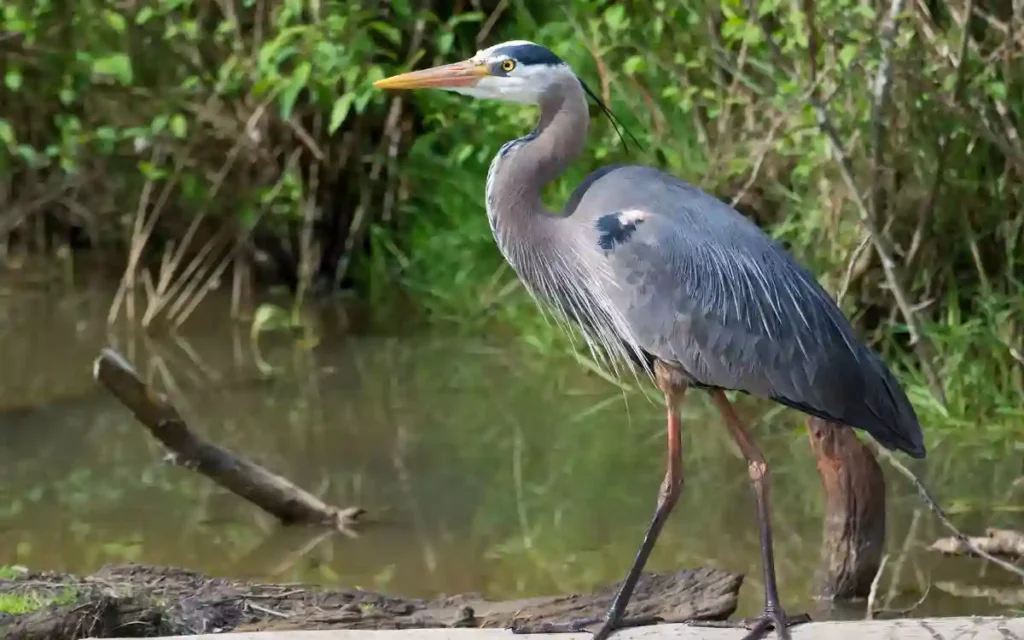
The Great Blue Heron is the largest regularly occurring heron in Texas. Its blue-gray body, long yellowish bill, black eyebrow, and dark head plumes make adults easy to recognize at close range. A rusty patch appears at the bend of the wing.
Look around reservoirs, farm ponds, rivers, drainage channels, tidal flats, and the edges of bays. Great Blues often hunt alone. One may stand motionless for several minutes before thrusting its bill at a fish, frog, crayfish, or small animal.
The neck folds back in flight, while the broad wings beat slowly and the long legs trail well behind the tail. That tucked neck separates a distant heron from a Sandhill Crane.
Do not confuse it with: Great Egret. A Great Egret is slimmer and entirely white. Very pale Great Blue Herons occur, but the all-white Great White Heron form is associated mainly with southern Florida and should not be assumed in Texas.
2. American Bittern
Scientific name: Botaurus lentiginosus
Length: 24–34 inches
Wingspan: About 36 inches
Texas status: Mainly a migrant and winter visitor; uncommon local breeder
Call: Deep, resonant “pump-er-lunk” or “booming” notes
Listen: American Bittern calls
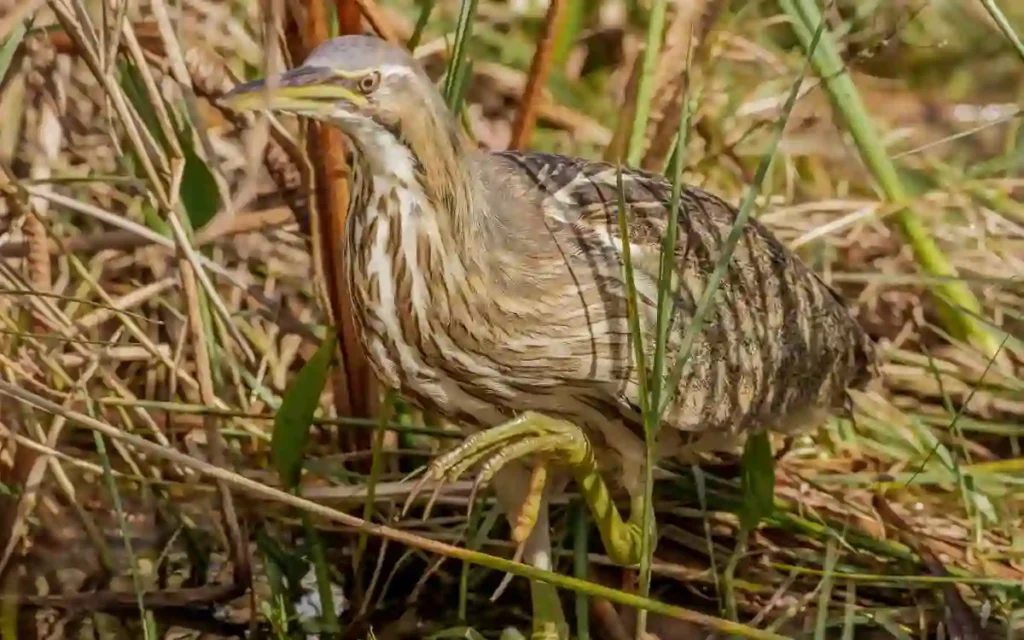
American Bitterns are thick-bodied brown herons covered with buff and dark streaks. A dark stripe runs down each side of the neck. The broad, dark outer wings contrast with the brown inner wing when a bird takes flight.
They live in freshwater marshes with cattails, bulrushes, reeds, and patches of open water. Instead of standing in the open like a Great Blue Heron, an American Bittern usually remains close to cover.
When alarmed, the bird points its bill upward and stretches its streaked neck. It may sway with the reeds, making the outline difficult to follow. The booming spring call can travel across a marsh even when the caller stays hidden.
Do not confuse it with: Least Bittern. An American Bittern is more than twice as large, more heavily streaked, and normally stands on the ground or in shallow water. A Least Bittern often climbs between reed stems.
3. Black-Crowned Night-Heron
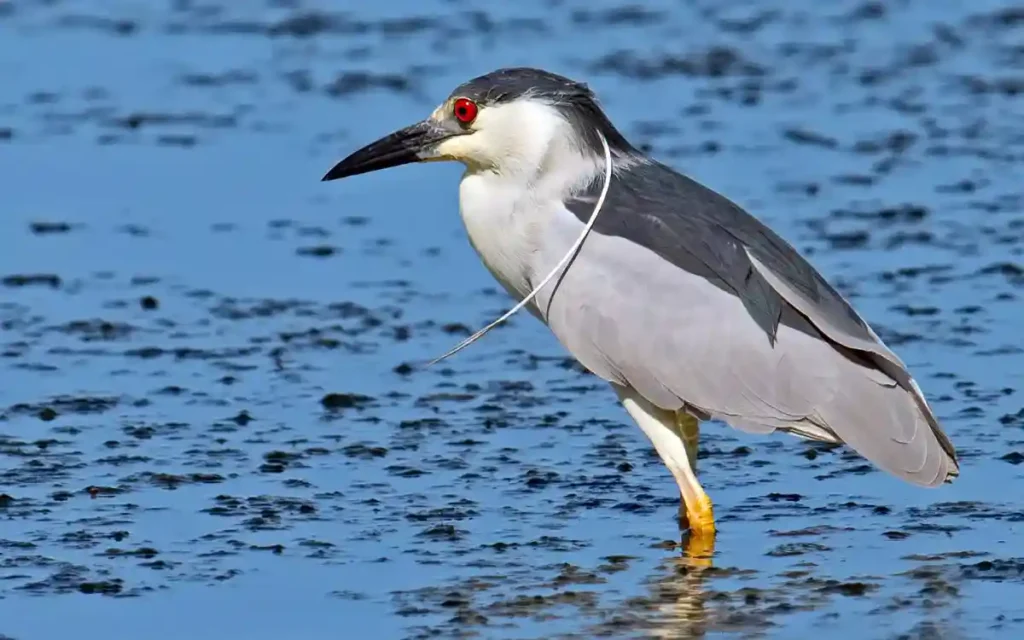
Scientific name: Nycticorax nycticorax
Length: 23–26 inches
Wingspan: 45–47 inches
Texas status: Regular year-round, with local seasonal changes
Call: A loud, barking “quawk,” often heard after dark
Listen: Black-crowned Night-Heron calls
Adult Black-crowned Night-Herons are stocky, short-necked birds with pale gray wings, a black back and cap, red eyes, and a thick black bill. Long white head plumes appear during the breeding season.
They rest in trees or dense vegetation during the day and become active near dusk. Listen for single “quawk” calls from birds crossing above lakes, marshes, reservoirs, canals, and coastal wetlands.
Immatures are brown with large pale spots on the wings and broad, blurry streaks below. Their bills are partly yellow, unlike the mostly dark bills of young Yellow-crowned Night-Herons.
Do not confuse it with: Yellow-crowned Night-Heron. Adult Black-crowneds have a plain black cap and pale belly. Yellow-crowneds have a bold white cheek patch, yellow crown, darker gray body, and longer legs.
4. Green Heron

Scientific name: Butorides virescens
Length: 16–18 inches
Wingspan: 25–27 inches
Texas status: Common spring through fall; local in winter
Call: A sharp, explosive “skeow,” often given while flying away
Listen: Green Heron calls
The Green Heron is small and compact, with a dark greenish back, chestnut neck, dark cap, and yellow or orange legs. When it pulls in its neck, the bird can look surprisingly short and thick. Young birds are brown with pale streaks down the neck.
Check shaded pond edges, wooded creeks, drainage canals, marsh borders, and overhanging branches. Green Herons often stay low and still, then flush with a loud “skeow” before the observer notices them.
Some Green Herons place feathers, twigs, insects, or other small objects on the water as bait. They wait for a fish to approach before striking.
Do not confuse it with: Least Bittern. A Green Heron is larger and darker, with a chestnut neck and dark green wings. A Least Bittern has broad pale buff areas on the wings and often grips vertical reeds.
5. Great Egret
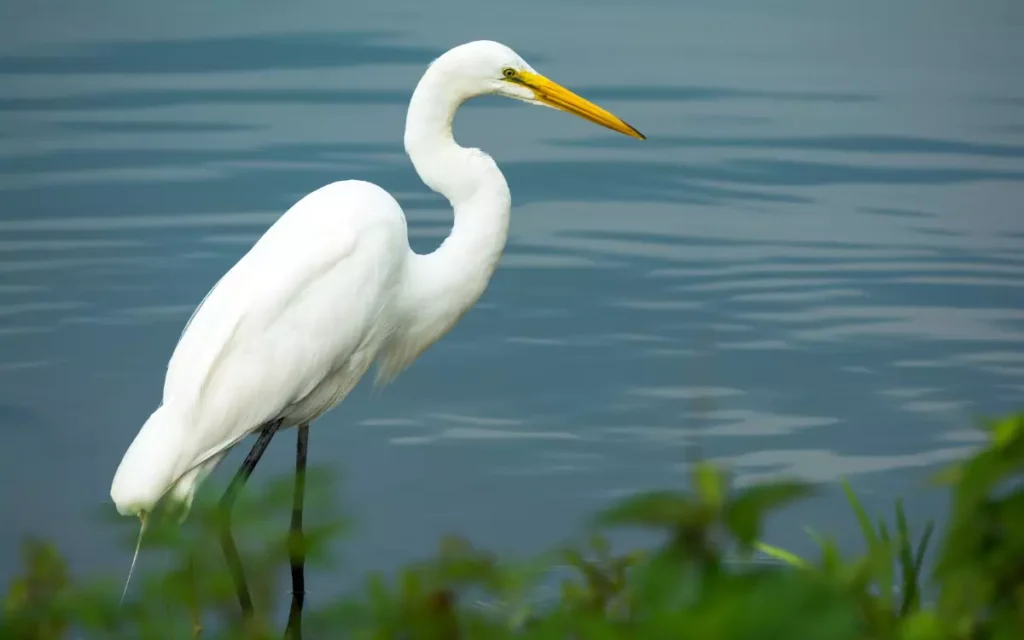
Scientific name: Ardea alba
Length: 37–41 inches
Wingspan: 51–57 inches
Texas status: Common year-round
Call: Low, hoarse croaks; harsher calls around nesting colonies
Listen: Great Egret calls
The Great Egret is a tall white heron with a long yellow bill, black legs, and black feet. During the breeding season, adults grow long back plumes. The bare facial skin can turn bright green for a short period during courtship.
Great Egrets use freshwater and coastal habitat across Texas. They stalk fish in shallow water, but they also take frogs, snakes, crayfish, and large insects. A bird feeding in an open pasture may be hunting rodents or grasshoppers.
In flight, look for all-white wings, a tucked neck, and legs extending beyond the tail. The wingbeats are deeper and slower than those of a Snowy Egret.
Do not confuse it with: Snowy Egret. A Great Egret is much larger and has a yellow bill with black feet. A Snowy Egret has a black bill and bright yellow feet.
6. Western Cattle-Egret
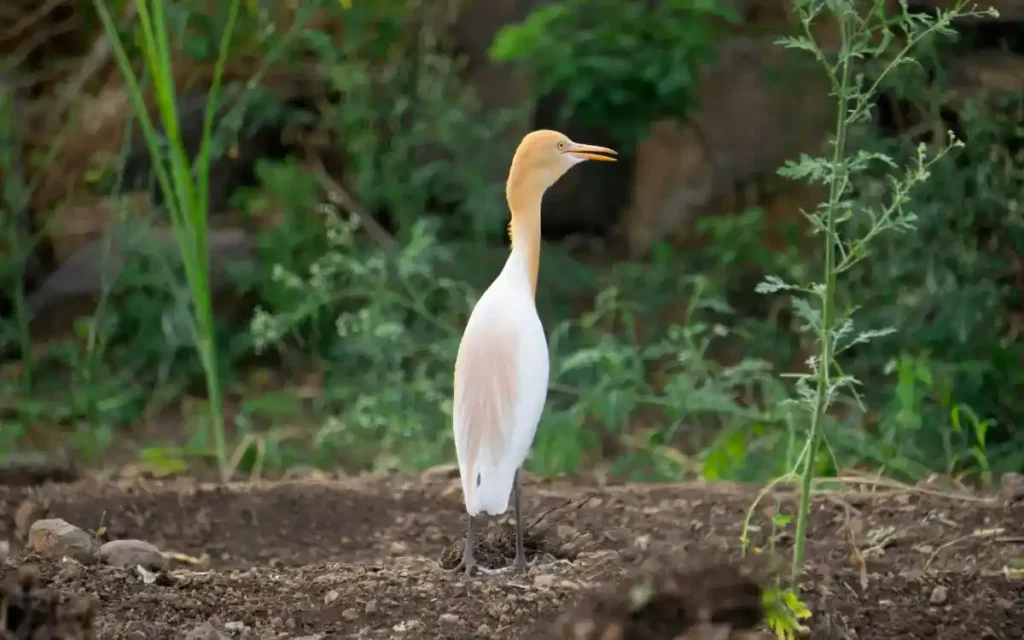
Scientific name: Ardea ibis
Length: 18–22 inches
Wingspan: 34–38 inches
Texas status: Widespread; most numerous from spring through fall
Call: Short, rough “rik-rak” notes and croaks near colonies
Listen: Western Cattle-Egret calls
The bird long called the Cattle Egret is now listed as the Western Cattle-Egret following a taxonomic split. It is a compact white heron with a short neck, thick yellow bill, and yellowish or dark legs. Breeding adults develop buff-orange feathers on the crown, chest, and back.
This is the Texas heron most likely to be found away from water. Flocks walk behind cattle, horses, tractors, and mowers, catching grasshoppers and other prey flushed from vegetation. Watch pastures, highway edges, ranchland, and freshly worked fields.
The short-legged, hunched shape gives it a different outline from Great and Snowy Egrets. Flocks often fly between feeding fields and communal roosts near sunset.
Do not confuse it with: Great Egret. A Great Egret is far taller, with a long dagger-shaped bill and long black legs. The Western Cattle-Egret has a short yellow bill and a compact body.
7. Snowy Egret
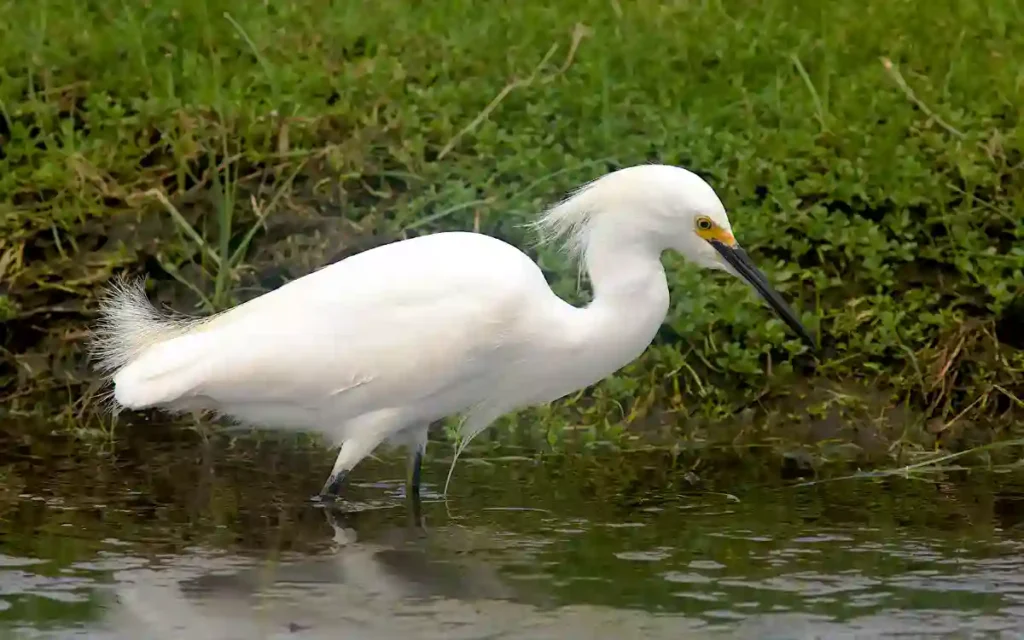
Scientific name: Egretta thula
Length: 22–26 inches
Wingspan: About 39 inches
Texas status: Common, especially near the Gulf Coast
Call: Raspy, nasal squawks, heard most often near colonies
Listen: Snowy Egret calls
Snowy Egrets are slender white birds with thin black bills, black legs, and yellow feet. Those bright feet are the quickest field mark, although mud or deep water can hide them. The face is normally yellow near the base of the bill.
Their feeding style is much busier than that of a Great Egret. A Snowy may run through shallows, shuffle its feet, flick its wings, or suddenly change direction while chasing minnows and shrimp.
They occur at salt marshes, coastal flats, ponds, rice fields, and flooded agricultural land. Coastal Texas holds the largest numbers, but migrants can appear well inland.
Do not confuse it with: Juvenile Little Blue Heron. Young Little Blues are white but have dull greenish legs and a thicker gray-and-black bill. They usually feed more slowly.
8. Least Bittern
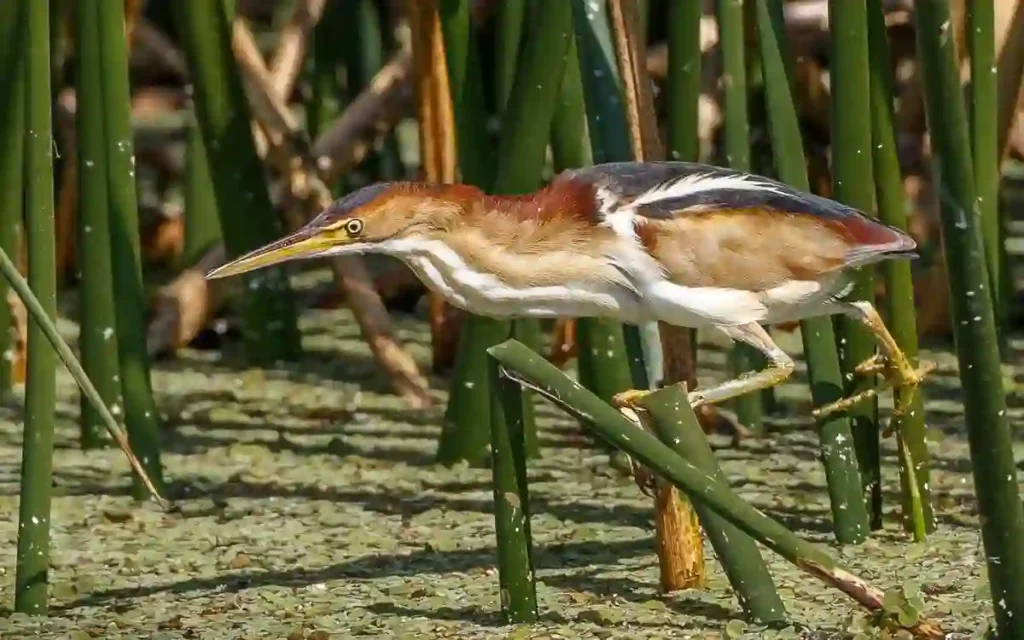
Scientific name: Botaurus exilis
Length: 11–14 inches
Wingspan: 16–18 inches
Texas status: Local spring and summer breeder; uncommon migrant
Call: A low, repeated “coo-coo-coo,” soft clucks, and ticking notes
Listen: Least Bittern calls
The Least Bittern is the smallest heron in Texas and one of the hardest to see. It has a pale buff neck and wing patches, a dark crown and back, and a thin pointed bill. Adult males have darker backs than females.
Least Bitterns move through cattails by gripping separate stems with their long toes. They can feed over water without leaving the vegetation. A small pale-and-dark bird flying weakly across a narrow opening may be the only view you get.
Search dense freshwater or brackish marshes from late spring into summer. Early morning and evening are good times to listen. Avoid playing recorded calls repeatedly around breeding birds.
Do not confuse it with: Green Heron. A Least Bittern is smaller and much paler, with broad buff wing patches. A Green Heron has dark greenish wings and a chestnut neck.
9. Yellow-Crowned Night-Heron
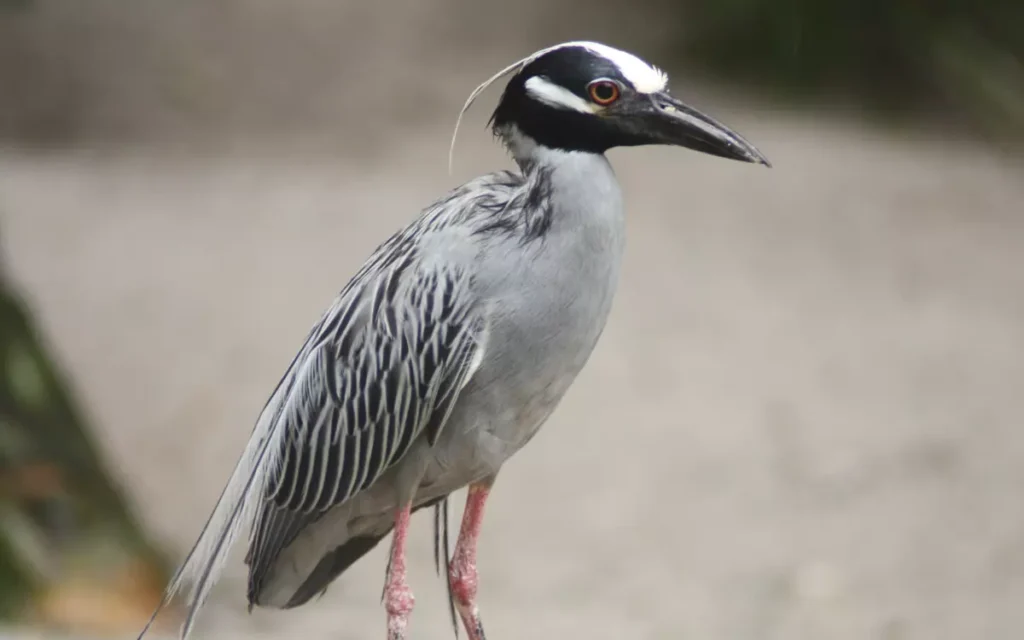
Scientific name: Nyctanassa violacea
Length: 22–28 inches
Wingspan: About 42–44 inches
Texas status: Regular along the coast and in eastern Texas; less common westward
Call: A harsh, repeated squawk or barking “kow”
Listen: Yellow-crowned Night-Heron calls
Adult Yellow-crowned Night-Herons have gray bodies, red eyes, thick black bills, creamy yellow crowns, and large white cheek patches. Their legs are longer than those of Black-crowned Night-Herons and extend farther beyond the tail in flight.
Crabs and crayfish form much of the diet, so these birds often hunt along tidal creeks, mangroves, bayous, swamp edges, and wet lawns. They sometimes nest in mature trees within coastal towns and wooded neighborhoods.
Young birds are brown with small pale spots and fine streaking. The thick all-dark bill is useful when the adult head pattern has not developed.
Do not confuse it with: Juvenile Black-crowned Night-Heron. A young Yellow-crowned has finer spotting, a longer-legged shape, and a heavy dark bill. A young Black-crowned usually has larger wing spots and a yellowish-and-dark bill.
10. Little Blue Heron
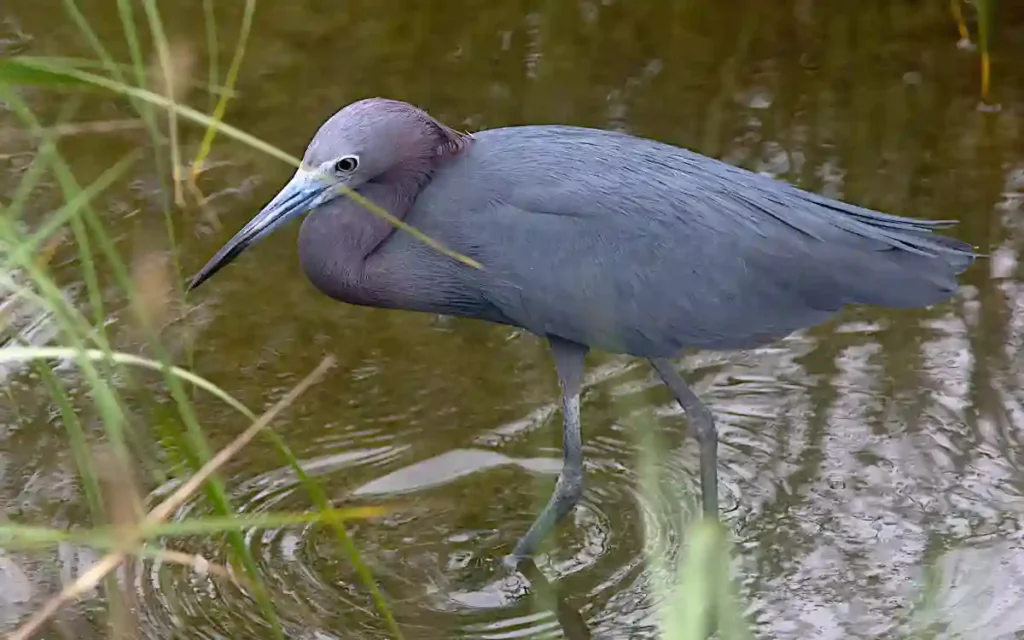
Scientific name: Egretta caerulea
Length: 22–29 inches
Wingspan: About 40 inches
Texas status: Regular along the coast and in eastern Texas
Call: Harsh croaks, squawks, and low clucking notes
Listen: Little Blue Heron calls
Adult Little Blue Herons have dark slate-blue bodies, purple-maroon heads and necks, and long gray bills tipped in black. Their legs are greenish. The colors often look almost black at a distance, especially under overcast skies.
Young birds are entirely white during their first year. As they molt into adult plumage, they develop irregular blue patches and are sometimes called “calico” herons. This patchy stage is useful for identification.
Little Blues feed slowly along the edges of ponds, marshes, ditches, lagoons, and rice fields. They are most widespread in the eastern half of Texas and near the coast.
Do not confuse it with: Snowy Egret when young. Check the bill and legs. A juvenile Little Blue has a two-toned gray-and-black bill and dull greenish legs; a Snowy has a black bill, black legs, and yellow feet.
11. Tricolored Heron
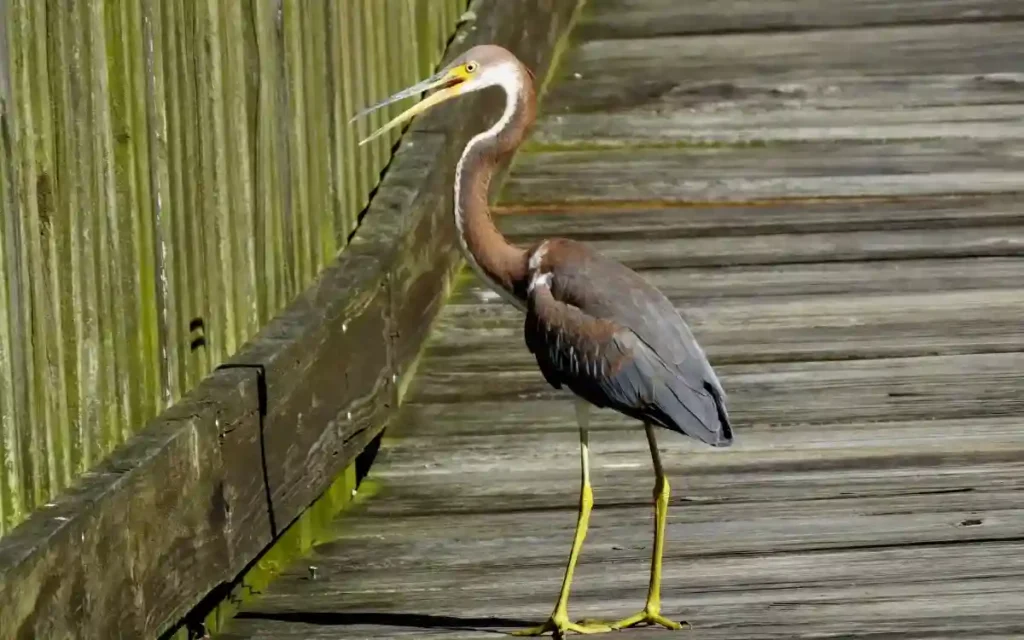
Scientific name: Egretta tricolor
Length: 22–27 inches
Wingspan: 36–38 inches
Texas status: Common along the Gulf Coast; less frequent inland
Call: Nasal squawks and low, hoarse croaks
Listen: Tricolored Heron calls
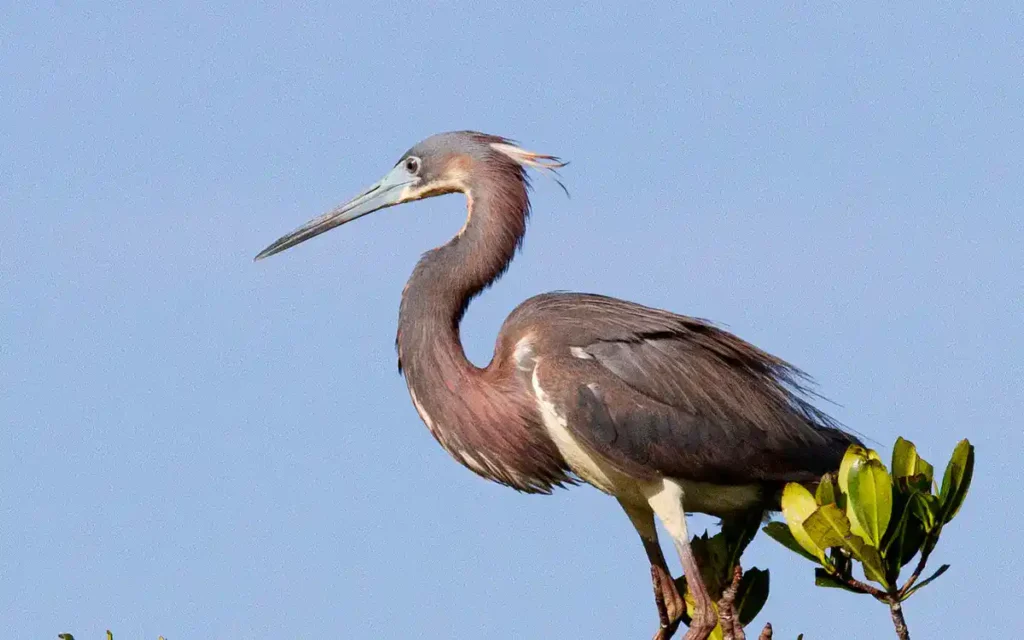
A Tricolored Heron has a blue-gray back, dark upper wings, a reddish or purplish neck, and a clean white belly. The white stripe running down the front of the neck can also stand out. Its long, thin bill and slim body look more delicate than those of a Great Blue Heron.
This bird is closely tied to coastal marshes, salt ponds, tidal creeks, lagoons, and shallow bays. It feeds with quick steps and sudden lunges, sometimes opening its wings to startle fish.
Young Tricolored Herons have more reddish brown across the neck and wings. They still retain the white belly, which is the most useful mark at a distance.
Do not confuse it with: Little Blue Heron. The Tricolored has a white belly and white line down the neck. An adult Little Blue is dark across the belly.
12. Reddish Egret
Scientific name: Egretta rufescens
Length: 27–32 inches
Wingspan: 46–49 inches
Texas status: Local year-round resident of the Gulf Coast; state threatened
Call: Low, guttural croaks and harsh calls near nesting sites
Listen: Reddish Egret calls
Dark-morph Reddish Egrets have slate-gray bodies, shaggy rusty heads and necks, blue-gray legs, and pink bills with black tips. A white morph also occurs. It has a fully white body but retains the two-toned bill and blue-gray legs.
The hunting behavior is hard to miss. A Reddish Egret may sprint, leap, spin, raise its wings, and create shade over the water while chasing fish. Great and Snowy Egrets rarely maintain this frantic style for so long.
Look on very shallow coastal flats, salt lagoons, tidal pools, and the edges of bays. This is a Texas coastal specialty and is not expected at an ordinary inland pond.
Texas lists the Reddish Egret as threatened. Nesting islands and feeding flats should be watched from a distance, especially during spring and summer.
Do not confuse it with: Little Blue Heron. A Reddish Egret is larger, has a shaggy rusty neck and thick two-toned bill, and feeds much more actively. A white-morph Reddish Egret differs from a Great Egret by its smaller size, blue-gray legs, shaggy neck, and pink-and-black bill.
What About the Bare-Throated Tiger-Heron?
The 2025 Texas Parks and Wildlife checklist recognizes 13 members of the heron family. Twelve are the expected species covered above. The 13th, the Bare-throated Tiger-Heron (Tigrisoma mexicanum), is marked accidental.
This large tropical heron normally lives from Mexico south through Central America. Texas’s accepted record came from Bentsen-Rio Grande Valley State Park in 2009. It should be mentioned for checklist accuracy, but adding it as a normal numbered bird would give readers the wrong idea about their chances of seeing one.
A suspected tiger-heron needs clear photographs and notes submitted to the Texas Bird Records Committee.
White Herons in Texas
Four regularly occurring Texas species can appear entirely white. Bill and leg color provide the fastest way to separate them.
| White Bird | Bill | Legs and Feet | Other Clue |
| Great Egret | Long and yellow | Black legs and feet | Very tall, slow feeding style |
| Snowy Egret | Thin and black | Black legs, yellow feet | Small and active |
| Juvenile Little Blue Heron | Gray with black tip | Dull greenish legs | Slower feeding; dusky wing tips may show |
| White-morph Reddish Egret | Pinkish with black tip | Blue-gray legs | Shaggy neck; runs and raises wings |
Western Cattle-Egrets are also white outside their breeding plumage. They have short yellow bills, compact bodies, and are often found in dry fields rather than shallow water.
Great Egret vs Snowy Egret
| Feature | Great Egret | Snowy Egret |
| Size | 37–41 in | 22–26 in |
| Bill | Yellow | Black |
| Feet | Black | Bright yellow |
| Neck | Long and smooth | Slimmer, with shaggy breeding plumes |
| Feeding | Slow stalking or standing | Runs, shuffles feet, changes direction |
If the feet are hidden, check bill color and compare the bird with nearby ducks. A Great Egret towers over most ducks; a Snowy Egret is much closer to them in body size.
Black-Crowned vs Yellow-Crowned Night-Heron
| Feature | Black-Crowned | Yellow-Crowned |
| Adult head | Solid black cap | Yellow crown and white cheek |
| Adult body | Pale gray | Darker gray |
| Bill | Medium, black | Thick, black |
| Legs in flight | Extend a short distance past tail | Extend farther past tail |
| Main food | Fish and varied aquatic prey | Crabs and crayfish |
| Juvenile marks | Large pale wing spots | Smaller, finer spots |
Adult birds are simple once the face is visible. Young birds deserve more care. Do not rely only on the amount of white spotting, which changes with wear and viewing distance.
American Bittern vs Least Bittern
An American Bittern is a medium-sized, thick-bodied marsh bird that usually stands at water level. It is heavily streaked from the neck through the body and has a wingspan of about three feet.
A Least Bittern is tiny, often grips reeds above the water, and has broad pale buff panels on the wings. Its wingspan is only 16–18 inches. Voice can settle the identification when the birds remain hidden: the American gives deep pumping notes, while the Least gives softer cooing or ticking calls.
Where to Find Herons in Texas
Upper Texas Coast
Bolivar Flats, Anahuac National Wildlife Refuge, Brazoria National Wildlife Refuge, and nearby coastal wetlands can hold large mixed groups. Great, Snowy, Little Blue, and Tricolored Herons are regular. Marsh edges also offer chances for bitterns and night-herons.
Central Texas
Brazos Bend State Park, reservoirs, city lakes, and river corridors support Great Blue Herons, Great Egrets, Green Herons, and Black-crowned Night-Herons. Yellow-crowned Night-Herons may nest along wooded waterways.
South Texas and Lower Rio Grande Valley
Wetlands near South Padre Island, Laguna Atascosa, Estero Llano Grande, and the Rio Grande provide a mix of coastal and inland species. Check shallow flats for Reddish Egrets and thick marshes for Least Bitterns.
Coastal Bend
The bays and flats around Corpus Christi, Port Aransas, Rockport, and Aransas National Wildlife Refuge are strong places for Reddish, Tricolored, Snowy, and Great Egrets. Low tide often concentrates feeding birds.
North and West Texas
Great Blue Herons and Great Egrets occur widely around lakes and rivers. Western Cattle-Egrets use open farmland. American Bitterns can appear in suitable marshes during migration and winter, while the coastal specialists become much less likely.
Before visiting, check water levels, access notices, and recent observations. Drought or flooding can move feeding birds from one wetland to another.
Best Time to See Texas Herons
Texas has herons during every month, but the mix changes.
Spring: Green Herons and Least Bitterns return to breeding habitat. Colonial nesting activity increases, and adults may show brighter facial skin or longer plumes.
Summer: Many resident species are nesting. Coastal and eastern wetlands can hold family groups and newly fledged birds. Give colonies plenty of room.
Fall: Young birds disperse, which can bring herons to ponds and wetlands away from their breeding areas. American Bitterns begin moving south.
Winter: Great Blue Herons, Great Egrets, night-herons, and coastal Reddish Egrets remain. American Bitterns are more likely in southern marshes, while Green Herons and Least Bitterns become less widespread.
How to Identify an Unknown Heron
Start with five observations:
- Overall color: Is it white, blue-gray, dark slate, or streaked brown?
- Bill: Note whether it is yellow, black, two-toned, thin, or heavy.
- Legs and feet: Yellow feet point strongly toward Snowy Egret; blue-gray legs can fit Reddish Egret.
- Feeding style: Slow stalking, frantic running, following cattle, and climbing reeds each narrow the choices.
- Habitat and region: Reddish Egrets belong on coastal flats, while American Bitterns stay inside vegetated marshes.
Take a photograph that includes the bill, legs, and feet. A full-body side view often helps more than a close portrait of the head.
Watching Herons Without Disturbing Them
Herons often nest in colonies called rookeries. A single island or stand of trees may hold hundreds of nests belonging to several species. Boats, drones, pets, and people approaching too closely can cause adults to leave eggs or chicks exposed.
Watch from established trails, public observation decks, or a boat kept well outside posted nesting areas. If adults repeatedly call, stand upright, circle overhead, or leave their nests as you approach, back away.
All native herons, egrets, and bitterns are protected under federal law. Do not collect feathers, disturb active nests, or try to handle a healthy wild bird.
More Texas Bird Guides
Heron habitat overlaps with many other Texas waterbirds. These guides can help with birds seen in the same areas:
- Ducks Found in Texas
- Geese of Texas
- Backyard Birds in Texas
- Hummingbirds in Texas
- Woodpeckers in Texas
- Falcons in Texas
- Owls in Texas
Frequently Asked Questions
How many types of herons live in Texas?
Texas has 12 herons, egrets, and bitterns that occur regularly or seasonally. The official state checklist also includes the Bare-throated Tiger-Heron as an accidental, bringing the documented Ardeidae total to 13.
What is the most common heron in Texas?
The Great Blue Heron is the most widespread and familiar across the state. It occurs year-round around ponds, rivers, reservoirs, bays, and marshes. Great Egrets are also common across much of Texas.
What is the largest heron in Texas?
The Great Blue Heron is the largest regular Texas heron. It measures about 38–54 inches long and may have a wingspan close to 6.5 feet.
What is the smallest Texas heron?
The Least Bittern is the smallest. It measures only 11–14 inches long and spends most of its time climbing through cattails and other dense marsh plants.
Are egrets a type of heron?
Yes. Egrets belong to the same family as herons and bitterns. The word “egret” is a common name rather than a separate scientific family.
Which white heron has yellow feet?
The Snowy Egret has black legs and bright yellow feet. A Great Egret has black feet and a yellow bill. Juvenile Little Blue Herons have dull greenish legs instead of sharply contrasting black legs and yellow feet.
Why do herons fly with their necks pulled back?
The folded neck helps balance their long, heavy bill during flight. It also gives flying herons a compact S-necked outline. Cranes and storks usually keep their necks straight.
Do herons stay in Texas during winter?
Several do. Great Blue Herons, Great Egrets, night-herons, and Reddish Egrets can remain year-round in suitable parts of Texas. American Bitterns become more likely during migration and winter, while Least Bitterns are mainly warm-season birds.
Is the Reddish Egret endangered?
The Reddish Egret is listed as threatened by the State of Texas. It is not federally listed as endangered. Texas holds an important part of the United States breeding population.
What should I do if I find an injured heron?
Keep people and pets away, do not offer food or water, and contact a permitted wildlife rehabilitator. Herons have strong pointed bills and can injure someone who tries to pick them up without training.