20 Red Birds in North America: Types and Identification Guide
A red bird sitting on your fence could be a Northern Cardinal, House Finch, or even a Summer Tanager. They may look similar at first, but their size, beaks, wing patterns, and behavior can tell you which bird you’re seeing.
North America has many types of red birds. Some have bright red feathers across most of their bodies, while others show red only on their heads, chests, throats, or wings. Males and females can also look surprisingly different.
Here are 20 red birds found in North America, with identification clues and details about where to look for each one. This guide focuses on species seen in the United States and Canada, including birds that appear only in certain regions or seasons.
Red Birds at a Glance: Quick Identification Chart
If you’ve just spotted a red bird, start with the feature that caught your attention. Its crest, bill, or wing markings may narrow your search immediately.
| Red Bird | Main Identification Clue | Where to Look |
|---|---|---|
| Northern Cardinal | Red body, pointed crest, black face | Backyards and shrubs |
| Summer Tanager | Entirely red adult male | Southern woodlands |
| Scarlet Tanager | Red body with black wings | Eastern forests |
| Vermilion Flycatcher | Bright red head and front, dark mask | Southwestern open areas |
| Hepatic Tanager | Brick-red body, gray cheeks | Southwestern mountain forests |
| Pine Grosbeak | Large, rosy-red bird with gray wings | Northern forests |
| Red Crossbill | Red body, crossed bill | Conifer forests |
| White-winged Crossbill | Red body, two white wing bars | Northern conifer forests |
| House Finch | Red head and chest, streaked belly | Backyards and feeders |
| Purple Finch | Raspberry-red head, breast, and back | Forests and feeders |
| Cassin’s Finch | Bright red crown, lighter underparts | Western mountains |
| Redpoll | Tiny red cap, often a rosy chest | Northern forests and winter flocks |
| Pyrrhuloxia | Gray body, red face, yellow bill | Southwestern deserts |
| Painted Bunting | Red belly, blue head, green back | Southern brushy habitats |
| Red-headed Woodpecker | Fully red head, black-and-white body | Open woodlands |
| Red-breasted Sapsucker | Red head and breast, white wing patch | Western forests |
| Red-bellied Woodpecker | Red crown, black-and-white barred back | Eastern woodlands |
| Rose-breasted Grosbeak | Red triangle on a black-and-white chest | Eastern forests |
| Ruby-throated Hummingbird | Small green bird with a red throat | Eastern gardens |
| Red-winged Blackbird | Black body, red shoulder patches | Marshes and fields |
20 Types of Red Birds in North America
Mostly Red Birds
These birds have some of the most noticeable red plumage in North America. Most appear red or rosy across much of their bodies, although several have dark wings, tails, or facial markings.
1. Northern Cardinal (Cardinalis cardinalis)
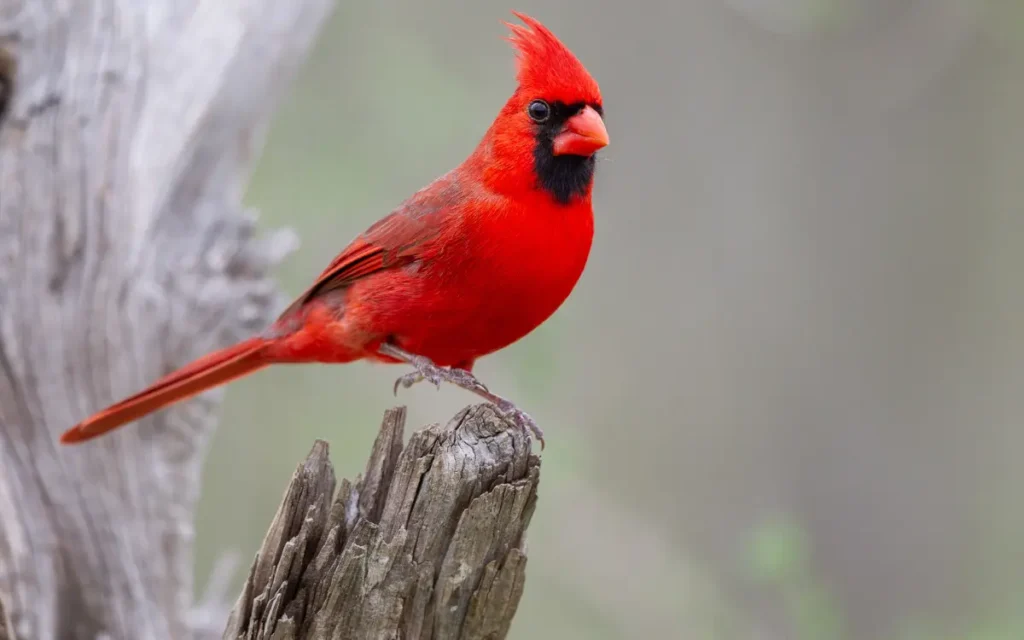
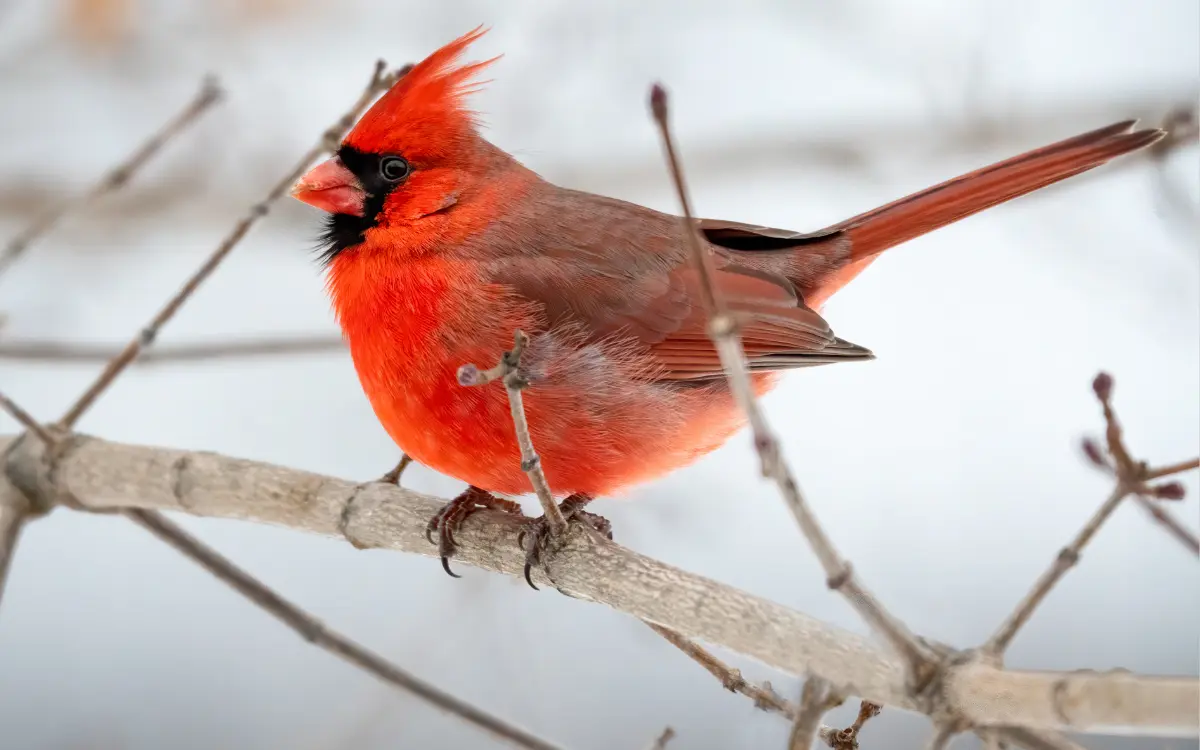
The Northern Cardinal is one of the easiest red birds to recognize. An adult male has a bright red body, a pointed crest, a black mask around its face, and a thick orange-red bill.
Female cardinals look quite different. Their feathers are mostly warm brown, with red along the wings, tail, and crest. Both sexes have a similar body shape and strong seed-cracking bill.
Cardinals live throughout much of the eastern and central United States, extending into parts of the Southwest and southern Canada. They are year-round residents in much of their range.
Look for them in backyards, parks, woodland edges, and dense shrubs. They often feed close to the ground or visit feeders for sunflower seeds.
Identification tip: A red bird with a pointed crest, black face, and thick reddish bill is very likely a male Northern Cardinal. Unlike many other red songbirds, cardinals do not migrate away for winter.
2. Summer Tanager (Piranga rubra)
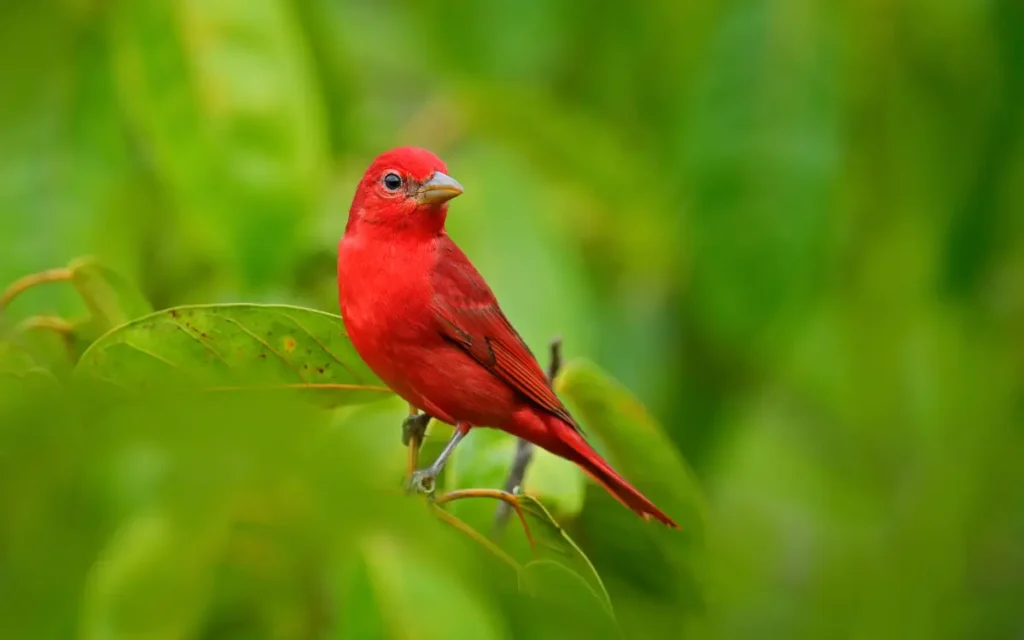
The adult male Summer Tanager is one of the few North American birds that appears almost entirely red. Its head, chest, belly, back, and wings are all red, with no black wing patches like those of a Scarlet Tanager.
Females are yellowish, sometimes with greener upperparts. Young males may show an uneven mixture of red and yellow feathers as they develop adult plumage.
Summer Tanagers breed across parts of the southern United States, from the Southeast through Texas and into southwestern woodland habitats. Most leave the United States during winter.
You are more likely to find them in open forests and wooded stream corridors than around backyard seed feeders. They spend much of their time high in trees, searching for insects, including bees and wasps.
Identification tip: If the bird looks entirely red but lacks a cardinal’s pointed crest and black face, check for a Summer Tanager. Its larger, pale bill is another clue.
3. Scarlet Tanager (Piranga olivacea)
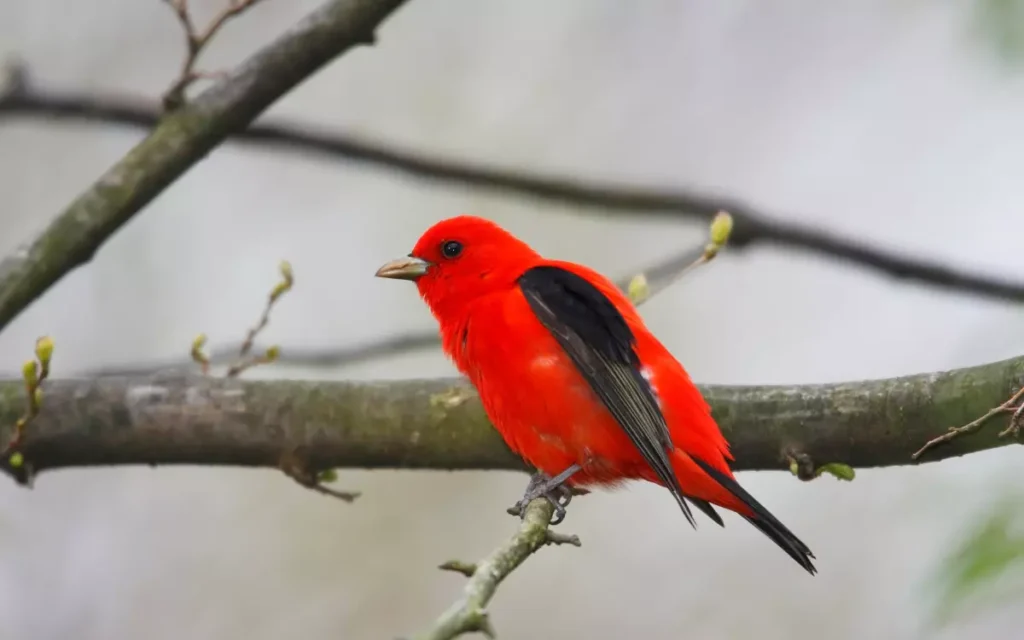
A breeding male Scarlet Tanager has a red head and body set against black wings and a black tail. This sharp contrast makes it different from the uniformly red Summer Tanager.
Females and young birds are olive-yellow with darker wings. Adult males also lose most of their red appearance after the breeding season, replacing it with yellow-green plumage while retaining dark wings.
Scarlet Tanagers breed in eastern North America’s deciduous and mixed forests. They spend winter farther south, mainly in South America.
Despite their bright breeding colors, these birds can be difficult to find. They often remain high among tree leaves, where their songs and calls may give away their location.
Identification tip: During spring and summer, a red songbird with solid black wings and tail is a strong match for a male Scarlet Tanager, especially in an eastern forest.
Related article: 9 Red Birds In South Carolina:Photo & Id
4. Vermilion Flycatcher (Pyrocephalus rubinus)
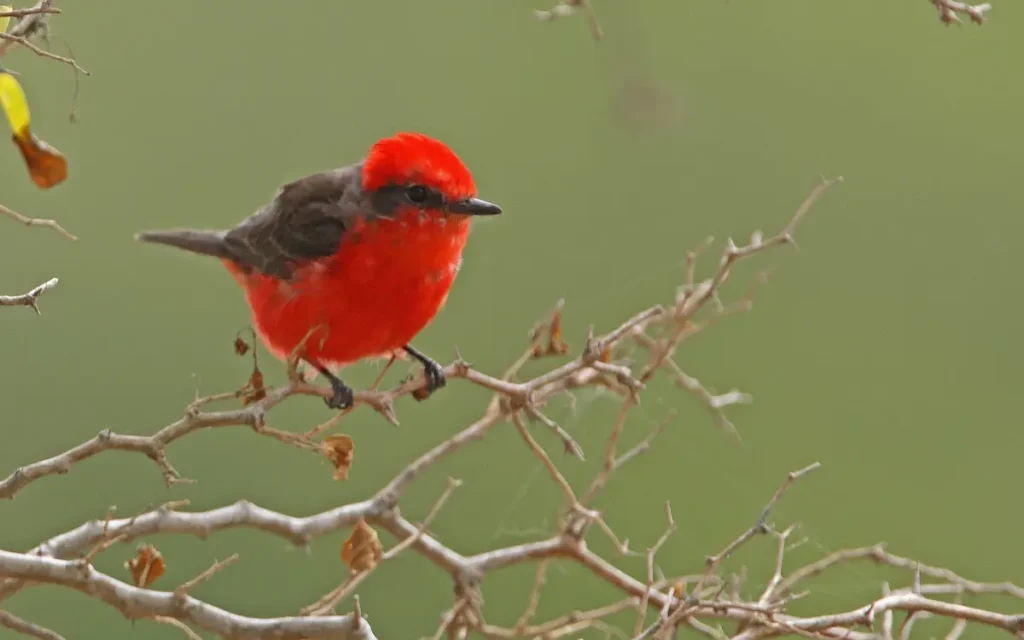
The male Vermilion Flycatcher has a brilliant red head and underparts, with a dark mask, back, wings, and tail. Its red coloring is especially noticeable against the dry vegetation of its preferred habitats.
Females are mostly gray-brown above, with pale underparts and a soft peach or salmon-colored wash below.
This small flycatcher occurs in parts of the southwestern United States, particularly in Arizona, New Mexico, Texas, and southern California. It favors open areas with scattered bushes, fence posts, or trees near water.
Rather than searching among leaves for food, Vermilion Flycatchers often sit on exposed perches and watch for insects. They fly out to catch prey and frequently return to a nearby perch.
Identification tip: Watch its behavior. A small red-and-dark bird repeatedly flying out from a low branch to catch insects may be a Vermilion Flycatcher.
5. Hepatic Tanager (Piranga flava)
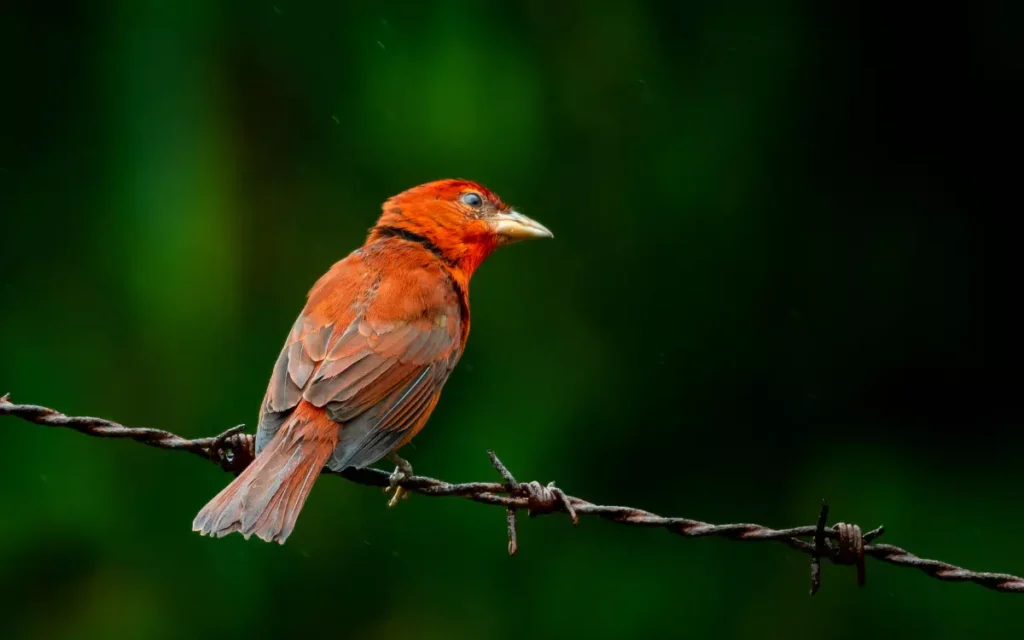
The Hepatic Tanager has a duller, deeper red color than the Summer Tanager. Adult males appear brick-red, with grayish patches around the cheeks and a heavy bill.
Females and young males are more yellowish or olive-toned, often with a noticeable grayish cheek area.
In the United States, Hepatic Tanagers occur mainly in southwestern mountain regions, including Arizona, New Mexico, and parts of western Texas.
They favor open pine and pine-oak woodlands, where they move through branches looking for insects and fruit. Their slower, more deliberate feeding movements can help separate them from smaller woodland birds.
Identification tip: If you see a large, dull-red tanager in southwestern mountain woodland, look for gray cheeks and a thick bill before identifying it as a Hepatic Tanager.
6. Pine Grosbeak (Pinicola enucleator)
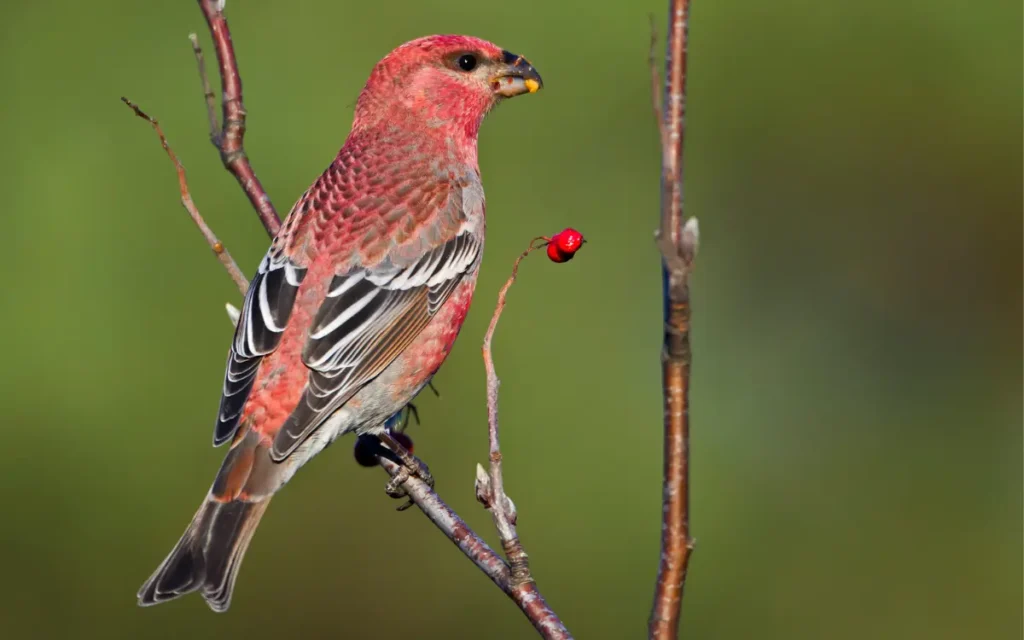
The Pine Grosbeak is a large, rounded finch with a thick, short bill. Adult males have rosy-red plumage mixed with gray, while the wings are dark with white wing bars.
Females and young birds are mainly gray, often with yellowish or orange tones on the head and rump.
These birds live in northern forests across Canada and Alaska, as well as some western mountain regions of the United States. During certain winters, they move farther south when food is harder to find.
Pine Grosbeaks eat seeds, buds, and fruit. In winter, small groups may feed on berries in trees or visit feeders in suitable northern areas.
Identification tip: A large, plump pinkish-red bird with a small, thick bill and white wing bars in a northern forest may be a Pine Grosbeak.
Related article: 15 Red Birds Live In Arizona
7. Red Crossbill (Loxia curvirostra)
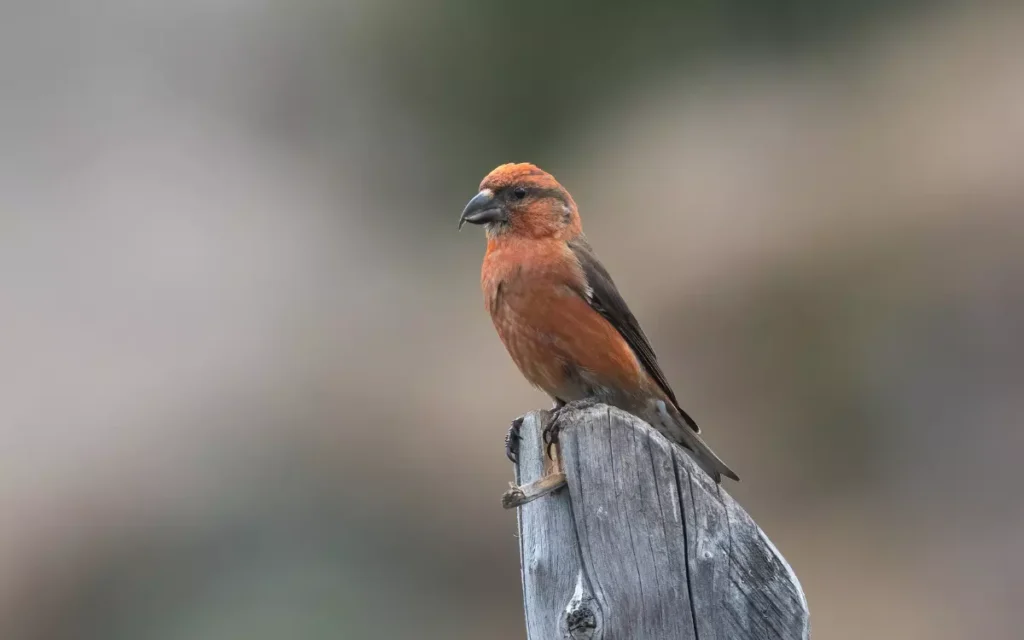
The Red Crossbill has one feature that separates it from nearly every other bird on this list: the tips of its upper and lower bill cross over each other.
Adult males are usually brick-red or orange-red, with darker wings and tails. Females are generally yellowish or olive-brown, while young birds are heavily streaked.
Red Crossbills inhabit conifer forests across much of northern and western North America. Their movements are irregular because they follow changes in seed availability.
Their unusual bill helps them pry apart cone scales and reach the seeds inside. You may spot them hanging from cones or moving in noisy groups between evergreen trees.
Identification tip: Even when the bird is partly hidden, try to see the bill. Crossed bill tips are much more dependable than its shade of red.
8. White winged Crossbill (Loxia leucoptera)
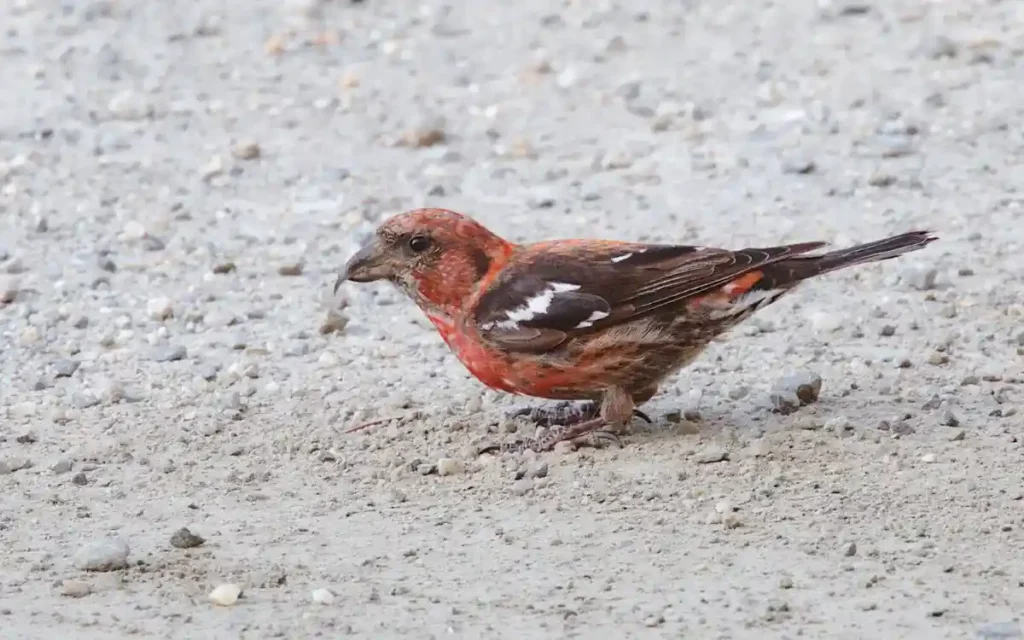
The White-winged Crossbill is another reddish finch with crossed bill tips. Adult males have rosy-red bodies, black wings, and two clear white wing bars.
Females are more yellowish or greenish, but they also show the white wing markings. Young birds are generally brown and streaked.
This species is associated with northern conifer forests, especially areas with spruce and tamarack trees. It occurs across much of Canada and Alaska, sometimes moving south into the United States during winters when cone crops are poor.
Like the Red Crossbill, it uses its unusual bill to remove seeds from cones. Birds often feed together in active flocks.
Identification tip: Look for the white wing bars. A reddish crossbill with two bold white bars is a White-winged Crossbill.
Small Red and Reddish Finches
Not every small red bird is a cardinal. Several North American finches have red feathers concentrated around their heads, breasts, or backs. These species can look alike at feeders, so the position of the red markings matters.
Related article: 16 Red Birds In Florida With Identification Tips
9. House Finch (Haemorhous mexicanus)
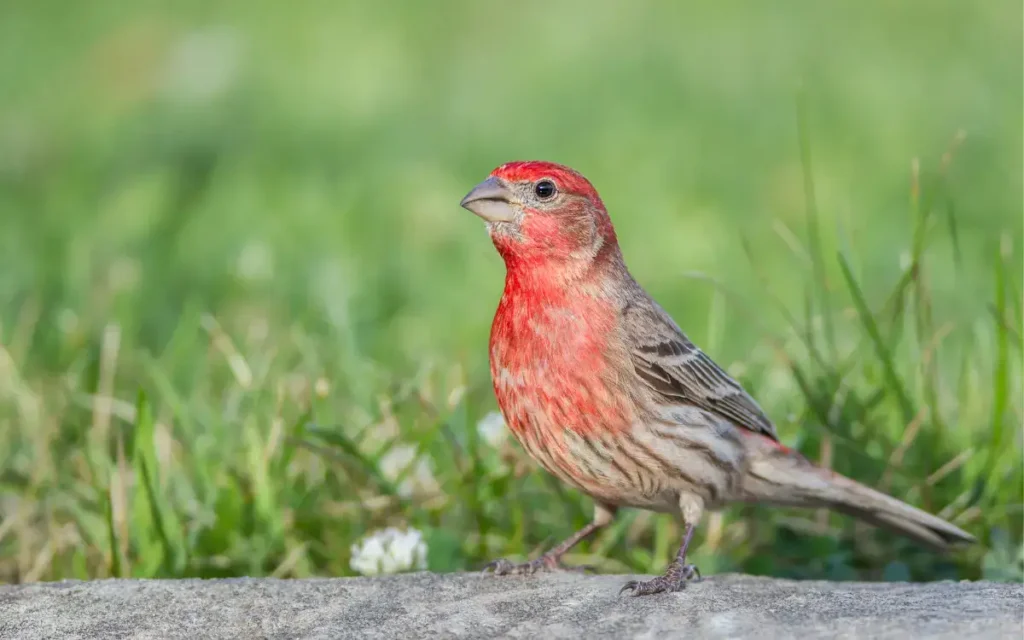
The House Finch is a familiar small bird around homes, parks, and feeders. Adult males usually have red around the forehead, face, throat, and upper chest, while the back and belly remain brown and streaked.
The amount of red varies. Some males look bright red, while others may appear orange or yellowish because their feather pigments are influenced by diet.
Females have no red plumage. They are brown with blurry streaks underneath and a fairly plain face.
House Finches occur across much of the United States and southern Canada. They are often seen in small groups, feeding on seeds or gathering in nearby trees.
Identification tip: A small red-headed bird with heavy brown streaks along the sides and belly is often a male House Finch, especially at a backyard feeder.
10. Purple Finch (Haemorhous purpureus)
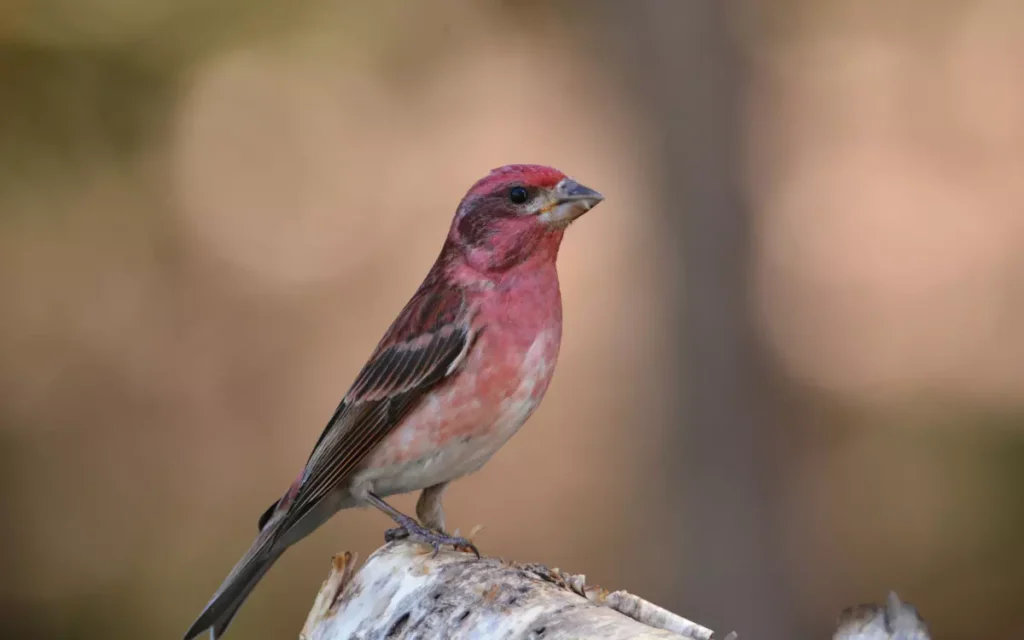
Despite its name, the male Purple Finch is usually raspberry-red rather than purple. The color spreads across its head, chest, and much of its back, giving it a more evenly washed appearance than a typical House Finch.
Females have brown streaked plumage with a stronger face pattern, including a pale eyebrow and darker cheek and throat markings.
Purple Finches live in forest habitats in parts of Canada, the northeastern United States, and along the Pacific Coast. Their presence farther south and around feeders can vary with the season and food supply.
They feed on seeds, buds, and berries. Black oil sunflower seeds may attract them to feeders in areas where they occur.
Identification tip: Compare the belly and face. A male Purple Finch usually has more red across its upper body and less obvious flank streaking than a House Finch, though western birds can be harder to separate.
11. Cassin’s Finch (Haemorhous cassinii)
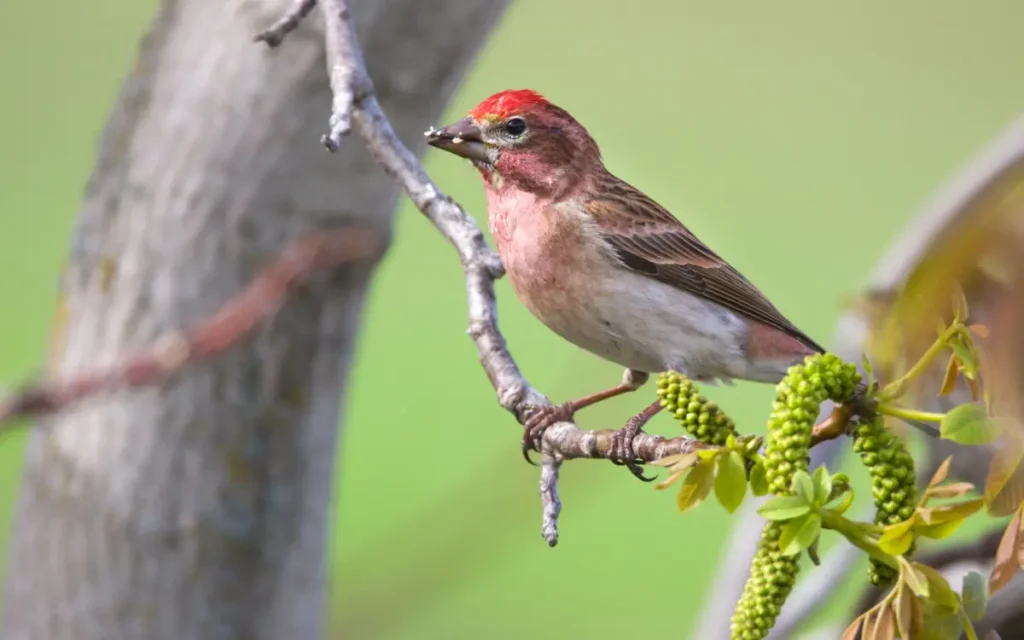
Cassin’s Finch resembles the House Finch and Purple Finch, but its strongest red coloring is usually concentrated on a raised or peaked crown.
Adult males have a rosy head, red-washed upperparts, pale underparts, and a relatively straight bill profile. Females are brown with clear dark streaks on the chest and belly.
These birds favor mountain forests in western North America, where they feed on seeds and tree buds. They sometimes move to lower elevations during winter.
Cassin’s Finches may visit sunflower seed feeders in mountain towns, but they are less likely to appear in ordinary lowland neighborhoods than House Finches.
Identification tip: In western mountain country, look for a bright red crown that appears slightly peaked. Check the bill shape and underpart streaking to separate it from other finches.
12. Redpoll (Acanthis flammea)

The Redpoll is a small northern finch with a red patch on its forehead. Many adult males also have pink or rosy-red feathers across the chest.
Its body is mostly brown, gray, and white, with dark streaks. A small yellowish bill and black area around the chin provide useful identification clues.
Redpolls breed in northern regions of Canada and Alaska, often around tundra edges and open northern woodland. During some winters, flocks travel farther south into the United States.
They feed on seeds from birch, alder, and other plants. Redpolls may hang upside down while feeding and sometimes gather in large, restless flocks.
Identification tip: A tiny, streaked winter finch with a red forehead patch and a small yellow bill may be a Redpoll.
Taxonomy note: Birds previously called Common Redpoll, Hoary Redpoll, and Lesser Redpoll have been grouped into one species, Redpoll, under the 2024 classification change. Older bird guides may still list them separately.
Birds With Red Heads, Chests, or Other Markings
The birds below are not red across most of their bodies. They are included because their red patches are among their easiest identification features.
13. Pyrrhuloxia (Cardinalis sinuatus)
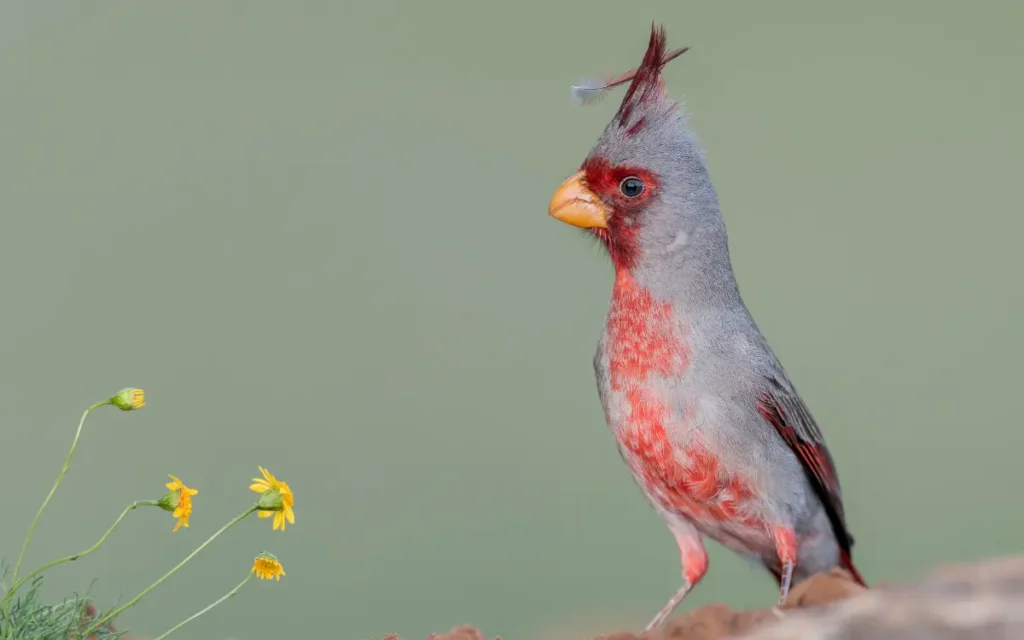
The Pyrrhuloxia looks like a gray relative of the Northern Cardinal. It has a pointed crest, long tail, and red feathers around the face, wings, chest, and tail.
Males have stronger red markings, while females are mostly gray-brown with smaller red patches.
Its thick yellowish bill is one of the easiest ways to recognize it. The upper edge is noticeably curved, giving the bill a short, rounded appearance.
Pyrrhuloxias live in dry southwestern habitats, including desert scrub, open mesquite woodland, and areas with cactus.
Identification tip: A gray cardinal-shaped bird with red patches and a yellow, curved bill is likely a Pyrrhuloxia. It is especially worth considering in Arizona, New Mexico, and western Texas.
Related article: 8 Bird Similar To Cardinal With Photo
14. Painted Bunting (Passerina ciris)
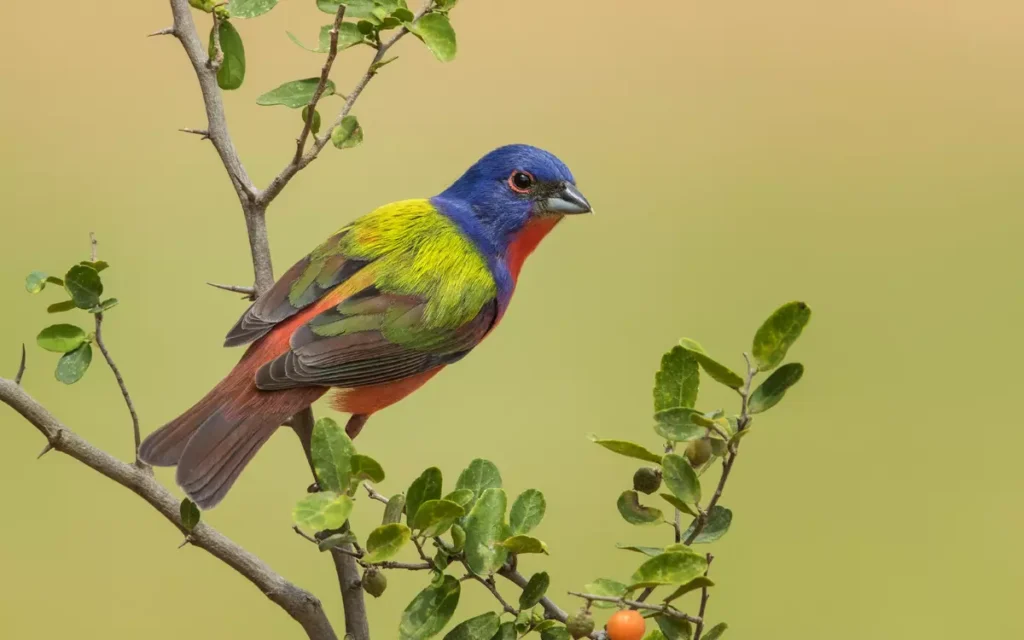
A male Painted Bunting has a remarkable combination of colors: a blue head, green back, and bright red underparts and rump.
Females are almost entirely green or yellow-green, without the male’s contrasting red and blue.
Painted Buntings breed in parts of the south-central and southeastern United States. They often remain hidden in dense bushes, woodland edges, and overgrown fields.
These birds mainly eat seeds, though they also take insects, especially during the breeding season. Males may sing from an exposed perch before dropping back into cover.
Identification tip: A small bird with a blue head and bright red belly is unmistakably a male Painted Bunting. If the bird is entirely green, check its small, thick bill and range.
15. Red-headed Woodpecker (Melanerpes erythrocephalus)
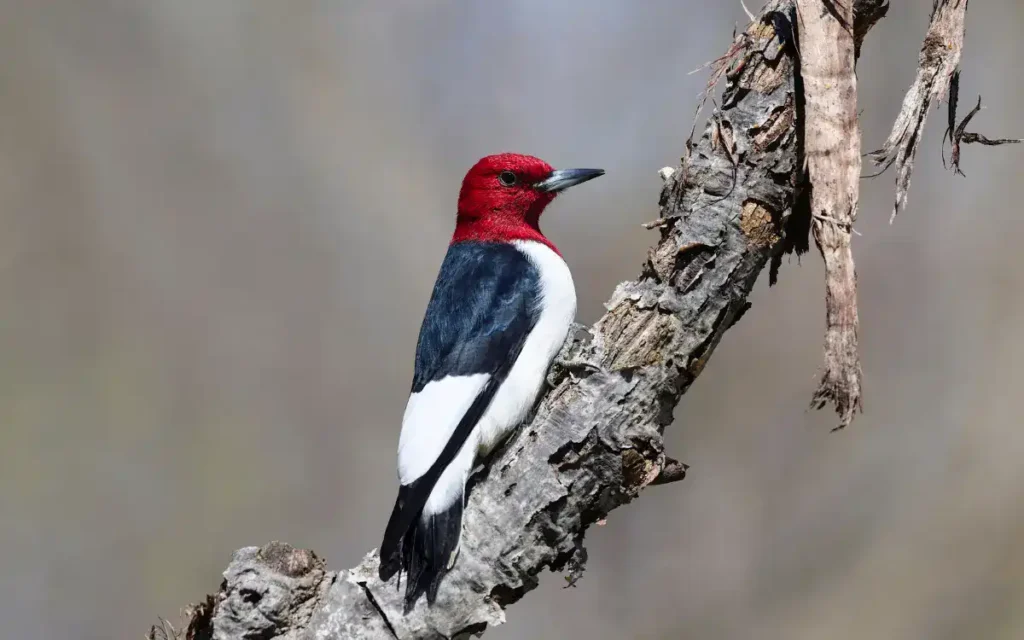
The adult Red-headed Woodpecker has a fully red head, neck, and throat. Its back is mostly black, while the belly and large wing patches are white.
Both adult males and females share this appearance. Young birds initially have brownish heads instead of bright red ones.
Red-headed Woodpeckers are found in parts of eastern and central North America. They favor open woods, woodland edges, and areas with dead trees or scattered mature trees.
They eat insects, fruits, nuts, and seeds. They may also catch flying insects and store food in tree crevices.
Identification tip: Unlike a Red-bellied Woodpecker, the adult Red-headed Woodpecker has red covering the entire head. Its large, clean white wing patches are another strong clue.
16. Red breasted Sapsucker (Sphyrapicus ruber)

The Red-breasted Sapsucker has red covering much of its head and upper breast. Its back is patterned in black and white, with a noticeable vertical white patch on each folded wing.
Males and females look similar, while younger birds have duller brownish plumage.
This woodpecker lives in western North America, from the Pacific Northwest into California and nearby mountain regions. Some populations move to lower elevations or more coastal areas during winter.
Red-breasted Sapsuckers drill orderly rows of shallow holes into tree bark. They return to these holes to drink sap and feed on insects attracted to it.
Identification tip: If you find a red-headed woodpecker beside neat rows of small sap holes in a western forest, check for a Red-breasted Sapsucker.
17. Red bellied Woodpecker (Melanerpes carolinus)
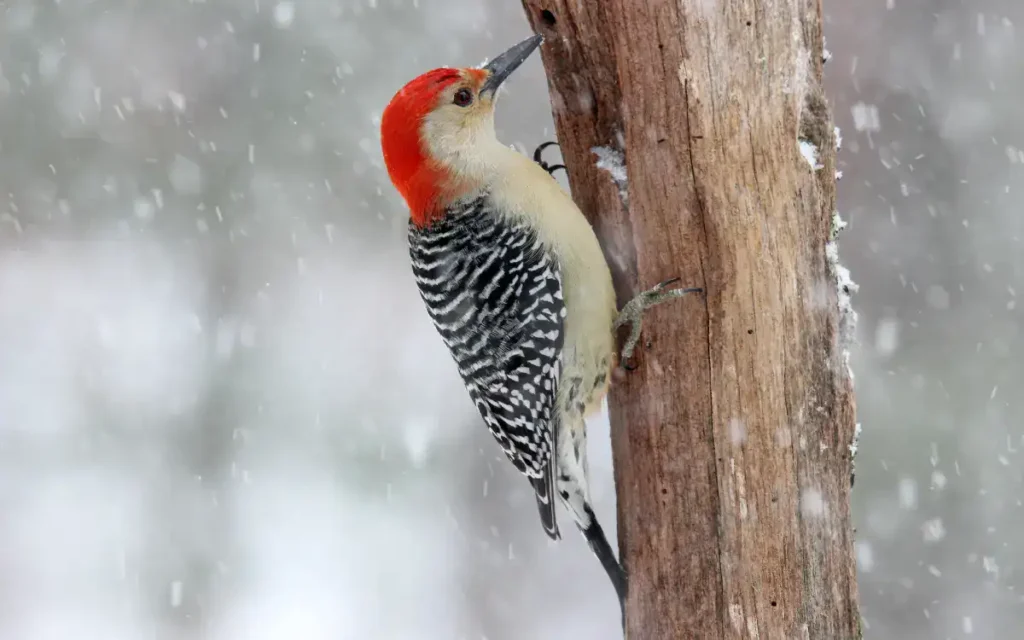
The Red-bellied Woodpecker is named for the faint reddish wash on its lower belly, but that color is often hard to see.
Its red head markings are much easier to notice. Adult males have red extending across the crown and nape, while females have red mainly on the nape and around the back of the head.
The back has narrow black-and-white bars that create a striped pattern.
Red-bellied Woodpeckers are regular residents of many eastern woodlands, parks, and wooded neighborhoods. They often visit feeders for suet, nuts, and seeds.
Identification tip: A woodpecker with a striped black-and-white back and red crown is more likely a Red-bellied Woodpecker than a Red-headed Woodpecker.
18. Rose breasted Grosbeak (Pheucticus ludovicianus)
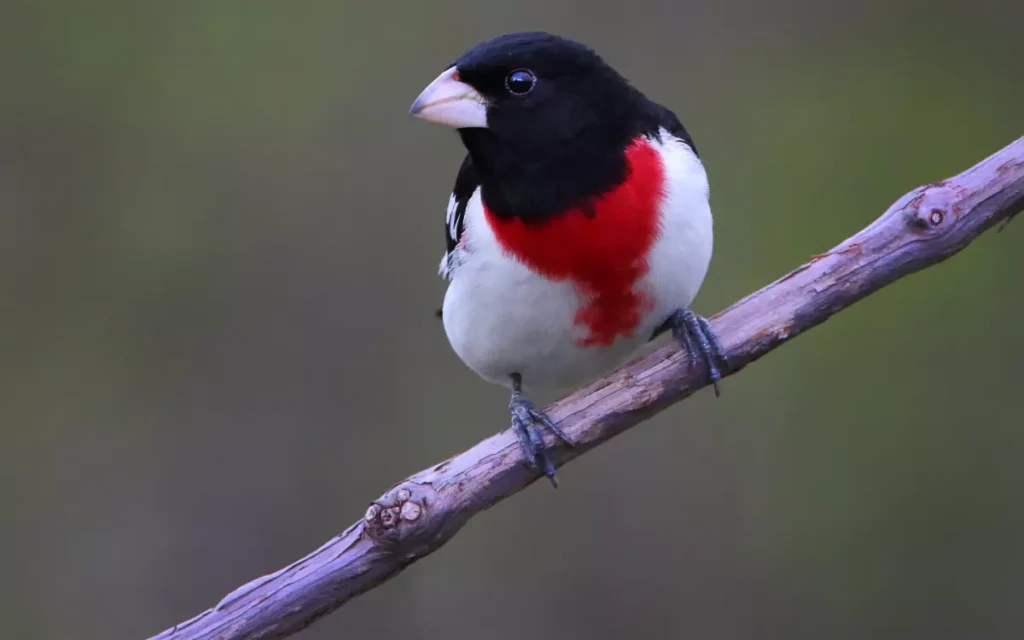
The male Rose-breasted Grosbeak is mostly black and white, with a bright red triangular patch that extends down from the throat onto the breast.
It has a large, pale, triangular bill suited to cracking seeds. Females look very different, with brown streaks, a pale eyebrow, and no bright red breast patch.
Rose-breasted Grosbeaks breed across much of eastern North America, including southern Canada. They winter in warmer regions farther south.
They live in forests, woodland edges, and areas with tall trees. During migration, they may visit backyard feeders for sunflower seeds.
Identification tip: If you see a black-and-white songbird with a large bill and a red triangle on its chest, look for a male Rose-breasted Grosbeak.
19. Ruby throated Hummingbird (Archilochus colubris)
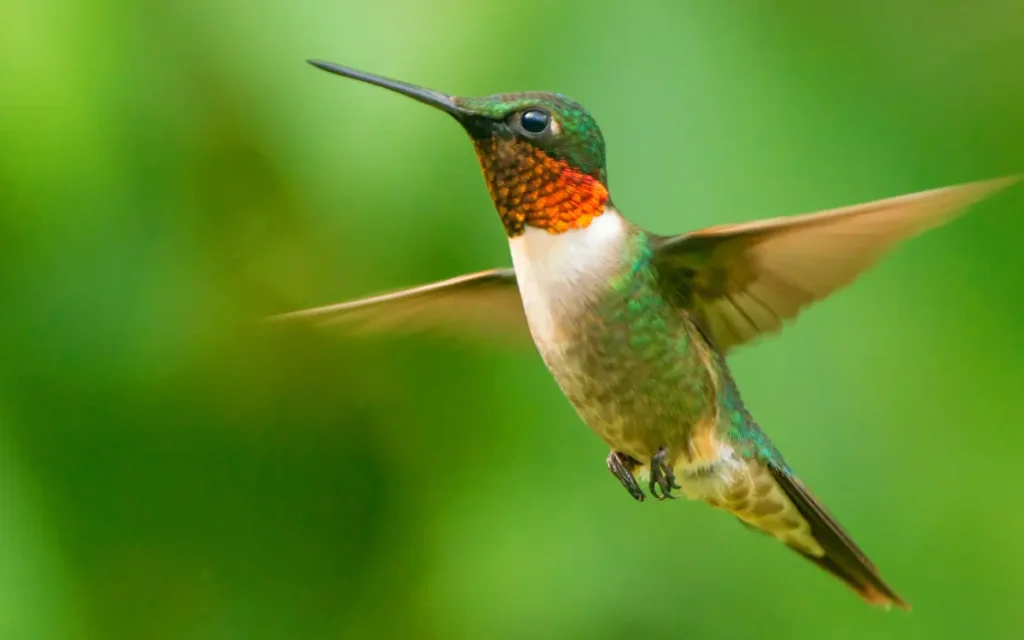
The Ruby-throated Hummingbird is a tiny green bird with a red throat patch in adult males. The red feathers are iridescent, meaning their appearance changes with the angle of the light.
In shade, the throat may look almost black. When sunlight strikes it at the right angle, it can suddenly appear ruby-red.
Females have green upperparts and pale underparts without the male’s red throat.
This hummingbird breeds across much of eastern North America and migrates south for winter. It visits flowers and nectar feeders, and also catches small insects.
Identification tip: A tiny green bird that hovers near flowers and briefly flashes a red throat may be a male Ruby-throated Hummingbird.
20. Red winged Blackbird (Agelaius phoeniceus)
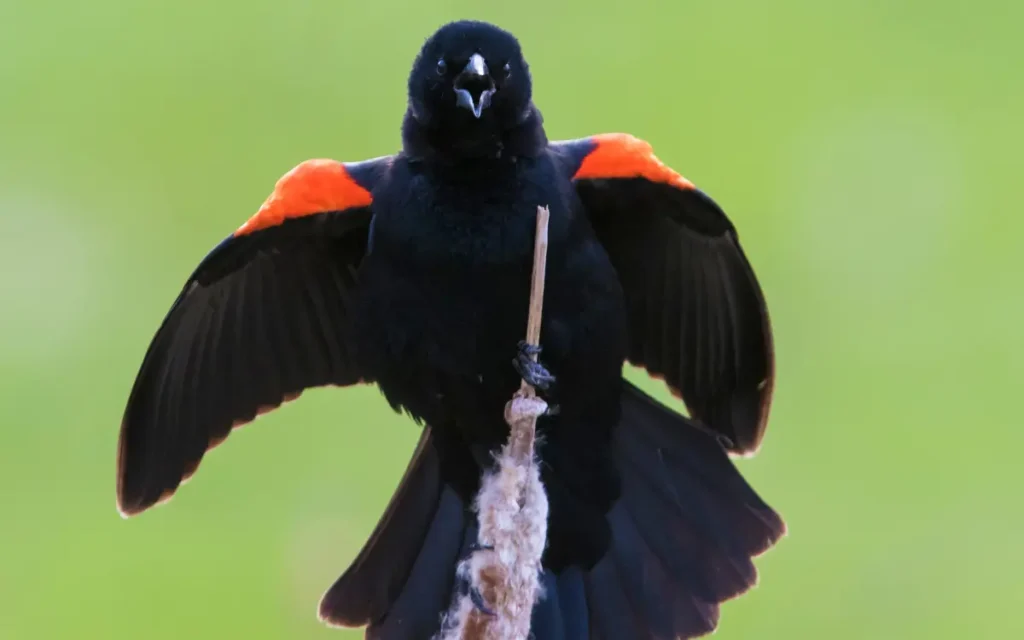
The male Red-winged Blackbird has a glossy black body with red shoulder patches, usually edged with yellow. These patches become especially noticeable when the bird spreads its wings or displays from a perch.
Females are brown and heavily streaked, with no obvious red shoulder patches. Their appearance can resemble a large sparrow.
Red-winged Blackbirds are widespread across North America. They are especially common around marshes, wet fields, ponds, and grassy areas.
Males often perch on cattails, fence posts, and wires while singing and displaying their red wing patches.
Identification tip: A black bird with red patches on its shoulders is likely a male Red-winged Blackbird, particularly if it is sitting near a marsh or open field.
How to Identify a Red Bird You Saw
Color may be the first feature you notice, but it should not be the only one you use. A few quick observations can help you separate similar birds.
Check How Much of the Bird Is Red
Start by looking at where the red feathers appear.
A bird that is red across nearly its entire body may be a Summer Tanager or Northern Cardinal. If the wings are solid black, a breeding male Scarlet Tanager becomes a stronger possibility.
Red only on the head and upper chest often points toward a finch. A fully red head on a black-and-white woodpecker suggests a Red-headed Woodpecker.
If only a small part of the bird is red, note exactly where that patch is. Red shoulders, a red throat, and a red forehead can indicate entirely different species.
Look at the Beak, Crest, and Wings
Bill shape tells you something about a bird’s identity.
Cardinals and finches have thick bills used to crack seeds. Tanagers have stout bills suited to a varied diet. Flycatchers have wider, flatter bills for catching insects.
Crossbills have crossed bill tips, woodpeckers have chisel-like bills, and hummingbirds have long, narrow bills.
A pointed crest is useful when identifying cardinals and Pyrrhuloxias. Wing markings can be just as helpful, especially the black wings of Scarlet Tanagers or the white wing bars of White-winged Crossbills.
Consider the Bird’s Size and Habitat
A red bird in a backyard is more likely to be a Northern Cardinal or House Finch than a bird that usually lives deep in a forest.
A reddish bird among pine cones may be a crossbill. A red-headed woodpecker climbing a tree belongs to a very different group from a red bird catching insects from a fence post.
Think about size too. A House Finch is much smaller than a Pine Grosbeak, while a Ruby-throated Hummingbird is tiny compared with either one.
Don’t Rely on Red Feathers Alone
Bird colors can change with age, sex, season, and lighting.
Female Summer Tanagers are yellow, not red. Female House Finches are brown and streaked. Male Scarlet Tanagers lose much of their red appearance outside the breeding season.
Even the angle of sunlight can matter. A male Ruby-throated Hummingbird may appear to have a black throat until the light catches its feathers.
When you’re uncertain, combine several clues instead of choosing a species based on color alone.
Common Red Birds That Look Similar
Some red birds are particularly easy to confuse, especially when you’re seeing them from a distance.
| Similar Birds | Best Way to Tell Them Apart |
|---|---|
| Northern Cardinal vs. Summer Tanager | Cardinal has a pointed crest and black face; Summer Tanager lacks the black mask |
| House Finch vs. Purple Finch | House Finch usually has stronger belly streaking; male Purple Finch has more raspberry-red across the upper body |
| Purple Finch vs. Cassin’s Finch | Cassin’s Finch usually has a brighter, peaked red crown and favors western mountain habitats |
| Scarlet Tanager vs. Summer Tanager | Breeding male Scarlet Tanager has black wings; adult male Summer Tanager is red all over |
| Red Crossbill vs. White-winged Crossbill | White-winged Crossbill has two bold white wing bars |
| Red-headed vs. Red-bellied Woodpecker | Red-headed has a completely red adult head; Red-bellied has a barred back and limited red on its head |
| Northern Cardinal vs. Pyrrhuloxia | Pyrrhuloxia has a mostly gray body and yellow bill |
| House Finch vs. Redpoll | Redpoll has a small red forehead patch and usually a smaller yellow bill |
These are starting points rather than absolute rules. When a bird’s markings are unclear, its location, calls, and behavior may help settle the identification.
For more examples of cardinal look-alikes, see our birds similar to cardinals guide.
Where Can You Find Red Birds in North America?
Different red birds prefer different regions and habitats. Some stay in one area throughout the year, while others migrate or move unpredictably in search of food.
Red Birds in the Eastern United States
Northern Cardinals and House Finches are familiar sights in many eastern neighborhoods.
During the warmer months, eastern forests also support Scarlet Tanagers, Summer Tanagers in southern areas, and Rose-breasted Grosbeaks.
Red-headed and Red-bellied Woodpeckers occur in suitable woodland habitats, although their local abundance differs.
Red Birds in the Western United States
Western mountain forests are home to Cassin’s Finches and several crossbill populations.
Vermilion Flycatchers and Hepatic Tanagers occur in suitable southwestern habitats, while Pyrrhuloxias favor desert scrub.
Along the Pacific Coast, Red-breasted Sapsuckers can be found in wooded areas.
Red Birds in Southern States
The southern United States is especially good for seeing several species that are absent or uncommon farther north.
Summer Tanagers breed across much of the South. Painted Buntings occur in suitable brushy habitats, while Pyrrhuloxias and Vermilion Flycatchers are associated with parts of the Southwest.
Texas is particularly varied, with eastern woodland species, western desert birds, and migratory visitors appearing in different parts of the state.
Red Birds in Canada and Northern Forests
Northern forests support birds such as Pine Grosbeaks, Redpolls, and White-winged Crossbills.
Some remain within northern breeding areas for much of the year. Others move south when food supplies change.
Redpolls and crossbills may appear farther south during certain winters, but these movements are not equally strong every year.
Which Red Birds Visit Backyard Feeders?
Not every red bird eats seeds or uses backyard feeders. Cardinals and finches are generally more likely to visit seed feeders than insect-eating tanagers and flycatchers.
| Red Bird | Suitable Food or Feeder | What to Expect |
|---|---|---|
| Northern Cardinal | Black oil sunflower seeds, safflower | Regular visitor in much of its range |
| House Finch | Black oil sunflower seeds | Frequent visitor, often in groups |
| Purple Finch | Black oil sunflower seeds | Seasonal or year-round visitor, depending on region |
| Cassin’s Finch | Sunflower seeds | May visit in western mountain areas |
| Pine Grosbeak | Sunflower seeds, suitable natural fruit sources | Occasional winter visitor in northern regions |
| Redpoll | Nyjer and small seeds | Mainly a winter visitor south of its breeding range |
| Rose-breasted Grosbeak | Sunflower seeds | Often seen during migration or breeding season |
| Red-bellied Woodpecker | Suet and nuts | Regular visitor in wooded eastern neighborhoods |
| Ruby-throated Hummingbird | Nectar feeders and suitable flowers | Visits during warmer months across much of its eastern range |
Native plants, clean water, and safe shelter can also make a yard more useful to birds.
For hummingbirds, use a mixture of one part plain white sugar to four parts water. Avoid red dye, honey, and artificial sweeteners. Clean nectar feeders frequently, especially during hot weather.
Keep all feeders clean and remove damp or spoiled food. If birds appear sick, temporarily remove feeders and clean the feeding area to reduce the risk of disease spreading.
Why Are Some Birds Red?
Red feathers come from the way pigments and feather structures interact with light. The reason a cardinal looks red is different from the reason a hummingbird’s throat can suddenly flash red.
How Birds Get Their Red Feather Color
Many birds get red, orange, and yellow feather colors from pigments called carotenoids.
These pigments originate in plants and enter birds’ diets through plant foods or animals that have eaten plants. Birds can also modify certain carotenoids inside their bodies.
The male House Finch is a familiar example. Its plumage may range from yellow-orange to red, depending partly on the pigments available in its diet when new feathers grow.
Why Male Birds Are Often Brighter Than Females
In several red bird species, males have stronger red coloring than females.
Northern Cardinals, Summer Tanagers, and Purple Finches all show noticeable differences between male and female plumage.
Bright male feathers may be connected with mate choice and visual signals during breeding. However, the reasons for plumage differences vary among species.
Not every red bird follows this pattern. Male and female adult Red-headed Woodpeckers, for example, look much alike.
Can Red Birds Change Color?
Yes, but the kind of change depends on the species.
Some birds replace colorful feathers during a seasonal molt. Male Scarlet Tanagers, for example, are bright red during the breeding season but become mostly yellow-green afterward.
Young male Summer Tanagers gradually develop red plumage, sometimes showing mixed yellow and red feathers.
Other apparent changes are caused by lighting rather than new feathers. A Ruby-throated Hummingbird’s throat may look black from one angle and bright red from another because of its feather structure.
Frequently Asked Questions About Red Birds
What is the most common red bird in North America?
Northern Cardinals and House Finches are two of the most familiar red birds around North American homes. Cardinals are especially common in much of the eastern United States, while House Finches occur widely across the continent. The most common species depends on your location and habitat.
What small red birds visit backyard feeders?
House Finches, Purple Finches, and Cassin’s Finches are examples of small birds with red markings that may visit seed feeders. Redpolls can also appear at feeders during winter in northern regions and farther south during some years.
What red bird looks like a cardinal but has no crest?
A male Summer Tanager may be mistaken for a cardinal because both can appear bright red. However, the Summer Tanager lacks the cardinal’s prominent pointed crest and black facial mask. Its bill also looks different.
What kind of bird is completely red?
The adult male Summer Tanager is one of the closest examples of an entirely red North American bird. Unlike the Scarlet Tanager, it does not have solid black wings.
What red bird has black wings?
A breeding male Scarlet Tanager has a red body with black wings and a black tail. Male White-winged Crossbills also have dark wings, but theirs have two prominent white wing bars.
Are female red birds also red?
Some are, but many are not. Female Northern Cardinals are mostly brown with reddish markings, while female Summer Tanagers are yellowish. Both sexes of adult Red-headed Woodpeckers have red heads.
What red birds can you see in winter?
Northern Cardinals, House Finches, and some woodpeckers remain in their ranges throughout winter. Pine Grosbeaks, Redpolls, and crossbills may also be seen in northern regions or farther south during certain winters.
Are all red birds cardinals?
No. Cardinals are only one group among many birds with red feathers. Finches, tanagers, grosbeaks, woodpeckers, hummingbirds, flycatchers, and blackbirds can all show red plumage.
The easiest way to separate them is by their bill shape, body size, feather pattern, habitat, and behavior.