20 White Birds in North America (Identification Guide)
A large white bird standing beside a pond might be a Great Egret, Snowy Egret, or young Little Blue Heron. All three can look similar from a distance, but their bills, legs, and feeding habits give them away.
North America has many types of white birds, from long-necked swans and pelicans to small Snow Buntings and Arctic owls. Some remain white throughout adulthood, while others develop white feathers only during certain seasons or stages of life.
This guide covers 20 white birds found in North America, including their identifying features, preferred habitats, and where you’re most likely to see them.
White Birds at a Glance: Quick Identification Chart
If you’ve spotted a white bird and want to identify it, start by checking its bill, legs, size, and surroundings.
| White Bird | Main Identification Feature | Where to Look |
| Great Egret | Tall, yellow bill, black legs | Marshes, ponds, lakes |
| Snowy Egret | Black bill, black legs, yellow feet | Coastal and inland wetlands |
| Western Cattle-Egret | Short neck, stocky body, often yellow bill | Pastures, fields |
| Little Blue Heron | White juvenile, two-toned bill | Southern wetlands |
| Great Blue Heron (white form) | Very large white heron | Coastal southern Florida |
| White Ibis | Long curved reddish bill, pink legs | Southeastern wetlands |
| Wood Stork | Dark bare head, heavy bill | Southern swamps |
| Whooping Crane | Very tall, red crown, black wingtips | Selected wetlands, rare |
| American White Pelican | Huge orange-yellow bill with pouch | Lakes and coastal waters |
| Trumpeter Swan | Large white body, black bill | Northern lakes and rivers |
| Tundra Swan | Black bill, often a small yellow spot | Arctic breeding areas, winter wetlands |
| Mute Swan | Orange bill, black knob | Ponds and lakes |
| Snow Goose | White body, pink bill, black wingtips | Fields and wetlands |
| Ross’s Goose | Small white goose, short pink bill | Migration and winter flocks |
| Snowy Owl | White body, yellow eyes | Arctic tundra, winter fields |
| White-tailed Ptarmigan | Completely white in winter | Alpine mountains |
| Snow Bunting | Small white-and-dark songbird | Northern open fields |
| White-tailed Kite | White head and belly, black shoulders | Open grasslands |
| Northern Gannet | White seabird, black wingtips | Atlantic Ocean |
| Ring-billed Gull | White body, gray back, ringed yellow bill | Lakes, fields, coasts |
White Wading Birds and Wetland Species
Several of North America’s most familiar white birds live around water. Egrets, herons, ibises, and storks may share the same wetlands, but their feeding styles and body shapes are different.
1. Great Egret (Ardea alba)
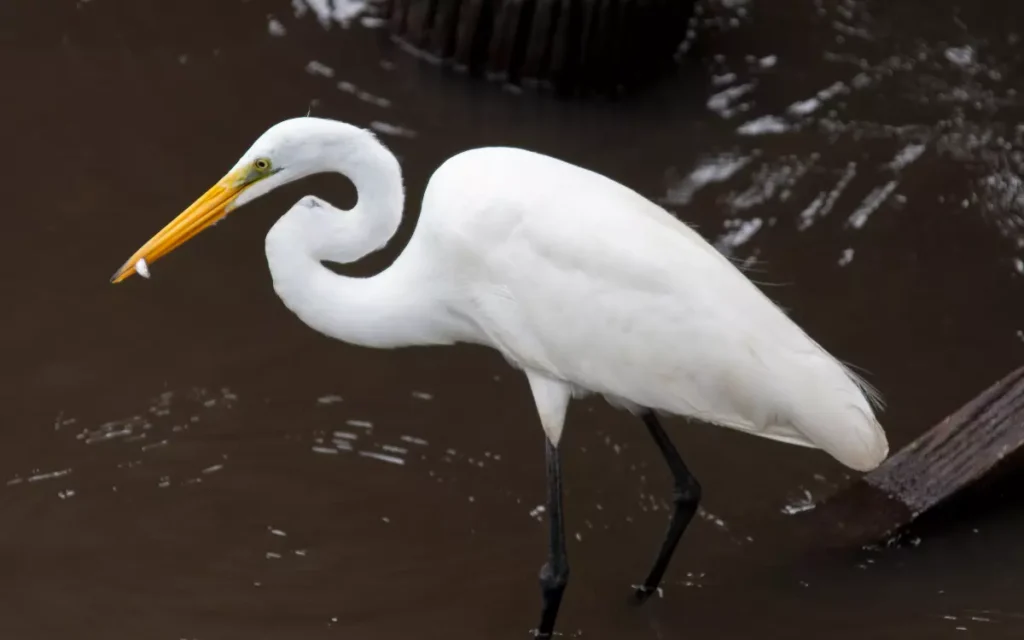
The Great Egret is a tall, slender white bird with a long neck, a straight yellow bill, and black legs. Its clean white feathers are easy to notice against dark water or green marsh vegetation.
It stands quietly in shallow water, waiting for fish to come within reach. When prey appears, the egret extends its neck quickly and catches it with its pointed bill.
Great Egrets occur in freshwater and coastal wetlands across much of the United States. Many birds from northern breeding areas travel south for winter, while those in warmer regions may remain throughout the year.
Both males and females look similar. During the breeding season, adults grow long, fine feathers along their backs.
How to identify: Look for a large white wading bird with a yellow bill and black legs. It is noticeably taller than a Snowy Egret and usually moves slowly while hunting.
2. Snowy Egret (Egretta thula)
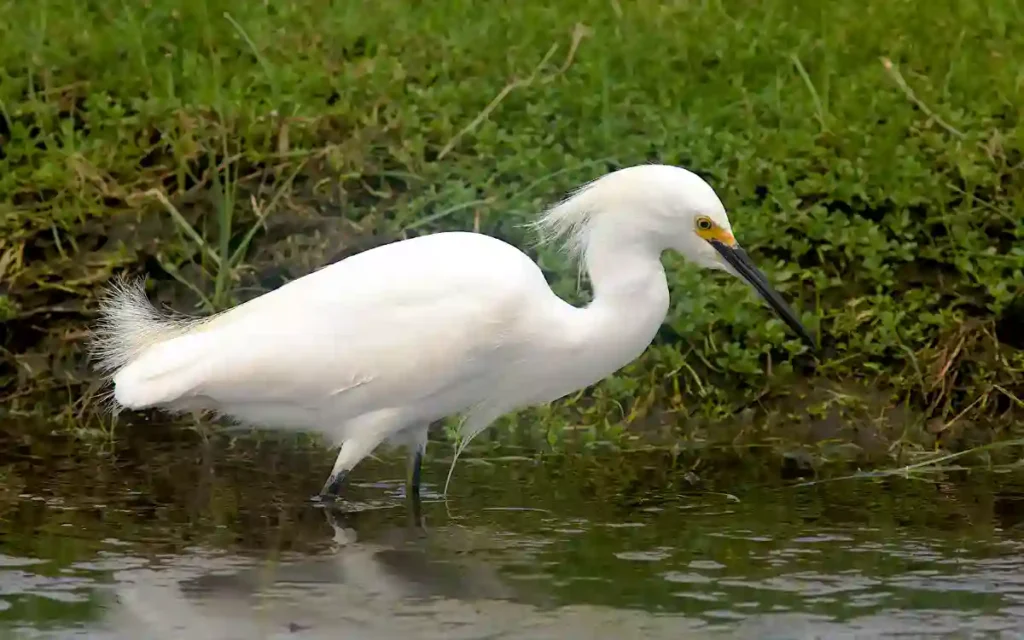
The Snowy Egret is smaller and more active than the Great Egret. It has a slender black bill, black legs, and yellow feet that are sometimes called golden slippers.
The feet are among its best identification features, although they can be difficult to see when the bird stands in water.
Snowy Egrets often move quickly through shallow pools, stirring the water with their feet or running after small fish and crustaceans.
They are especially familiar along coastal wetlands in the southern United States, though they also breed in scattered inland areas and migrate through other regions.
During breeding season, adults develop long white head and back plumes.
How to identify: A medium-sized white egret with a black bill and yellow feet is a Snowy Egret. Watch its quick, active feeding movements.
3. Western Cattle Egret (Ardea ibis)
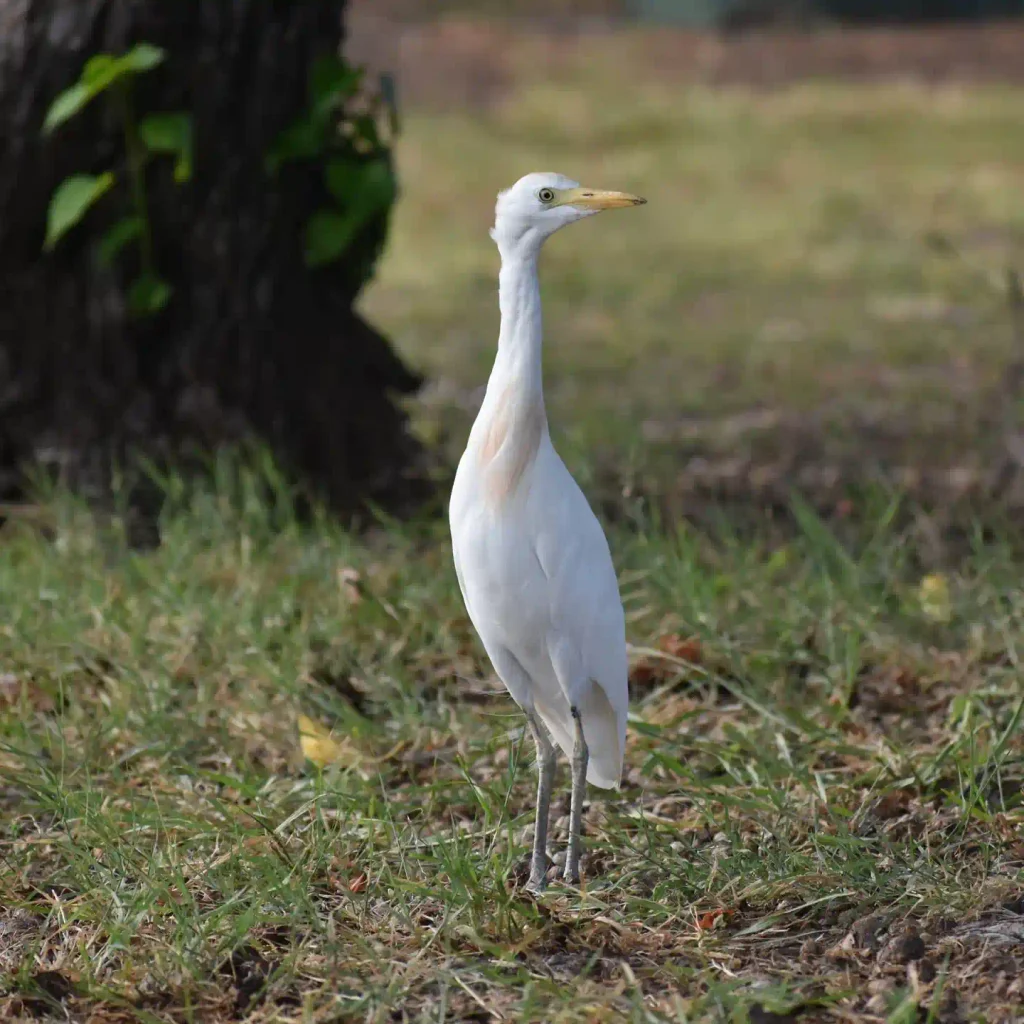
The Western Cattle-Egret, often simply called a Cattle Egret, is a compact white bird with a short neck, relatively short legs, and a thick bill.
Unlike most egrets, it spends much of its time in grassy fields rather than standing in water.
You may see these birds walking beside cattle, horses, or farm equipment, catching insects disturbed by movement through the grass.
Outside the breeding season, adults are mostly white. Breeding birds develop pale golden or buff-colored feathers around the head, chest, and back. Their bill and leg colors also change with age and breeding condition.
Western Cattle-Egrets occur in suitable agricultural and wetland habitats across parts of the United States, particularly in warmer regions.
How to identify: A small, stocky white egret following grazing animals in a field is more likely a Western Cattle-Egret than a Snowy Egret.
Name note: Older field guides may list this bird as Cattle Egret under the scientific name Bubulcus ibis.
Related article: 20 White Birds In Alabama
4. Little Blue Heron, Juvenile (Egretta caerulea)
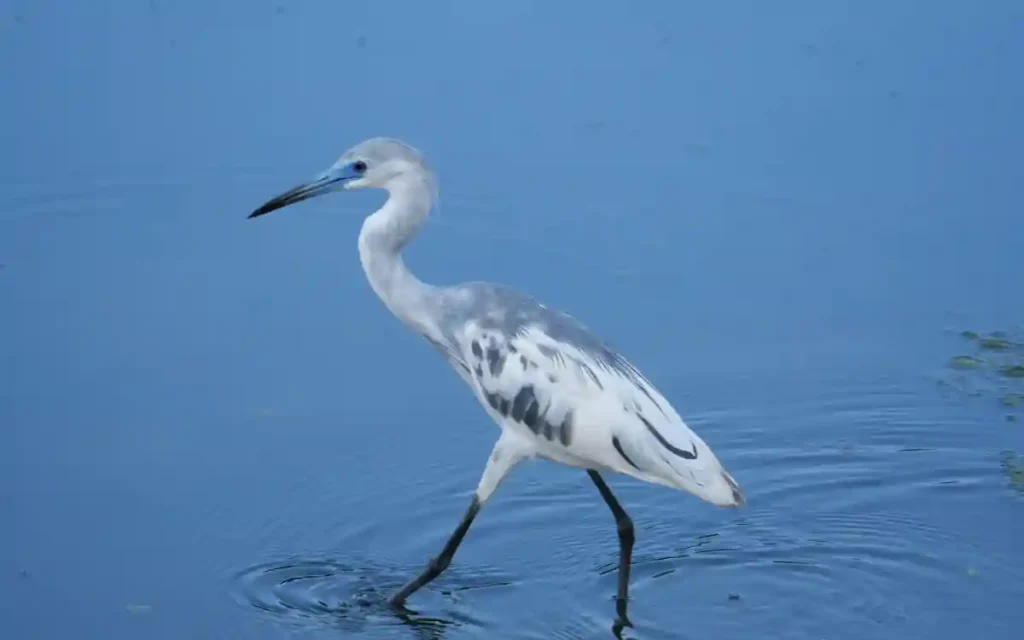
The name Little Blue Heron can be misleading when identifying young birds.
Juveniles are almost entirely white, while adults develop dark blue-gray bodies with purplish heads and necks.
A young Little Blue Heron has a slender body, greenish legs, and a bill that is pale bluish-gray near the base and dark toward the tip.
These birds occur in southern and eastern wetlands, including marshes, swamps, shallow ponds, and coastal lagoons.
They usually hunt slowly, walking carefully through shallow water while watching for fish and other small aquatic animals.
As immature birds replace their juvenile feathers, they may develop a patchwork of white and blue.
How to identify: A white heron with a two-toned bill and greenish legs may be a juvenile Little Blue Heron. Unlike a Snowy Egret, it does not have the same combination of a black bill and bright yellow feet.
5. Great Blue Heron, White Form (Ardea herodias)
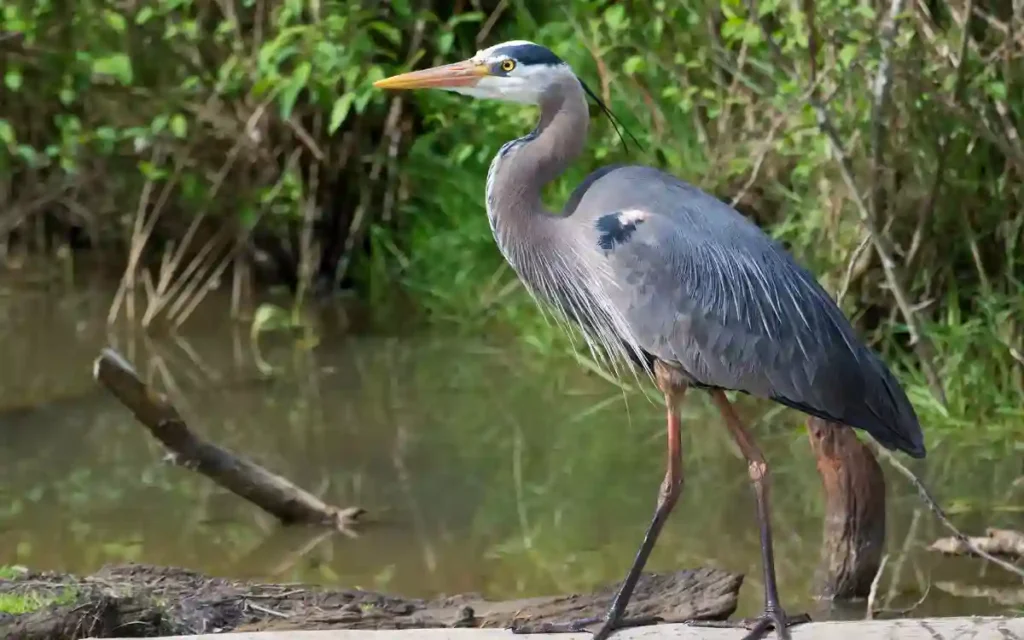
Most Great Blue Herons are blue-gray, but a white form occurs mainly in coastal southern Florida, especially around the Florida Keys.
These birds are sometimes called Great White Herons.
The white form is much larger and heavier-looking than a typical Great Egret. It has a long, thick yellowish bill, strong legs, and a broad body.
Like other Great Blue Herons, it hunts by standing still or walking slowly through shallow water. It catches fish and other small animals with quick movements of its long neck.
Its limited range is an important identification clue. Seeing a white bird of this size in southern Florida makes the white form of the Great Blue Heron worth considering.
How to identify: Look for a very large, heavily built white heron with a thick bill. Compare its body size and head shape with nearby Great Egrets.
This is a white form of the Great Blue Heron, not a separate species on this list.
6. White Ibis (Eudocimus albus)
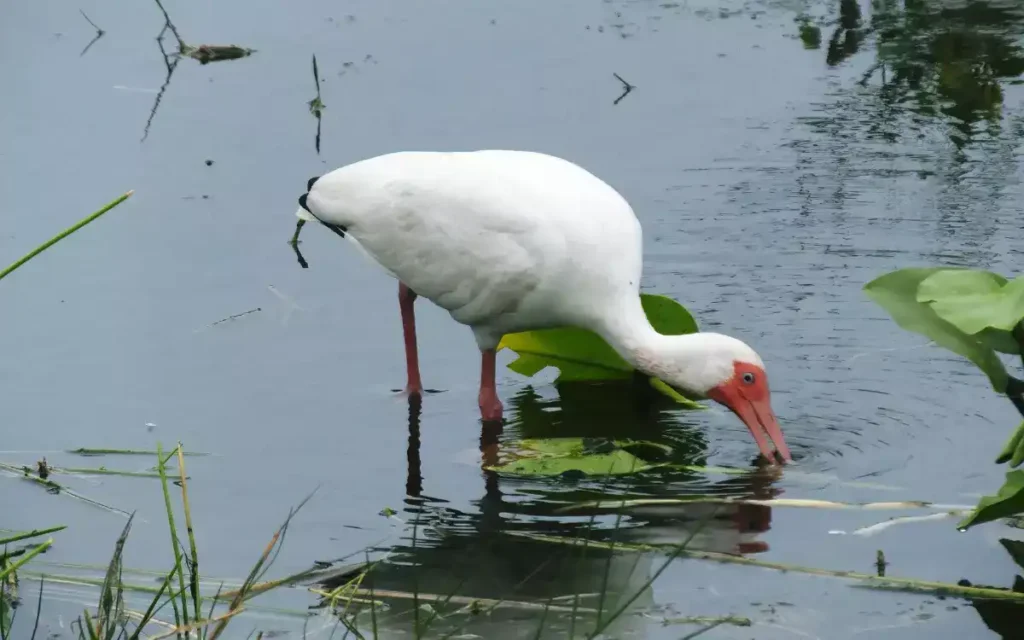
The White Ibis has a rounded white body, long reddish-pink legs, and a long bill that curves downward.
Adults also have reddish facial skin around pale blue eyes. Their wings have black tips, which are most noticeable during flight.
Young White Ibises look quite different. They begin with brown plumage and gradually develop more white feathers as they mature.
White Ibises are familiar in southeastern wetlands, particularly in Florida and along the Gulf Coast. They use marshes, mudflats, flooded fields, and sometimes grassy parks.
Their curved bills are designed for probing soft mud and shallow water for crustaceans, insects, and other small animals.
How to identify: A white bird with long pink legs and a downward-curving reddish bill is likely a White Ibis.
Related article: 14 White Birds In Florida: Exploring Their (ID & PICS)
7. Wood Stork (Mycteria americana)
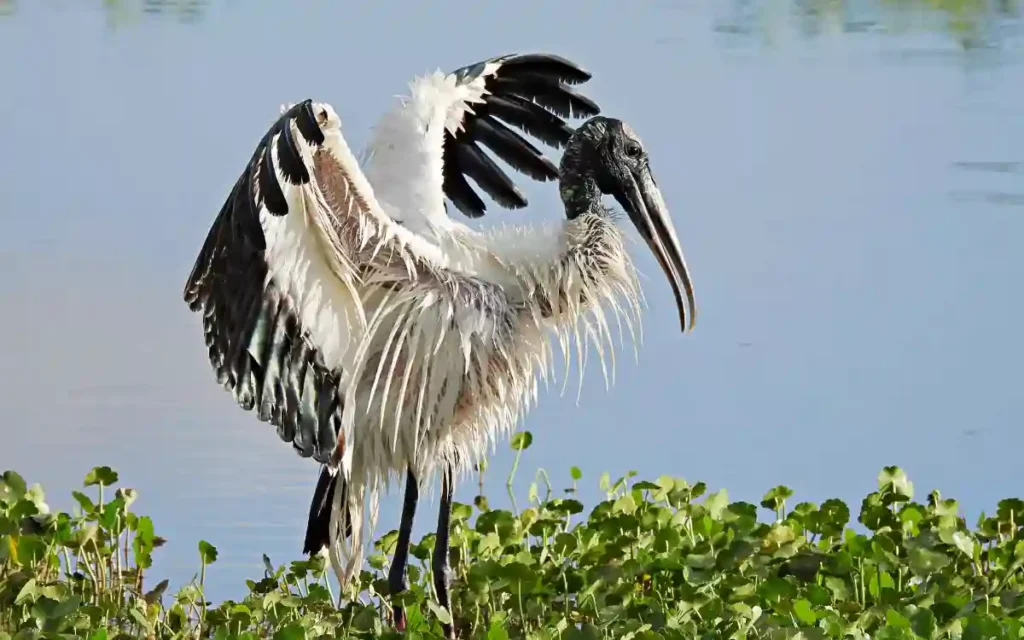
The Wood Stork is a large white wading bird with a dark, featherless head and a long, thick bill that curves slightly downward.
Its body appears mostly white while standing, but its black flight feathers become obvious when it spreads its wings.
Wood Storks live mainly in wetlands of the southeastern United States, including Florida, Georgia, and South Carolina. Their seasonal movements can take them into other southern regions.
They search for fish by moving their open bills through shallow water. When a fish touches the bill, it snaps shut quickly.
Wood Storks may also soar high in the sky using rising warm air, sometimes alongside vultures and other large birds.
How to identify: A large white wading bird with a bald-looking dark head, thick bill, and black flight feathers is a Wood Stork.
8. Whooping Crane (Grus americana)

The Whooping Crane is North America’s tallest bird and one of its rarest.
Adults have nearly all-white plumage, long dark legs, and a red crown. Their black wingtips are generally hidden while standing but become visible during flight.
Young Whooping Cranes have cinnamon-colored feathers mixed with white, particularly around the head and upper body.
The naturally occurring migratory population breeds in remote Canadian wetlands and winters along the Texas Gulf Coast, particularly near Aransas National Wildlife Refuge. Smaller reintroduced populations occur in other areas.
Unlike herons, Whooping Cranes fly with their necks stretched straight forward rather than folded back.
How to identify: Look for an exceptionally tall white bird with a red crown and long neck. A bird’s location matters because Whooping Cranes are rare and have a limited range.
9. American White Pelican (Pelecanus erythrorhynchos)
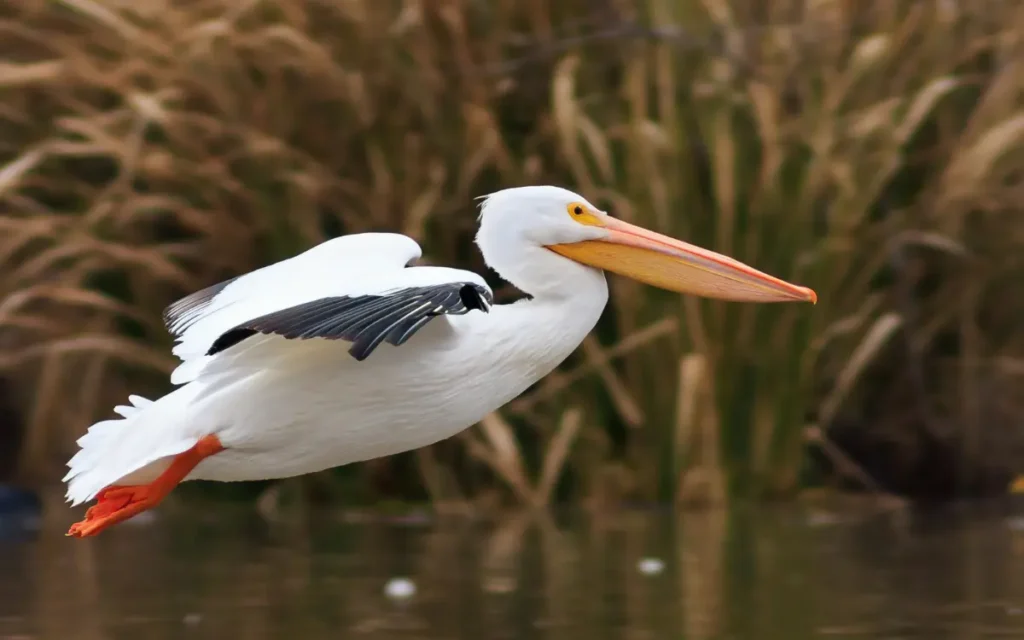
The American White Pelican is one of the largest white birds in North America.
It has a massive orange-yellow bill with a flexible throat pouch, a broad body, and extremely long wings.
While resting on water, it appears almost entirely white. In flight, large black feathers along the rear edges of its wings create a strong contrast.
American White Pelicans breed around suitable lakes and wetlands in the interior of North America. Many migrate to warmer coastal and inland waters during winter.
Unlike Brown Pelicans, they usually catch fish by dipping their bills into the water while swimming instead of diving headfirst from the air.
How to identify: A huge white waterbird with an oversized bill and black flight feathers is an American White Pelican.
Related article: 15 White Birds In Hawaii: Easy Identification Guide
10. Trumpeter Swan (Cygnus buccinator)
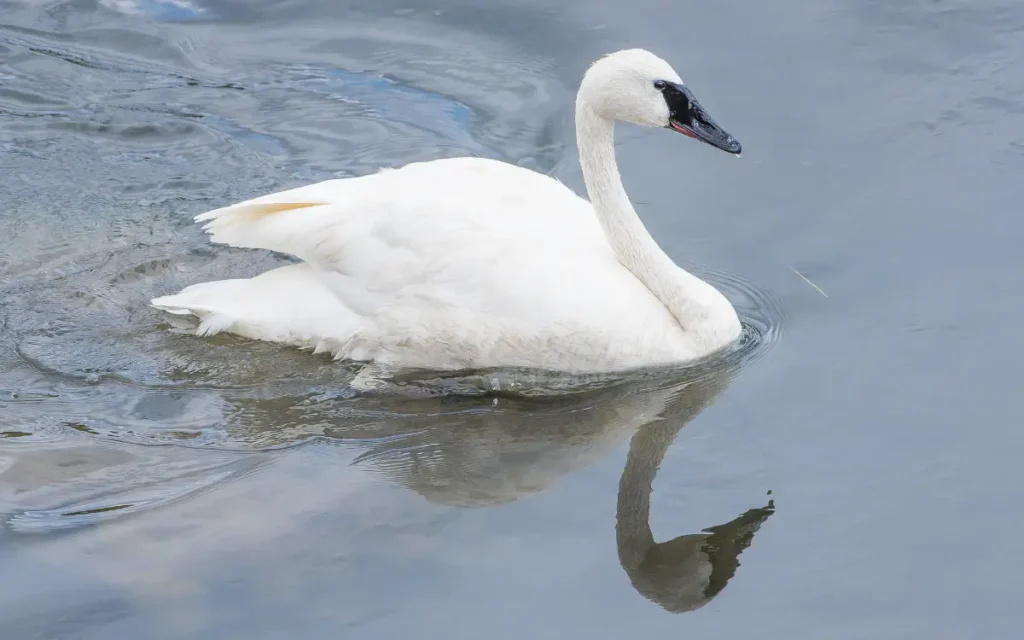
The Trumpeter Swan is the largest native waterfowl species in North America.
Adults have white plumage, black legs, and a long black bill that blends into the black skin around the eyes.
Their necks are long and thick, while their bodies are heavier than those of Tundra Swans.
Trumpeter Swans breed around shallow lakes, ponds, and wetlands in parts of Canada, Alaska, and the northern United States. Many spend winter where water remains open.
They feed mainly on aquatic plants, reaching below the water’s surface with their long necks.
How to identify: A very large white swan with a broad, sloping black bill and a heavy body may be a Trumpeter Swan. Its deep, trumpet-like voice can also help with identification.
11. Tundra Swan (Cygnus columbianus)
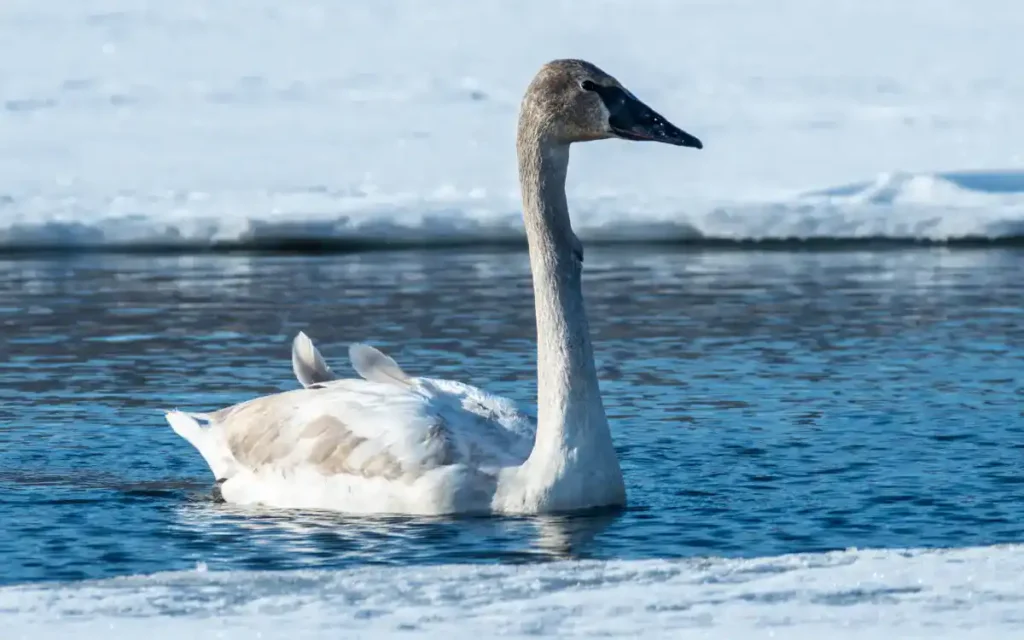
The Tundra Swan resembles the Trumpeter Swan but is generally smaller, with a more rounded head and shorter-looking bill.
Adults are entirely white with black legs and a mostly black bill. Many have a small yellow spot near the eye, although this marking can be missing.
Tundra Swans breed in Arctic regions and migrate to wintering areas in parts of the United States.
They often gather in flocks on lakes, wetlands, agricultural fields, and coastal estuaries.
Young birds are grayish before developing the clean white plumage of adults.
How to identify: Look for a white swan with a black bill and a possible yellow spot near its base. Size, head shape, and voice help distinguish it from a Trumpeter Swan.
12. Mute Swan (Cygnus olor)
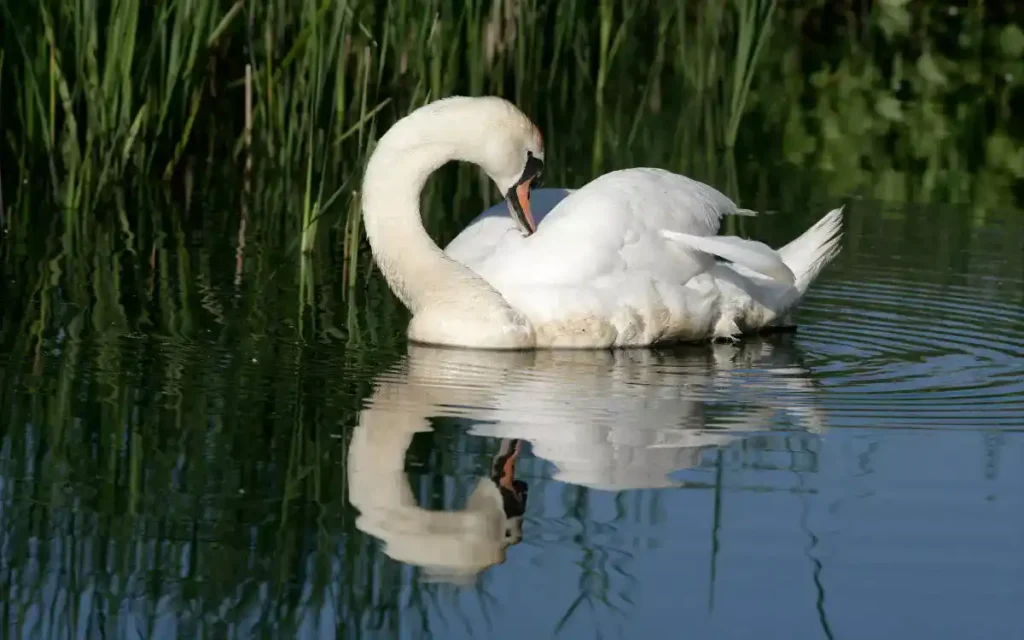
The Mute Swan is a large white waterbird with an orange bill and a black knob at its base.
Its long neck often curves into an S shape while the bird swims.
Mute Swans are native to Eurasia but were introduced to North America. Established populations occur around some lakes, rivers, and ponds, particularly in the northeastern and Great Lakes regions.
Adults have white plumage, while young birds may appear grayish or pale brown.
Mute Swans feed on aquatic plants and can be territorial during nesting.
How to identify: An adult white swan with a bright orange bill and a prominent black knob is a Mute Swan. This bill color separates it from native Trumpeter and Tundra Swans.
13. Snow Goose (Anser caerulescens)
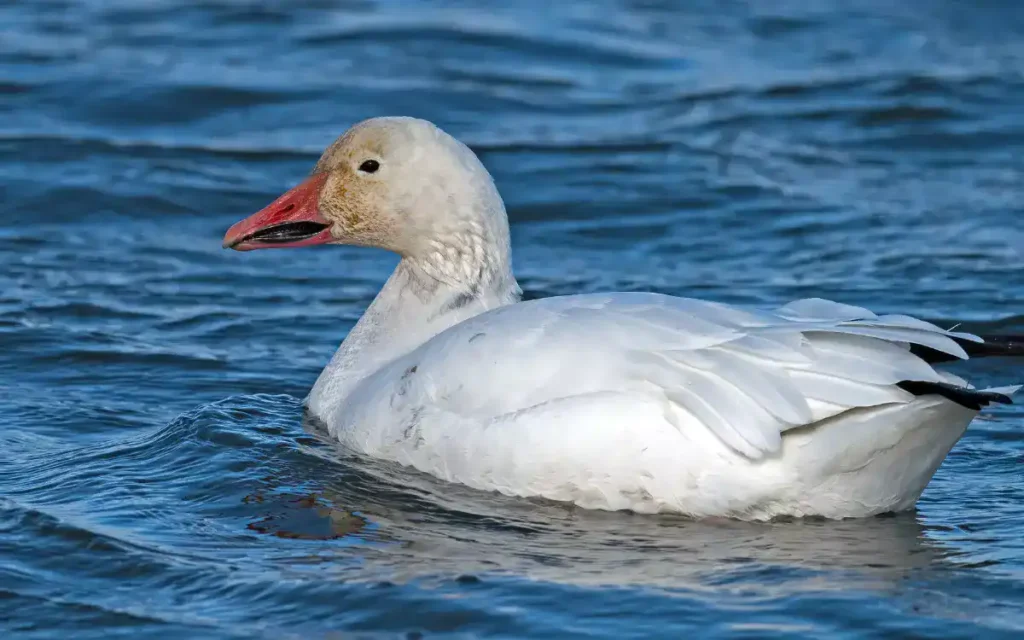
The Snow Goose is a medium-sized goose with a pink bill, pink legs, and a thick neck.
White-morph adults have white plumage with black wingtips. However, Snow Geese also occur in a darker form, commonly called the blue morph.
A useful feature is the black line along the pink bill, often called the grinning patch.
Snow Geese breed in Arctic tundra regions and migrate south to wintering areas across parts of the United States.
Large flocks gather in agricultural fields, marshes, and shallow wetlands, feeding on plant material such as grasses, roots, and leftover crops.
How to identify: A white goose with black wingtips and a pink bill showing a dark grinning patch is likely a Snow Goose.
Related article: 8 White Birds In West Virginia (ID & INFO)
14. Ross’s Goose (Anser rossii)

Ross’s Goose looks like a smaller, more compact Snow Goose.
Adult white-morph birds have white plumage, black wingtips, pink legs, and a short pink bill.
The bill is especially useful for identification. Ross’s Goose has a shorter, more triangular bill without the broad black grinning patch typical of adult Snow Geese.
Ross’s Geese breed in Arctic Canada and migrate south during the colder months.
They may gather with Snow Geese in large feeding flocks across fields, shallow wetlands, and lakes.
How to identify: In a group of Snow Geese, look for a noticeably smaller bird with a rounder head, shorter neck, and stubby pink bill.
White Owls, Songbirds, Raptors, and Seabirds
Not all white birds live near ponds or marshes. Some inhabit snowy mountains and open fields, while others hunt above grasslands or spend much of their lives over the ocean.
15. Snowy Owl (Bubo scandiacus)
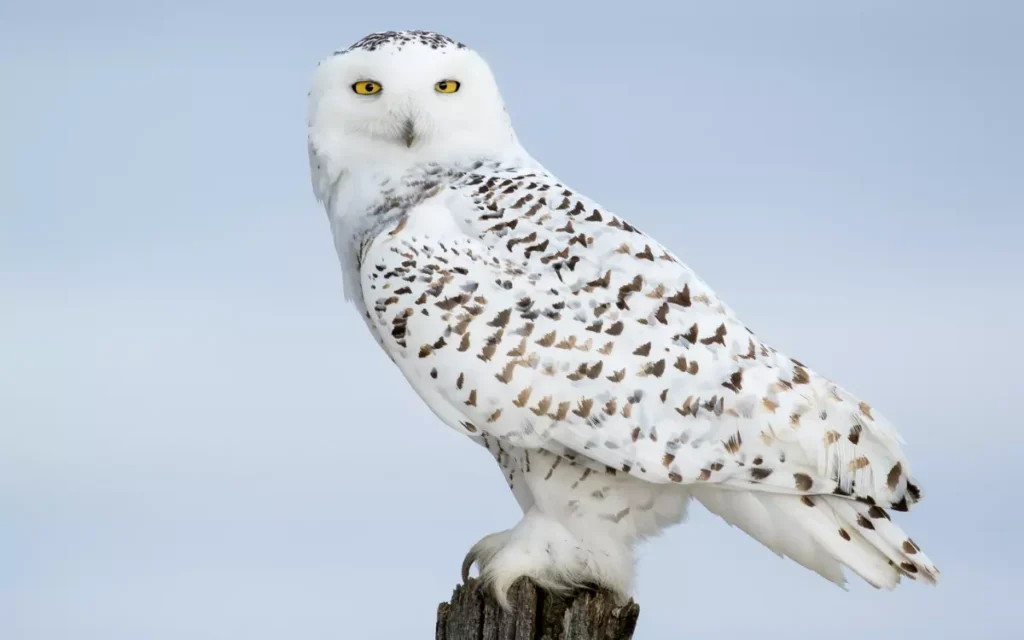
The Snowy Owl is a large, powerful owl with a rounded head, bright yellow eyes, and white plumage.
Adult males may become nearly pure white as they age. Females and younger birds usually have darker bars and spots across their feathers.
Snowy Owls breed in Arctic tundra, where their pale plumage helps them blend into snowy surroundings.
During winter, some move south into southern Canada and the northern United States. Their movements vary from year to year.
Unlike many woodland owls, Snowy Owls prefer open areas. They may perch on low rises, fence posts, dunes, and other exposed places while searching for prey.
How to identify: A large white owl with yellow eyes and a rounded head, sitting in an open northern landscape, may be a Snowy Owl.
16. White tailed Ptarmigan (Lagopus leucura)
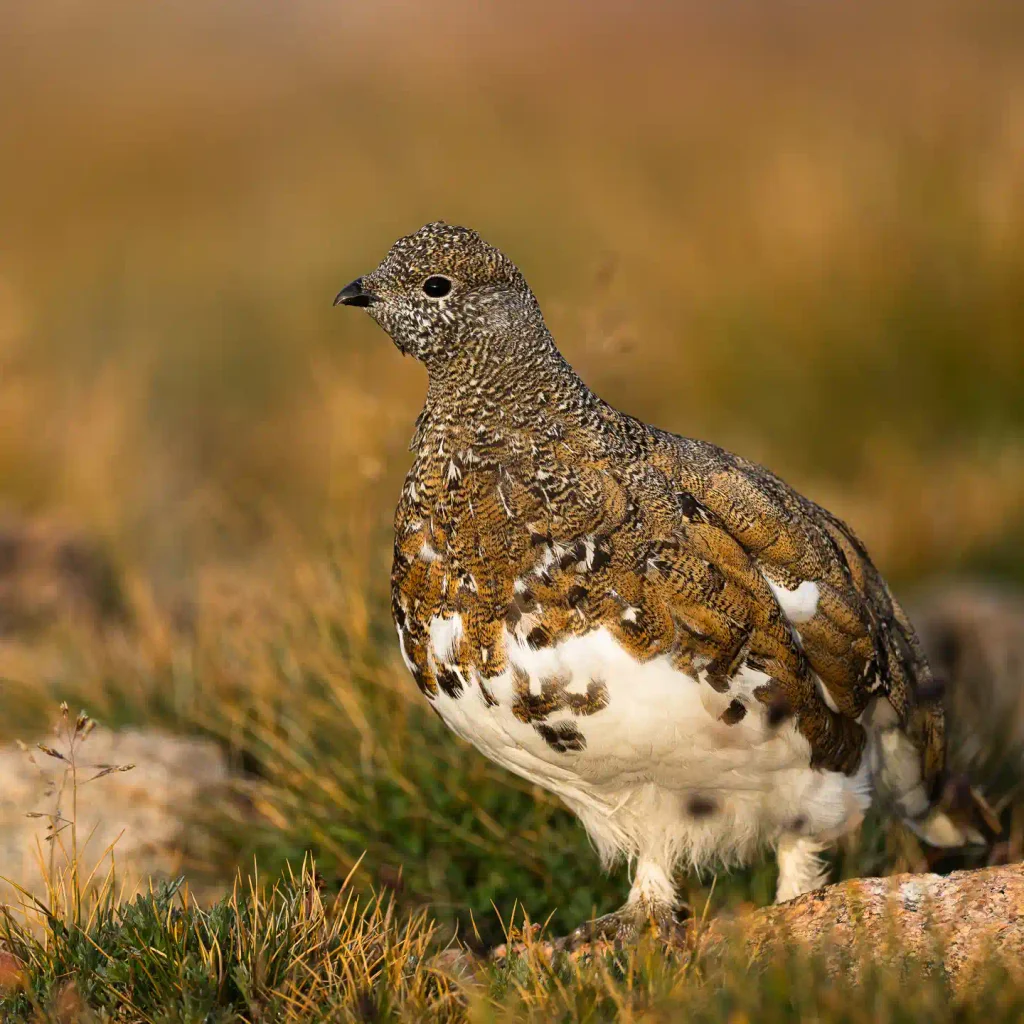
The White-tailed Ptarmigan is a small, rounded grouse found in high mountain habitats of western North America.
Its plumage changes with the seasons. During winter, both males and females become almost completely white, with dark eyes and bills.
In warmer months, brown and gray feathers replace much of the white plumage, helping the bird blend into rocky tundra.
Unlike other North American ptarmigan species, the White-tailed Ptarmigan retains a white tail throughout the year.
These birds live above the treeline, often walking slowly among rocks, low plants, and snowbanks while feeding on vegetation.
How to identify: A small, rounded, almost entirely white bird walking on snowy alpine ground may be a White-tailed Ptarmigan. In summer, check for its white tail.
Related article: 15 White Birds In Georgia
17. Snow Bunting (Plectrophenax nivalis)
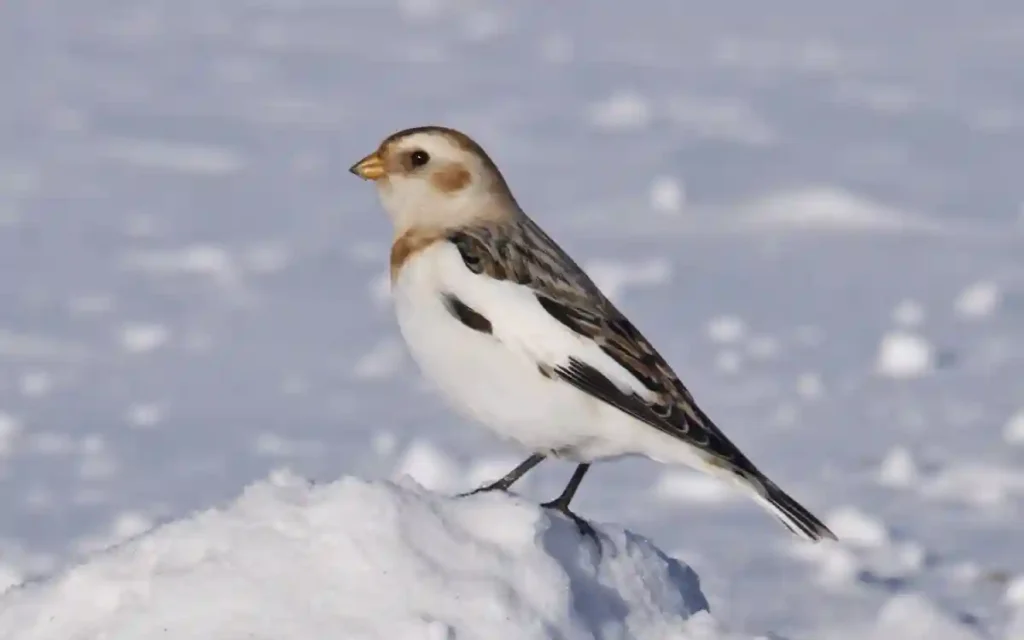
The Snow Bunting is one of the smaller white birds in North America.
Breeding males have mostly white plumage with a black back and dark outer wing feathers. Females and nonbreeding birds show more brown, rusty, or streaked markings.
Snow Buntings breed in Arctic regions, where they nest among rocky areas.
During winter, they move into more southern open habitats, including fields, barren ground, beaches, and lake shores.
They often feed in flocks, walking or hopping along the ground while searching for seeds.
When a flock takes off, the birds flash striking white and dark wing patterns.
How to identify: A small, sparrow-like bird with broad white wing patches in an open winter field may be a Snow Bunting.
18. White tailed Kite (Elanus leucurus)

The White-tailed Kite is a small bird of prey with a white head, white underparts, pale gray back, and black shoulder patches.
It also has red eyes, although these may be difficult to see from a distance.
White-tailed Kites inhabit open grasslands, agricultural areas, marsh edges, and scattered woodland habitats.
In the United States, they are particularly associated with parts of California, Texas, and other southern regions.
Their hunting behavior is distinctive. They often hover in one position above a field, rapidly beating their wings while looking down for small mammals.
How to identify: A mostly white, long-winged bird hovering above a grassy field, with dark shoulder patches, is a strong match for a White-tailed Kite.
19. Northern Gannet (Morus bassanus)

The Northern Gannet is a large seabird with long, narrow wings, a pointed bill, and a streamlined body.
Adults are mainly white with black wingtips and a pale yellowish wash on the head.
Young Northern Gannets look quite different. They begin with dark brown plumage and gradually develop more white feathers over several years.
These birds inhabit the North Atlantic, breeding in colonies along rocky coastal cliffs and islands.
They spend much of their time over open water, searching for fish.
One of their most recognizable behaviors is plunging into the sea from above, sometimes with their wings folded tightly against the body.
How to identify: A large white seabird with long pointed wings and black tips, flying over the Atlantic Ocean, may be a Northern Gannet.
Related article: 19 White Birds In Alaska
20. Ring billed Gull (Larus delawarensis)
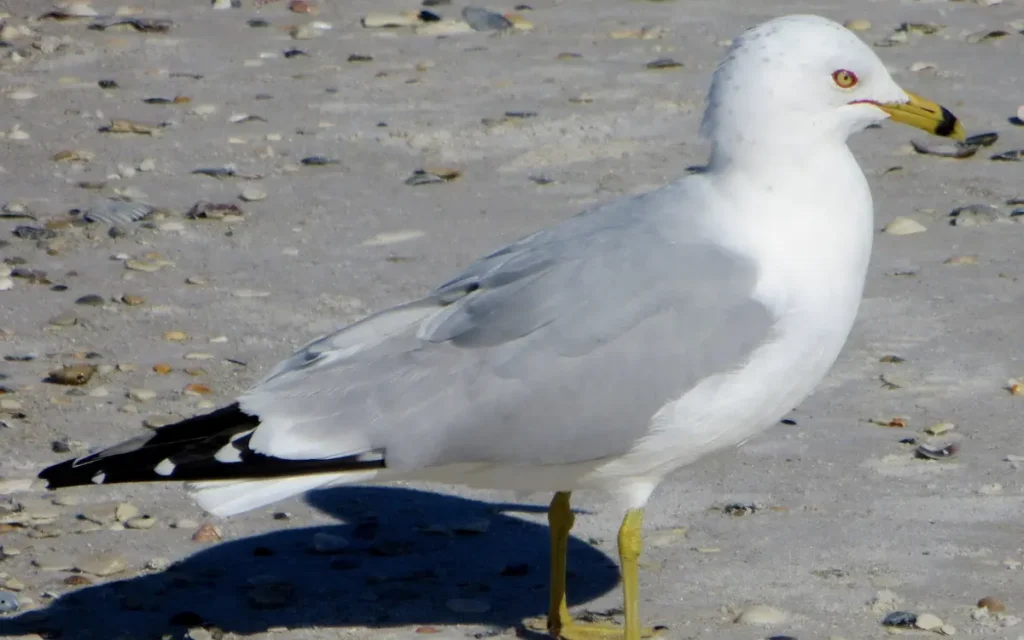
The Ring-billed Gull is a common white-and-gray bird around many North American lakes, beaches, fields, and urban areas.
Adults have a white head, chest, and belly, with pale gray feathers across the back and upper wings.
The yellow bill has a black ring near the tip, which gives the species its name. Adults also have yellow legs and black wingtips with small white spots.
Young Ring-billed Gulls are mottled brown and gray, gradually gaining their adult appearance as they mature.
These gulls eat a variety of foods, including insects, fish, and other small animals. They are often seen walking across open fields or resting in groups beside water.
How to identify: A medium-sized white-and-gray gull with yellow legs and a black ring around its yellow bill is likely an adult Ring-billed Gull.
How to Identify a White Bird You Saw
White feathers alone cannot tell you exactly which species you’ve seen. Many birds share a similar appearance, particularly around wetlands.
Start with the bird’s bill, legs, size, and behavior.
Check the Bird’s Size
A small white bird moving through an open winter field could be a Snow Bunting.
A medium-sized white bird walking through shallow water might be a Snowy Egret or young Little Blue Heron.
Very large white birds found around lakes and wetlands include Great Egrets, swans, pelicans, and cranes.
If possible, compare the bird with nearby ducks, geese, or other familiar species.
Look at the Bill and Leg Colors
The bill is often one of the fastest ways to distinguish white birds.
| Bill or Leg Feature | Possible Bird |
| Yellow bill, black legs | Great Egret |
| Black bill, yellow feet | Snowy Egret |
| Short yellow bill, compact body | Adult Western Cattle-Egret |
| Pale bill with dark tip, greenish legs | Juvenile Little Blue Heron |
| Long curved reddish bill | White Ibis |
| Long orange-yellow bill with pouch | American White Pelican |
| Orange bill with black knob | Mute Swan |
| Black bill, long neck | Trumpeter Swan or Tundra Swan |
| Pink bill with black grinning patch | Snow Goose |
| Short pink bill, compact goose | Ross’s Goose |
Remember that immature birds and breeding adults sometimes have different bill and leg colors.
Watch How the Bird Moves
Behavior can narrow down a bird’s identity even when its markings are difficult to see.
Great Egrets often hunt slowly, standing still before catching fish.
Snowy Egrets may run or stir the water with their feet.
Western Cattle-Egrets usually walk through grassy fields, often near livestock.
Pelicans swim and scoop food with their large bills, while White-tailed Kites hover above open fields while hunting.
Consider Where You Saw It
Location is another useful clue.
A white wading bird in a Florida marsh has a different set of likely identities from one seen on a frozen lake in Canada.
A large white bird in an open field during winter might be a Snow Goose, while a white bird soaring over the Atlantic could be a Northern Gannet.
Think about the habitat before settling on a species.
Great Egret vs. Snowy Egret vs. Little Blue Heron
Three of the most easily confused white wetland birds are the Great Egret, Snowy Egret, and juvenile Little Blue Heron.
| Feature | Great Egret | Snowy Egret | Juvenile Little Blue Heron |
| Overall size | Large | Medium | Medium |
| Bill | Usually yellow | Black | Pale base, dark tip |
| Legs | Black | Black | Greenish |
| Feet | Black | Usually yellow | Greenish |
| Feeding style | Slow stalking | Often active | Slow, patient stalking |
| Plumage | White | White | White when young |
| Useful clue | Size and yellow bill | Yellow feet | Two-toned bill |
The Great Egret is generally the easiest to separate because of its larger size.
Snowy Egrets are smaller and have yellow feet. Young Little Blue Herons may be similar in size to Snowy Egrets, but their two-toned bills and greenish legs are useful differences.
If the feet are hidden underwater, look carefully at the bill and how the bird moves.
Where Can You Find White Birds in North America?
White birds occur in many habitats, but their presence depends on the region and season.
White Birds in the Eastern United States
Great Egrets, Snowy Egrets, White Ibises, and other wading birds occur in suitable eastern wetlands, though their local abundance differs.
Ring-billed Gulls are also familiar around lakes and open fields.
Along the Atlantic Coast, Northern Gannets may be seen offshore during suitable seasons.
White Birds in the Southern United States
Southern wetlands support Great Egrets, Snowy Egrets, White Ibises, Wood Storks, and Western Cattle-Egrets in appropriate habitats.
Coastal southern Florida is also home to the white form of the Great Blue Heron.
During winter, parts of the southern United States receive migrating Snow Geese and Ross’s Geese.
Whooping Cranes are a much rarer sight, with an important wintering area along the Texas Gulf Coast.
White Birds in the Western United States
Western wetlands and lakes provide habitat for American White Pelicans, egrets, and several other white waterbirds.
Trumpeter Swans occur around selected northern and western lakes and rivers.
White-tailed Kites can be found in suitable open habitats, particularly in California and parts of the Southwest.
Higher mountain areas are home to White-tailed Ptarmigan, which become white during winter.
White Birds in Canada and Arctic Regions
Canada’s northern habitats support Tundra Swans, Snow Geese, Ross’s Geese, Snowy Owls, and Snow Buntings during breeding season.
Some move south for winter, while others remain in northern regions.
White-tailed Ptarmigan also occur in mountain areas where snowy conditions may last much of the year.
Why Are Some Birds White?
White feathers can be a normal feature of a species, a temporary seasonal change, or the result of an unusual pigment condition.
Natural White Plumage
White feathers generally lack the pigments that produce darker feather colors. Their feather structure scatters incoming light, making them look white.
For birds such as Great Egrets and adult swans, white plumage is a normal part of their appearance.
Seasonal White Feathers
Some birds replace their feathers to match changing surroundings.
White-tailed Ptarmigan are brown and gray during warmer months but become white in winter, helping them blend into snow-covered habitats.
Other species may appear white only during a particular life stage. Juvenile Little Blue Herons are white before gradually developing their darker adult feathers.
Leucism and Albinism
A bird that is normally brown, black, or gray may occasionally appear partly or almost entirely white.
Leucism can cause feathers to lack normal pigmentation while the eyes generally retain their usual color.
Albinism involves a lack of melanin pigmentation and is often associated with pinkish or reddish eyes. True albinism is rare in wild birds.
A white American Robin, for example, may have leucism rather than belonging to a naturally white species.
Final Thoughts
White birds can look similar from a distance, especially when several species share the same wetland.
The best way to identify one is to check its bill, legs, body size, and behavior. A Snowy Egret’s yellow feet, a White Ibis’s curved bill, or a pelican’s enormous throat pouch can tell you far more than feather color alone.
Frequently Asked Questions About White Birds
What is the most common white bird in North America?
There is no single most common white bird across every region. Great Egrets, Ring-billed Gulls, and Snow Geese are familiar white or mostly white birds in suitable North American habitats. Which one you see most often depends on your location and season.
What are the large white birds with long legs?
Large white birds with long legs include Great Egrets, Wood Storks, Whooping Cranes, and white-form Great Blue Herons. Their bill shapes, body sizes, and ranges help separate them.
What is a small white bird?
The Snow Bunting is a small North American songbird with extensive white plumage, especially in breeding males. In winter, it often has darker and rusty markings. Some other small birds may appear white because of unusual pigment conditions.
What is the difference between a white heron and an egret?
Egrets belong to the heron family, so the names describe closely related birds rather than two completely separate groups. Differences in size, bill color, leg color, and behavior are more useful for identifying individual species.
What white bird has a long yellow beak?
The Great Egret has a long yellow bill and black legs. American White Pelicans also have long yellow-orange bills, but theirs are much larger and have a throat pouch.
What white bird has a long curved beak?
The White Ibis has a long downward-curving reddish bill. It uses this bill to search through mud and shallow water for food.
What white bird has black wingtips?
Snow Geese, Ross’s Geese, American White Pelicans, Whooping Cranes, and Northern Gannets all have white plumage with black wingtips or flight feathers. Their size, bill shape, and location help distinguish them.
What white birds can you see in winter?
Depending on the region, winter white birds may include Snow Geese, Ross’s Geese, Tundra Swans, Trumpeter Swans, Snow Buntings, and Snowy Owls. White-tailed Ptarmigan also have white winter plumage in their mountain habitats.
Are all white birds albino?
No. White is the natural feather color of many bird species. Albino birds have a pigment condition that differs from the normal white plumage of birds such as egrets, swans, and pelicans.
What is the difference between a Snow Goose and a white swan?
Snow Geese are smaller and have pink bills and black wingtips. Adult native North American swans are much larger, have longer necks, and generally have black bills without black wingtips. Mute Swans instead have orange bills.
What white bird looks like a crane?
Great Egrets and other large herons may resemble cranes when standing. In flight, however, cranes hold their necks straight, while herons and egrets usually fold theirs back into an S shape.
Are white birds rare?
Some white birds, such as Great Egrets and Ring-billed Gulls, are widespread. Others, such as Whooping Cranes, are rare and have limited populations. A bird’s white coloration alone does not indicate how rare it is.