Red tailed Hawk vs Cooper’s Hawk: How to Tell Them Apart
Spotting a hawk can feel exciting, but naming the bird is not always easy. Two hawks that often confuse people are the Red-tailed Hawk and the Cooper’s Hawk. Both are common across much of North America, both are skilled hunters, and both may appear near towns, parks, fields, and wooded areas.
The easiest way to tell them apart is to look at shape, tail length, flight style, and habitat. A Red-tailed Hawk is a larger, broad-winged hawk often seen soaring over open land. A Cooper’s Hawk is slimmer, faster, and more likely to zip through trees or appear near backyard bird feeders.
This guide breaks down the clear differences so you can make a better ID the next time you see one.
Red-tailed Hawk vs Cooper’s Hawk: Quick Comparison
| Feature | Red-tailed Hawk | Cooper’s Hawk |
| Hawk Type | Buteo | Accipiter |
| Size | Larger and heavier | Smaller and slimmer |
| Wings | Broad and rounded | Shorter, rounded wings |
| Tail | Shorter and wider; red in adults | Long, narrow, rounded tip |
| Flight Style | Soars in wide circles | Quick flaps with short glides |
| Common Habitat | Fields, highways, open country | Woods, suburbs, parks, backyards |
| Main Food | Mice, voles, rabbits, squirrels | Birds, doves, pigeons, small mammals |
| Best ID Clue | Broad wings and open-area soaring | Long tail and fast tree-level flight |
The Biggest Difference Is Shape
Color can help, but shape is usually more reliable. Hawks may look different depending on age, light, distance, and angle. Shape stays easier to read once you know what to look for.
A Red-tailed Hawk looks broad, heavy, and powerful. A Cooper’s Hawk looks slimmer, longer, and built for quick turns.
Red-tailed Hawk Shape
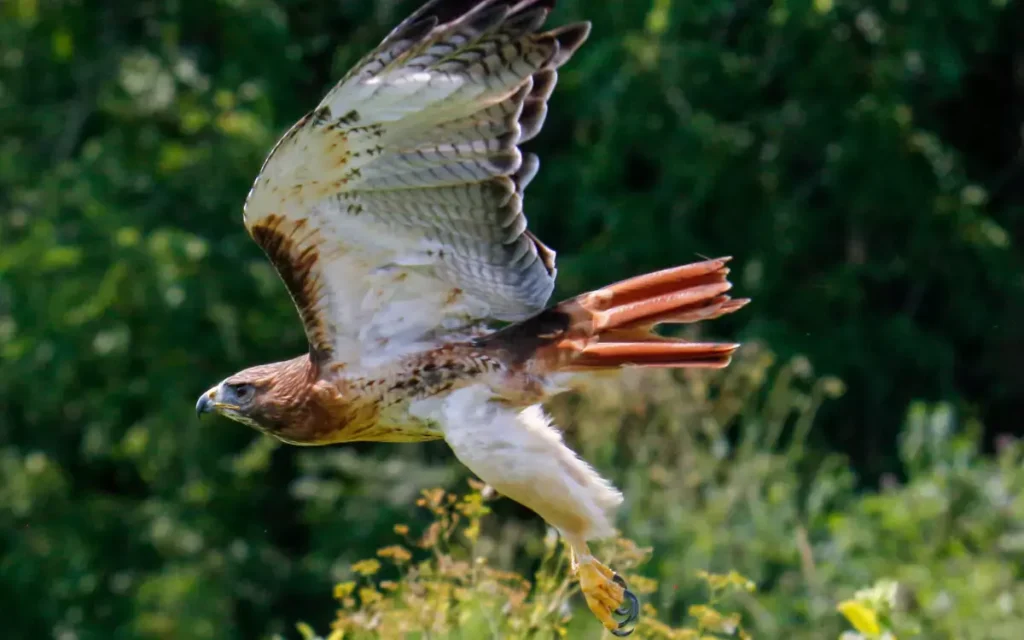
Red-tailed Hawks are broad-bodied raptors with wide wings and a shorter tail. When they soar, they often look steady and strong in the air. Their wings are long and rounded, which helps them circle over open fields, roadsides, and forest edges while searching for prey.
Look for these clues:
- Broad wings
- Stocky body
- Shorter, wider tail
- Slow, steady flight
- Often seen soaring high in circles
Cooper’s Hawk Shape
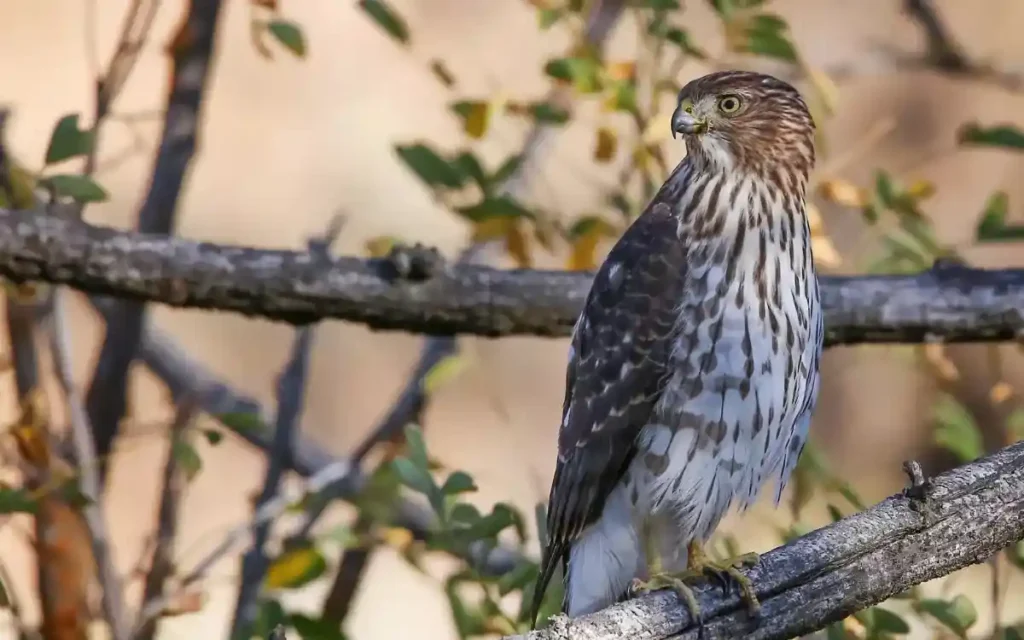
Cooper’s Hawks are built for speed and sharp turns. They have shorter rounded wings and a long tail that helps them steer through trees. If a hawk suddenly flashes through your yard, weaves between branches, or chases birds near a feeder, Cooper’s Hawk is a strong possibility.
Look for these clues:
- Slim body
- Long tail
- Rounded tail tip
- Shorter rounded wings
- Fast, direct flight through trees
Red-tailed Hawk Identification
The Red-tailed Hawk is one of the most familiar hawks in North America. Many people see them perched on roadside poles or soaring over open land.
Adult birds are famous for their rusty-red tail, but not every Red-tailed Hawk looks the same. Young birds do not have the classic red tail yet, and some birds may look darker or lighter depending on region.
Adult Red-tailed Hawk
Adult Red-tailed Hawks often show a rusty-red tail, especially when seen from above or when sunlight passes through the tail feathers. They usually have pale underparts with a darker belly band across the lower chest and belly.
Their broad wings and heavy body are often easier to notice than color, especially when the bird is far away.
Common adult field marks:
- Rusty-red tail
- Broad wings
- Pale chest
- Dark belly band
- Stocky build
- Large head and body
Juvenile Red-tailed Hawk
Young Red-tailed Hawks cause confusion because they do not yet have a red tail. Instead, their tails are brown and barred. This can make people mistake them for other hawks.
For juvenile birds, focus on the body shape. A young Red-tailed Hawk still has broad wings, a chunky body, and the classic buteo shape.
Best juvenile clues:
- Brown barred tail
- Broad wings
- Stocky body
- Often perched in open areas
- May still show a belly band
Red-tailed Hawk in Flight
In flight, Red-tailed Hawks often soar in wide circles. They use rising warm air to stay high with little effort. You may see them over fields, highways, farmland, deserts, and open woodland edges.
A helpful flight mark is the dark area along the front edge of the underwing, often called the patagial mark. From below, this can help separate Red-tailed Hawks from many other raptors.
Cooper’s Hawk Identification
The Cooper’s Hawk is a woodland hunter. It is fast, alert, and built to chase birds through tight spaces. Many people notice Cooper’s Hawks after one darts through a backyard or lands near a bird feeder.
Compared with a Red-tailed Hawk, a Cooper’s Hawk looks longer-tailed and more narrow-bodied.
Adult Cooper’s Hawk
Adult Cooper’s Hawks often have blue-gray backs, reddish barring on the chest, and long banded tails. Their heads may look darker on top, giving them a capped look.
When perched, the long tail is one of the best clues. It often extends well below the body and looks much longer than the tail of a Red-tailed Hawk.
Common adult field marks:
- Blue-gray back
- Reddish barred chest
- Long banded tail
- Rounded tail tip
- Slim body
- Alert, sharp look
Juvenile Cooper’s Hawk
Young Cooper’s Hawks are brown above with streaked underparts. They do not have the clean gray-and-rust adult pattern yet, so they can look plain at first glance.
Again, tail length is the key. A juvenile Cooper’s Hawk still has a long tail and shorter rounded wings. If it is flying low through trees or chasing smaller birds, that behavior also points toward Cooper’s Hawk.
Cooper’s Hawk in Flight
Cooper’s Hawks often fly with a pattern of several quick wingbeats followed by a short glide. Birders often describe this as a flap-flap-glide style.
They are not usually seen soaring high over open fields like Red-tailed Hawks. Instead, they move through woodlands, yards, parks, and neighborhoods where birds are active.
Tail Differences: One of the Best ID Clues
The tail is one of the easiest ways to separate these two hawks.
A Red-tailed Hawk has a shorter, broader tail. Adults have a rusty-red tail, but juveniles have brown barred tails.
A Cooper’s Hawk has a long, narrow tail with dark bands and a rounded tip. The tail looks especially long when the bird is perched.
| Tail Clue | Red-tailed Hawk | Cooper’s Hawk |
| Adult Tail Color | Rusty red | Gray with dark bands |
| Young Bird Tail | Brown and barred | Brown or gray with dark bands |
| Tail Length | Shorter | Much longer |
| Tail Shape | Broad | Narrow with rounded tip |
| Best Use for ID | Helpful in adults | Helpful at all ages |
If you only get a quick look, ask yourself: Did the hawk look broad-winged and short-tailed, or slim with a long tail?
That question alone can often point you in the right direction.
Size Comparison: Which Hawk Is Bigger?
The Red-tailed Hawk is bigger than the Cooper’s Hawk. It has a heavier body, wider wings, and a stronger overall look.
But size can be tricky in the field. A large female Cooper’s Hawk may look bigger than expected, while a distant Red-tailed Hawk may seem smaller than it really is.
| Size Detail | Red-tailed Hawk | Cooper’s Hawk |
| Length | About 18–26 inches | About 14–20 inches |
| Wingspan | About 43–56 inches | About 24–35 inches |
| Body Look | Heavy and broad | Slim and long-tailed |
| Best Size Clue | Wide wings | Long tail |
Habitat: Where You See the Hawk Matters
Location is a major clue. These two hawks often use different hunting spaces.
Where Red-tailed Hawks Are Common
Red-tailed Hawks prefer open or semi-open habitats. They need space to scan for prey and often perch where they can see the ground clearly.
You may see them in:
- Open fields
- Grasslands
- Farmland
- Desert edges
- Roadsides
- Highway poles
- Forest edges
- Fence posts
- Tall dead trees
If you see a large hawk perched beside a road or circling above a field, it is very often a Red-tailed Hawk.
Where Cooper’s Hawks Are Common
Cooper’s Hawks prefer wooded spaces and areas with plenty of birds. They are also common in suburbs and city parks, especially where trees and feeders attract prey.
You may see them in:
- Woodlands
- Backyards
- Parks
- Suburban neighborhoods
- Tree-lined streets
- Areas near bird feeders
- Places with doves, pigeons, sparrows, and finches
If a hawk appears suddenly in your yard and chases birds, Cooper’s Hawk is a strong match.
Hunting Style: Open-Country Hunter vs Backyard Hunter
These hawks hunt in very different ways.
How Red-tailed Hawks Hunt
Red-tailed Hawks are patient hunters. They often sit on a high perch and scan the ground. Once they spot movement, they drop down to catch prey.
They also hunt while soaring. Their broad wings allow them to circle over open spaces while searching for mammals below.
Common prey includes:
- Mice
- Voles
- Rabbits
- Squirrels
- Rats
- Snakes
- Other small animals
A Red-tailed Hawk may take birds sometimes, but mammals are usually a bigger part of its diet.
How Cooper’s Hawks Hunt
Cooper’s Hawks are fast pursuit hunters. They often use surprise, cover, and speed to catch birds. They may fly low through trees, around shrubs, and between buildings.
Backyard feeders can attract Cooper’s Hawks because feeders bring in the birds they hunt.
Common prey includes:
- Doves
- Pigeons
- Sparrows
- Finches
- Starlings
- Robins
- Small mammals
If you see a hawk chasing birds through your yard, it is much more likely to be a Cooper’s Hawk than a Red-tailed Hawk.
Diet Differences
| Food Type | Red-tailed Hawk | Cooper’s Hawk |
| Mice and Voles | Very common | Sometimes |
| Rabbits | Common | Rare |
| Squirrels | Common | Sometimes |
| Songbirds | Less common | Very common |
| Doves and Pigeons | Sometimes | Common |
| Snakes | Sometimes | Less common |
| Feeder Birds | Uncommon | Common |
The diet difference also explains why Cooper’s Hawks show up near bird feeders more often. They are not interested in seed. They are hunting the birds that come for the seed.
Calls and Sounds
Sound can help, but it is not always the best clue. Hawks are often silent when hunting or soaring.
Red-tailed Hawk Call
The Red-tailed Hawk has a loud, raspy scream often written as “kee-eee-arrr.” This is the classic hawk sound used in many movies, even when the bird shown on screen is an eagle.
The call sounds wild, sharp, and drawn out.
Cooper’s Hawk Call
The Cooper’s Hawk call is usually a harsh, repeated “cak-cak-cak.” You may hear it during nesting season or when the bird is alarmed.
Compared with the Red-tailed Hawk’s scream, the Cooper’s Hawk call sounds shorter, faster, and more repetitive.
Perched Hawk Clues
Sometimes you will not see the hawk flying. It may be sitting on a fence, branch, pole, or roof. Perched shape can still help.
Red-tailed Hawk When Perched
A perched Red-tailed Hawk looks large and upright. It often sits in open places where it can watch the ground.
Look for:
- Large body
- Broad chest
- Shorter tail
- Heavy build
- Open perch location
- Roadside poles or fence posts
Cooper’s Hawk When Perched
A perched Cooper’s Hawk looks slimmer and longer-tailed. It may sit quietly near trees, shrubs, or feeders before making a sudden chase.
Look for:
- Slim body
- Long tail hanging below the perch
- Rounded head shape
- Woodland or backyard setting
- Alert posture
- Nearby bird activity
Red-tailed Hawk vs Cooper’s Hawk in Your Backyard
Many people search this comparison after seeing a hawk in the backyard. In that setting, Cooper’s Hawk is often the answer, but not always.
If the Hawk Is Near a Bird Feeder
A hawk near a bird feeder is often a Cooper’s Hawk, especially if it is chasing small birds or doves.
Bird feeders attract prey species, and Cooper’s Hawks learn to hunt where birds gather. This can look harsh, but it is normal predator behavior.
If the Hawk Is Sitting Over an Open Yard
A Red-tailed Hawk may visit a large yard, pasture, farm edge, or open property where rodents are active. If the hawk is perched high and scanning the ground, Red-tailed Hawk is possible.
Should You Be Worried About Backyard Hawks?
Usually, no. Hawks are part of the natural food chain. If you want to help smaller birds, place feeders near shrubs or trees so birds have cover. Just avoid placing feeders too close to dense hiding spots where cats may wait.
A Cooper’s Hawk visiting your feeder does not mean you are doing anything wrong. It simply means your yard has become part of the local bird activity.
Common Mistakes When Identifying These Hawks
Mistake 1: Looking Only for a Red Tail
Not every Red-tailed Hawk shows an obvious red tail. Juveniles have brown barred tails, and poor lighting can hide the red color even on adults.
Use wing shape, body shape, and habitat too.
Mistake 2: Judging by Size Alone
Size is helpful, but not perfect. Female Cooper’s Hawks are larger than males and can look surprisingly big. Distance can also make a Red-tailed Hawk seem smaller.
Mistake 3: Ignoring Flight Style
Flight style is one of the best clues.
Red-tailed Hawks often soar in circles. Cooper’s Hawks usually fly with quick flaps and short glides, especially through trees.
Mistake 4: Forgetting About Habitat
A hawk over a wide field is more likely a Red-tailed Hawk. A hawk cutting through a wooded backyard is more likely a Cooper’s Hawk.
Mistake 5: Confusing Cooper’s Hawk With Sharp-shinned Hawk
Cooper’s Hawks are also often confused with Sharp-shinned Hawks. Both have long tails and hunt birds. A separate comparison article on Cooper’s Hawk vs Sharp-shinned Hawk would be a smart internal link for this topic.
Quick Field Checklist
Use this simple checklist when you see a hawk.
| Question | More Likely Red-tailed Hawk | More Likely Cooper’s Hawk |
| Is it soaring high in circles? | Yes | Less likely |
| Is it flying fast through trees? | Less likely | Yes |
| Does it have broad wings? | Yes | No |
| Does it have a long rounded tail? | No | Yes |
| Is it near a highway or field? | Yes | Less likely |
| Is it hunting birds near feeders? | Less likely | Yes |
| Does it look stocky? | Yes | No |
| Does it look slim and quick? | No | Yes |
Which Hawk Did You See? Simple Scenarios
A Large Hawk Circling Above a Field
Most likely: Red-tailed Hawk
This is classic Red-tailed Hawk behavior. They often soar over open land while searching for rodents.
A Hawk Sitting on a Highway Pole
Most likely: Red-tailed Hawk
Roadside poles give Red-tailed Hawks a clear view of grassy edges and open ground.
A Hawk Chasing Birds Through Your Yard
Most likely: Cooper’s Hawk
This is one of the most common ways people notice Cooper’s Hawks. They are skilled bird hunters and often use trees and shrubs for cover.
A Hawk With a Long Banded Tail Flying Between Trees
Most likely: Cooper’s Hawk
The long tail helps the bird steer through branches and tight spaces.
A Hawk With Broad Wings and a Rusty Tail
Most likely: Red-tailed Hawk
A rusty-red tail on a broad-winged hawk is one of the clearest signs of an adult Red-tailed Hawk.
Red-tailed Hawk vs Cooper’s Hawk: Final ID Tips
If you only remember a few things, remember these:
| Clue | Red-tailed Hawk | Cooper’s Hawk |
| Overall Look | Broad and powerful | Slim and fast |
| Tail | Shorter, red in adults | Long and banded |
| Wings | Wide and rounded | Shorter and rounded |
| Flight | Soaring in circles | Quick flaps and short glides |
| Habitat | Open land, fields, highways | Woods, parks, backyards |
| Hunting | Mammals on the ground | Birds in trees and yards |
The best beginner tip is simple: look at the wings and tail before worrying about color.
Broad wings and a shorter tail usually point to Red-tailed Hawk. A slim body with a long tail usually points to Cooper’s Hawk.
FAQs
How do I tell a Red-tailed Hawk from a Cooper’s Hawk quickly?
Look at shape and flight style. Red-tailed Hawks have broad wings and often soar in wide circles. Cooper’s Hawks have long tails and fly with quick flaps and short glides, often through trees.
Which is bigger, a Red-tailed Hawk or a Cooper’s Hawk?
The Red-tailed Hawk is bigger and heavier. Cooper’s Hawks are slimmer, but females can still look fairly large.
Do Cooper’s Hawks have red tails?
No. Cooper’s Hawks have long banded tails, not rusty-red tails. Adult Red-tailed Hawks are known for the red tail.
Why is a Cooper’s Hawk in my backyard?
A Cooper’s Hawk may visit your backyard because it is hunting birds. Feeders attract doves, sparrows, finches, and other birds that Cooper’s Hawks may chase.
Do Red-tailed Hawks eat birds?
Yes, they can eat birds, but they more often hunt mammals such as mice, voles, rabbits, squirrels, and rats.
Are Cooper’s Hawks dangerous to people?
No. Cooper’s Hawks are not a real danger to people. They may act defensive near nests, but most backyard visits are related to hunting.
Are Red-tailed Hawks more common than Cooper’s Hawks?
Red-tailed Hawks are among the most commonly seen hawks in North America because they often perch and soar in open areas. Cooper’s Hawks are also common, especially in wooded suburbs and cities.
What hawk screams in movies?
The classic raspy hawk scream used in many movies is usually a Red-tailed Hawk call, even when the scene shows an eagle.
Is a hawk near my bird feeder usually a Cooper’s Hawk?
Often, yes. A hawk chasing birds around a feeder is more likely to be a Cooper’s Hawk. A Red-tailed Hawk is more likely to hunt rodents in open areas.
Can juvenile Red-tailed Hawks be mistaken for Cooper’s Hawks?
Yes. Young Red-tailed Hawks do not have red tails yet, so beginners may get confused. Look for broad wings, a stocky body, and soaring behavior.