15 White Birds in Delaware Complete Identification Guide
Delaware may be one of the smallest U.S. states, but when it comes to birdwatching especially white birds it offers surprising variety. From quiet marshlands to busy coastal shores, these bright-feathered birds stand out clearly against water, sky, and greenery.
If you’ve ever spotted a white bird and wondered what it was, this guide will help you identify them quickly. Whether you’re visiting wildlife refuges or just watching from your backyard, these are the most common white birds you’ll see across Delaware.
Overview of White Birds in Delaware
| Bird Name | Habitat | Best Time to See | Key Feature |
| Great Egret | Wetlands | Spring–Fall | Tall with yellow bill |
| Snowy Egret | Marshes | Summer | Yellow feet |
| Cattle Egret | Farmland | Spring–Fall | Follows livestock |
| Mute Swan | Lakes/Ponds | Year-round | Orange bill |
| Tundra Swan | Coastal Bays | Winter | Large flocks |
| Snow Goose | Fields/Wetlands | Winter | Black wingtips |
| Ring-billed Gull | Beaches/Cities | Year-round | Ring on bill |
| Herring Gull | Coast | Year-round | Large size |
| Laughing Gull | Coast | Summer | Black head (seasonal) |
| Forster’s Tern | Lagoons | Spring–Fall | Slim body |
| Royal Tern | Coast | Summer | Orange bill |
| Caspian Tern | Lakes/Coast | Migration | Thick red bill |
| American White Pelican | Wetlands | Migration | Huge wingspan |
| Rock Pigeon (White) | Urban | Year-round | Common city bird |
1. Great Egret (Ardea alba)
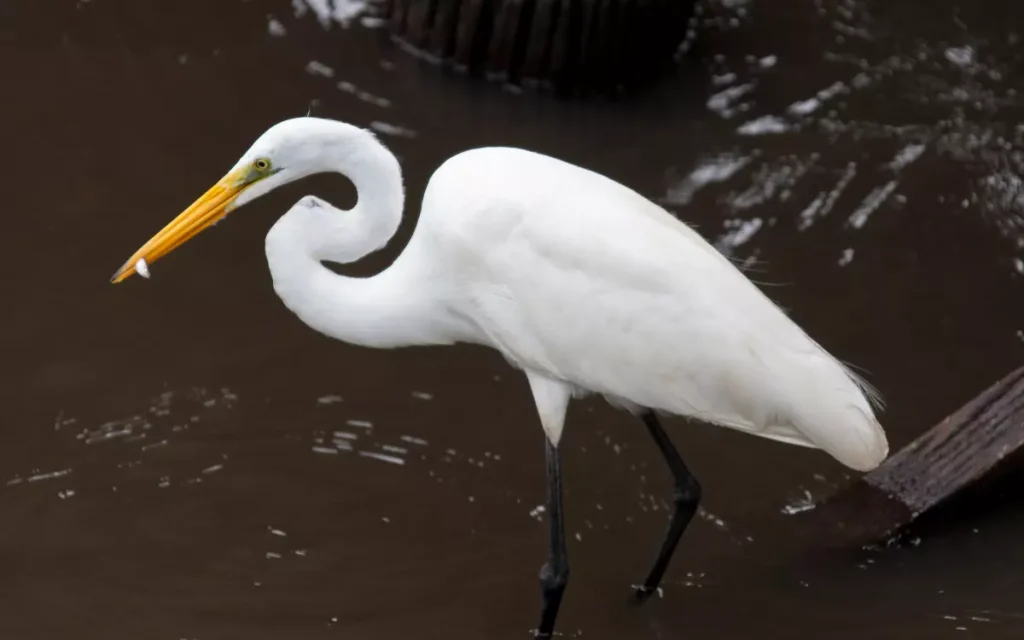
The Great Egret is one of the easiest white birds to identify in Delaware thanks to its tall height and clean white plumage. It often stands motionless in shallow water, which can make it look like part of the landscape until it suddenly strikes.
You’ll mostly find this bird in wetlands, tidal creeks, and marshes, especially in protected areas like Bombay Hook and Prime Hook. It prefers calm, shallow water where fish are easy to spot.
What sets the Great Egret apart is its patient hunting technique. Instead of chasing prey, it waits silently and uses its long neck like a spring to catch fish, frogs, and small aquatic animals.
Key Identification Features
| Feature | Details |
| Size | Large (3–3.5 feet tall) |
| Bill | Yellow, long and pointed |
| Legs | Black and very long |
| Neck | Long, S-shaped |
| Flight Style | Slow wingbeats, neck tucked |
Behavior & Habitat
- Hunts alone or in small groups
- Moves slowly to avoid disturbing water
- Often seen standing still for long periods
- Nests in colonies with other wading birds
When & Where to See in Delaware
- Best season: Spring through early fall
- Top locations: Bombay Hook, Prime Hook, coastal marshes
Pro Tip: If the bird looks tall, all-white, and has a yellow bill with black legs it’s almost always a Great Egret.
2. Snowy Egret (Egretta thula)
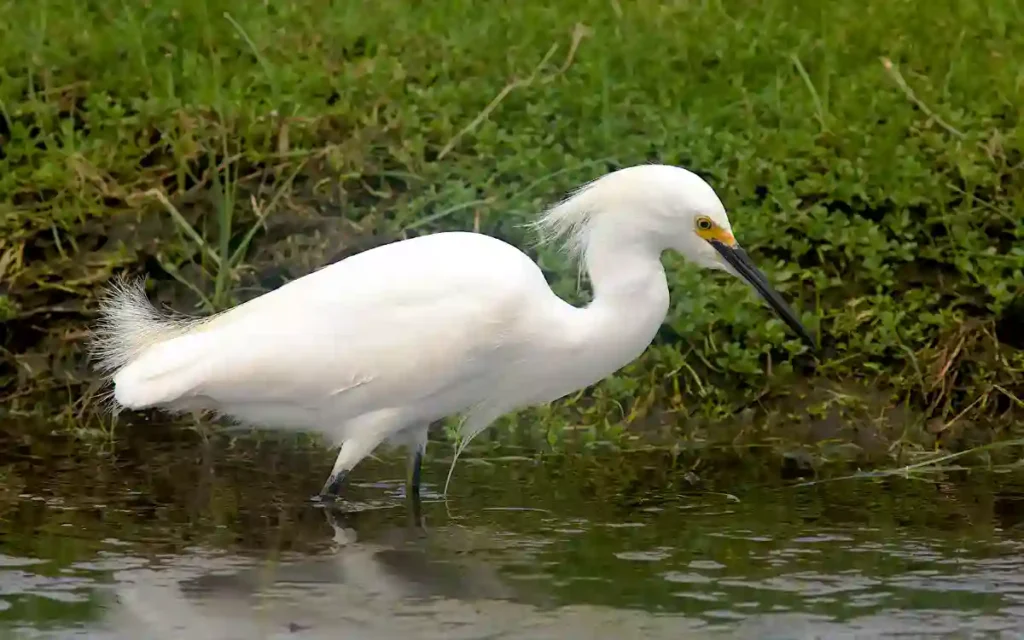
The Snowy Egret is smaller than the Great Egret but much more active and energetic. Once you learn to spot its bright yellow feet, identification becomes very easy.
Unlike the calm hunting style of larger egrets, Snowy Egrets are constantly moving. They run, shuffle, and even use their feet to stir up fish in shallow water.
Key Identification Features
| Feature | Details |
| Size | Medium (about 2 feet tall) |
| Bill | Black and slender |
| Legs | Black |
| Feet | Bright yellow (“golden slippers”) |
| Plumage | Pure white, sometimes fluffy during breeding |
Behavior & Habitat
- Actively chases prey instead of waiting
- Uses feet to disturb fish and insects
- Often seen in small flocks
- Breeding birds develop decorative plumes
They are commonly found in salt marshes, lagoons, and tidal flats, where shallow water supports plenty of small fish.
When & Where to See in Delaware
- Best season: Late spring to summer
- Top locations: Coastal marshes, wildlife refuges
Pro Tip: If you see a white bird running in water with bright yellow feet, it’s a Snowy Egret—not a Great Egret.
Read also: 15 Shorebirds in Delaware
3. Cattle Egret (Bubulcus ibis)
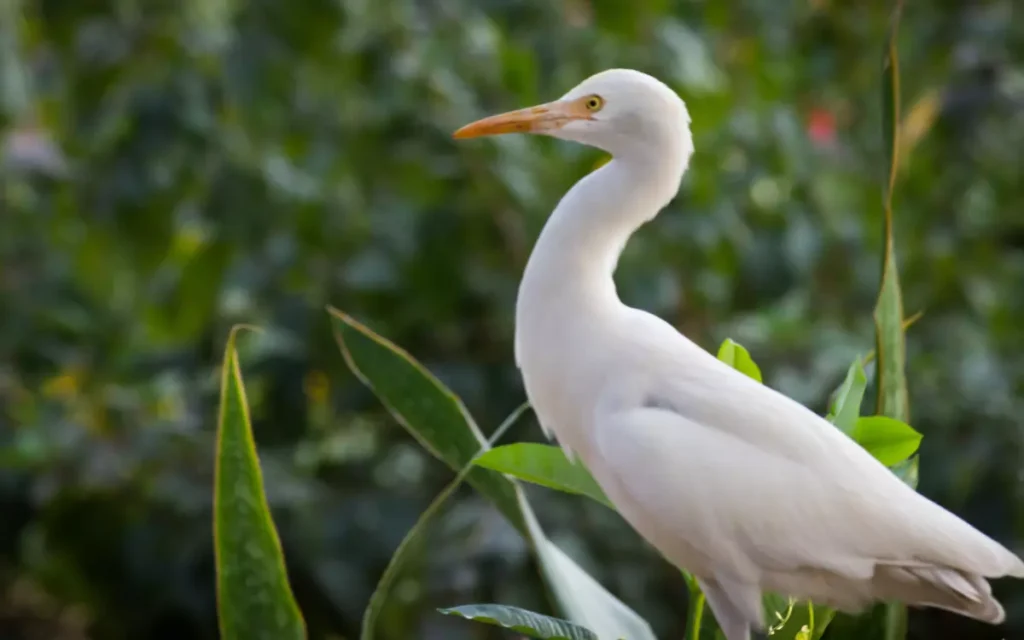
The Cattle Egret breaks the pattern of most white birds in Delaware it prefers land over water. Instead of marshes, you’ll often find it in open fields, farms, and grassy areas.
This bird has a close relationship with livestock. It follows cows, horses, or tractors, feeding on insects that get stirred up as they move.
Key Identification Features
| Feature | Details |
| Size | Smaller and stockier than other egrets |
| Bill | Yellow to orange |
| Legs | Dark gray to black |
| Body Shape | Compact with shorter neck |
| Breeding Color | Buff/orange patches on head and back |
Behavior & Habitat
- Feeds on insects rather than fish
- Walks alongside livestock or farm equipment
- Often seen in groups
- Less dependent on water compared to other egrets
This makes them much easier to spot in rural parts of Delaware, especially in agricultural areas.
When & Where to See in Delaware
- Best season: Spring through fall
- Top locations: Farmlands, pastures, open grassy fields
Pro Tip: If you see a white bird in a field instead of water, especially near cows—it’s almost certainly a Cattle Egret.
4. Great Blue Heron (White Form – Rare Visitor)
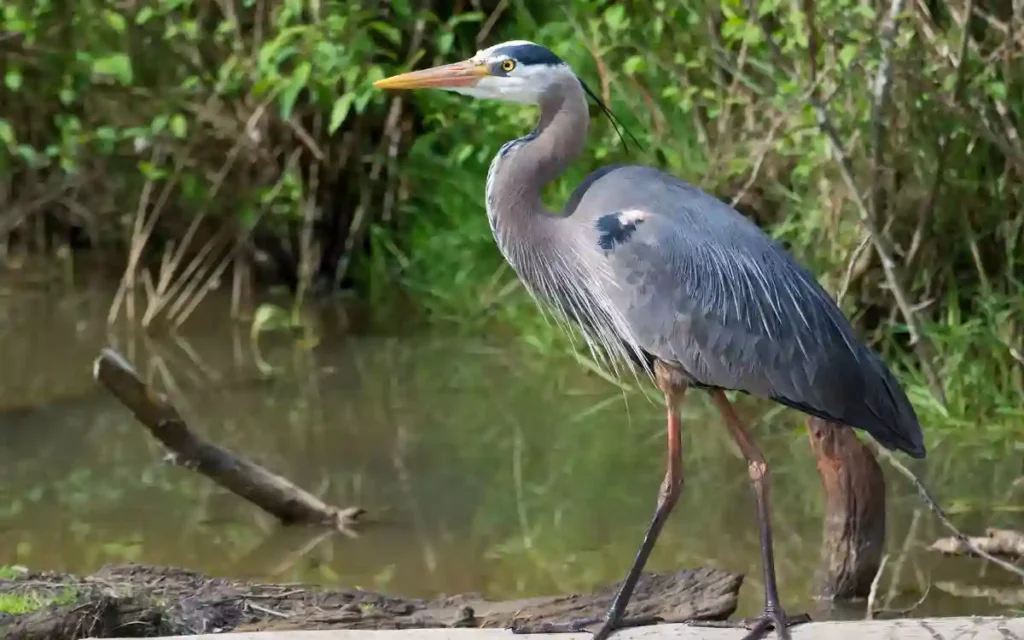
The Great Blue Heron is usually gray, but a rare white variation often called the Great White Heron can occasionally be seen along Delaware’s coast during migration. These sightings are uncommon, which makes spotting one especially exciting.
Even in its white form, this bird keeps the same large size and strong build as the typical Great Blue Heron. It stands taller and bulkier than egrets, with a heavier bill and slower, more deliberate movements.
Key Identification Features
| Feature | Details |
| Size | Very large (up to 4 feet tall) |
| Bill | Thick, pale yellow |
| Legs | Pale or grayish |
| Body Shape | Heavier and bulkier than egrets |
| Neck | Thick, powerful |
Behavior & Habitat
- Hunts in shallow water like other herons
- Moves slowly but strikes with force
- Usually seen alone
- Prefers quiet coastal or wetland areas
Because this white form is rare in Delaware, most sightings happen during migration periods, especially near coastal wetlands.
When & Where to See in Delaware
- Best chance: During migration (spring/fall)
- Top locations: Coastal marshes and bays
Pro Tip: If the bird looks larger and heavier than an egret with a thicker bill, it may be this rare white heron form.
5. Mute Swan (Cygnus olor)
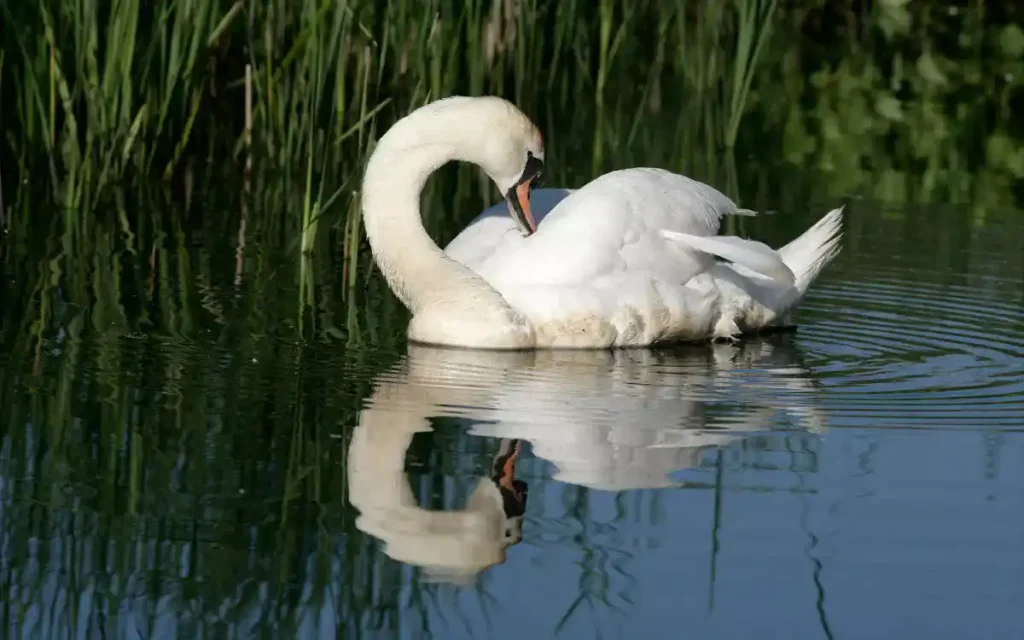
The Mute Swan is one of the most elegant white birds found across Delaware’s lakes and ponds. With its long curved neck and bright white feathers, it’s often the most noticeable bird on calm water.
Unlike wild swans, Mute Swans are non-native but have become well established. They are usually seen in pairs or small groups, gliding quietly across the surface.
Key Identification Features
| Feature | Details |
| Size | Very large waterbird |
| Bill | Orange with black base |
| Neck | Long, curved “S” shape |
| Wingspan | Up to 7–8 feet |
| Sound | Mostly silent |
Behavior & Habitat
- Spends most of its time floating or grazing
- Feeds on aquatic plants
- Can be territorial, especially during nesting
- Often stays in the same area year-round
Mute Swans are commonly found in ponds, reservoirs, and slow-moving rivers, making them easy to observe.
When & Where to See in Delaware
- Best season: Year-round
- Top locations: Newark Reservoir, Silver Lake, local ponds
Pro Tip: Look for the orange bill this is the easiest way to distinguish Mute Swans from native swans.
6. Tundra Swan (Cygnus columbianus)
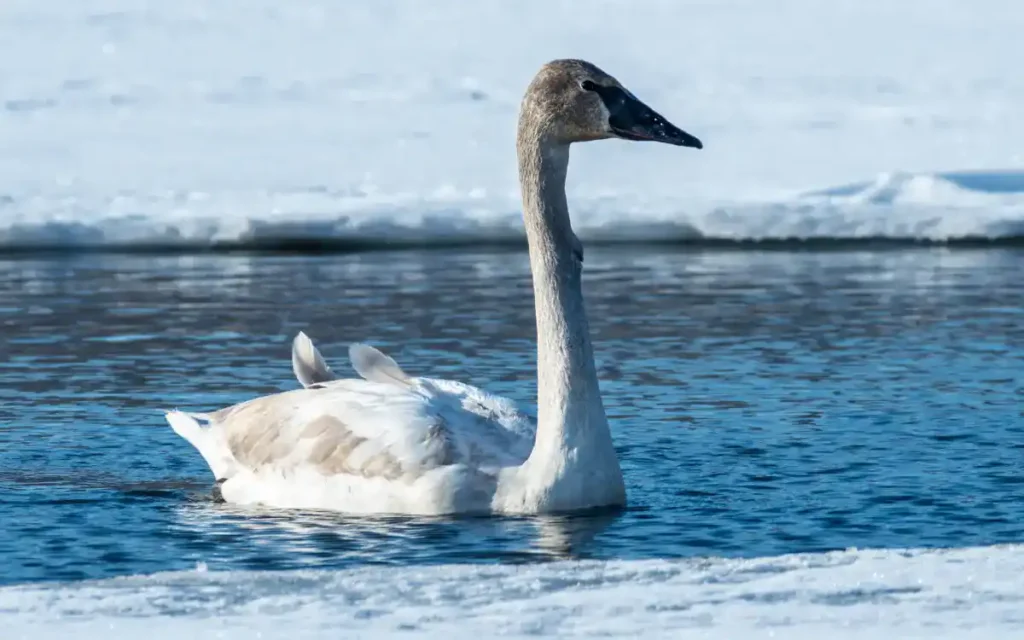
The Tundra Swan is a seasonal visitor that transforms Delaware’s winter landscapes. Large flocks arrive from Arctic breeding grounds, filling wetlands and bays with movement and sound.
These swans are slightly smaller than Mute Swans but still impressive. Their loud, bugling calls often give them away before you even see them.
Key Identification Features
| Feature | Details |
| Size | Large (slightly smaller than Mute Swan) |
| Bill | Black with small yellow patch near eye |
| Neck | Straight, less curved than Mute Swan |
| Flock Size | Often hundreds or thousands |
Behavior & Habitat
- Travels in large migratory flocks
- Feeds in shallow water and flooded fields
- Very vocal compared to Mute Swans
- Rests in open water for safety
They are most commonly found in coastal bays, wetlands, and agricultural fields during winter.
When & Where to See in Delaware
- Best season: Winter (peak migration)
- Top locations: Bombay Hook, Woodland Beach, Delaware Bay
Pro Tip: If you see a large group of swans flying together and hear loud calls, they are Tundra Swans not Mute Swans.
Read also: 15 Small Birds in Delaware
7. Snow Goose (Anser caerulescens)
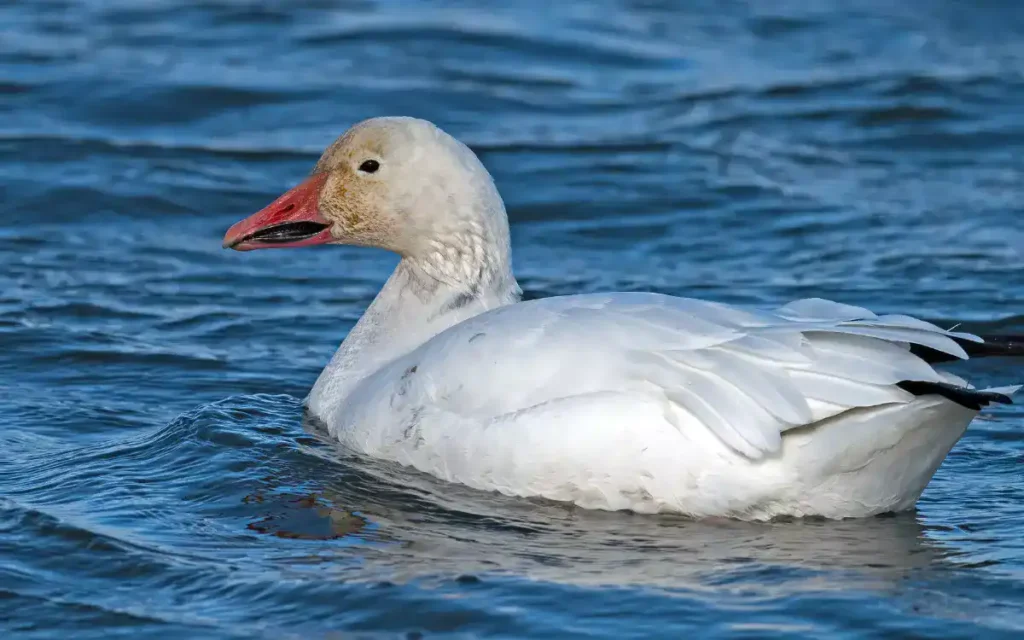
The Snow Goose is one of the most dramatic winter birds in Delaware. Instead of seeing just one or two, you’ll often witness massive flocks covering fields and skies, sometimes numbering in the thousands.
Their white bodies contrast sharply with their black wingtips, which become especially visible during flight. When a flock takes off together, it creates a loud, continuous wave of sound.
Key Identification Features
| Feature | Details |
| Size | Medium to large goose |
| Body | White with black wingtips |
| Bill | Pink with a dark “grin patch” |
| Legs | Pink |
| Variations | White morph and darker “Blue Goose” morph |
Behavior & Habitat
- Travels in very large flocks
- Feeds on grains, grasses, and roots
- Often rests in fields and wetlands
- Highly vocal and active
Snow Geese rely on open farmland and coastal wetlands, making Delaware an ideal winter stop.
When & Where to See in Delaware
- Best season: Winter
- Top locations: Prime Hook, Bombay Hook, open agricultural fields
Pro Tip: If you see a huge white flock moving together like a wave, you’re almost certainly looking at Snow Geese.
8. Ring-billed Gull (Larus delawarensis)
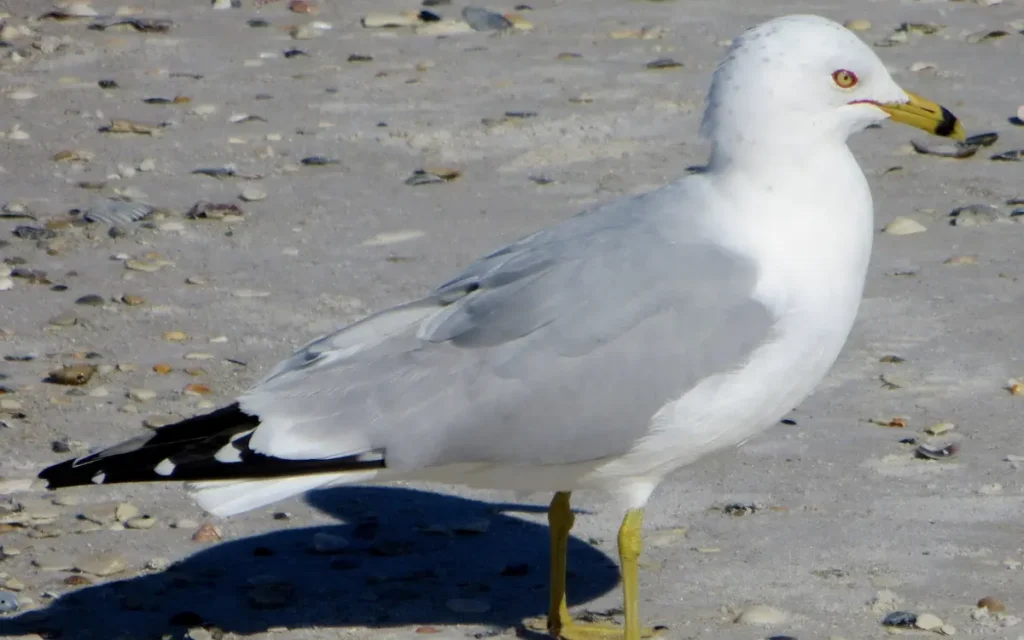
The Ring-billed Gull is one of the most familiar birds in Delaware, especially around people. You’ll see them not just on beaches, but also in parking lots, parks, and city waterfronts.
They are medium-sized gulls with a clean, simple appearance. The small black ring on their yellow bill is the key feature that gives them their name.
Key Identification Features
| Feature | Details |
| Size | Medium |
| Bill | Yellow with a black ring |
| Legs | Yellow-green |
| Wings | Gray with black tips |
| Head | White (may show light streaks in winter) |
Behavior & Habitat
- Opportunistic feeder (eats almost anything)
- Often found near humans
- Forms large groups when feeding
- Active year-round
They are highly adaptable and thrive in both coastal and urban environments.
When & Where to See in Delaware
- Best season: Year-round
- Top locations: Beaches, parking lots, city waterfronts
Pro Tip: Look at the bill if you see a clear black ring, it’s a Ring-billed Gull.
9. Herring Gull (Larus argentatus)
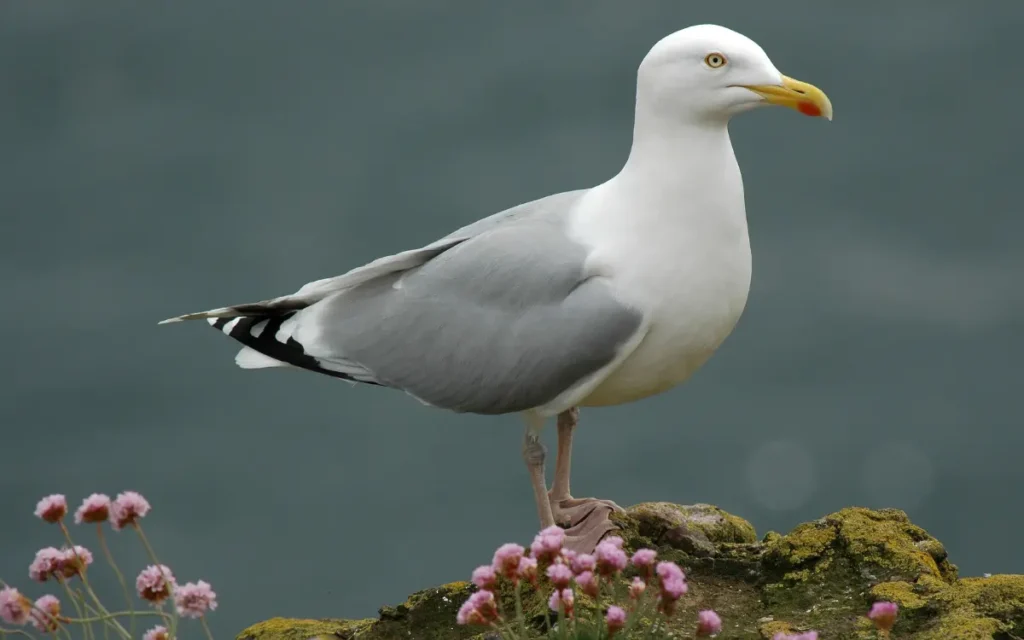
The Herring Gull is larger, stronger, and more dominant than the Ring-billed Gull. It’s a common sight along Delaware’s coastline, often seen gliding above the ocean or standing near fishing areas.
Adults have a clean white head and gray wings, while younger birds appear mottled brown, which can confuse beginners.
Key Identification Features
| Feature | Details |
| Size | Large |
| Bill | Yellow with a red spot |
| Legs | Pink |
| Wings | Gray upper wings |
| Juveniles | Brown and mottled |
Behavior & Habitat
- Strong scavenger and predator
- Often steals food from other birds
- Seen alone or in loose groups
- Uses coastal winds to glide effortlessly
They are most common along beaches, piers, and coastal waters, where food is abundant.
When & Where to See in Delaware
- Best season: Year-round (more visible in winter)
- Top locations: Beaches, fishing piers, coastal towns
Pro Tip: If the gull looks bigger and more powerful with pink legs, it’s likely a Herring Gull—not a Ring-billed.
10. Laughing Gull (Leucophaeus atricilla)
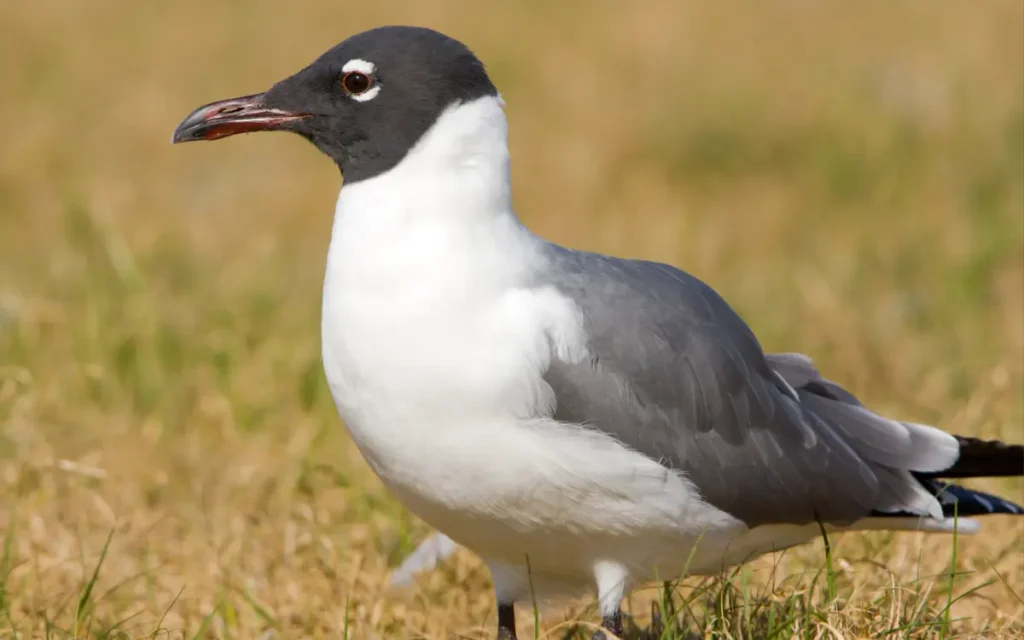
The Laughing Gull is one of the most recognizable coastal birds in Delaware, not just for its look but for its distinct call that sounds like laughter. During summer, adults develop a dark black head with a white body, making them easy to identify.
As seasons change, their head turns white again, which can confuse beginners who expect the black cap year-round.
Key Identification Features
| Feature | Details |
| Size | Medium |
| Bill | Dark red |
| Legs | Dark red to black |
| Summer Look | Black head + white body |
| Winter Look | Mostly white with faint markings |
Behavior & Habitat
- Very social and noisy
- Often seen in flocks along beaches
- Feeds on fish, scraps, and insects
- Frequently follows boats or gathers near food sources
They are common along coastlines, beaches, and bays, especially in warmer months.
When & Where to See in Delaware
- Best season: Late spring through summer
- Top locations: Lewes Beach, Cape Henlopen, coastal areas
Pro Tip: If you hear a loud, laughing-like call before spotting the bird, it’s likely a Laughing Gull.
11. Forster’s Tern (Sterna forsteri)
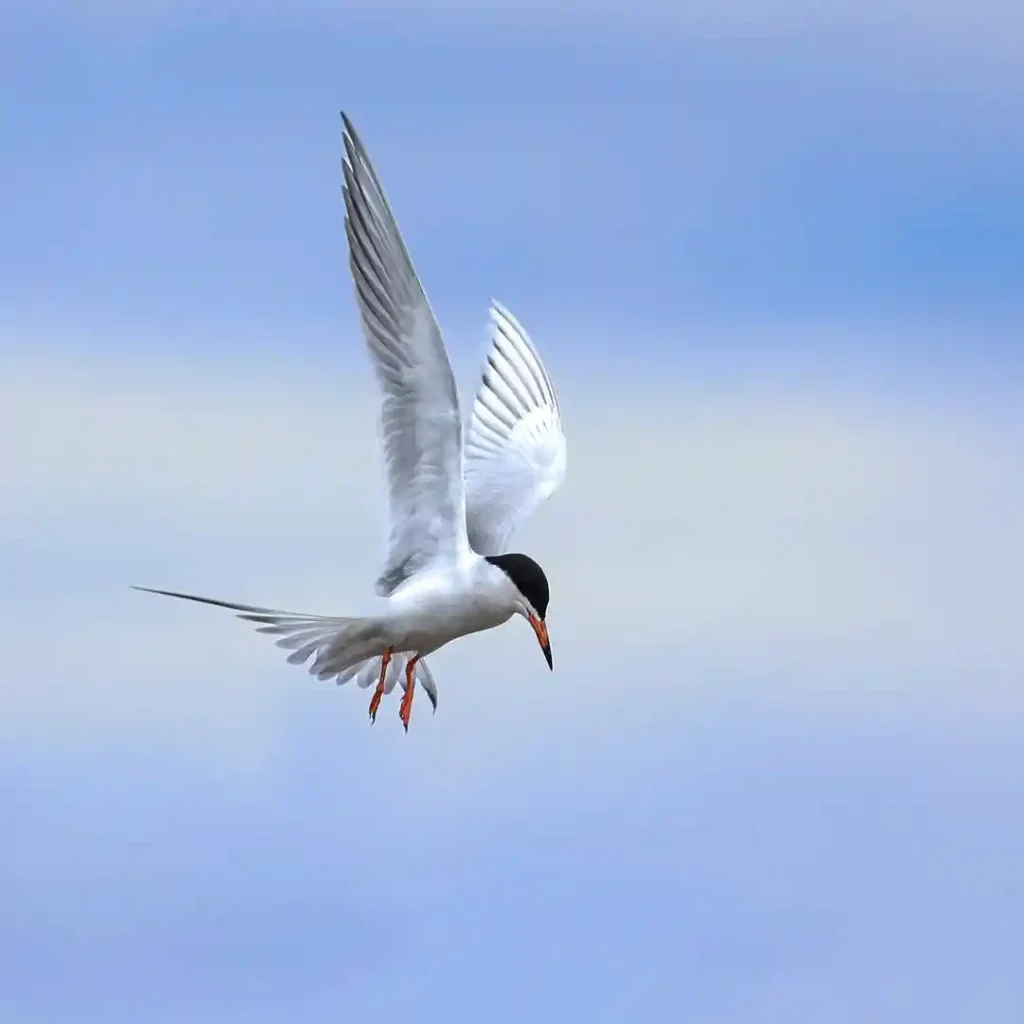
The Forster’s Tern is a slim, elegant bird often seen hovering over water before diving straight down to catch fish. Its graceful flight and pointed wings make it stand out from gulls.
In breeding season, it has a black cap and orange bill, while in winter, it becomes paler with a small dark patch near the eye.
Key Identification Features
| Feature | Details |
| Size | Medium-small |
| Bill | Orange (breeding), darker in winter |
| Tail | Long and deeply forked |
| Wings | Narrow and pointed |
| Flight Style | Hovering and diving |
Behavior & Habitat
- Hovers above water before diving
- Feeds mainly on small fish
- Often seen in small groups
- Prefers calm coastal waters and lagoons
These birds are commonly found in coastal lagoons, marshes, and shallow bays.
When & Where to See in Delaware
- Best season: Spring through early fall
- Top locations: Coastal lagoons, marsh edges
Pro Tip: If the bird is hovering mid-air before diving into water, it’s likely a tern—not a gull.
12. Royal Tern (Thalasseus maximus)
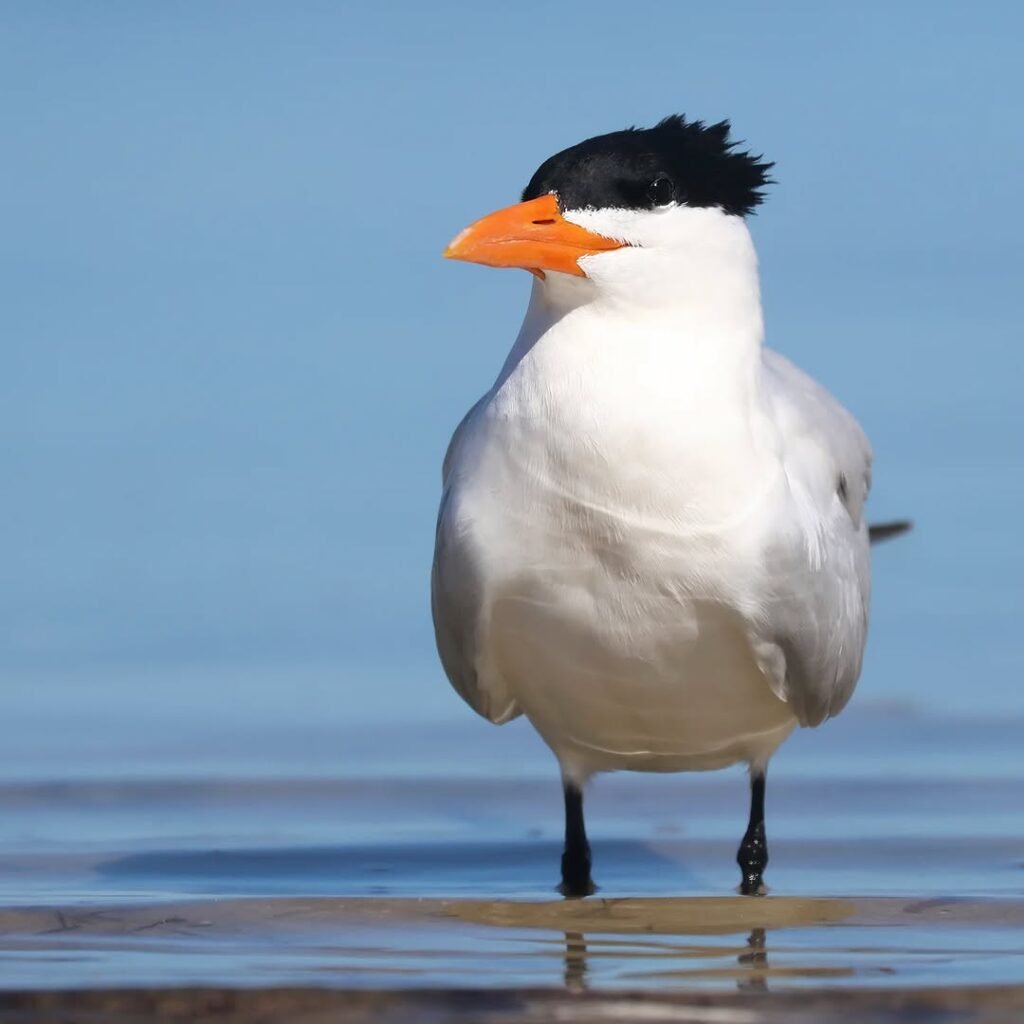
The Royal Tern is larger and more robust than most other terns in Delaware. Its bright orange bill and slightly shaggy crest give it a distinctive look, especially when resting in groups along sandy shores.
They are strong flyers and are often seen gliding just above the waterline.
Key Identification Features
| Feature | Details |
| Size | Large tern |
| Bill | Bright orange, thick |
| Head | Partial black crest |
| Wings | Long and narrow |
| Body | Pale gray and white |
Behavior & Habitat
- Flies low over water searching for fish
- Often rests in large groups on sandbars
- Dives directly into water to catch prey
- More coastal than other terns
Royal Terns prefer open coastlines, beaches, and sandbars, where they gather in visible flocks.
When & Where to See in Delaware
- Best season: Summer
- Top locations: Cape Henlopen, Delaware Bay shoreline
Pro Tip: The thick orange bill is the fastest way to identify a Royal Tern compared to slimmer-billed species.
13. Caspian Tern (Hydroprogne caspia)
The Caspian Tern is the largest tern species you’ll encounter in Delaware. At first glance, it may look similar to other terns, but its thick red bill and powerful build make it stand out quickly.
It has a strong, direct flight style and often flies higher than smaller terns. Its call is also louder and harsher, which helps in identifying it even before you see it clearly.
Key Identification Features
| Feature | Details |
| Size | Largest tern |
| Bill | Thick, bright red |
| Wings | Long and broad |
| Head | Black cap (breeding season) |
| Flight Style | Strong, steady |
Behavior & Habitat
- Dives aggressively to catch fish
- Often seen alone or in small groups
- Uses larger bodies of water than smaller terns
- Less agile but more powerful in flight
They are commonly found near coastal waters, large lakes, and bays, especially during migration.
When & Where to See in Delaware
- Best season: Migration (spring and fall)
- Top locations: Coastal areas, large inland lakes
Pro Tip: If the tern looks bigger and has a thick red bill, it’s a Caspian Tern—not a Royal or Forster’s.
14. American White Pelican (Pelecanus erythrorhynchos)
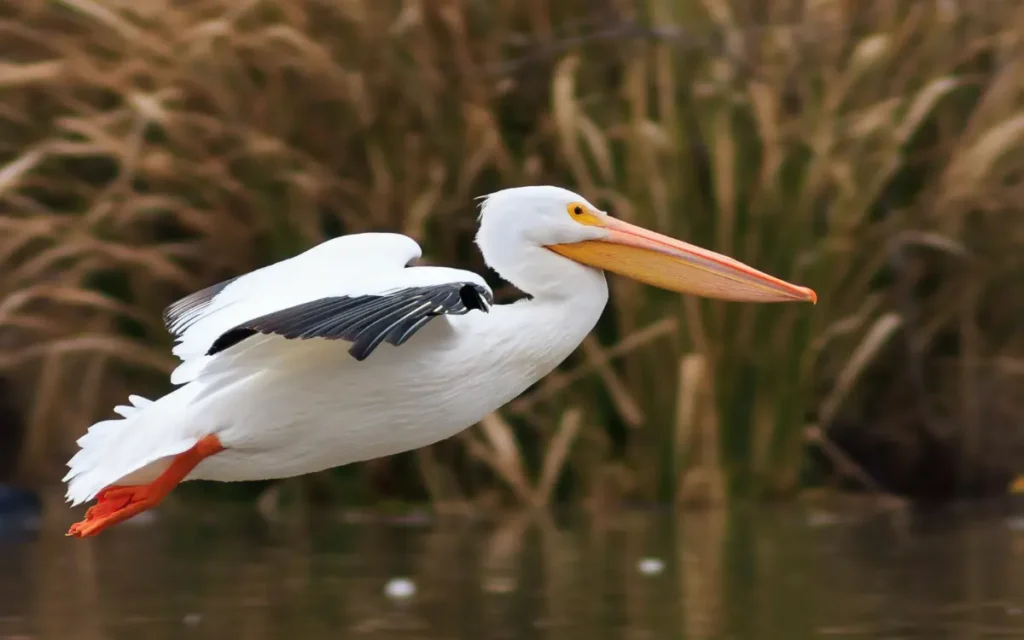
The American White Pelican is one of the most impressive birds you can see in Delaware. With a wingspan that can reach up to 9 feet, it’s hard to miss when one appears.
Unlike brown pelicans, these birds do not dive into water. Instead, they work together in groups, herding fish into shallow areas before scooping them up.
Key Identification Features
| Feature | Details |
| Size | Very large |
| Wingspan | Up to 9 feet |
| Bill | Long, orange, with pouch |
| Body | Bright white with black wing edges |
| Flight | Soaring, steady |
Behavior & Habitat
- Feeds cooperatively in groups
- Glides smoothly on thermal air currents
- Prefers shallow wetlands and sandbars
- Rare but increasing sightings in Delaware
They are not permanent residents but are seen during migration periods, especially in protected wetland areas.
When & Where to See in Delaware
- Best season: Migration (spring/fall)
- Top locations: Bombay Hook, Prime Hook
Pro Tip: If you see a massive white bird soaring with black-edged wings, it’s a pelican nothing else in Delaware looks similar.
15. Rock Pigeon (White Variant) (Columba livia)
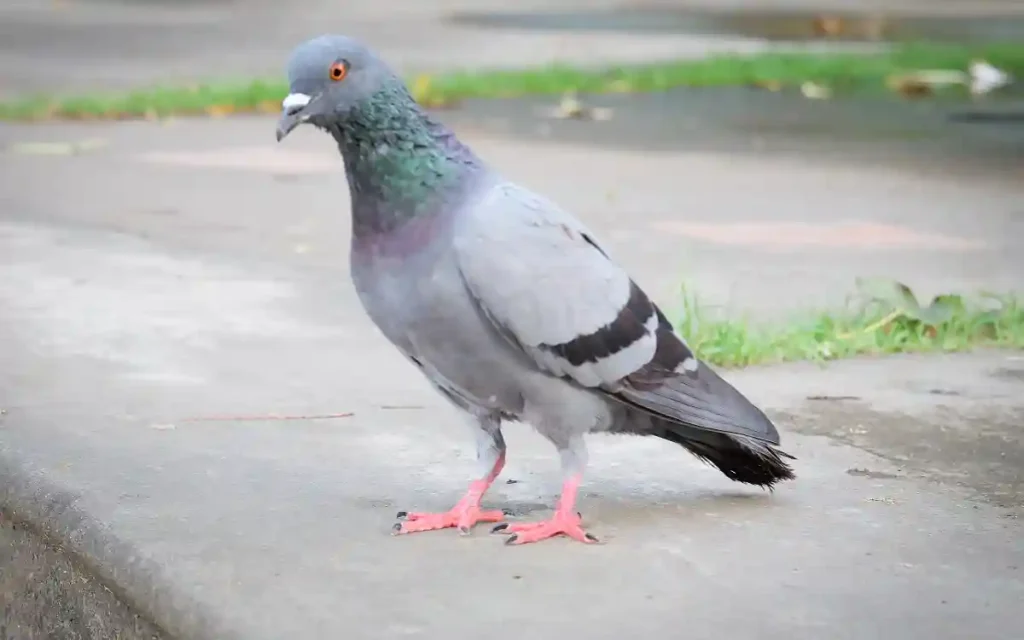
The Rock Pigeon is one of the most common birds in Delaware, but many people don’t realize that it can appear completely white or mostly white.
These birds are highly adaptable and thrive in urban environments, often seen on rooftops, bridges, and sidewalks.
Key Identification Features
| Feature | Details |
| Size | Medium |
| Color | Varies (including pure white) |
| Bill | Small, dark |
| Body Shape | Compact |
| Wings | Broad and rounded |
Behavior & Habitat
- Lives close to human structures
- Feeds on scraps, grains, and seeds
- Forms flocks in cities
- Nests on buildings and ledges
Even though they are not native, they are now part of everyday bird life in cities and towns across Delaware.
When & Where to See in Delaware
- Best season: Year-round
- Top locations: Cities, towns, coastal communities
Pro Tip: If you see a white bird in a city setting rather than near water, it’s likely a Rock Pigeon variant not a wild coastal species.
FAQs
What are the most common white birds in Delaware?
The most commonly seen white birds include Ring-billed Gulls, Great Egrets, Snowy Egrets, and Mute Swans. Gulls are found year-round near people, while egrets are more common in warmer months around wetlands.
When is the best time to see white birds in Delaware?
It depends on the species:
- Winter: Best for Snow Geese and Tundra Swans
- Spring–Summer: Ideal for egrets and terns
- Year-round: Gulls and pigeons
Winter is the best season if you want to see large flocks.
Where can I see white birds in Delaware?
Top locations include:
- Bombay Hook National Wildlife Refuge
- Prime Hook National Wildlife Refuge
- Cape Henlopen State Park
- Woodland Beach
- Rehoboth Bay
These areas offer the best mix of wetlands and coastal habitats.
How do I identify a white bird quickly?
Use this simple method:
- Check size (small, medium, large)
- Look at bill color (yellow, orange, red, black)
- Notice leg color
- Observe behavior (wading, flying, hovering, walking in fields)
This is much more reliable than color alone.
What is the difference between a white egret and a heron?
Egrets are typically slimmer and fully white, while herons are bulkier and usually gray. A rare white heron can appear, but it will still look heavier with a thicker bill.
Are swans and geese the same?
No. Swans are larger with longer, curved necks, while geese are smaller, louder, and usually seen in big flocks. In Delaware, Mute Swans stay year-round, while Snow Geese are winter visitors.
Why are there so many white birds in winter?
Many white birds like Snow Geese and Tundra Swans migrate from Arctic regions to Delaware during winter. The state’s wetlands and farmland provide ideal feeding and resting areas.
Are white pigeons rare in Delaware?
No, white or mostly white Rock Pigeons are fairly common in cities and towns. Their color varies widely, so seeing a white one is normal.
What is the largest white bird in Delaware?
The American White Pelican is the largest, with a wingspan reaching up to 9 feet. However, it is not always present and is mostly seen during migration.
What white bird has yellow feet?
The Snowy Egret is known for its bright yellow feet, which are often called “golden slippers.” This is one of the easiest ways to identify it.