16 Hawks in Texas: Pictures, Sizes and ID Guide
Texas has more hawk diversity than most states, but the species you encounter depend heavily on where and when you look. A Red-tailed Hawk beside a Dallas highway, a Harris’s Hawk in South Texas, and a Ferruginous Hawk over a Panhandle field occupy very different parts of the state.
This guide covers common residents, seasonal visitors, localized breeding species, and two rare hawks recorded in Texas. Use the comparison chart first, then check each bird’s shape, plumage, habitat, and flight pattern.
Texas Hawk Identification Chart
| Hawk | Length | Wingspan | Texas Status | Best Identification Mark |
| Red-tailed Hawk | 17.7–25.6 in | 44.9–52.4 in | Year-round | Broad wings and reddish adult tail |
| Red-shouldered Hawk | 16.9–24.0 in | 37.0–43.7 in | Year-round | Checkered wings and banded tail |
| Cooper’s Hawk | 14.6–17.7 in | 24.4–35.4 in | Year-round | Long rounded tail and large head |
| Sharp-shinned Hawk | 9.4–13.4 in | 16.9–22.1 in | Mainly winter | Small body and square-ended tail |
| Harris’s Hawk | 18.1–23.2 in | 40.5–46.9 in | Year-round in South Texas | Chestnut shoulders and white tail base |
| White-tailed Hawk | 17.3–22.1 in | 46.9–55.1 in | South Texas resident | White adult tail with dark tip |
| Swainson’s Hawk | 18.9–22.1 in | 46.9–54.3 in | Spring and summer | Dark chest bib and long pointed wings |
| Broad-winged Hawk | 13.4–17.3 in | 31.9–39.4 in | Migrant; local breeder | Wide black-and-white tail bands |
| Ferruginous Hawk | 22.1–27.2 in | 52.4–55.9 in | Winter | Rusty shoulders and pale tail |
| Northern Harrier | 16.1–19.7 in | 38.2–48.0 in | Mainly winter | White rump and low, tilting flight |
| Rough-legged Hawk | 18.5–20.5 in | 52.0–54.3 in | Uncommon winter visitor | Dark wrists and feathered legs |
| Gray Hawk | 15.0–18.0 in | About 35 in | Local in far South Texas | Gray body and strongly banded tail |
| Zone-tailed Hawk | 17.7–22.1 in | 46.9–55.1 in | Local breeder and migrant | Black body with a white tail band |
| Common Black Hawk | 17.0–21.0 in | About 50 in | Local in West Texas | Broad white band on short black tail |
| Short-tailed Hawk | 15.0–17.0 in | About 35–39 in | Very rare | Compact shape and two-toned underwings |
| Roadside Hawk | 12.0–16.0 in | About 30–36 in | Exceptional Texas record | Streaked breast, yellow eyes and legs |
Measurements are ranges, not identification rules. Female hawks are often larger than males.
1. Harris’s Hawk

Scientific name: Parabuteo unicinctus
Texas status: Resident in southern and southwestern Texas
Harris’s Hawks are dark brown with chestnut shoulders, reddish thighs, yellow facial skin, and white at the base and tip of the tail. The white rump is especially noticeable when the bird flies away.
They are strongly associated with dry brush country, ranchland, mesquite, utility structures, and cactus-covered areas. South Texas and the Lower Rio Grande Valley provide the best chances of finding them.
Unlike most North American raptors, Harris’s Hawks often live and hunt in social groups. Family members may cooperate while pursuing rabbits and other prey.
Look-alike: A dark Red-tailed Hawk lacks the Harris’s Hawk’s chestnut shoulder patches and bold white tail base. Harris’s Hawks are also more likely to be seen with other members of the same species.
5. White Tailed Hawk
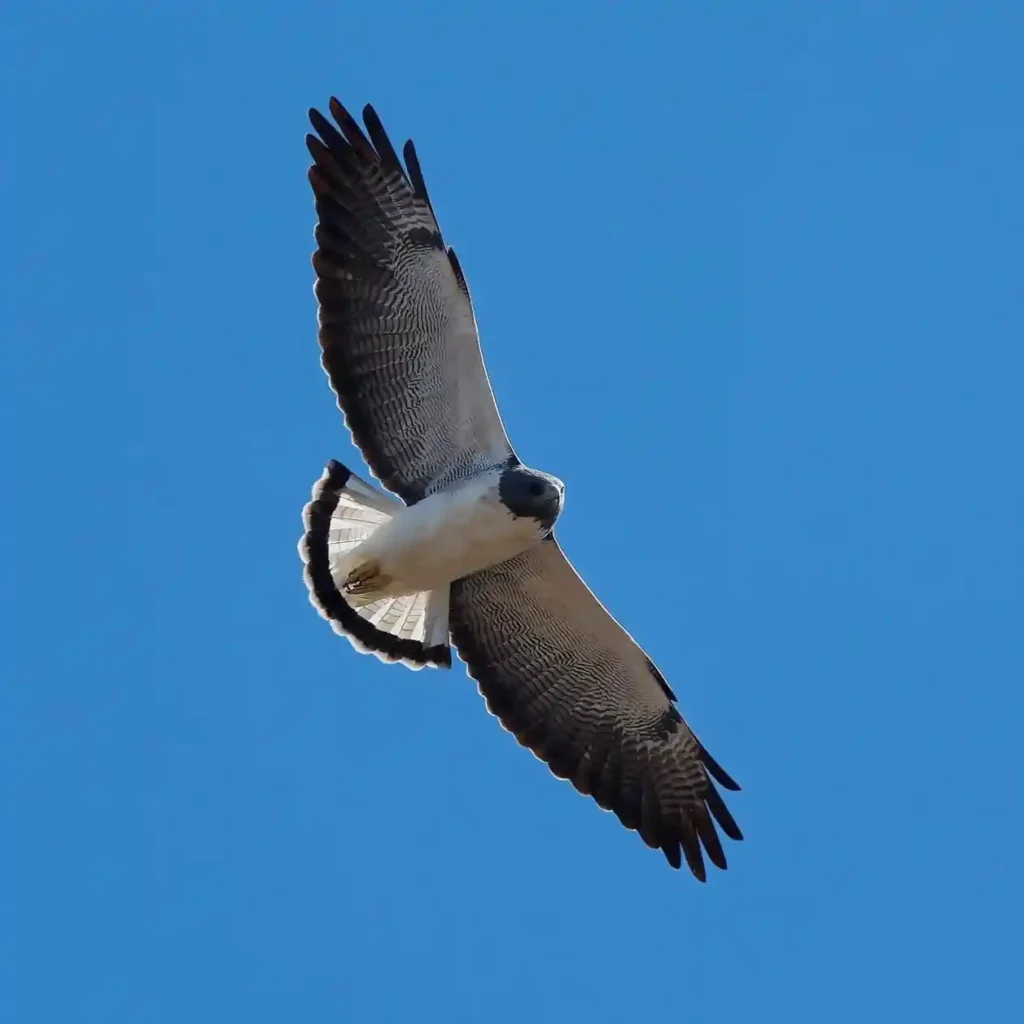
Scientific name: Geranoaetus albicaudatus
Texas status: Resident in coastal and southern Texas
The White-tailed Hawk was an important omission from the original article. It is a large open-country hawk found in South Texas grassland, coastal prairie, ranches, and brush country.
Adults have a gray back, pale underside, rusty shoulder patch, and a mostly white tail ending in a dark band. Viewed from below, the wings show dark flight feathers contrasting with paler inner sections.
Young White-tailed Hawks look very different. They are brown and streaked, with a pale tail crossed by several narrow dark bands.
Look-alike: Red-tailed Hawk. An adult White-tailed Hawk has a white tail rather than a reddish one, longer wings, and a more restricted South Texas range.
3. Red-tailed Hawk
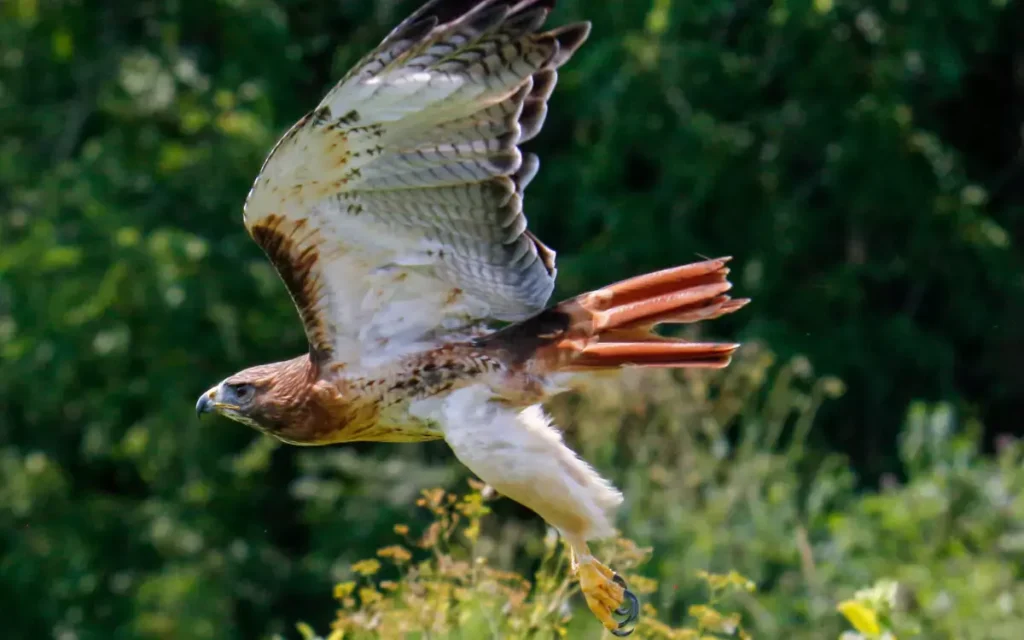
Scientific name: Buteo jamaicensis
Texas status: Year-round resident; more numerous during winter
The Red-tailed Hawk is the large hawk most Texans see perched on utility poles, highway signs, dead branches, and roadside trees. Adults commonly have a brick-red upper tail, broad rounded wings, a pale chest, and a dark band of streaks across the belly.
Do not depend on the tail alone. Young birds have brown, narrowly banded tails, and Texas receives several regional color forms. A pale mark across the upper chest and dark bars along the front edge of the underwings are often better clues.
Red-tailed Hawks hunt rodents, rabbits, snakes, and other small animals in fields, ranchland, highway medians, and woodland openings.
Look-alike: Swainson’s Hawk. A Swainson’s has longer, narrower wings and usually shows a dark bib across the upper chest rather than a belly band.
4. Sharp-shinned Hawk
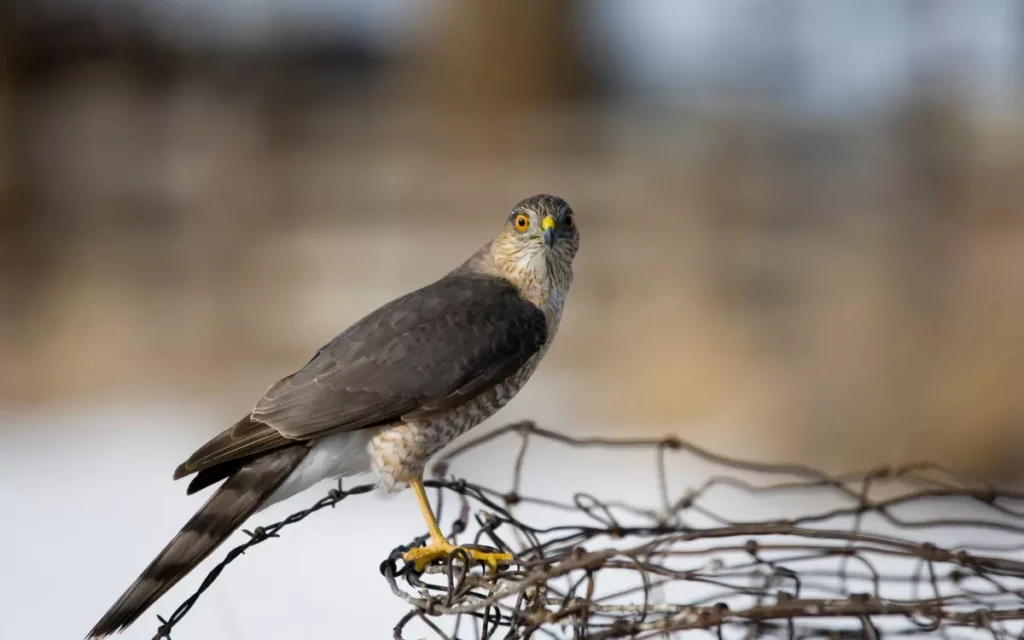
Scientific name: Accipiter striatus
Texas status: Mainly a migrant and winter visitor
The Sharp-shinned Hawk is the smallest regularly occurring hawk in Texas. It has short rounded wings, a long banded tail, a small head, and very thin legs. Adults are blue-gray above and reddish barred below; immature birds are brown with coarse streaking.
These hawks hunt small birds by using woodland edges and backyard vegetation as cover. Their flight alternates between several quick wingbeats and a short glide.
A Sharp-shinned Hawk may visit a yard because it has found prey there, not because it is interested in birdseed.
Look-alike: Cooper’s Hawk. A Sharp-shinned has a smaller head that barely extends beyond the wings, a slimmer body, and a squarer tail. These clues are easiest to judge when the bird is flying.
5. Cooper’s Hawk
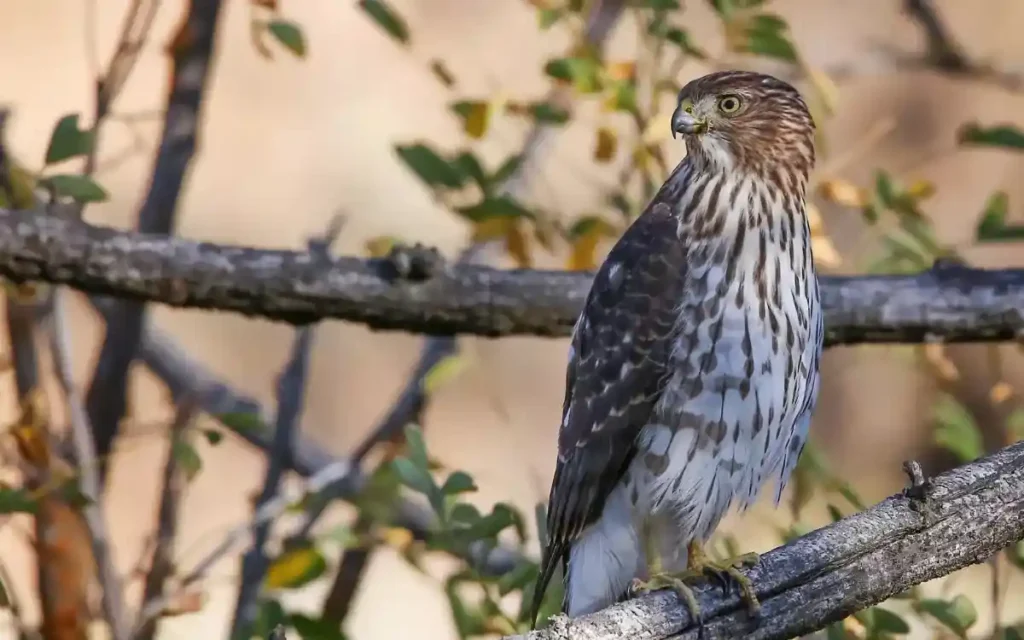
Scientific name: Astur cooperii
Texas status: Year-round; numbers rise during migration and winter
Cooper’s Hawks have adapted well to cities and suburbs. They fly through trees with short bursts of wingbeats and may appear near bird feeders where doves, starlings, and other potential prey gather.
Adults are blue-gray above with reddish barring below, red eyes, and a long tail ending in a rounded tip. Young birds are brown above and marked with narrow brown streaks on the chest.
The head usually looks large and projects noticeably beyond the wings in flight. The tail may also show graduated feathers, with the outer feathers shorter than the central pair.
Look-alike: Sharp-shinned Hawk. Cooper’s Hawks are larger, have a more prominent head, thicker legs, and a more rounded tail tip. Size alone can mislead because a male Cooper’s may approach a female Sharp-shinned in size.
6. Ferruginous Hawk
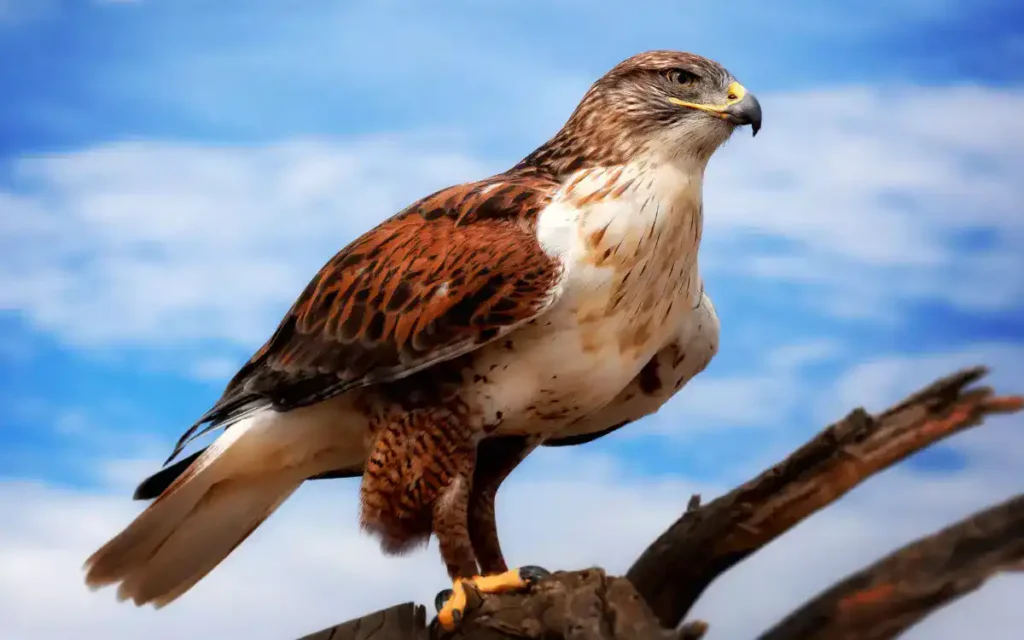
Scientific name: Buteo regalis
Texas status: Winter visitor, mainly in northern and western Texas
The Ferruginous Hawk is North America’s largest buteo. It has a large head, long wings, feathered legs, and a broad mouth that gives the face a different shape from many other hawks.
Light-form birds have pale underparts, rusty markings on the shoulders and legs, and a pale tail. In flight, the rusty legs can form a dark V against the otherwise pale body. Dark-form birds occur but are much less straightforward to identify.
Look across open prairie, ranchland, farmland, and desert grassland for birds perched on poles, fence posts, or even on the ground.
Look-alike: Red-tailed Hawk. Ferruginous Hawks are larger and longer-winged, usually have a pale tail, and lack the typical Red-tailed Hawk belly band.
7. Red-shouldered Hawk
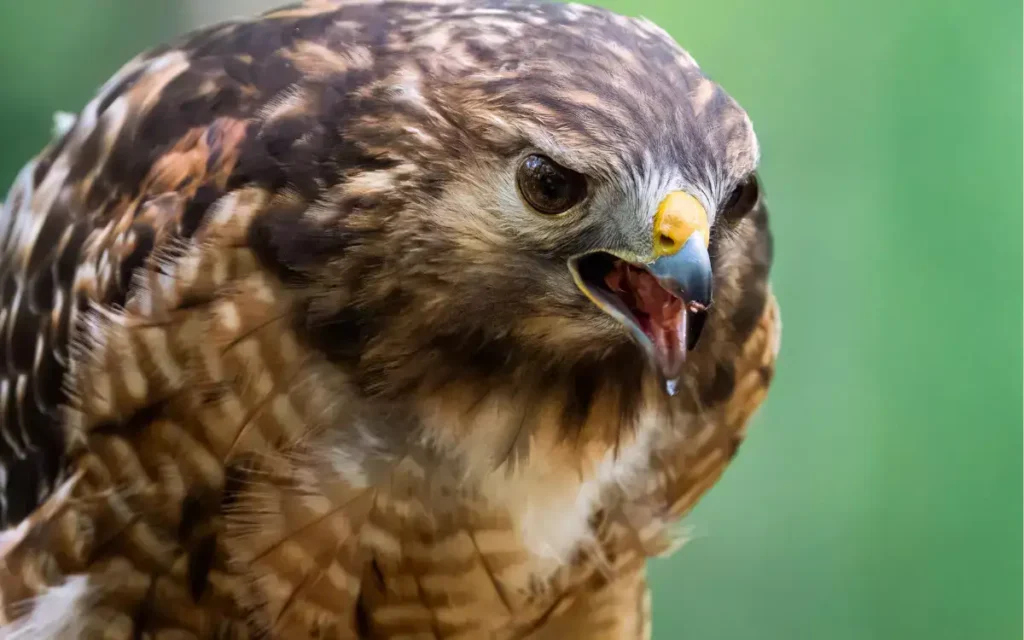
Scientific name: Buteo lineatus
Texas status: Year-round resident, mainly in central and eastern regions
Red-shouldered Hawks favor wooded creeks, bottomland forests, suburban parks, and wet woodland. Adults have rusty barring across the chest, black-and-white checkering on the wings, and several narrow white bands across the dark tail.
Their repeated, whistled “kee-ah” call is often heard before the bird appears. Blue Jays can imitate this call surprisingly well, so look for the hawk before recording an identification.
These hawks usually hunt from a low or medium-height perch, dropping onto frogs, snakes, crayfish, mice, and other prey.
Look-alike: Broad-winged Hawk. The Red-shouldered has more wing checkering and narrower tail bands. A Broad-winged Hawk normally has one broad white band through the middle of its adult tail.
8. Swainson’s Hawk
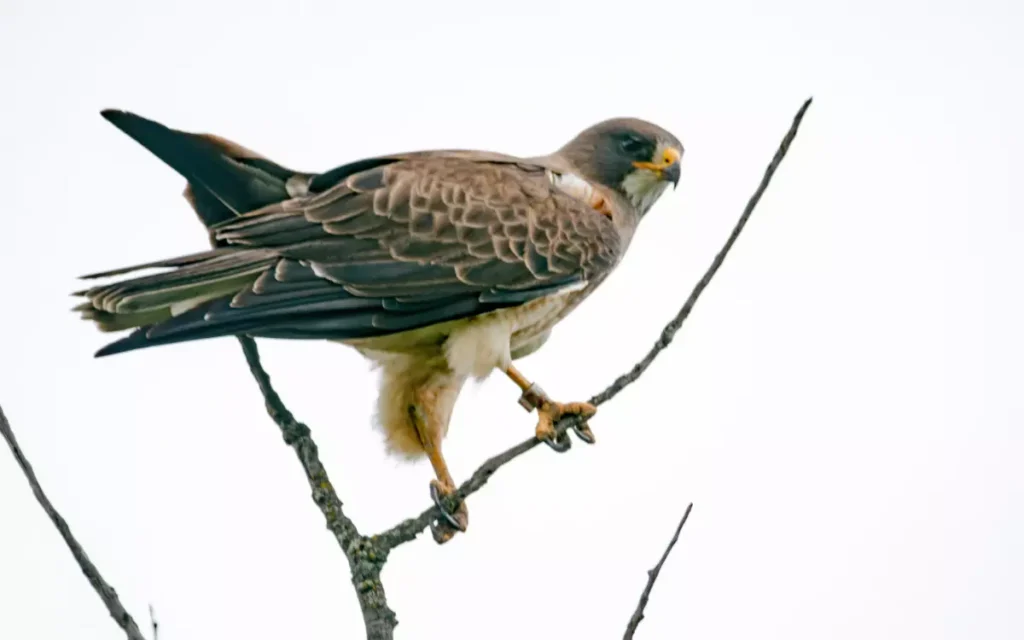
Scientific name: Buteo swainsoni
Texas status: Spring and summer breeder; abundant migrant in some areas
Swainson’s Hawks are long-winged hawks of farmland, grassland, ranches, and open plains. Light-form adults usually have a brown upper chest that forms a bib above a much paler belly. Their flight feathers create a dark trailing half of the underwing.
These hawks often perch on fence posts and irrigation equipment. During summer, they eat rodents and other small vertebrates around the nest. Large insects, including grasshoppers, become an important food during migration.
Swainson’s Hawks travel to South America for winter and can form large migrating groups.
Look-alike: Red-tailed Hawk. The Swainson’s has narrower, more pointed wings and usually holds them in a shallow V while soaring. Its dark flight feathers also contrast more strongly with the pale wing linings.
9. Broad-winged Hawk
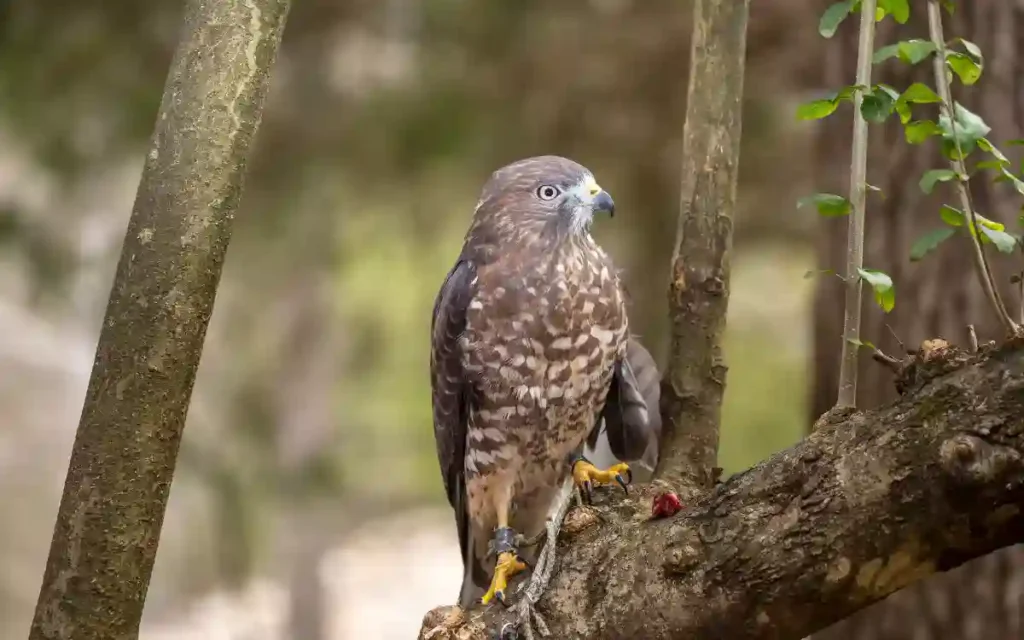
Scientific name: Buteo platypterus
Texas status: Migrant; breeds locally in eastern Texas
Broad-winged Hawks are compact forest raptors with broad wings and relatively short tails. Adults have reddish barring below and a dark tail crossed by one broad white middle band, plus a narrower pale band near the base.
Outside migration, these hawks can be difficult to see because they hunt beneath the woodland canopy. Their thin, high-pitched whistle may reveal a nesting bird.
Large numbers move through Texas during migration, especially along the Gulf Coast. Groups circle upward on rising warm air before gliding toward the next thermal. These groups are known as kettles.
Look-alike: Red-shouldered Hawk. The Broad-winged Hawk lacks the Red-shouldered Hawk’s bold wing checkering and has broader tail bands.
10. Gray Hawk

Scientific name: Buteo plagiatus
Texas status: Local resident and breeder in far South Texas
Adult Gray Hawks are pale gray with fine barring below, yellow eyes, and a long black tail crossed by narrow white bands. Their short, rounded wings suit the wooded river corridors where they hunt.
In Texas, they are closely associated with the Lower Rio Grande Valley. Look in mature riverside woodland and areas with tall trees near water. Their diet includes lizards, snakes, small mammals, birds, and large insects.
Young Gray Hawks look unlike the adults. They are brown above and heavily marked below, so the long banded tail and habitat become more useful.
Look-alike: Adult Cooper’s Hawk. A Gray Hawk has a more evenly gray underside, broader black-and-white tail pattern, and occurs in a much smaller part of Texas.
11. Zone-tailed Hawk

Scientific name: Buteo albonotatus
Texas status: Local breeder and migrant in western and southwestern Texas
The Zone-tailed Hawk is a dark raptor with broad wings, yellow legs, and a black tail crossed by a wide white band. It often soars with raised wings and rocks from side to side.
That flight style makes it look surprisingly similar to a Turkey Vulture. Zone-tailed Hawks may even fly near vultures, possibly allowing them to approach prey without causing immediate alarm.
Look around canyons, wooded desert streams, rocky hills, and mountain foothills in West Texas.
Look-alike: Turkey Vulture. Check for the white tail band and fully feathered head. A Turkey Vulture has a small bare head and silver-gray flight feathers extending across much of the underwing.
12. Northern Harrier
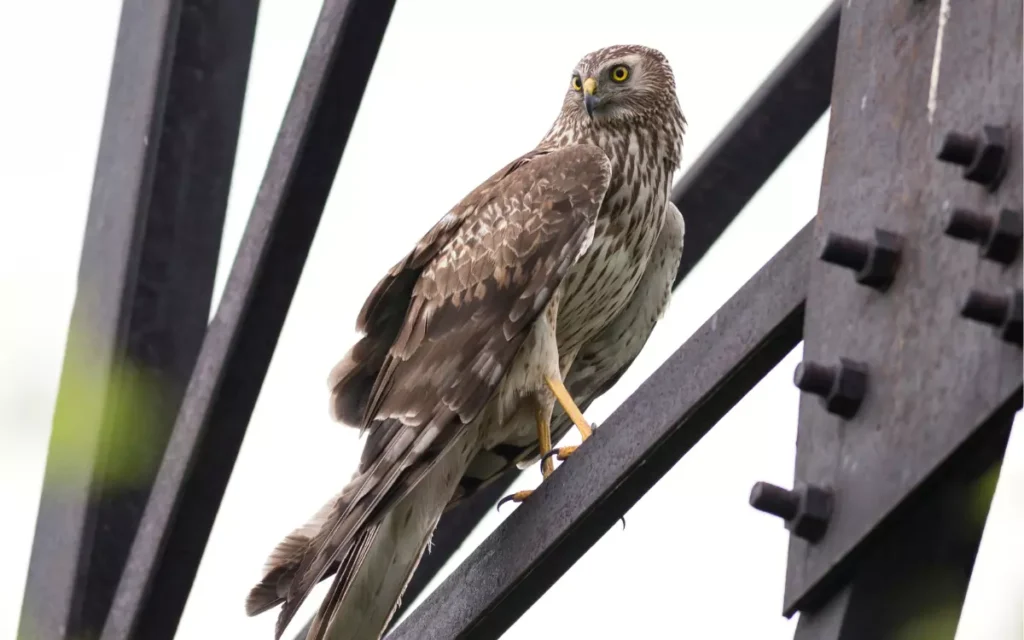
Scientific name: Circus hudsonius
Texas status: Common winter visitor; scarce during summer
Northern Harriers fly low over marshes, fields, coastal prairie, and grassland with their long wings held in a shallow V. Their flight often looks buoyant and unsteady compared with the direct movement of many other hawks.
Both sexes have a white rump. Adult males are gray above and pale below, while females and young birds are brown with streaked underparts. Females are noticeably larger.
The facial feathers form an owl-like disk that helps funnel sound toward the ears. Harriers use both sight and hearing while searching for rodents and small birds.
Look-alike: A Short-eared Owl also flies low over open ground. The harrier has a longer tail, narrower wings, and a clear white rump.
13. Rough legged Buzzard

Scientific name: Buteo lagopus
Texas status: Uncommon and irregular winter visitor
Rough-legged Hawks breed in the Arctic and reach Texas during some winters. They are most likely in open country across the Panhandle and northern or western parts of the state.
Light-form birds commonly show dark wrist patches, a pale head, a dark belly patch, and a pale tail with a dark tip. Like Ferruginous Hawks, they have feathers extending down the legs to the toes.
They frequently hover or face into the wind while searching grassland for rodents.
Look-alike: Light-form Ferruginous Hawk. A Rough-legged Hawk usually has stronger black wrist patches and a dark belly, while a Ferruginous Hawk shows rusty legs and cleaner pale underparts.
14. Common Black Hawk

Scientific name: Buteogallus anthracinus
Texas status: Local breeder in far West Texas; rare elsewhere
The Common Black Hawk is a broad-winged, short-tailed raptor associated with streams and rivers in arid country. Adults are mostly black with yellow facial skin and legs. The short black tail has one broad white band and a narrow white tip.
Texas has a small breeding population in the Trans-Pecos. These hawks hunt near water, taking fish, frogs, crayfish, snakes, insects, and other small animals.
A Common Black Hawk may sit quietly inside riverside woodland, making the call and tail pattern more noticeable than the body.
Look-alike: Zone-tailed Hawk. Common Black Hawks have broader wings, a shorter tail, and a heavier body. They also spend more time close to wooded streams.
15. Short Tailed Hawk
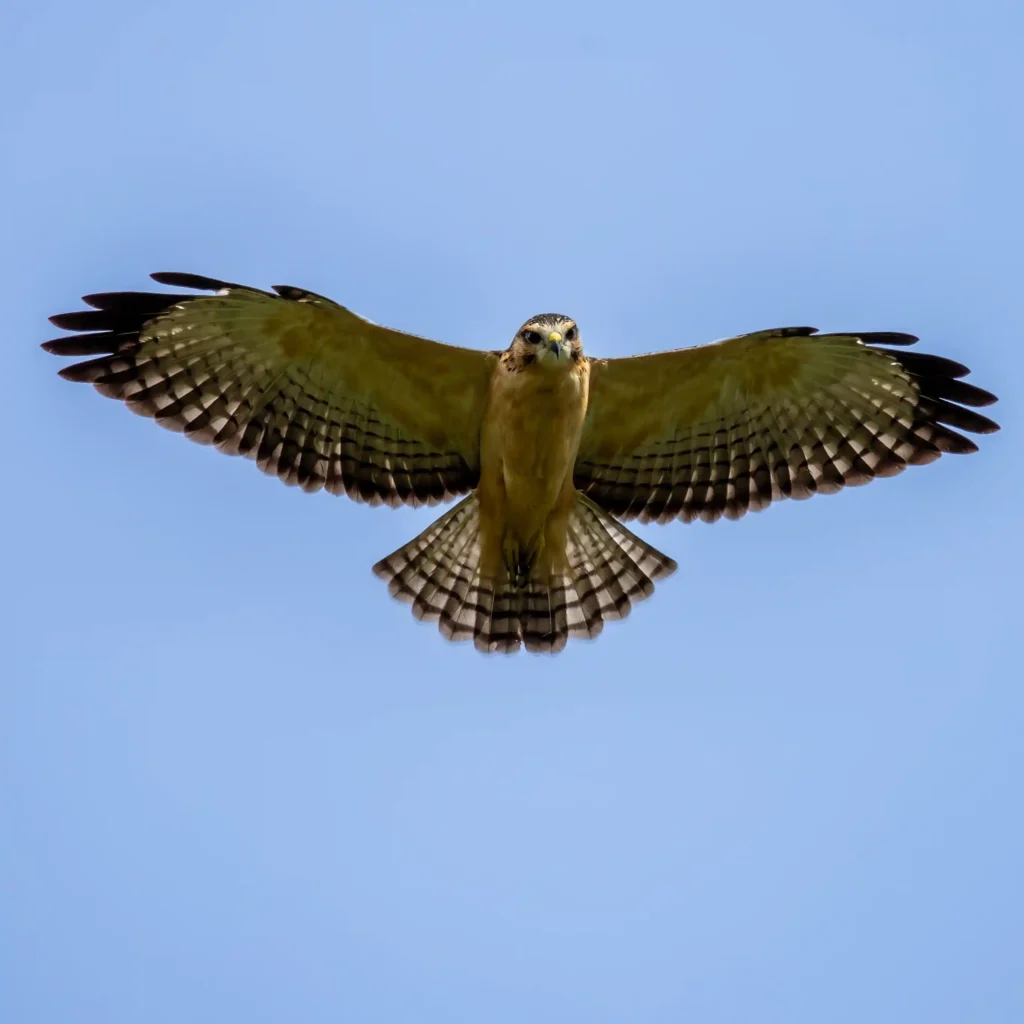
Scientific name: Buteo brachyurus
Texas status: Very rare; sightings require careful documentation
Short-tailed Hawks occur regularly in Florida and from Mexico southward, but Texas records are rare. They should not be presented as a normal South Texas hawk.
This compact buteo occurs in light and dark forms. Light-form adults are white below with a dark head, dark upper breast sides, and dark flight feathers. Dark-form birds can be almost entirely black below.
Short-tailed Hawks spend much of their time soaring and often capture birds from above.
Look-alike: Light-form Swainson’s Hawk. The Short-tailed Hawk has a shorter, broader wing shape and lacks the Swainson’s Hawk’s long, pointed-winged profile.
16. Crane Hawk

Scientific name: Geranospiza caerulescens
Texas status: Exceptional visitor to the Lower Rio Grande Valley
The Crane Hawk is a tropical raptor with a slender gray body, long reddish legs, rounded wings, and a black tail crossed by two white bands. Its unusually flexible legs help it reach into tree holes, bromeliads, and bark openings while searching for prey.
Texas has only a tiny number of accepted records. One bird appeared in the Lower Rio Grande Valley during the winter of 1987–88, while another was documented near Salineño in Starr County during 2024.
This is not a hawk most visitors should expect to find. Any suspected Crane Hawk needs clear photographs and detailed field notes.
Look-alike: Gray Hawk. The Crane Hawk has much longer legs, a smaller head, and a slimmer body. Its two broad white tail bands are also useful identification marks.
17. Osprey (Fish Hawk)
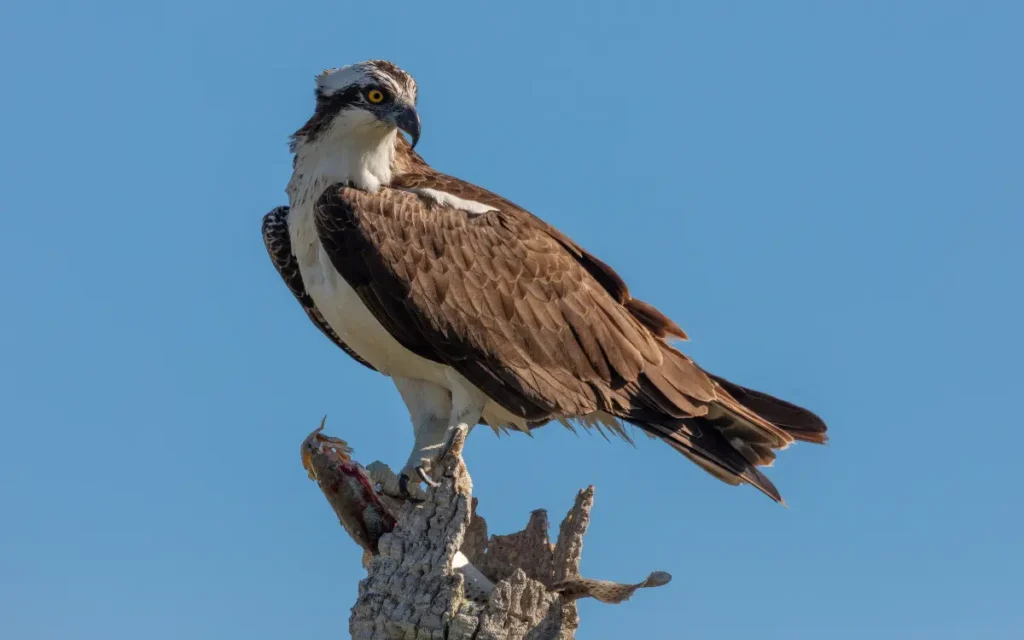
Scientific name: Pandion haliaetus
Texas status: Migrant, winter visitor, and local breeder
The Osprey is a large fish-eating raptor found near Texas lakes, rivers, reservoirs, bays, and coastal wetlands. It has long, narrow wings, a white underside, dark wrist patches, and a white head crossed by a dark eye stripe.
Ospreys hover briefly before plunging feet-first into the water. Their feet have rough pads and strongly curved claws that help them hold slippery fish.
Although people often call this bird a fish hawk, it belongs to its own family rather than the main hawk family.
Look-alike: Bald Eagle. An adult Bald Eagle has a heavier body, broader wings, and an entirely white head without a dark eye stripe.
18. Roadside Hawk

Scientific name: Rupornis magnirostris
Texas status: Exceptional vagrant; not a regular Texas species
The Roadside Hawk is widespread from Mexico through much of Central and South America, but Texas observations are exceptional. A reader should not expect to find one simply by driving roads in the Lower Rio Grande Valley.
This small tropical hawk has yellow eyes and legs, a streaked or barred chest, reddish barring on the belly, and a banded tail. As its name suggests, it often uses exposed roadside perches within its normal range.
Any suspected Texas Roadside Hawk should be photographed and reported with a detailed location and field notes.
Look-alike: Gray Hawk. A Roadside Hawk is smaller, browner, and more heavily marked below. Adult Gray Hawks are cleaner gray and have a bolder black-and-white tail.
Picture caption: Roadside Hawk showing its yellow eye, barred underside, and banded tail.
Cooper’s Hawk vs Sharp-Shinned Hawk
These two woodland hawks cause more identification trouble than any other Texas pair.
| Feature | Cooper’s Hawk | Sharp-Shinned Hawk |
| Overall size | Crow-sized or slightly smaller | Jay-sized |
| Head | Large and projects past wings | Small and rounded |
| Tail tip | Usually rounded | Usually square |
| Legs | Thicker | Very thin |
| Flight | Stronger, slower wingbeats | Quick, flicking wingbeats |
| Typical prey | Doves and medium birds | Sparrows and other small birds |
Size overlap makes a single feature unreliable. Use the head, tail, legs, and flight pattern together.
Red-Tailed Hawk vs Red-Shouldered Hawk
A Red-tailed Hawk favors open ground and usually looks heavier. Its wings are broad but relatively plain, and most adults have a reddish upper tail.
A Red-shouldered Hawk is more closely tied to wet woodland. Its wings show strong black-and-white checkering, while the tail carries several pale bands. The rusty color spreads across much of the adult’s chest rather than being restricted to the tail or shoulders.
Best Places to See Hawks in Texas
Lower Rio Grande Valley
South Texas is the best region for Harris’s, White-tailed, and Gray Hawks. Common species such as Cooper’s and Red-tailed Hawks also occur there.
While visiting wetland areas, you may also encounter herons found in Texas and several Texas hummingbirds.
Trans-Pecos and Big Bend
West Texas can produce Zone-tailed, Common Black, Red-tailed, and Cooper’s Hawks. Swainson’s Hawks occur across suitable open country during the warmer months.
Texas Panhandle
The Panhandle is especially useful in winter. Red-tailed, Ferruginous, Rough-legged, and Northern Harriers can all occur across open farmland and prairie.
East Texas
Wooded streams and bottomland forest support Red-shouldered Hawks. Broad-winged Hawks breed locally and become easier to see during migration.
Upper Texas Coast
The Smith Point Hawk Watch on Galveston Bay is one of the state’s main raptor migration locations. Large numbers of Broad-winged Hawks, Mississippi Kites, accipiters, and other birds of prey pass through the region.
When to Watch Hawks in Texas
Texas has hawks throughout the year, but the mix changes seasonally.
- Winter: Red-tailed, Sharp-shinned, Northern Harrier, Ferruginous and Rough-legged Hawks
- Spring: Swainson’s and Broad-winged Hawks return or pass through
- Summer: Harris’s, White-tailed, Cooper’s, Red-shouldered and several localized breeding hawks
- Fall: Migrating Broad-winged, Swainson’s, Sharp-shinned and Cooper’s Hawks may gather along established routes
Midmorning through early afternoon can be productive once the ground warms and rising air helps large hawks soar.
How to Identify a Hawk in Flight
Start with the bird’s outline instead of trying to see plumage immediately.
Broad wings and short tail
This shape points toward a buteo, such as a Red-tailed, Red-shouldered, Broad-winged, Ferruginous, or Swainson’s Hawk.
Short wings and long tail
This combination fits Cooper’s and Sharp-shinned Hawks. They are built for quick turns between trees.
Long wings held in a V
Consider Northern Harrier or Swainson’s Hawk. A harrier usually flies much lower and has a white rump.
Dark bird rocking like a vulture
Check the tail. A wide white band supports Zone-tailed Hawk, while a Turkey Vulture lacks that tail band.
Do Hawks Visit Texas Backyards?
Cooper’s Hawks and Sharp-shinned Hawks are the most likely species to appear around backyard bird feeders. They come to hunt birds, not to eat seed.
If a hawk begins visiting regularly, taking feeders down for one or two weeks can encourage songbirds to spread out. Dense native shrubs give smaller birds places to escape, but feeders should not be positioned beside windows or enclosed corners.
Read the backyard birds of Texas guide to identify the smaller species a visiting hawk may be watching.
Are Hawks Protected in Texas?
Native hawks are protected under the federal Migratory Bird Treaty Act. Capturing, killing, possessing, or taking hawks, their eggs, or active nests generally requires federal authorization.
Watching or photographing a nest from a safe distance is allowed, but repeated close approaches can cause stress or nest abandonment. Never handle an injured hawk yourself. Contact a licensed wildlife rehabilitator.
Frequently Asked Questions
What is the most common hawk in Texas?
The Red-tailed Hawk is the most widespread and easily noticed Texas hawk. It occurs throughout the year and becomes even more numerous when northern birds arrive for winter.
What Texas hawk has a white tail?
Adult White-tailed Hawks have a mostly white tail with a dark terminal band. Harris’s Hawks have white at the base and tip of an otherwise dark tail.
What hawk has a white rump in Texas?
The Northern Harrier has a bright white rump visible in both males and females. It usually flies low over fields and marshes.
Which Texas hawk looks like a Turkey Vulture?
The Zone-tailed Hawk resembles a Turkey Vulture in color and flight style. Look for yellow legs and a wide white band across its black tail.
What is the large pale hawk seen in West Texas during winter?
A large, pale grassland hawk could be a Ferruginous Hawk. Check for rusty shoulder or leg markings, a pale tail, and long wings. Rough-legged Hawks are another winter possibility but usually have dark wrist patches.
Are hawks dangerous to people?
Wild hawks do not normally attack people. A nesting bird may call or fly nearby when someone approaches too closely. Give active nests plenty of space.
Will a hawk carry away a dog or cat?
Most Texas hawks cannot lift an average dog or adult cat. Very small pets can be vulnerable to large raptors, coyotes, and other predators, so they should be supervised outdoors.
Is an Osprey a hawk?
An Osprey is a bird of prey but is placed in its own family, Pandionidae. Calling it a “fish hawk” is common, but it should not take a numbered position in a strict Texas hawk identification guide.
More Texas Bird Guides