14 Types of Gulls: Identification Guide to Common Gull Species
Most people see a gray-and-white bird near the beach and call it a seagull. That is understandable, but gulls are more varied than they first appear. Some are small and delicate, some are huge and powerful, and many change their appearance by age and season.
Gulls can be found along oceans, lakes, rivers, wetlands, farms, parking lots, and even city rooftops. That is one reason they are both familiar and confusing. A bird that looks plain white from a distance may have a ringed bill, pink legs, black wingtips, a dark hood, or pale wing edges that help identify it.
This guide covers the main types of gulls, how to tell them apart, and what clues to look for when you see one in the wild.
What Is a Gull?
A gull is a medium to large bird in the family Laridae, the same larger family group that includes terns and skimmers. Gulls are strong flyers, smart feeders, and highly adaptable birds.
They are often linked with the sea, but not all gulls live only near saltwater. Many species are common around inland lakes, rivers, reservoirs, farms, landfills, and urban areas.
Most gulls have:
- Long wings
- Webbed feet
- Strong bills
- Gray, white, black, or brown plumage
- Loud calls
- Flexible feeding habits
Gulls eat fish, crabs, insects, worms, shellfish, eggs, carrion, small animals, and scraps left by people. Their ability to use many food sources is one reason they do so well in different habitats.
Are Gulls and Seagulls the Same?
Yes and no. People often use the word seagull for any gull seen near water, but “seagull” is not the best birding term. The correct general name is gull.
This matters because many gulls are not always found by the sea. Some spend much of their time around lakes, fields, rivers, parking lots, and inland towns.
How to Identify Different Types of Gulls
Gull identification can feel hard because many species look similar from a distance. The easiest way to start is not by memorizing every species. Instead, look for a few simple clues.
Look at Size and Shape
Size is one of the first clues. If several gulls are standing together, compare them.
Small gulls, like Bonaparte’s Gull, look light, delicate, and tern-like. Medium gulls, like Ring-billed Gull and Laughing Gull, are common in mixed flocks. Large gulls, like Herring Gull, look heavier with broader wings and thicker bills. Very large gulls, like Great Black-backed Gull, can look almost bulky next to other gulls.
Body shape also helps. Some gulls look slim and graceful, while others look heavy, strong, and dominant.
Check the Bill
The bill is one of the best gull ID features.
Some gulls have plain yellow bills, while others have black rings, red spots, dark tips, or mixed markings. For example, a Ring-billed Gull has a clear dark ring around its yellow bill. A Herring Gull has a yellow bill with a red spot near the lower tip.
Small gulls usually have thinner, more delicate bills. Large gulls often have thicker, stronger bills.
Notice the Leg Color
Leg color is another easy clue, especially when the bird is standing.
| Leg Color | Possible Gull Species |
| Yellow | Ring-billed Gull, California Gull, Lesser Black-backed Gull |
| Pink | Herring Gull, Great Black-backed Gull, Western Gull |
| Black or dark | Laughing Gull, Bonaparte’s Gull, Black-legged Kittiwake |
| Pale pink | Glaucous Gull, Iceland Gull |
Leg color is not perfect in every season or age, but it gives you a strong starting point.
Watch the Wing Pattern
Adult gulls often have gray backs and white bodies, but the wingtips can vary a lot.
Some gulls have bold black wingtips with white spots. Others, like Glaucous Gull and Iceland Gull, have pale wingtips with little or no black. Dark-backed gulls, such as Great Black-backed Gull, Lesser Black-backed Gull, and Western Gull, stand out because their upperparts are much darker than typical pale-gray gulls.
Remember Young Gulls Look Different
This is where many beginners get stuck. Young gulls are often brown, streaky, mottled, or patchy. They may look nothing like clean adult gulls.
Some large gulls take several years to reach full adult plumage. A young Herring Gull, for example, can look mostly brown, while an adult has a white head, pale gray back, pink legs, and yellow bill.
When you are learning, start with adult gulls first. Immature gulls can come later.
1. Ring billed Gull
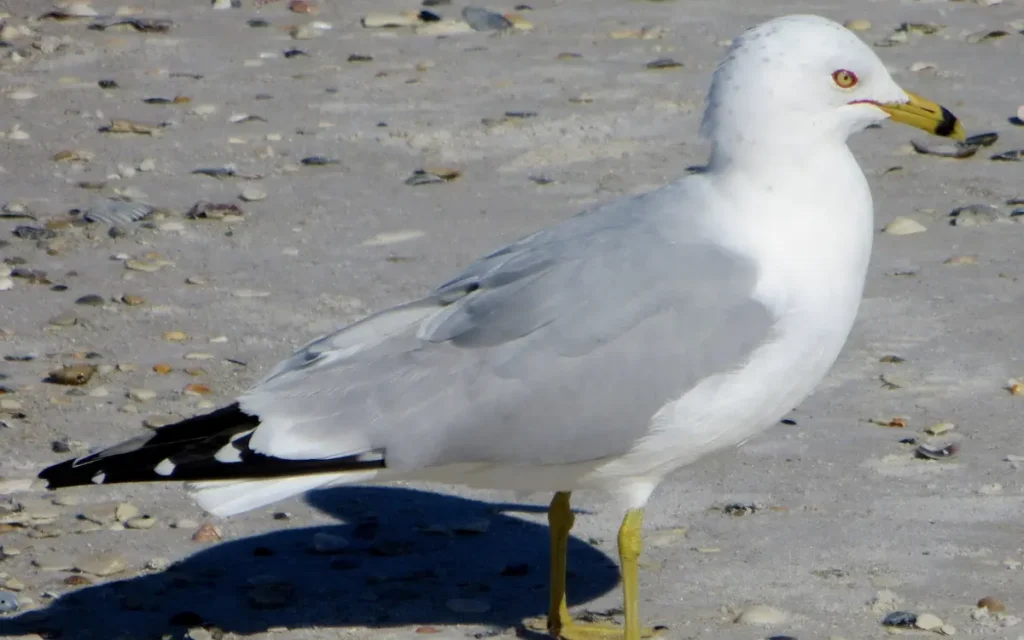
The Ring-billed Gull is one of the easiest gulls for beginners to recognize. It is a medium-sized gull with a pale gray back, white body, yellow legs, and a yellow bill marked by a black ring.
This species is very common across much of North America. You may see it around beaches, lakes, rivers, parking lots, sports fields, farms, and fast-food areas. It is one of those gulls that often lives close to people.
Adult Ring-billed Gulls are neat-looking birds. Their black wingtips show white spots, and their yellow legs help separate them from larger pink-legged gulls.
Best ID clue: Yellow bill with a black ring.
Quick facts:
| Feature | Ring-billed Gull |
| Size | Medium |
| Legs | Yellow |
| Bill | Yellow with black ring |
| Back | Pale gray |
| Common Range | North America |
| Best Habitat Clue | Lakes, parking lots, beaches |
2. Herring Gull
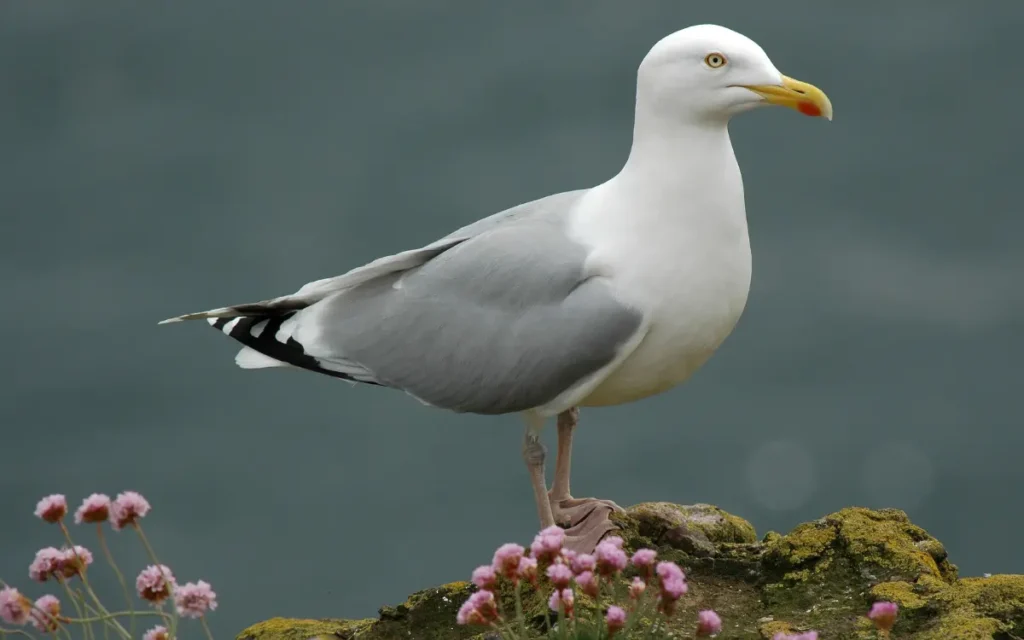
The Herring Gull is a classic large gull. It is often the bird people picture when they think of gulls along coasts, harbors, and fishing docks.
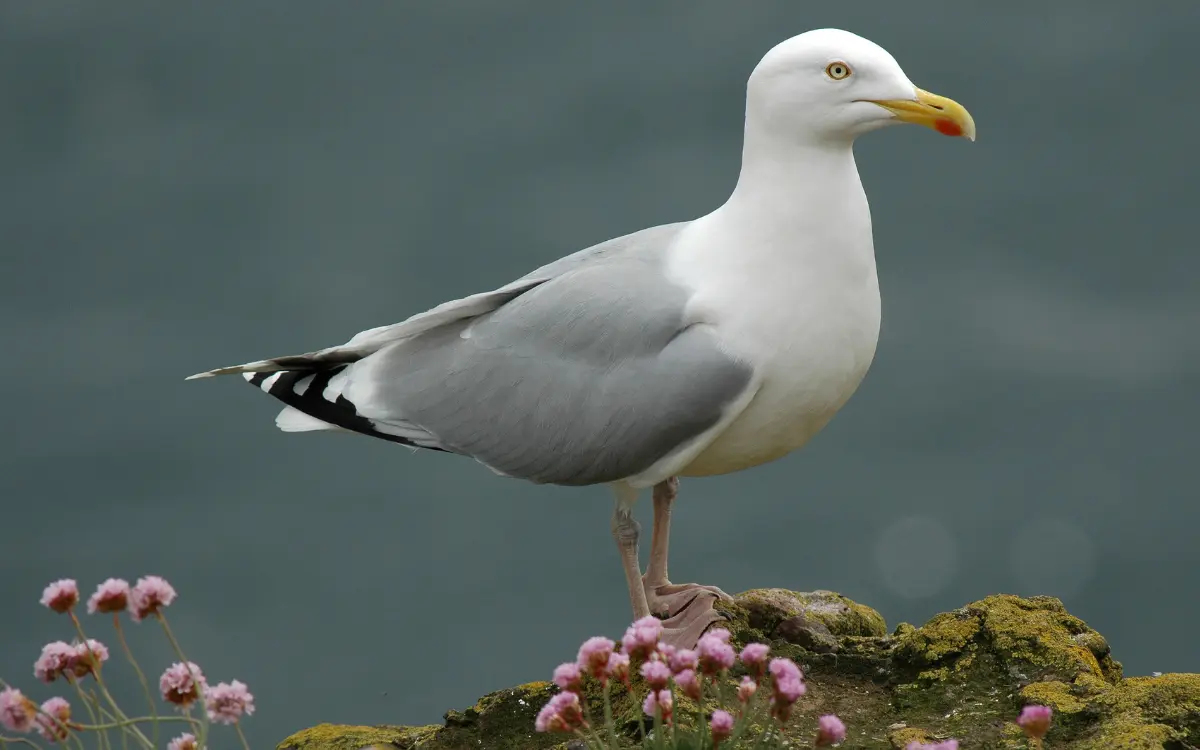
Adult Herring Gulls have a pale gray back, white head and body, black wingtips, pink legs, and a thick yellow bill with a red spot near the tip. That red spot is a helpful mark when the bird is close enough to see well.
This gull is common near coasts, but it can also appear inland around lakes, reservoirs, farms, and landfills. It is bold, noisy, and often gathers in large groups.
Young Herring Gulls are much harder to identify because they are brown and mottled. They slowly change into adult plumage over several years.
Best ID clue: Large gull with pink legs and a yellow bill with a red spot.
Quick facts:
| Feature | Herring Gull |
| Size | Large |
| Legs | Pink |
| Bill | Yellow with red spot |
| Back | Pale gray |
| Common Habitat | Coasts, harbors, lakes |
| ID Difficulty | Easy as adult, harder when young |
3. Laughing Gull
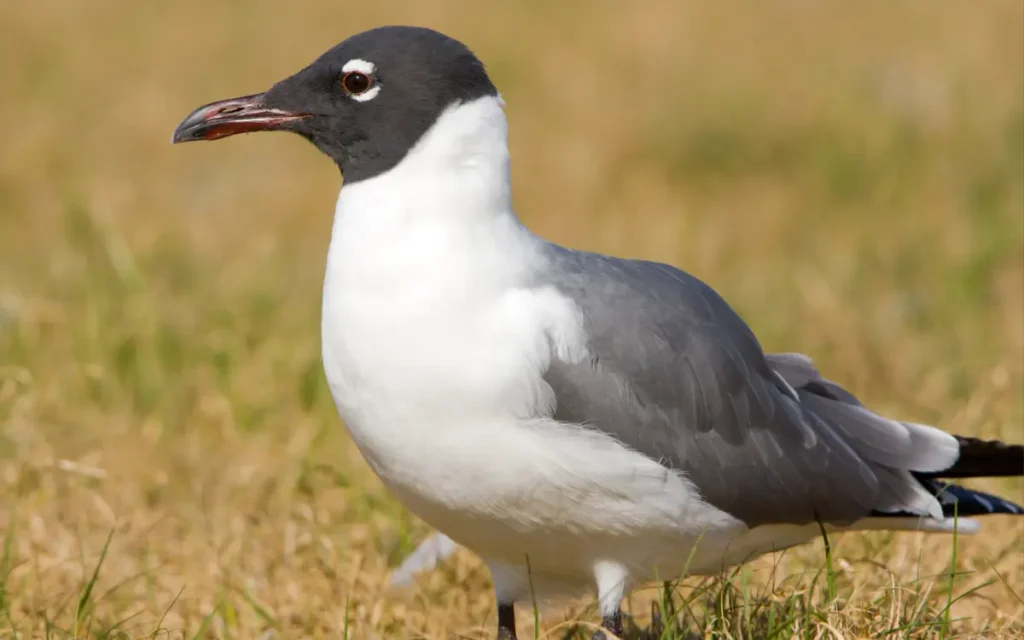
The Laughing Gull is a medium-sized gull known for its loud, laughing call. It is common along the Atlantic and Gulf coasts, especially around beaches, marshes, bays, and coastal towns.
In breeding season, adult Laughing Gulls have a black head, white eye arcs, dark gray back, white body, and reddish bill and legs. In winter, the black head fades, leaving a smudgy gray head pattern.
This gull is slimmer than a Herring Gull and has a more graceful look. It often feeds along beaches, mudflats, and shallow coastal water.
Best ID clue: Black head in breeding season and loud laughing call.
Quick facts:
| Feature | Laughing Gull |
| Size | Medium |
| Legs | Dark red to blackish |
| Bill | Reddish in breeding season |
| Head | Black in breeding season |
| Common Habitat | Atlantic and Gulf coasts |
| Voice | Loud laughing call |
4. Great Black backed Gull
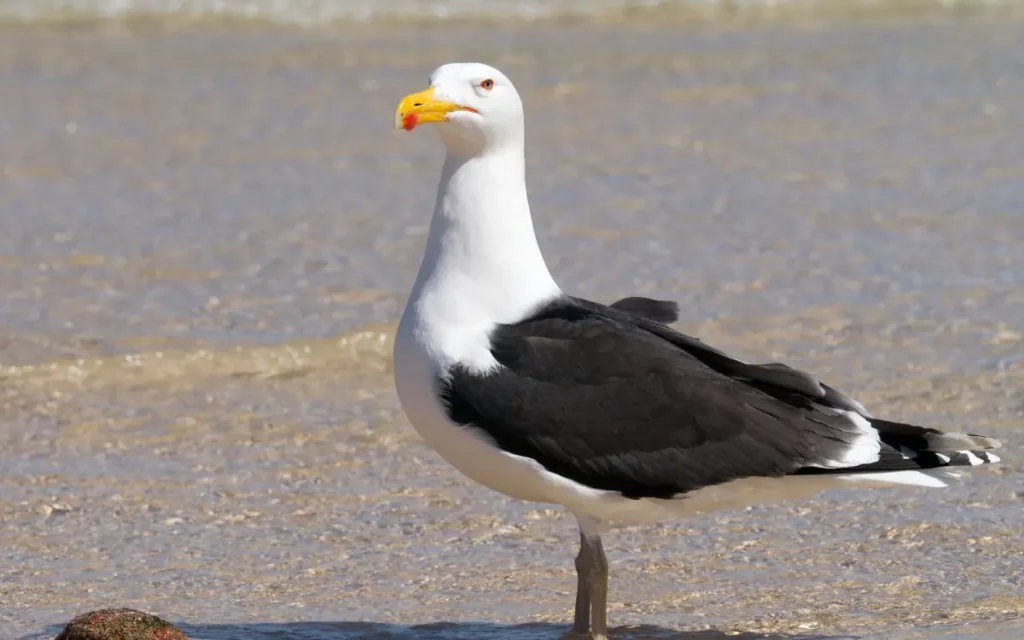
The Great Black-backed Gull is the largest gull in the world. It is a powerful bird with a heavy body, broad wings, thick bill, pink legs, and a black back.
This gull is often seen along rocky coasts, beaches, islands, harbors, and fishing areas. It can dominate smaller gulls around food and is known for taking fish, eggs, chicks, carrion, and scraps.
Adults are fairly easy to recognize because of their huge size and dark upperparts. When standing beside Herring Gulls, they look much larger and heavier.
Best ID clue: Huge size with a black back and pink legs.
Quick facts:
| Feature | Great Black-backed Gull |
| Size | Very large |
| Legs | Pink |
| Bill | Heavy yellow bill |
| Back | Black |
| Common Habitat | Coasts, harbors, islands |
| Behavior | Strong, dominant feeder |
5. Lesser Black backed Gull
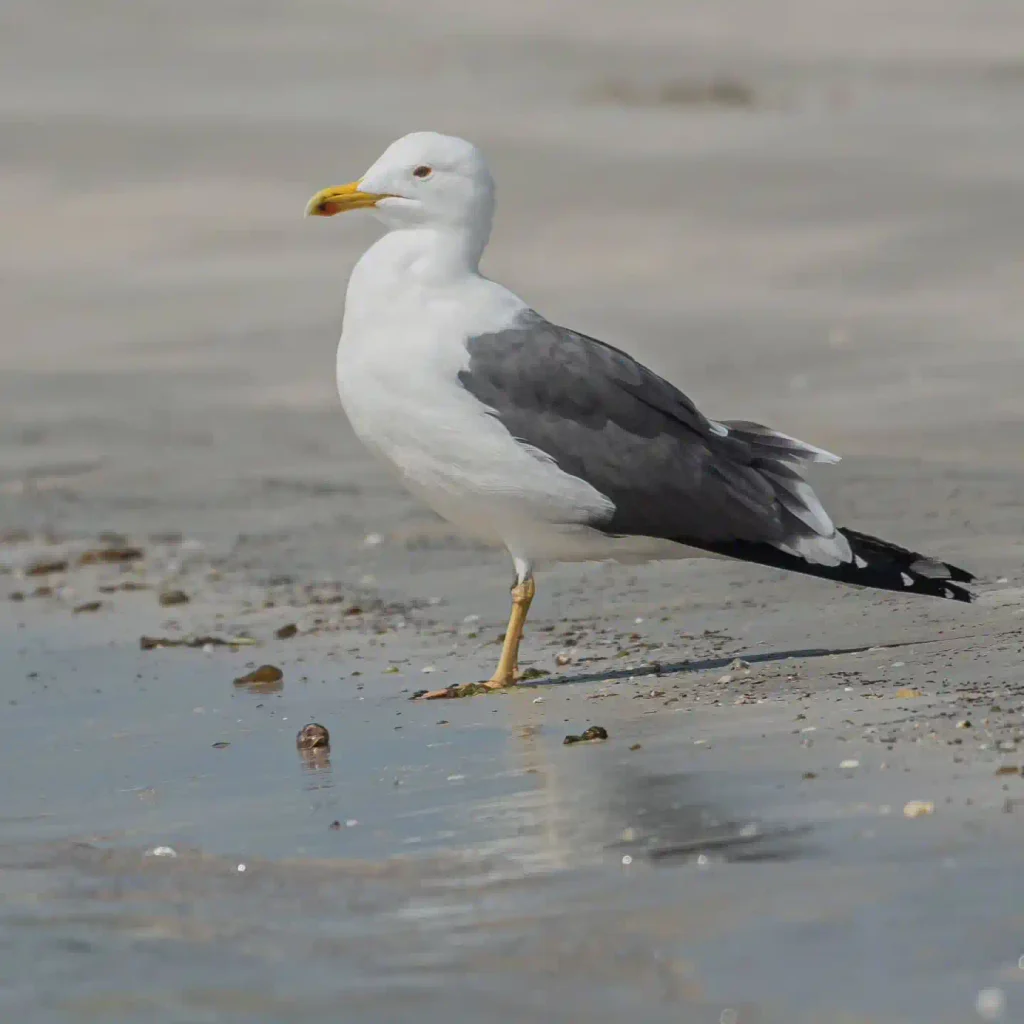
The Lesser Black-backed Gull looks similar to the Great Black-backed Gull at first, but it is smaller, slimmer, and usually has yellow legs.
Adults have a dark gray to blackish back, white body, yellow bill with a red spot, and yellow legs. The contrast between dark back and yellow legs is one of the best clues.
This gull is common in parts of Europe and is increasingly seen in North America, especially in winter. It may appear around coasts, reservoirs, fields, lakes, and landfills.
Best ID clue: Dark back with yellow legs.
Quick facts:
| Feature | Lesser Black-backed Gull |
| Size | Large |
| Legs | Yellow |
| Bill | Yellow with red spot |
| Back | Dark gray to blackish |
| Common Habitat | Coasts, fields, reservoirs |
| Similar Species | Great Black-backed Gull |
6. Bonaparte’s Gull
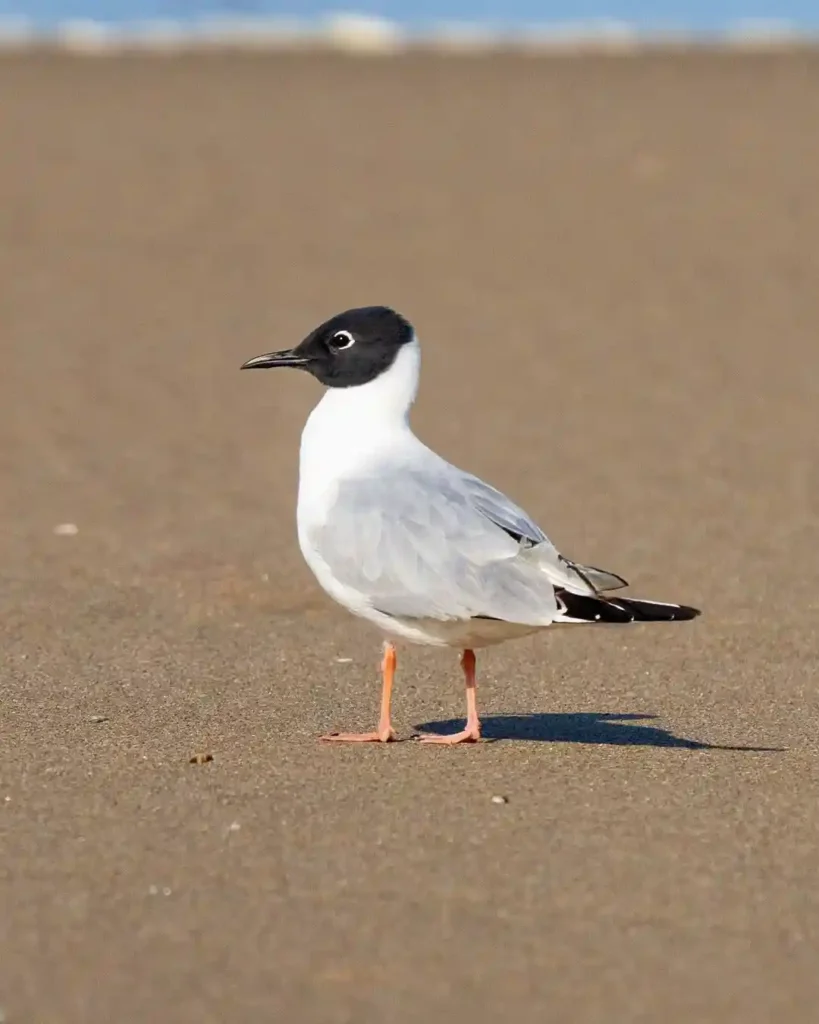
The Bonaparte’s Gull is a small, graceful gull with a delicate look. It is much lighter and more elegant than many larger gulls.
In breeding season, adults have a black head, pale gray back, white body, and a thin dark bill. In nonbreeding plumage, the black head mostly disappears, leaving a dark ear spot.
Bonaparte’s Gulls are often seen over lakes, rivers, ponds, mudflats, and coastlines. They feed by picking small prey from the water surface and can look almost tern-like in flight.
Best ID clue: Small size, delicate flight, and dark ear spot in winter.
Quick facts:
| Feature | Bonaparte’s Gull |
| Size | Small |
| Legs | Reddish to dark |
| Bill | Small and dark |
| Head | Black in breeding season |
| Common Habitat | Lakes, rivers, coastlines |
| Flight Style | Light and graceful |
7. Franklin’s Gull
The Franklin’s Gull is a medium-small gull often linked with inland wetlands, marshes, prairie lakes, and fields. It is sometimes confused with Laughing Gull because both can have dark heads.
Breeding adults have a dark hood, white eye arcs, pale gray back, and reddish bill. Compared with Laughing Gull, Franklin’s Gull is usually smaller and more compact, with a shorter bill.
This species migrates long distances and can gather in large flocks. It is more inland than Laughing Gull for much of its life cycle.
Best ID clue: Dark hood with bold white eye arcs and a compact body.
Quick facts:
| Feature | Franklin’s Gull |
| Size | Medium-small |
| Legs | Dark reddish |
| Bill | Short, reddish to dark |
| Head | Dark hood in breeding season |
| Common Habitat | Marshes, lakes, fields |
| Similar Species | Laughing Gull |
8. California Gull
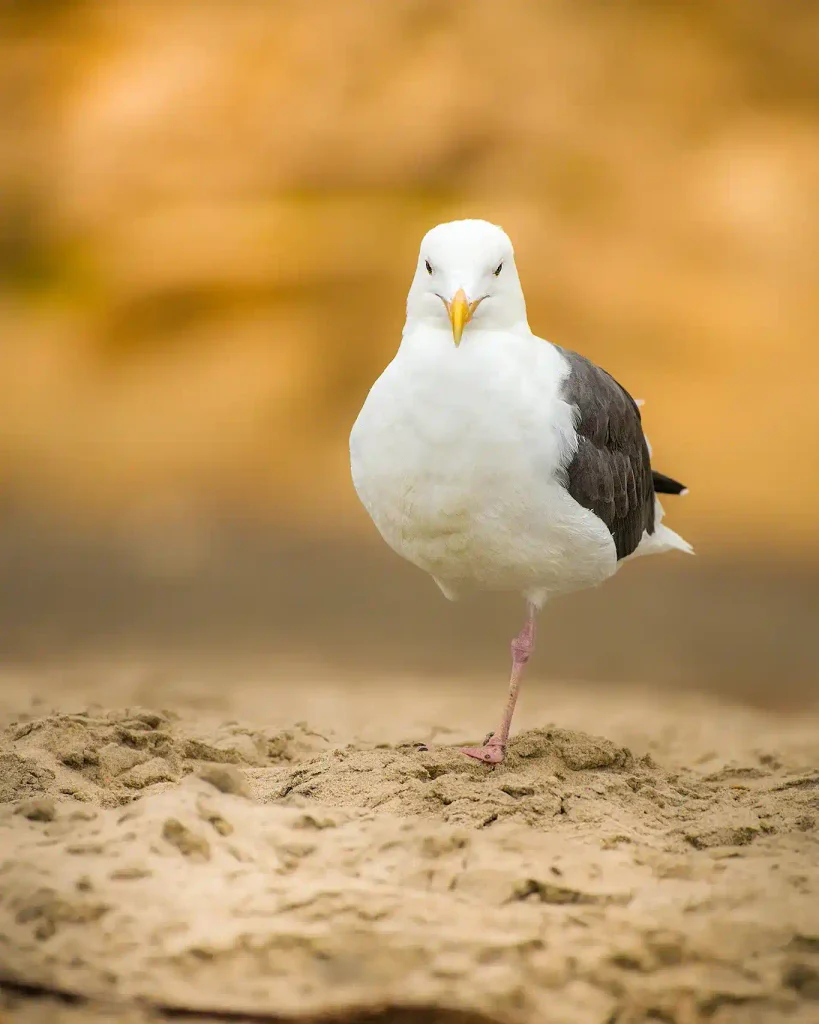
The California Gull is a medium-large gull of western North America. It looks somewhat like a Herring Gull, but there are useful differences.
Adults usually have yellow-green legs, a pale gray back, black wingtips, and a yellow bill marked with both red and black near the tip. That bill pattern is one of the best ID clues.
California Gulls are common around western lakes, reservoirs, rivers, coastlines, agricultural areas, and open habitats. They are especially useful to learn if you bird in the western United States.
Best ID clue: Yellow-green legs and a bill with red and black marks.
Quick facts:
| Feature | California Gull |
| Size | Medium-large |
| Legs | Yellow-green |
| Bill | Yellow with red and black marks |
| Back | Pale gray |
| Common Habitat | Western lakes and coasts |
| Similar Species | Herring Gull, Ring-billed Gull |
9. Western Gull
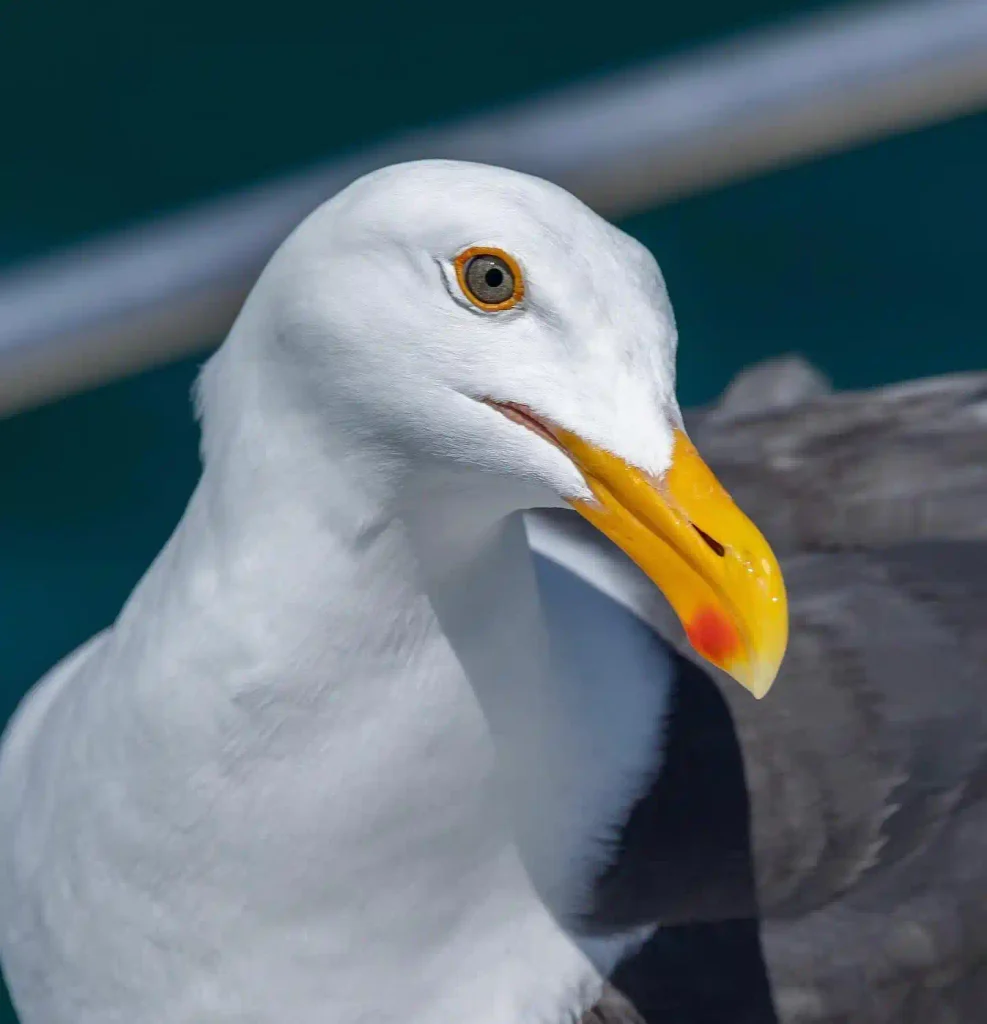
The Western Gull is a large dark-backed gull found mainly along the Pacific Coast. It has a strong body, thick bill, pink legs, white head and body, and dark gray upperparts.
This species is common around beaches, rocky shores, cliffs, harbors, and coastal towns. It is much more tied to the coast than many inland gulls.
Western Gull can be tricky in some areas because it hybridizes with Glaucous-winged Gull, creating birds with mixed features. Still, a typical adult Western Gull has a dark back and pink legs, which makes it stand out from yellow-legged dark-backed gulls.
Best ID clue: Dark gray back, pink legs, and Pacific Coast range.
Quick facts:
| Feature | Western Gull |
| Size | Large |
| Legs | Pink |
| Bill | Thick yellow bill |
| Back | Dark gray |
| Common Habitat | Pacific Coast |
| ID Challenge | Hybrids with Glaucous-winged Gull |
10. Glaucous winged Gull

The Glaucous-winged Gull is a large pale-gray gull common along the Pacific Northwest and nearby coastal areas. Its name comes from its pale gray wings.
Unlike many gulls with black wingtips, this species has wingtips that are pale gray and close in color to the back. That gives the bird a softer, washed-out look.
Adults have pink legs, a heavy bill, pale gray upperparts, and white body plumage. This species often mixes with other gulls, and hybrids can make identification harder.
Best ID clue: Pale gray wingtips that match the back.
Quick facts:
| Feature | Glaucous-winged Gull |
| Size | Large |
| Legs | Pink |
| Bill | Heavy yellow bill |
| Wingtips | Pale gray, not black |
| Common Habitat | Pacific Northwest coasts |
| Similar Species | Western Gull, Glaucous Gull |
11. Iceland Gull

The Iceland Gull is another pale northern gull, but it is generally smaller and slimmer than the Glaucous Gull. It has a softer look, with pale gray upperparts and light-colored wingtips.
Adults have a white body, pale gray back, pinkish legs, and pale wingtips. Immature birds can be pale tan or creamy, which makes them confusing for beginners.
Iceland Gulls are often seen in winter in northern coastal areas, harbors, lakes, and open water. They are part of the group many birders call “white-winged gulls.”
Best ID clue: Pale gull with light wingtips, smaller and slimmer than Glaucous Gull.
Quick facts:
| Feature | Iceland Gull |
| Size | Medium-large |
| Legs | Pinkish |
| Bill | Yellow in adults |
| Wingtips | Pale |
| Common Habitat | Northern coasts, winter waters |
| Similar Species | Glaucous Gull |
12. Black headed Gull
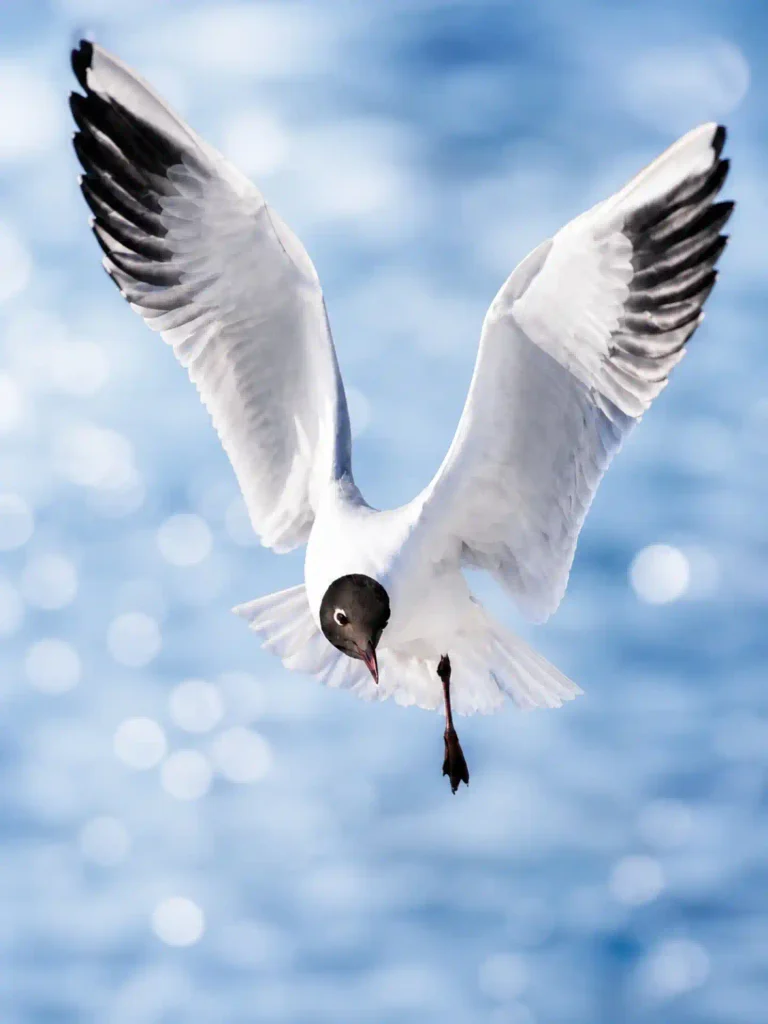
The Black-headed Gull is common in Europe and parts of Asia. It is also seen rarely in North America. Despite the name, breeding adults usually have a dark chocolate-brown hood rather than a pure black head.
This gull is small to medium in size, with a slim body, pale gray back, white body, red bill, and red legs. In winter, the hood disappears, leaving a dark ear spot.
Black-headed Gulls are often found around lakes, rivers, wetlands, parks, fields, and coasts. They are active, noisy, and often gather in groups.
Best ID clue: Brown hood in breeding season and dark ear spot in winter.
Quick facts:
| Feature | Black-headed Gull |
| Size | Small-medium |
| Legs | Red |
| Bill | Red |
| Head | Brown hood in breeding season |
| Common Habitat | Lakes, rivers, wetlands, coasts |
| Winter Look | White head with dark ear spot |
13. Little Gull
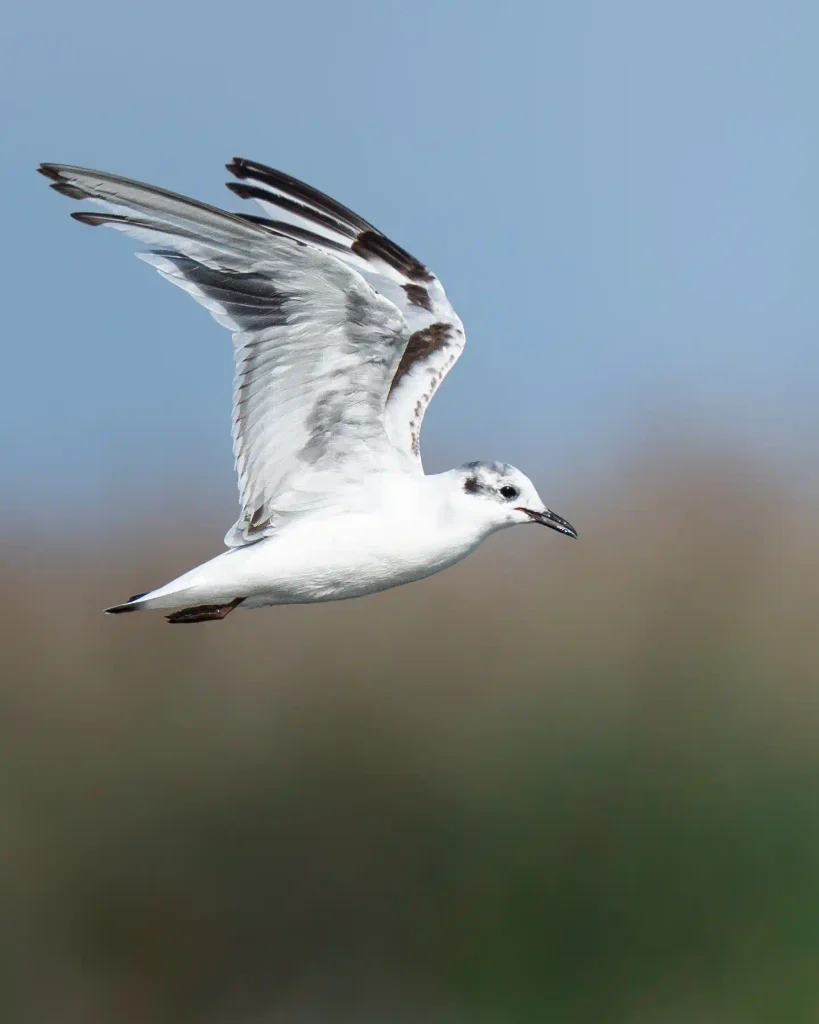
The Little Gull is the smallest gull species. It has a tiny body, rounded wings, and a light, fluttery flight style.
Breeding adults have a dark hood, pale gray upperparts, and dark underwings, which can be helpful in flight. Nonbreeding birds look paler and may show a dark ear mark.
Little Gulls are found mainly in Europe and Asia, but they can also appear in North America. They often feed over lakes, wetlands, and coastal waters, picking small insects and aquatic prey from the surface.
Best ID clue: Very small size and rounded wings.
Quick facts:
| Feature | Little Gull |
| Size | Very small |
| Legs | Red to dark |
| Bill | Small and dark |
| Head | Dark hood in breeding season |
| Common Habitat | Lakes, wetlands, coasts |
| Flight | Light and fluttery |
14. Black legged Kittiwake
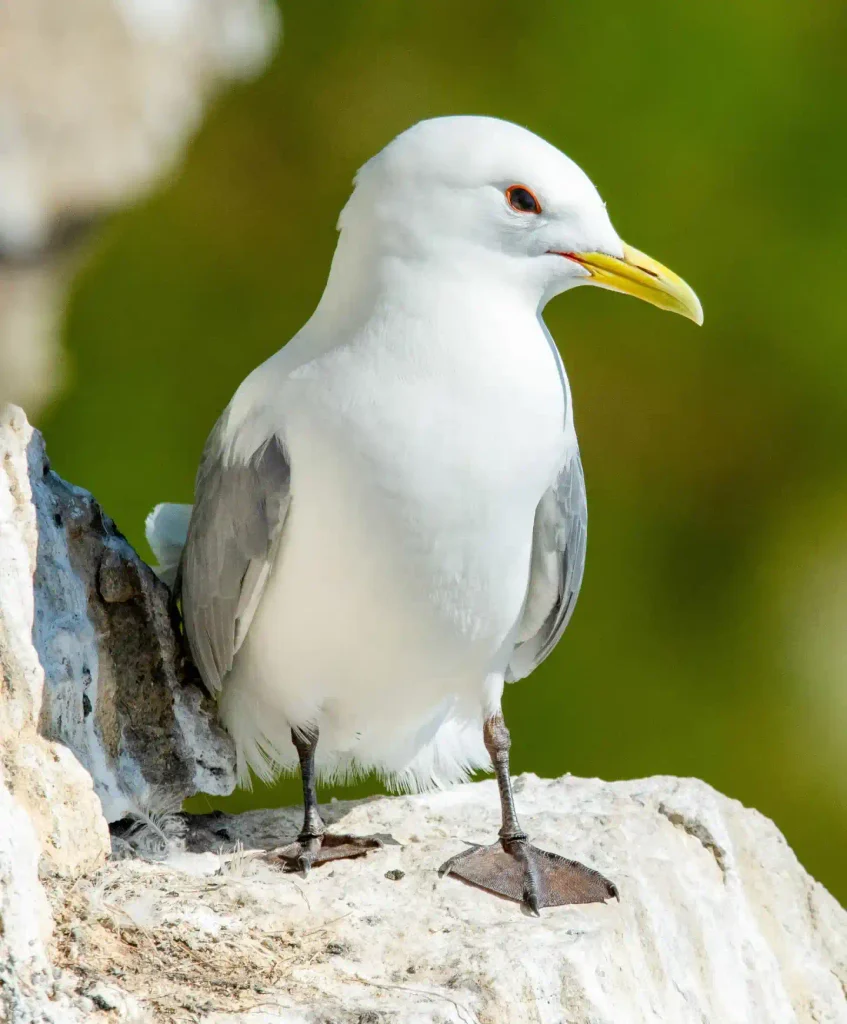
The Black-legged Kittiwake is a gull, but it behaves differently from the gulls most people see in parking lots or around city beaches.
This species is more ocean-based. It nests on steep sea cliffs in colonies and spends much of its life around offshore waters. Adults have a clean white body, pale gray back, black wingtips, yellow bill, and black legs.
Kittiwakes are less likely to walk around picnic areas looking for scraps. They are true seabirds and are often seen near cliffs, islands, and open water.
Best ID clue: Black legs, yellow bill, and ocean cliff habitat.
Quick facts:
| Feature | Black-legged Kittiwake |
| Size | Medium |
| Legs | Black |
| Bill | Yellow |
| Back | Pale gray |
| Common Habitat | Sea cliffs, offshore waters |
| Lifestyle | More ocean-based than many gulls |
Why Do Gulls Change Color?
Gulls change appearance because of age, season, and molt. This is one reason gull identification can be tricky.
Many adult gulls look cleaner and brighter in breeding season. Some develop dark heads or hoods, like Laughing Gull, Franklin’s Gull, Bonaparte’s Gull, Black-headed Gull, and Little Gull.
In winter, those dark hoods may fade into smudges, streaks, or ear spots.
Young gulls are even more confusing. Many immature gulls are brown, streaky, or mottled. Large gulls may take several years to reach adult plumage. During that time, the same species can look very different from year to year.
For beginners, the best path is simple: learn adult gulls first, then study young gulls after you are comfortable with the main field marks.
What Do Gulls Eat?
Gulls are flexible feeders. Their diet changes based on habitat, season, and what food is available.
Common gull foods include:
- Fish
- Crabs
- Shrimp
- Clams and mussels
- Insects
- Worms
- Bird eggs
- Small birds
- Small mammals
- Carrion
- Food scraps
Some gulls hunt, some scavenge, and some steal food from other birds. Many follow fishing boats, gather near landfills, or patrol beaches for easy meals.
It is better not to feed gulls. Feeding can make them bold around people and may lead to aggressive behavior in busy beach areas.
Are Gulls Good Birds for Beginners?
Yes, gulls are excellent birds for beginners, even though they can be confusing.
My direct opinion: gulls are underrated. Many people ignore them because they seem common, but they teach some of the most useful bird identification skills.
Gulls help beginners learn:
- Size comparison
- Bill shape
- Leg color
- Wing patterns
- Seasonal plumage
- Adult vs immature plumage
- Habitat clues
- Flock behavior
They are also easy to find. You do not need a remote forest or rare birding hotspot to study gulls. A beach, lake, harbor, river, parking lot, or city park may be enough.
Beginner Tips for Gull Identification
If you are new to gulls, do not try to identify every bird in a mixed flock right away. Start with the clearest adults and work slowly.
Use this simple checklist:
| What to Check | Why It Helps |
| Size | Separates small, medium, large, and huge gulls |
| Leg color | Helps narrow species quickly |
| Bill markings | Rings, red spots, and dark tips are useful |
| Back color | Pale gray vs dark gray vs black |
| Wingtips | Black wingtips vs pale wingtips |
| Head pattern | Hood, ear spot, streaking, or clean white head |
| Habitat | Coastal, inland, Arctic, urban, or offshore |
| Season | Breeding and winter plumage may differ |
A good photo helps too. Try to capture the bill, legs, wings, and standing posture. Even a simple phone photo can help when you compare the bird later.
FAQs
How many types of gulls are there?
There are dozens of gull species around the world. The exact number can vary depending on taxonomy, but birders recognize many different gulls across North America, Europe, Asia, the Arctic, and coastal regions worldwide.
What is the most common gull?
It depends on where you live. In much of North America, Ring-billed Gull and Herring Gull are among the most familiar. In Europe, Black-headed Gull and Herring Gull are very common in many areas.
Is a seagull a real bird?
“Seagull” is a casual name, but it is not the best formal term. The correct birding term is gull. Many gulls live near the sea, but others are common inland.
What is the biggest type of gull?
The Great Black-backed Gull is the largest gull species. It is a huge, powerful gull with a black back, pink legs, and a heavy yellow bill.
What is the smallest type of gull?
The Little Gull is the smallest gull species. It has a tiny body, rounded wings, and a light flight style.
What gull has a black ring on its bill?
The Ring-billed Gull has a yellow bill with a clear black ring around it. This is one of the easiest gull field marks for beginners.
What gull has a black head?
Several gulls can have dark heads or hoods in breeding season. These include Laughing Gull, Franklin’s Gull, Bonaparte’s Gull, Black-headed Gull, and Little Gull.
Why are young gulls brown?
Young gulls are often brown or mottled because immature plumage helps with camouflage. Many gulls slowly change into adult plumage over several years.
Are gulls only found near the ocean?
No. Many gulls live or feed around lakes, rivers, wetlands, reservoirs, farms, parking lots, landfills, and cities. That is why “gull” is more accurate than “seagull.”
Do gulls eat other birds?
Some larger gulls may eat eggs, chicks, or even small birds when the opportunity appears. Gulls have a wide diet and often feed on whatever is easiest to find.