Common Grackle vs Great tailed Grackle: Key Differences Explained
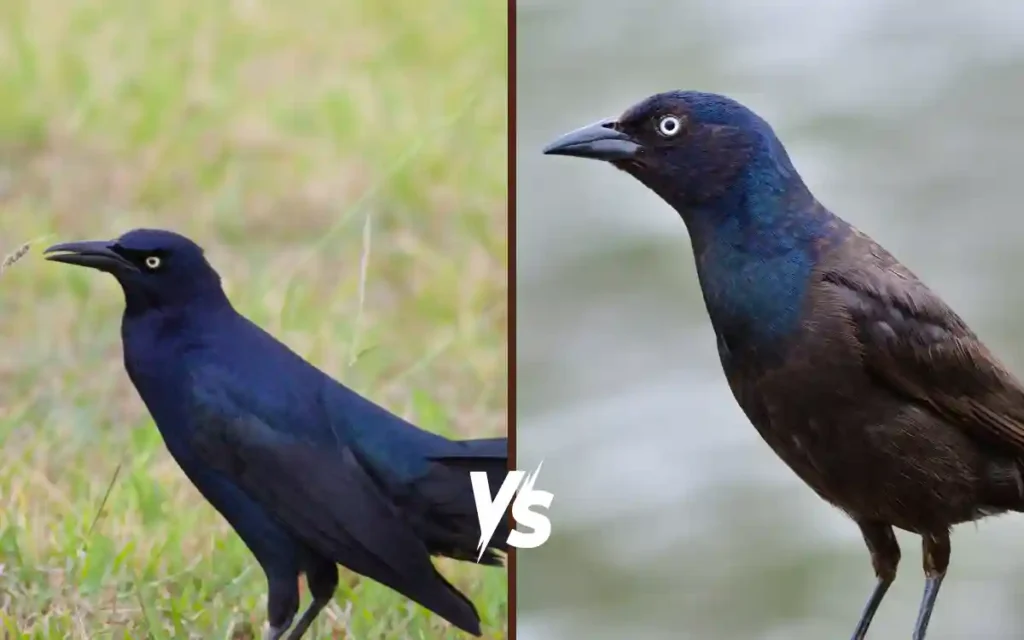
A Common Grackle is smaller, shorter-tailed, and usually has a glossy purple head that contrasts with its bronze body. A Great-tailed Grackle is much larger and has longer legs, a heavier bill, and an oversized V-shaped tail.
Females offer an even easier clue. Female Common Grackles are dark and look similar to males, while female Great-tailed Grackles are warm brown and much smaller than their glossy black male partners.
Location also helps. Common Grackles live mainly across the eastern and central United States. Great-tailed Grackles are widespread in Texas, the Southwest, Mexico, and parts of the western Great Plains.
Common Grackle vs Great-tailed Grackle at a Glance
| Feature | Common Grackle | Great-tailed Grackle |
| Scientific name | Quiscalus quiscula | Quiscalus mexicanus |
| Length | 11–13.4 inches | 15–18.1 inches |
| Wingspan | 14.2–18.1 inches | 18.9–22.8 inches |
| Weight | 2.6–5 ounces | 3.7–6.7 ounces |
| Male color | Purple head with bronze or purple body | Glossy black with blue-purple shine |
| Female color | Dark, similar to male | Warm brown with a paler chest |
| Tail | Long but moderately sized | Extremely long and often V-shaped |
| Bill | Long and tapered | Longer, heavier, and slightly curved |
| Eye color | Pale yellow in adults | Pale yellow in adults |
| Range | Eastern and central North America | South-central and western North America |
| Typical habitat | Lawns, farms, woodland edges, wetlands | Parks, parking lots, fields, towns, and wetlands |
| Voice | Harsh “readle-eak” or rusty-hinge sound | Loud whistles, clicks, rattles, and squeaks |
1. Great-tailed Grackles Are Much Larger
Size is one of the quickest ways to separate these birds when you have a clear view.
A Common Grackle is larger than a Red-winged Blackbird but considerably smaller than a crow. Its body looks stretched, with long legs, a tapered bill, and a tail longer than that of most other blackbirds.
A male Great-tailed Grackle can look almost crow-sized because of its long body and huge tail. It also stands taller on longer legs. The difference is especially clear when the two species are near pigeons, blackbirds, or other familiar birds.
According to the Cornell Lab’s Common Grackle guide, Common Grackles measure about 11 to 13.4 inches long. Great-tailed Grackles measure roughly 15 to 18.1 inches, although individual males can appear even longer when their tails are fully grown.
Size can be difficult to judge when a bird is alone. Tail proportions, color, and range provide better confirmation.
2. Their Tails Have Different Shapes
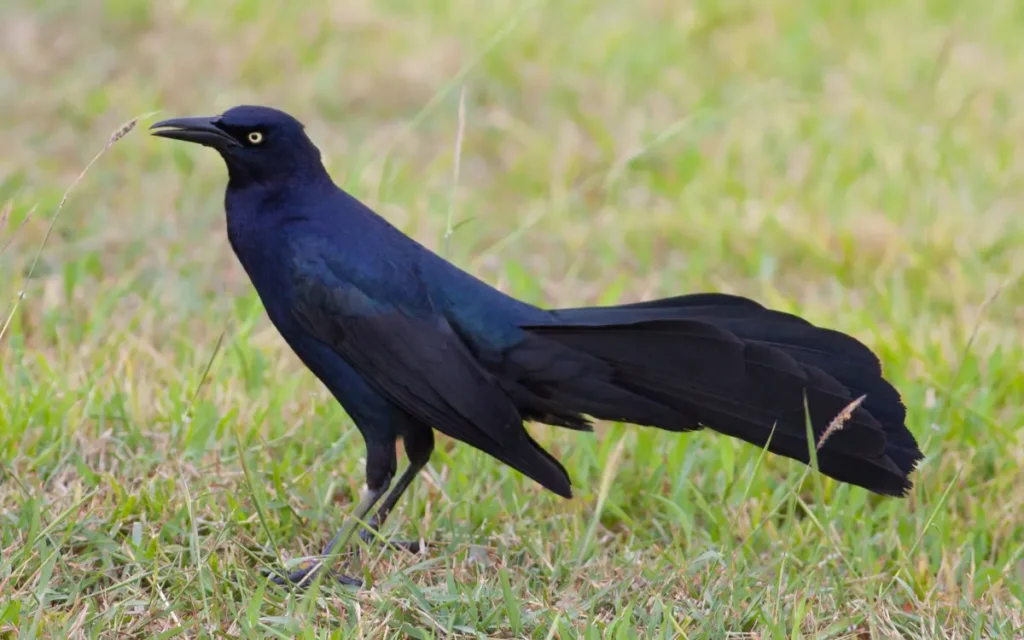
The Great-tailed Grackle gets its name from the male’s oversized tail. It makes up a large part of the bird’s total length and may trail behind the body like a long rudder.
A male Great-tailed Grackle often folds his tail lengthwise into a deep V. From the side, the raised edges can make the tail appear narrow. When spread during a display, it becomes broad and dramatic.
The Common Grackle also has a long tail, but it is shorter in relation to the body. It can show a shallow central crease, though it rarely looks as deep or oversized as the tail of a male Great-tailed Grackle.
Do Female Great-tailed Grackles Have Long Tails?
Yes, but a female’s tail is shorter and less dramatic than a male’s. It is still long compared with her body and usually looks more substantial than the tail of a female Common Grackle.
When Tail Shape Can Mislead You
Tail feathers become worn or damaged. A molting bird may temporarily have a short, uneven, or ragged tail.
Young Great-tailed Grackles have not yet grown the full tails seen on mature males. If the tail looks unclear, use body size, sex-related color, voice, and location as supporting clues.
3. Male Plumage Is Not the Same
Both male grackles can look entirely black from a distance. Sunlight reveals the differences.
Male Common Grackle
A male Common Grackle usually has:
- A glossy blue or purple head
- A bronze, green, or purple body
- Strong contrast between the head and body
- Pale yellow eyes
- Black legs and feet
- A long, pointed bill
The exact shine changes across its range. “Bronzed Grackles” have blue-purple heads and bronze bodies. The form sometimes called the “Purple Grackle” has more purple, blue, and green across the body.
Light angle matters. The same Common Grackle may look purple from one direction and nearly black after turning its body.
Male Great-tailed Grackle
A male Great-tailed Grackle has:
- Glossy black plumage
- Blue, green, or purple shine
- More even coloring between the head and body
- Pale yellow eyes
- A heavy black bill
- Long legs
- A very long tail
Its head does not normally contrast with a bronze body as sharply as it does on many Common Grackles.
Color alone is not enough for a safe identification. Poor light can hide the bronze on a Common Grackle and the colored shine on either species.
4. Female Color Is the Easiest Difference
Female plumage may be the most useful clue in this comparison.
Female Common Grackle
A female Common Grackle looks much like the male. She is dark brownish-black and may show blue, purple, or bronze gloss, though she is usually duller.
She has a pale yellow eye as an adult and is only slightly smaller than the male.
Female Great-tailed Grackle
A female Great-tailed Grackle looks like a different species from the male. She is rich brown rather than black, with darker wings and a paler buff-brown chest and throat.
She is also much smaller than the male. This difference between the sexes is known as sexual dimorphism.
If you see a huge glossy male next to a much smaller brown female, you are probably watching Great-tailed Grackles. A pair of Common Grackles will both look dark and much closer in size.
5. Body Shape and Bill Size Differ

Common Grackles are lanky birds, but their bodies appear more compact than those of Great-tailed Grackles. Their bills are long, straight, and tapered.
Great-tailed Grackles have:
- Longer legs
- Longer bodies
- Heavier bills
- Flatter-looking foreheads
- More upright postures
- Much larger tails
A male Great-tailed Grackle often walks with his chest raised and tail angled behind him. During courtship, he may lift his bill, spread his wings, fluff his feathers, and turn the tail into a broad fan.
6. Their Ranges Overlap Only in Some Areas
Checking where you are can quickly narrow the identification.
Common Grackle Range
Common Grackles are widespread across:
- The eastern United States
- The Midwest
- Southern and central Canada during summer
- Parts of the Great Plains
- The Southeast throughout the year
Northern populations migrate south during fall. Many Common Grackles remain year-round across the central and southern parts of their range.
They become much less expected in the Southwest and far West.
Great-tailed Grackle Range
Great-tailed Grackles are common across:
- Texas
- Oklahoma
- Kansas
- New Mexico
- Arizona
- Southern California
- Parts of Nevada and Utah
- Mexico
- Central America
- Expanding parts of the western Great Plains
Their North American range has grown greatly over the past century. Irrigated farmland, reservoirs, suburban lawns, parking lots, and urban trees have allowed them to move into new areas.
Where Do Both Grackles Occur?
The species can overlap in parts of Texas, Oklahoma, Kansas, Nebraska, and nearby areas.
Identification in the overlap zone requires more than a range map. Check the bird’s size, tail proportions, plumage, sex, and voice.
7. Their Calls Sound Different
Neither grackle is known for a sweet song. Both produce loud mechanical sounds that can seem more like gates, machinery, or electronic noises than birdsong.
Common Grackle Call
The Common Grackle’s short song is often written as:
“Readle-eak!”
It sounds sharp, rising, and metallic. Many people compare it to a rusty gate opening.
Common Grackles also make clucks, squeaks, whistles, and harsh calls. When a large flock gathers, these sounds can blend into a noisy chorus.
Great-tailed Grackle Call
The Great-tailed Grackle has a wider and stranger collection of sounds. Its calls include:
- Loud whistles
- Metallic clicks
- Rattles
- Squeaks
- Harsh chatters
- Low croaks
- Rising electronic-sounding notes
A displaying male may point his bill upward, spread his feathers, and produce a loud sequence of whistles and mechanical sounds.
If the bird sounds like a malfunctioning car alarm or a noisy electronic toy, Great-tailed Grackle is a good possibility.
8. Habitat Can Help With Identification
Both species adapt well to places changed by people. Either one may appear in fields, parks, feedlots, shopping areas, and wetlands.
Common Grackle Habitat
Common Grackles regularly use:
- Suburban lawns
- Agricultural fields
- Woodland edges
- Streamsides
- Freshwater marshes
- Parks with large trees
- Evergreen groves
- Bird-feeding areas
They often nest in dense conifers or other trees near open feeding grounds.
Great-tailed Grackle Habitat
Great-tailed Grackles are often found around:
- City parks
- Parking lots
- Golf courses
- Irrigated fields
- Cattle feedlots
- Ponds and canals
- Marshes
- Shopping centers
- Outdoor restaurants
They are especially noticeable around water in dry regions. At sunset, thousands may gather in city trees or reed beds to sleep.
Habitat helps, but it cannot confirm the species by itself.
9. Their Walking and Display Behavior Differs
Both grackles spend plenty of time walking on the ground. They use their bills to probe soil, move leaves, turn objects, or collect discarded food.
Great-tailed Grackles usually appear bolder and more dramatic. Males perform conspicuous displays by spreading their wings and tails, pointing their bills upward, and fluffing their feathers.
A Common Grackle may also raise and spread its tail during courtship, but the display looks smaller because the bird has a less extreme tail.
Large groups of either species may gather outside the breeding season. Great-tailed Grackle roosts can be particularly loud and dense in towns.
10. Both Species Eat Almost Anything
Common and Great-tailed Grackles are opportunistic feeders. Their diets change with the season and available food.
They may eat:
- Insects
- Spiders
- Worms
- Snails
- Seeds
- Grain
- Fruit
- Small fish
- Frogs
- Crayfish
- Eggs
- Small nestlings
- Human food scraps
Common Grackles are frequently seen eating corn in agricultural fields. They may also visit bird feeders for sunflower seeds, cracked corn, and mixed grain.
Great-tailed Grackles often search lawns, parking lots, restaurant patios, and livestock areas. They sometimes wade into shallow water to catch small aquatic animals.
11. Nesting Habits Are Slightly Different
Common Grackle Nest
Common Grackles usually place their nests in dense trees, conifers, shrubs, cattails, or human-made structures.
The female builds a bulky cup from twigs, grass, leaves, paper, and other materials. Mud or damp plant matter may strengthen the inside.
Common Grackles often nest near others of their species, though colonies vary in size.
Great-tailed Grackle Nest
Female Great-tailed Grackles build cup-shaped nests in trees, shrubs, marsh plants, or structures near water. Several females may nest within one male’s territory.
The female handles nest construction, incubation, and most or all care of the chicks. A male may mate with multiple females during one breeding season.
Common Grackle vs Great-tailed Grackle in Flight
A Common Grackle has a direct flight with steady wingbeats. Its tail looks long, but the bird remains relatively compact.
A male Great-tailed Grackle looks more stretched in flight. Its extremely long tail may trail behind the body, spread into a fan, or twist as the bird turns. Its wings and body also look larger and heavier.
Use these in-flight clues:
| Flight clue | Common Grackle | Great-tailed Grackle |
| Overall size | Medium-large blackbird | Very large blackbird |
| Tail length | Long | Extremely long |
| Tail shape | Shallow keel or rounded end | Deep V, broad fan, or heavy wedge |
| Wings | Relatively short and broad | Larger and broader |
| Silhouette | Compact | Long and stretched |
What Do Juvenile Grackles Look Like?
Young grackles do not have the glossy colors or pale eyes of adults.
Juvenile Common Grackle
A juvenile Common Grackle is:
- Dark brown overall
- Plain rather than glossy
- Dark-eyed
- Long-billed
- Long-tailed
- Similar in size to an adult
Its eye gradually becomes pale as the bird matures.
Juvenile Great-tailed Grackle
Young Great-tailed Grackles are brown and can resemble adult females. Young males become darker as they mature and eventually develop glossy black plumage.
Size helps, but juvenile males may not yet have the huge tails of breeding adults. Location, companions, body proportions, and calls provide extra clues.
Common Grackle vs Great-tailed Grackle vs Boat-tailed Grackle
The Boat-tailed Grackle causes the most identification trouble because male Boat-tailed and Great-tailed Grackles both have glossy black bodies and oversized tails.
| Feature | Common Grackle | Great-tailed Grackle | Boat-tailed Grackle |
| Male size | Smallest | Usually largest | Large |
| Female | Dark | Brown | Dark brown |
| Main range | East and Midwest | Texas, Southwest, West | Atlantic and Gulf coasts |
| Preferred habitat | Fields, lawns, woods | Inland towns, fields, wetlands | Coastal marshes and beaches |
| Adult eye | Pale yellow | Pale yellow | Pale or dark depending on region |
| Male tail | Moderately long | Extremely long | Extremely long |
Location is often the strongest clue between Great-tailed and Boat-tailed Grackles. Boat-tailed Grackles are closely tied to coastal marshes, beaches, and tidewater outside Florida. Great-tailed Grackles are common well inland.
The two species overlap along parts of the Gulf Coast, where voice, body structure, eye color, and close observation may be needed.
Common Grackle vs Brewer’s Blackbird
A male Brewer’s Blackbird is glossy black with a pale eye, which can make it look like a small grackle.
Brewer’s Blackbirds are smaller and have:
- Shorter bills
- Shorter legs
- Short, rounded tails
- More compact bodies
- Purple heads with greenish bodies in males
Female Brewer’s Blackbirds are plain gray-brown with dark eyes. Unlike female Great-tailed Grackles, they are small and short-tailed.
Common Grackle vs Crow
A grackle may appear crow-like when seen alone, but crows are much larger and heavier.
Crows have thick bills, broad wings, strong legs, and square or rounded tails. They also have dark eyes rather than the pale yellow eyes of adult grackles.
A crow’s familiar “caw” is very different from the metallic whistles and squeaks produced by grackles.
FAQs
What is the main difference between a Common Grackle and a Great-tailed Grackle?
The Great-tailed Grackle is larger and has a much longer tail. Female Great-tailed Grackles are brown, while female Common Grackles remain dark like the males.
Is a Great-tailed Grackle bigger than a Common Grackle?
Yes. Great-tailed Grackles measure about 15 to 18.1 inches long, compared with approximately 11 to 13.4 inches for Common Grackles. Large males can look close to crow-sized.
Do Common Grackles have long tails?
Yes. A Common Grackle has a long, slightly keel-shaped tail. It is still far shorter and less dramatic than the oversized tail of a male Great-tailed Grackle.
How can I identify a female Great-tailed Grackle?
Look for a long-legged, warm-brown bird with a paler chest, darker wings, a long tail, and a fairly heavy bill. She may be near a much larger glossy black male.
Are female Common Grackles brown?
Females can look brownish-black in poor light, but they are much darker than female Great-tailed Grackles. They usually show some gloss and look similar to male Common Grackles.
Do both grackle species have yellow eyes?
Healthy adults of both species normally have pale yellow eyes. Juveniles have dark eyes, so eye color should be combined with size, tail shape, range, and plumage.
Can Common and Great-tailed Grackles live in the same area?
Yes. Their ranges overlap across parts of the central and south-central United States. Identification in these areas should be based on several physical and behavioral clues.
Which grackle has a V-shaped tail?
The male Great-tailed Grackle frequently folds his long tail into a deep V. Common and Boat-tailed Grackles can also hold their tails in a keel, but the Great-tailed male’s tail is usually much larger.
Why do Great-tailed Grackles make so many strange noises?
They use a wide collection of whistles, rattles, clicks, squeaks, and harsh calls for courtship, territorial displays, group communication, and warnings.
Are Great-tailed Grackles aggressive?
They can act boldly around food, nesting sites, and other birds. They may chase smaller birds, but they generally do not pose a danger to people.
Are grackles part of the crow family?
No. Grackles belong to the blackbird family, Icteridae. Crows belong to the family Corvidae.
Is a grackle the same as a blackbird?
A grackle is a type of New World blackbird. However, “blackbird” covers several species, including Red-winged Blackbirds, Brewer’s Blackbirds, cowbirds, meadowlarks, and grackles.