Sparrow vs Robin: How to Identify
A robin is much larger than a sparrow, with longer legs, a yellow bill, and an orange breast. Most sparrows are small, brown birds with short legs, streaked backs, and thick bills made for cracking seeds.
The difference is usually easy once you compare body shape. A robin stands tall and often runs across lawns. A sparrow stays closer to shrubs, feeders, fences, and the ground.
In North America, “robin” usually means the American Robin. “Sparrow” can refer to many species, so this guide compares the robin with common backyard sparrows such as the House Sparrow, Song Sparrow, Chipping Sparrow, and White-throated Sparrow.
Robin vs Sparrow Comparison
| Feature | Sparrow | American Robin |
| Length | Usually 5–7 inches | About 8–11 inches |
| Body shape | Small, compact, and round | Larger with a long body and upright stance |
| Breast | Brown, gray, pale, or streaked | Orange or rusty red |
| Back | Brown and usually streaked | Gray-brown with little streaking |
| Bill | Short, thick, and cone-shaped | Longer, slimmer, and yellow |
| Legs | Short | Noticeably long |
| Tail | Short to medium | Fairly long with white outer corners |
| Voice | Chirps, trills, or short musical phrases | Clear, repeated whistles |
| Main foods | Seeds and insects | Worms, insects, fruit, and berries |
| Feeding area | Feeders, shrubs, weeds, and ground | Lawns, open soil, trees, and fruiting shrubs |
| Nest | Cup or enclosed nest, depending on species | Mud-lined open cup |
| Social behavior | Often gathers in flocks | Often alone, in pairs, or in loose winter flocks |
| Seasonal pattern | Depends on the species | Year-round in many areas; partly migratory |

The Fastest Way to Tell Them Apart
Check these four features first:
- Size: A robin is roughly twice as heavy and several inches longer than most backyard sparrows.
- Breast: Adult robins have orange underparts. Sparrows are usually brown, gray, buff, or streaked below.
- Bill: Sparrows have short seed-cracking bills. Robins have longer yellow bills.
- Posture: Robins stand tall on long legs. Sparrows appear lower, rounder, and more compact.
If the bird is large, orange-breasted, and searching a lawn for worms, it is probably an American Robin. A small brown bird eating seed beneath a feeder is more likely a sparrow.
Size and Body Shape
An American Robin measures about 8 to 11 inches long. It has a full chest, a fairly long tail, and legs built for walking and running over open ground.
Most common sparrows measure between 5 and 7 inches. Their bodies look compact, and their necks may seem almost hidden when their feathers are fluffed.
Size can be difficult to judge without a nearby object. Look at posture instead. A robin often pauses with its chest raised and head held high. A sparrow tends to sit lower, with a rounder outline.
Color and Markings
American Robin
Adult American Robins have:
- Orange or rusty-red breasts
- Dark gray or blackish heads
- Gray-brown backs
- Yellow bills
- White markings around the eyes
- White under the tail
Males usually have darker heads and richer orange breasts. Females can look paler, but they still have the familiar robin pattern.
Common Sparrow Markings
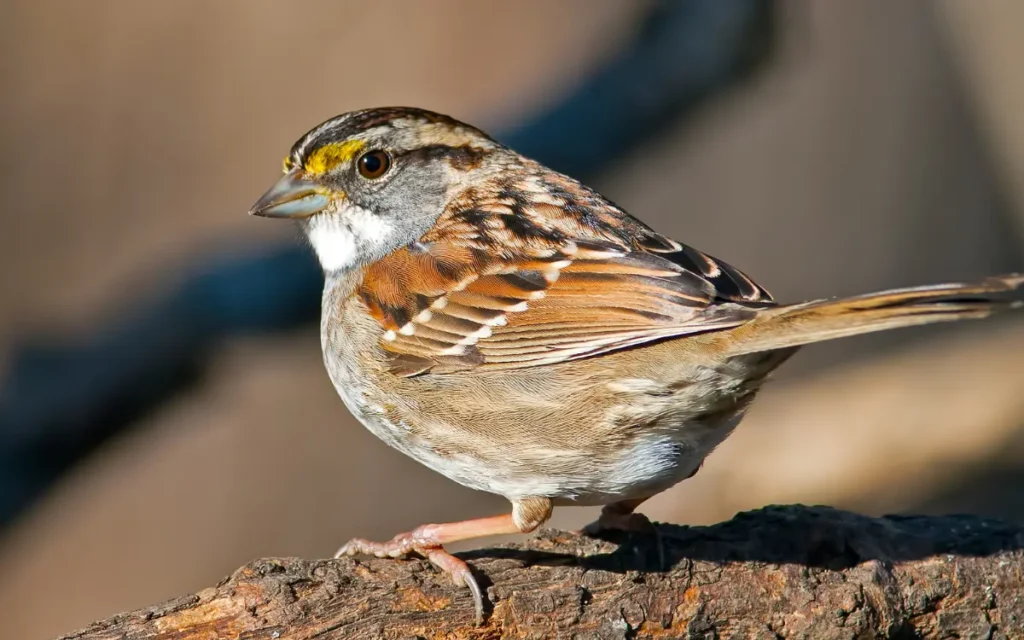
Sparrows don’t all look alike. Most have some mix of brown, buff, gray, black, or white.
A male House Sparrow has a gray crown, chestnut sides on the head, white cheeks, and a black throat patch. The female is plain brown with a pale eyebrow.
A Song Sparrow has a streaked breast, a brown-striped head, and often a dark spot in the center of its chest.
A Chipping Sparrow has a rusty cap, a pale gray breast, and a dark line through the eye during the breeding season.
The thick bill and small body will still separate these birds from a robin.
Can a Young Robin Look Like a Sparrow?
A juvenile robin can cause confusion because its breast is spotted rather than solid orange. Young robins have pale spots across the chest, mottled backs, and shorter-looking tails.
Even then, a juvenile robin is larger and longer-legged than a sparrow. Its bill is slimmer, and patches of orange or peach may be visible beneath the spotting.
A heavily streaked Song Sparrow stays smaller and has a short, thick bill. Its streaks form narrow lines rather than the rounded spots seen on a young robin.
Robin and Sparrow Bills
Bill shape gives a useful clue when the bird’s colors are hard to see.
Sparrows have short, triangular bills. These thick bills let them crack millet, sunflower chips, grass seeds, and other small seeds.
American Robins have longer, thinner bills with yellow coloring. Their bills work well for catching insects, pulling earthworms from soil, and picking berries.
A bird with a cone-shaped bill is likely a sparrow or another seed-eating songbird. A larger bird with a narrow yellow bill is a robin.
Differences in Behavior
American Robins spend plenty of time on lawns. They run or hop a short distance, stop suddenly, tilt their heads, and then strike at the ground. This familiar routine helps them locate earthworms and insects.
Sparrows usually hop rather than run. They scratch through leaves, pick seeds from the ground, visit feeders, or move through low shrubs. Many species stay close to cover and disappear into a hedge when disturbed.
Robins also perch in trees, especially when singing or feeding on fruit. During winter, they may gather in large flocks around berry-producing trees.
Robin vs Sparrow Songs
American Robins sing a series of clear, flute-like phrases. Their song is often translated as “cheerily, cheer-up, cheerio.” They frequently sing before sunrise and again near sunset.
Sparrow songs vary by species:
- House Sparrows make repeated “cheep” calls.
- Song Sparrows sing several clear notes followed by a buzzy trill.
- Chipping Sparrows produce a fast, dry trill.
- White-throated Sparrows whistle a clear, descending song.
If the sound is rich, slow, and whistled from a tree, check for a robin. Short chirps coming from a flock near a building often belong to House Sparrows.
Sparrow call
Robins call
What Do Sparrows and Robins Eat?
Their diets overlap, but they search for food in different ways.
| Food | Sparrows | American Robins |
| Seeds | Major part of the diet for many species | Rarely a main food |
| Earthworms | Occasionally | Commonly eaten |
| Insects | Important, especially when raising young | Important throughout warmer months |
| Berries | Eaten by some species | Important during fall and winter |
| Birdseed | Regular feeder visitors | Usually ignored |
| Mealworms | May eat small pieces | Readily eaten |
| Bread and crumbs | May eat them, but not recommended | Occasionally eaten, but not recommended |
Sparrows commonly search beneath feeders for fallen millet and sunflower pieces. Robins seldom use hanging seed feeders because seeds aren’t a major part of their natural diet.
Bread offers little useful nutrition and can spoil when left outdoors. Seed, live or dried mealworms, native fruit, and clean water are better choices.
How to Attract Each Bird
Attracting Sparrows
Different sparrows prefer different foods. House Sparrows readily eat millet, cracked corn, and sunflower seed. Native sparrows often search for fallen seed near low cover.
You can make the yard more suitable by:
- Growing native grasses and seed-producing flowers
- Leaving a small patch of leaf litter
- Offering black-oil sunflower seed
- Placing feeders near shrubs
- Providing a shallow birdbath
- Cleaning feeders and the ground below them regularly
House Sparrows are nonnative in North America and can take nest cavities from bluebirds and other native birds. Don’t place food inside or close to an active bluebird nesting area if House Sparrows are causing trouble.
Attracting Robins
Robins are more interested in habitat than seed feeders. They may visit yards with:
- Open lawn or bare soil
- Native berry-producing shrubs
- Shallow water
- Leaf litter containing insects
- Mealworms on a tray feeder
- Trees or sturdy ledges for nesting
Avoid using lawn pesticides. Robins feed heavily on insects and other small invertebrates found in soil and grass.
Nesting Differences
Sparrow Nests
Nest design depends on the sparrow species.
House Sparrows build bulky nests from dry grass, feathers, string, and other materials. They often use roof gaps, vents, signs, streetlights, or nest boxes.
Song Sparrows usually place open cup nests low in shrubs, tall grass, or dense ground cover. Chipping Sparrows commonly nest in small trees and shrubs.
This is another reason not to treat all sparrows as one bird.
American Robin Nests
A robin builds a firm open cup using grass, twigs, and mud. The inside is lined with fine dry grass.
Robin nests may appear on:
- Tree branches
- Porch ledges
- Outdoor light fixtures
- Window ledges
- Gutters
- Beams beneath decks or roofs
The eggs are famously blue, usually without heavy markings. Many sparrow eggs are pale with brown or gray spots, though their appearance differs by species.
Don’t move an active nest. Give the adults space and keep pets away until the young have left.
Where You’re Likely to See Them
Sparrows
Sparrows occupy backyards, farms, brushy fields, marsh edges, city streets, and woodland borders. Habitat depends on the species.
House Sparrows stay close to buildings and people. Song Sparrows favor brushy areas, wetland edges, and overgrown gardens. White-throated Sparrows often feed beneath shrubs during winter.
American Robins
Robins are common in lawns, parks, gardens, woodland openings, campuses, and suburban neighborhoods. They need open ground for feeding and trees or shrubs for cover.
A robin on a short lawn is easy to notice because it spends more time in the open than many sparrows.
Do Robins and Sparrows Migrate?
There is no single migration pattern for every sparrow.
House Sparrows generally remain in the same area throughout the year. Chipping Sparrows and White-throated Sparrows migrate in much of their ranges. Song Sparrows may be resident in one region and migratory in another.
American Robins are partly migratory. Northern birds often move south during winter, while robins in milder regions may stay all year. Even where robins remain, they can seem to disappear because they leave lawns and gather in wooded areas to eat fruit.
Seeing a robin does not always mean spring has arrived. Large robin flocks can be found in parts of the United States during winter.
House Sparrow vs American Robin
House Sparrows and American Robins often share neighborhoods, but they look and behave quite differently.
| Trait | House Sparrow | American Robin |
| Length | About 6 inches | About 8–11 inches |
| Bill | Short, thick, and dark | Longer, slimmer, and yellow |
| Male coloring | Gray crown, brown head, black throat | Dark head, orange breast, gray back |
| Female coloring | Plain brown with a pale eyebrow | Paler version of the male |
| Feeding style | Picks seeds from the ground and feeders | Runs and pauses on lawns |
| Nest location | Building holes, roof gaps, and boxes | Trees, shrubs, ledges, and lights |
| Social pattern | Usually in groups | Often alone or in loose flocks |
| North American status | Nonnative | Native |
A House Sparrow is considerably smaller than a robin. Its black throat can look bold, but the rest of the bird stays brown, gray, and white rather than orange-breasted.
Song Sparrow vs American Robin
A Song Sparrow may be confused with a young robin because both can have marked breasts.
| Feature | Song Sparrow | American Robin |
| Breast pattern | Narrow brown streaks, often with a central spot | Solid orange in adults; rounded dark spots in juveniles |
| Bill | Short and cone-shaped | Slim and yellow |
| Legs | Short | Long |
| Size | About 5–7 inches | About 8–11 inches |
| Usual habitat | Thickets, marsh edges, brush, gardens | Lawns, parks, gardens, open woodland |
| Song | Varied notes ending in a buzz or trill | Clear whistled phrases |
Focus on the bill and legs when the breast pattern causes doubt. A juvenile robin still has the proportions of a robin.
Are Robins and Sparrows Related?
Robins and sparrows are both songbirds, but they don’t belong to the same family.
The American Robin belongs to the thrush family, Turdidae. Its close North American relatives include bluebirds and other thrushes.
Native New World sparrows belong mainly to the family Passerellidae. The House Sparrow belongs to Passeridae, an Old World sparrow family.
Their shared backyard habits don’t make them close relatives.
Similar Birds That Cause Confusion
A few other backyard birds can resemble either a robin or a sparrow.
Eastern Towhee
An Eastern Towhee is larger than most sparrows and has rusty sides. Unlike a robin, it has a black or brown hood, a white belly, and a thick seed-eating bill.
Spotted Towhee
This western towhee has rusty sides, a dark head and back, white spots on the wings, and a white belly. It often scratches noisily through leaf litter.
Varied Thrush
A Varied Thrush resembles a robin but has a dark breast band and strong orange-and-black wing markings. It is mainly found in western North America.
Brown-headed Cowbird
Female Brown-headed Cowbirds are plain gray-brown and larger than many sparrows. They have thick bills but lack the striped head and back patterns common in sparrows.
FAQs
What is the main difference between a sparrow and a robin?
A robin is larger, longer-legged, and usually has an orange breast and yellow bill. A sparrow is smaller, mainly brown or gray, and has a short cone-shaped bill.
Are sparrows smaller than robins?
Yes. Most backyard sparrows are about 5 to 7 inches long, while American Robins measure roughly 8 to 11 inches.
Do sparrows have red or orange breasts?
Most sparrows don’t have solid orange breasts. Some species have warm brown or rusty markings, but their thick bills and smaller bodies separate them from robins.
Can a juvenile robin look like a sparrow?
A young robin’s spotted breast can resemble the streaking on a Song Sparrow. The robin is larger, has longer legs, and carries a slimmer bill.
Do robins eat birdseed?
Robins rarely eat ordinary birdseed. They prefer insects, earthworms, berries, fruit, and mealworms.
Can robins and sparrows visit the same yard?
Yes. Sparrows may gather near seed feeders while robins search the lawn for insects. Both may use a birdbath.
Do robins stay all winter?
Some do. American Robins are partly migratory, and their winter movements depend on location, weather, and food. Winter flocks often feed on berries away from lawns.
Are House Sparrows native to North America?
No. House Sparrows were introduced from Europe during the 1800s. Native sparrows such as Song Sparrows and Chipping Sparrows belong to a different bird family.
Which bird has the more musical song?
American Robins give clear, flute-like whistles. Sparrow songs range from simple House Sparrow chirps to the more musical songs of Song and White-throated Sparrows.
Is a robin a type of sparrow?
No. The American Robin is a thrush, while sparrows belong to other bird families.