White Ibis vs Glossy Ibis: How to Tell Them Apart
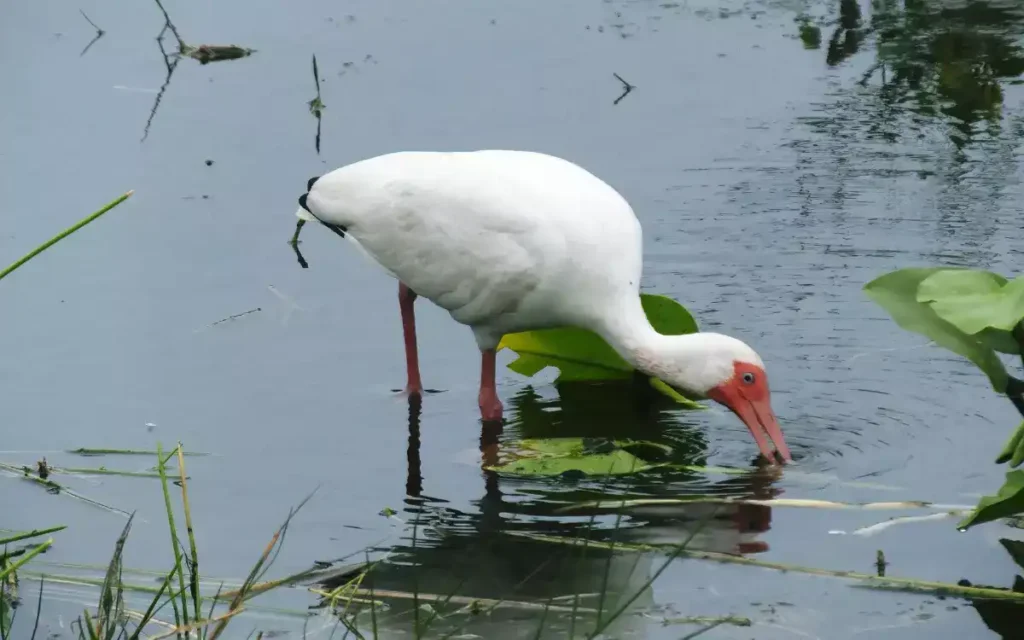
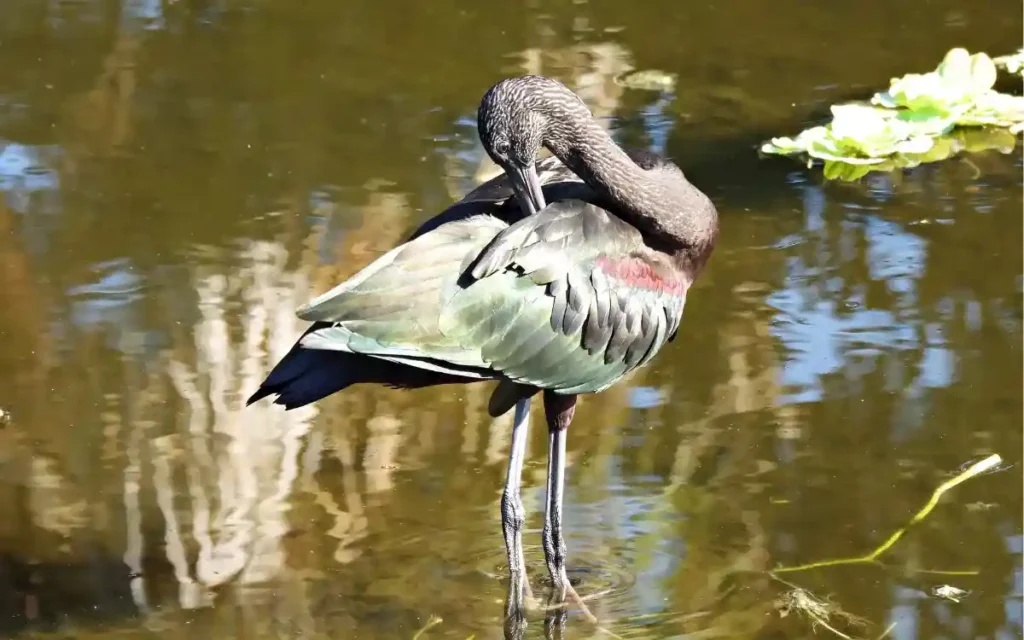
The easiest way to separate an adult White Ibis from a Glossy Ibis is by body color. An adult White Ibis is almost entirely white, with a reddish-pink curved bill and matching legs. A Glossy Ibis is dark chestnut with metallic green, bronze, and purple feathers.
Young birds require a closer look. A juvenile White Ibis has a brown back but a white belly and pinkish-orange bill. A juvenile Glossy Ibis is dark brown across both its upperparts and underparts, with a grayish bill.
Both birds walk through shallow wetlands and probe mud with long, curved bills. Check the belly color, bill color, size, and location when adult plumage is not obvious.
White Ibis vs. Glossy Ibis at a Glance
| Feature | White Ibis | Glossy Ibis |
| Scientific name | Eudocimus albus | Plegadis falcinellus |
| Adult body | Mostly white | Dark chestnut and metallic |
| Wing color | White with black tips | Green, bronze, and purple |
| Bill | Reddish pink or orange-red | Gray-brown to dark gray |
| Legs | Bright reddish pink in adults | Grayish, brownish, or dark |
| Eye | Blue-gray with red facial skin | Dark brown |
| Juvenile body | Brown above and white below | Dark brown overall |
| Length | 22.1–26.8 inches | 18.9–26 inches |
| Weight | 26.5–37 ounces | 18.7–27.1 ounces |
| Main U.S. range | Southeast and Gulf Coast | Atlantic Coast and Florida |
| Feeding style | Probes and sweeps bill in shallow water | Probes wet mud and shallow water |
| Flight clue | White body with black wingtips | Entire bird appears dark |
1. Adult Plumage Is the Clearest Difference
An adult White Ibis is white across its head, neck, body, and most of its wings. Black appears only on the tips of its longest wing feathers. Those black tips are usually hidden when the bird is standing.
An adult Glossy Ibis looks dark from a distance. In strong sunlight, its body appears deep chestnut or maroon, while the wings shine green, bronze, and purple.
The colors of a Glossy Ibis can disappear under clouds or in poor light. A distant bird may look plain black or dark brown rather than glossy.
If the body is clean white, choose White Ibis. If the whole bird appears dark, choose Glossy Ibis.
White Ibises Are Usually Heavier
The two species overlap in length, so body length alone is not always useful. White Ibises are generally heavier and look more thick-bodied.
White Ibis Measurements
- Length: 22.1–26.8 inches
- Weight: 26.5–37 ounces
- Relative size: Larger than a Cattle Egret but smaller than a Great Egret
Glossy Ibis Measurements
- Length: 18.9–26 inches
- Weight: 18.7–27.1 ounces
- Wingspan: About 31–41 inches
- Relative size: Larger than a Cattle Egret but slightly smaller than a night-heron
A White Ibis often has a heavier chest, thicker neck, and more substantial bill. A Glossy Ibis tends to look slimmer and more compact.
Size is difficult to judge when the birds are far apart. Use it to support other clues rather than making the decision by size alone.
Their Bills Differ in Color
Both species have long, downcurved bills used to feel for prey hidden in mud and shallow water.
White Ibis Bill
An adult White Ibis has a reddish-pink to orange-red bill. The color may become brighter during the breeding season.
Young White Ibises have duller orange-pink bills. Even when the body is still brown, this warm bill color is a useful clue.
Glossy Ibis Bill
A Glossy Ibis has a darker bill. It may appear gray, gray-brown, olive-gray, or nearly black, depending on age and lighting.
Unlike a White Ibis, it does not normally have a bright pink or orange-red bill.
Leg Color Provides Another Quick Clue
Adult White Ibises have bright reddish-pink legs. The feet may appear slightly darker or redder.
Glossy Ibises have duller legs. They usually look grayish, brownish, green-gray, or dark red-brown. Breeding birds may show more color, but their legs do not normally match the strong pink-red seen on adult White Ibises.
Juvenile White Ibises have pinkish-orange legs. Young Glossy Ibises have darker, duller legs.
Mud, water, shadow, and distance can alter leg color. Check the bill and body at the same time.
Read also: Scrub jay vs pinyon: Comparison
The Eyes and Facial Skin Are Different
A close look at the face can confirm the identification.
White Ibis Face
An adult White Ibis has:
- Pale blue or blue-gray eyes
- Bare reddish-pink skin around the eye
- A reddish-pink bill
- White feathers around the face
The red facial skin connects visually with the bill, creating one bright area around the front of the head.
Glossy Ibis Face
A Glossy Ibis has:
- Dark brown eyes
- Dark gray facial skin
- A grayish bill
- Thin pale lines around parts of the facial skin during breeding season
The pale lines on a breeding Glossy Ibis run from the bill toward the eye but do not form a complete white ring around it.
This facial detail is more useful when separating Glossy and White-faced Ibises than when comparing Glossy and White Ibises.
Juveniles Can Cause Confusion
Adult White and Glossy Ibises are easy to separate. Young birds are where mistakes happen.
Juvenile White Ibis
A juvenile White Ibis is:
- Brown across the back and upper wings
- White on the belly
- Streaky brown on the neck
- Equipped with a pinkish-orange curved bill
- Pinkish or orange-legged
- Larger and heavier-looking than a Glossy Ibis
As it matures, white feathers replace the brown ones. A first-summer bird may look patchy brown and white.
Juvenile Glossy Ibis
A juvenile Glossy Ibis is:
- Dark brown above
- Dark brown below
- Faintly streaked with white on the head and neck
- Dark-billed
- Dark-legged
- Slimmer and more uniformly colored
The belly is the quickest clue. A young White Ibis has a pale or white belly, while a young Glossy Ibis remains dark underneath.
Juvenile White Ibis vs. Juvenile Glossy Ibis
| Juvenile feature | White Ibis | Glossy Ibis |
| Back | Brown | Dark brown |
| Belly | White | Dark brown |
| Neck | Brown and white streaks | Dark with fine pale streaks |
| Bill | Pinkish orange | Gray or dark |
| Legs | Orange-pink | Dull and dark |
| Overall pattern | Two-toned | Mostly uniform |
| Molting bird | Patchy white and brown | Remains generally dark |
Their Wing Patterns Look Different in Flight
Both species fly with their necks stretched forward and their legs trailing behind. Their broad wings beat steadily, and flocks may form loose lines or V formations.
White Ibis in Flight
An adult White Ibis shows:
- White head, neck, and body
- Broad white wings
- Black outer flight feathers
- Pink-red bill and trailing legs
The black wingtips contrast sharply with the white wings. They may make the bird look somewhat like a White Stork from a distance, though the ibis is much smaller and has a curved bill.
A juvenile White Ibis looks brown across the upper wings but white underneath.
Glossy Ibis in Flight
A Glossy Ibis looks dark across its entire body and wings. Good light may reveal green or bronze shine, but a flying flock often appears nearly black.
No bold white wing areas or black-and-white contrast are present.
White Ibises Have a More Southern U.S. Range
Range is useful in North America, although both species occur in Florida and parts of the Southeast.
White Ibis Range
White Ibises are most common in:
- Florida
- Coastal Georgia
- Coastal South Carolina
- The Gulf Coast
- Louisiana
- Eastern and southern Texas
- Mexico
- Central America
- The Caribbean
- Northern South America
They remain year-round across much of their southeastern range. After breeding, individuals may wander far north and inland.
White Ibises have become familiar visitors to parks and lawns in southern Florida.
Glossy Ibis Range
Glossy Ibises occur across a far wider global range, including parts of:
- North America
- South America
- Europe
- Africa
- Asia
- Australia
- The Caribbean
Within the United States, they are found mainly along the Atlantic and Gulf coasts. Florida holds birds throughout the year, while northern populations are more migratory.
During spring and summer, Glossy Ibises may wander north or inland beyond their usual breeding range.
Both Use Wetlands, but Their Preferences Differ Slightly
White and Glossy Ibises may forage together in the same marsh. Both need shallow water, soft soil, or exposed mud.
White Ibis Habitat
White Ibises use:
- Freshwater marshes
- Mangrove swamps
- Coastal estuaries
- Mudflats
- Flooded pastures
- Rice fields
- Swamps
- Pond edges
- Urban lawns
- City parks
They often move between coastal nesting areas and inland freshwater feeding grounds.
Glossy Ibis Habitat
Glossy Ibises use:
- Freshwater marshes
- Salt marshes
- Brackish wetlands
- Flooded fields
- Rice fields
- Shallow ponds
- Estuaries
- Mangroves
- Wet agricultural soil
- Exposed mudflats
Glossy Ibises are less likely than White Ibises to become regular lawn birds in urban neighborhoods.
Habitat cannot confirm the species because the two often share feeding and nesting areas.
Their Feeding Behavior Is Very Similar
Both birds walk through shallow water with their heads lowered. They insert their curved bills into mud and use touch to locate prey they cannot see.
White Ibis Feeding
A White Ibis may sweep its bill from side to side while probing. It commonly eats:
- Crayfish
- Crabs
- Aquatic insects
- Snails
- Marine worms
- Frogs
- Small fish
- Small snakes
Groups may move through the water together. Egrets sometimes follow behind and catch animals disturbed by the ibises.
White Ibises may also search lawns and grassy fields, especially in southern Florida.
Glossy Ibis Feeding
A Glossy Ibis lowers its bill into wet soil or water and feels for:
- Insect larvae
- Beetles
- Crayfish
- Crabs
- Leeches
- Snails
- Frogs
- Small fish
- Small snakes
It may also pick visible insects directly from plants or the water’s surface.
Feeding style will confirm that you are watching an ibis, but it usually will not separate these two species.
Both Are Social Birds
White and Glossy Ibises commonly feed, fly, roost, and nest in groups.
A feeding flock may include:
- White Ibises
- Glossy Ibises
- White-faced Ibises
- Egrets
- Herons
- Roseate Spoonbills
- Wood Storks
White Ibises can form large and conspicuous flocks, particularly in Florida and along the Gulf Coast.
Glossy Ibises also nest in colonies and often mix with other wading birds. A mixed flock gives birders a useful chance to compare the birds directly.
Their Calls Are Not Useful From Far Away
Ibises are generally quieter while feeding than many familiar birds. Most sounds are heard in flight, around nesting colonies, or during disagreements.
White Ibises make grunts, growls, croaks, and low calls.
Glossy Ibises produce low grunts, croaks, bleats, and nasal sounds.
Their calls overlap enough that voice alone is not a dependable field mark. Plumage and bill color are much easier to use.
Their Nesting Habits Are Similar
Both species breed in colonies, sometimes alongside herons, egrets, and spoonbills.
White Ibis Nesting
White Ibises build nests in:
- Mangroves
- Swamp trees
- Dense shrubs
- Marsh vegetation
- Low trees over water
- Protected islands
Both sexes participate. The male gathers much of the material, while the female performs more of the construction.
A typical clutch contains two or three eggs, though larger clutches occur.
Glossy Ibis Nesting
Glossy Ibises build bulky platforms from sticks and marsh plants. Nest sites include:
- Low shrubs
- Willows
- Mangroves
- Dense wetland thickets
- Marsh vegetation
- Low trees
- Protected islands
The female does more of the incubation, while both parents feed the young.
Finding a nest colony is not enough to identify the birds because both species may nest in the same general area.
White Ibis vs. Glossy Ibis vs. White-faced Ibis
The White-faced Ibis is much more likely to be mistaken for a Glossy Ibis than for an adult White Ibis.
| Feature | White Ibis | Glossy Ibis | White-faced Ibis |
| Adult body | White | Dark chestnut | Dark chestnut |
| Eye color | Pale blue-gray | Dark brown | Red |
| Facial skin | Red-pink | Dark gray | Pink-red |
| Facial border | No narrow border needed for ID | Pale line does not circle eye | White feathers circle face in breeding plumage |
| Bill | Pink-red | Gray-brown | Grayish |
| Legs | Pink-red | Dull gray or brown | Pink-red in breeding birds |
| Main U.S. range | Southeast | East and Southeast | West and central interior |
How to Separate Glossy and White-faced Ibises
A breeding White-faced Ibis has red eyes, pink facial skin, and a thin white feathered border that surrounds the face.
A breeding Glossy Ibis has dark eyes and dark gray facial skin. Its pale facial lines do not wrap fully around the eye.
Nonbreeding and immature birds are much harder. If you cannot see the eye and facial skin clearly, identifying the bird only as a Plegadis ibis may be the honest choice.
White Ibis vs. Egret
A distant adult White Ibis can be mistaken for an egret because both are white wading birds.
Look at the bill:
- A White Ibis has a long, downward-curved bill.
- An egret has a straight, pointed bill.
White Ibises also have shorter, heavier necks and more compact bodies. In flight, ibises keep their necks extended. Egrets pull their necks back into an S shape.
White Ibis vs. Wood Stork
Both birds are white with black flight feathers, but a Wood Stork is much larger.
A Wood Stork has:
- A heavy straight bill
- A bare dark head
- Very long legs
- A wingspan of about 5 feet
- A much heavier body
A White Ibis has a feathered white head, reddish face, and narrow curved bill.
Glossy Ibis vs. Little Blue Heron
A distant Glossy Ibis may be confused with a dark heron.
A Little Blue Heron has a straight, pointed bill and a blue-gray body. It flies with its neck folded.
A Glossy Ibis has a curved bill, metallic chestnut plumage, and an outstretched neck in flight.
FAQs
What is the main difference between a White Ibis and a Glossy Ibis?
An adult White Ibis is white with black wingtips and a reddish-pink bill. A Glossy Ibis is dark chestnut with metallic green, bronze, and purple wings.
Is a Glossy Ibis larger than a White Ibis?
No. Their lengths overlap, but a White Ibis is generally heavier and often looks more thick-bodied. A Glossy Ibis usually has a slimmer build.
How can you identify a juvenile White Ibis?
Look for a brown back, streaky brown neck, white belly, and pinkish-orange curved bill. Its plumage becomes patchy brown and white as it matures.
What does a juvenile Glossy Ibis look like?
A juvenile Glossy Ibis is dull dark brown over most of its body. It may have fine white streaks on its head and neck, but its belly remains dark.
Do Glossy Ibises ever look black?
Yes. At a distance or in poor light, their deep chestnut and metallic plumage can appear plain black. Sunlight reveals green, bronze, purple, and reddish tones.
Do White Ibises have black wings?
Their wings are mostly white. Only the outer flight feathers are black, and these are easiest to see when the wings are spread.
Can White and Glossy Ibises live in the same area?
Yes. Their ranges overlap in Florida and other parts of the southeastern United States. They may feed or nest in mixed groups.
Are White Ibises found only in Florida?
No. They also occur along the Atlantic and Gulf coasts, in parts of Texas, Mexico, the Caribbean, Central America, and northern South America. Wandering birds sometimes appear farther north.
Are Glossy Ibises rare in North America?
They are locally common in Florida and along parts of the Atlantic Coast. Their distribution is more limited than their broad global range might suggest.
What does a White Ibis eat?
White Ibises eat crayfish, crabs, aquatic insects, snails, worms, frogs, small fish, and other wetland animals.
What does a Glossy Ibis eat?
Glossy Ibises eat aquatic insects, insect larvae, crayfish, crabs, snails, leeches, frogs, small fish, and occasionally small snakes.
Why do ibises have curved bills?
Their curved bills help them probe mud, wet soil, and shallow water. Sensitive structures in the bill allow them to detect and catch hidden prey by touch.
Do ibises fly with their necks extended?
Yes. White and Glossy Ibises fly with their necks stretched forward and their legs trailing behind. Herons and egrets usually pull their necks back during flight.
How can I separate a Glossy Ibis from a White-faced Ibis?
Check the face of a breeding adult. A White-faced Ibis has red eyes, pink-red facial skin, and a thin white border surrounding the face. A Glossy Ibis has dark eyes and dark gray facial skin.
What should I do if I cannot identify a dark ibis?
Record the location, date, eye color, facial skin, leg color, and any pale border around the face. Take photographs if possible. An immature dark ibis may need to remain identified only as Glossy/White-faced Ibis.