Raven vs Crow: How to Tell the Difference
A large black bird flies overhead. It looks heavy, dark, and smart enough to know exactly what it’s doing. But is it a raven or a crow?
That question trips up a lot of people. Ravens and crows are closely related, both are black, and both are known for sharp problem-solving skills. From far away, they can look almost the same.
The good news is that you do not need to memorize every feather detail. Start with four clues: size, tail shape, voice, and behavior. Ravens are larger, often travel alone or in pairs, and give deep croaking calls. Crows are smaller, more social, and make the familiar “caw-caw” sound.
Raven vs Crow: Quick Comparison

| Feature | Raven | Crow |
| Size | Larger and heavier | Smaller and slimmer |
| Length | About 22–27 inches | About 16–21 inches |
| Wingspan | Around 46–47 inches | Around 34–39 inches |
| Tail shape | Wedge-shaped | Rounded or square/fan-shaped |
| Beak | Large, thick, slightly curved | Heavy but straighter and smaller |
| Throat feathers | Shaggy-looking | Smoother |
| Call | Deep croak or “gronk” | Sharp “caw” |
| Social style | Often alone or in pairs | Often in groups |
| Flight | Soars, glides, may tumble | Steady wingbeats |
| Common habitat | Wild areas, cliffs, forests, deserts, coasts | Cities, farms, fields, parks, roadsides |
Cornell describes Common Ravens as much larger than American Crows, with wedge-shaped tails, thick necks, shaggy throat feathers, and heavy bills. American Crows are also all black, but they have shorter rounded or squared tails and a more familiar cawing voice.
Is It a Raven or a Crow?
If the bird is huge, flying alone, has a wedge-shaped tail, and makes a deep croaking sound, it is probably a raven.
If the bird is smaller, calling “caw-caw,” flying with others, or hanging around neighborhoods and parking lots, it is probably a crow.
This quick check works well in most everyday situations. The tail shape is especially helpful when the bird is flying overhead.
Raven vs Crow Size
Size is one of the easiest clues, but it can be tricky without another bird nearby for comparison.
A Common Raven is a much bigger bird. It can look closer to a hawk in size than to a backyard crow. Ravens also have longer wings, heavier bodies, and a stronger-looking neck.
American Crows are still large birds, but they look neater and more compact. Their wings are shorter and broader, and their overall shape feels less bulky.
| Bird | Length | Wingspan | Weight |
| Common Raven | 22–27 inches | 46–47 inches | 1.5–3.6 pounds |
| American Crow | 16–21 inches | 33.5–39.4 inches | 11–22 ounces |
Audubon lists the Common Raven at about 22–27 inches long with a wingspan near 46–47 inches, while the American Crow is about 16–21 inches long with a wingspan around 34–39 inches.
One of the Best Field Marks
When the bird is flying, look at the tail.
A raven’s tail usually looks wedge-shaped or slightly diamond-shaped. The middle tail feathers are longer, so the tail often comes to a point.
A crow’s tail looks rounded, squared, or fan-shaped. The tail feathers are more even in length, so the end looks flatter.
This is one of the simplest ways to separate them in the field. Audubon also points out that raven tails look wedge-shaped, while crow tails look more rounded and fan-like.
Beak and Head Shape
Ravens have a heavier, more dramatic head shape. Their bill is large, thick, and slightly curved. Up close, the beak can look almost too big for the face.
They also have shaggy throat feathers, sometimes called hackles. These feathers can look rough or beard-like, especially when the bird calls.
Crows have a heavy bill too, but it is smaller and straighter than a raven’s. Their head and throat look smoother, with less of that rough, shaggy look.
A perched bird is often easier to judge than a flying bird. If the bird looks bulky, big-billed, and shaggy around the throat, raven is a strong possibility.
Raven vs Crow Sound
Sound may be the fastest clue once you know what to listen for.
Raven Calls
Ravens make a low, rough croaking sound. Many birders describe it as “gronk,” “kronk,” or a deep croak.
Their calls often sound heavier and more hollow than a crow’s call. A raven’s voice can carry across open land, cliffs, forests, and mountain areas.
Ravens don’t “caw.” They make a deep, rough, almost croaking sound that can feel a little eerie, especially in quiet areas. Their calls echo more and sound slower.
Crow Calls
Crows make the classic “caw-caw” sound. It is sharper, brighter, and often repeated several times.
When several black birds are calling loudly together, you are probably hearing crows. American Crows are known for their hoarse cawing voices and are common in treetops, fields, roadsides, towns, and open woods.
Flight Style
Ravens and crows do not move through the air in quite the same way.
Ravens often soar and glide. They may ride rising air currents, circle high above hills, and sometimes tumble or roll in the air. Their longer wings make their flight look slower and more powerful.
Crows flap more steadily. Their flight is usually more direct, with regular wingbeats and less gliding.
If the bird is floating high with wide, easy wingbeats, think raven. If it is flapping across a field or neighborhood with other black birds, think crow.
Cornell notes that Common Ravens move with easy, flowing wingbeats and are also known for acrobatic flight. Audubon also says ravens soar more, while crows do more steady flapping.
Alone or in a Group?
This clue helps a lot in everyday birdwatching.
Ravens are often seen alone or in pairs. You may spot one perched on a tall tree, flying across open country, or calling from a cliff or high point.
Crows are much more social. They gather in family groups, feeding groups, and large evening roosts. Around farms, parks, roads, and neighborhoods, it is common to see several crows together.
So if you see one huge black bird by itself, check for raven traits. If you see a noisy group of black birds, crows are more likely.
Where Did You See the Bird?
Location is not perfect, but it can guide your guess.
Common Raven Habitat
Ravens are often linked with wilder places. You may find them around:
| Raven Habitat | Why It Fits |
| Mountains | Good soaring conditions and nesting spots |
| Forests | Tall trees and open hunting areas |
| Deserts | Open land and carrion sources |
| Cliffs | Safe nesting areas |
| Remote coastlines | Food from shorelines and seabird colonies |
Ravens can live near people too, but they still feel more tied to open, rugged, or less crowded places.
American Crow Habitat
Crows are much easier to find around people. You may see them in:
| Crow Habitat | Why It Fits |
| Cities | Food scraps, trees, buildings, and open spaces |
| Suburbs | Lawns, parks, roads, and gardens |
| Farms | Crops, insects, carrion, and open feeding areas |
| Roadsides | Food waste and carrion |
| Parks | Trees, people, and easy food sources |
American Crows use many habitats, including town centers, open woods, fields, roadsides, and beaches. That wide comfort zone is one reason they are so familiar across much of North America.
Raven vs Crow Diet
Both birds eat a wide mix of foods. They are opportunistic, which means they take advantage of whatever food is available.
What Ravens Eat
Ravens often eat carrion, insects, eggs, small animals, food scraps, and leftovers from larger predators. Their size helps them handle bigger food items than crows.
They are also skilled at finding food in tough places. A raven may follow predators, search roadsides, or watch other animals for feeding chances.
What Crows Eat
Crows eat insects, fruit, seeds, eggs, small animals, garbage, carrion, and human food scraps.
Their flexible diet is one reason they do so well around towns and farms. Cornell notes that American Crows usually feed on the ground and eat almost anything, including insects, seeds, fruit, garbage, carrion, and nestlings.
Raven vs Crow Intelligence
Both ravens and crows belong to the corvid family, a bird family known for smart behavior.
They can solve problems, remember threats, learn from each other, and adjust their behavior based on experience. Crows are famous for social learning and group warning calls. Ravens are known for puzzle-solving, curiosity, and complex behavior around food.
It is not really a case of one bird being “smart” and the other being “less smart.” They show intelligence in different ways.
Crows often stand out in group communication. Ravens often stand out in individual problem-solving and playful behavior.
Are Ravens and Crows the Same Bird?
No. Ravens and crows are related, but they are not the same bird.
Both are corvids, which means they belong to the same bird family as jays, magpies, and nutcrackers. That shared family connection explains why they have similar black plumage, strong bills, sharp calls, and high intelligence.
Still, Common Ravens and American Crows are separate species with different size, sound, shape, and behavior.
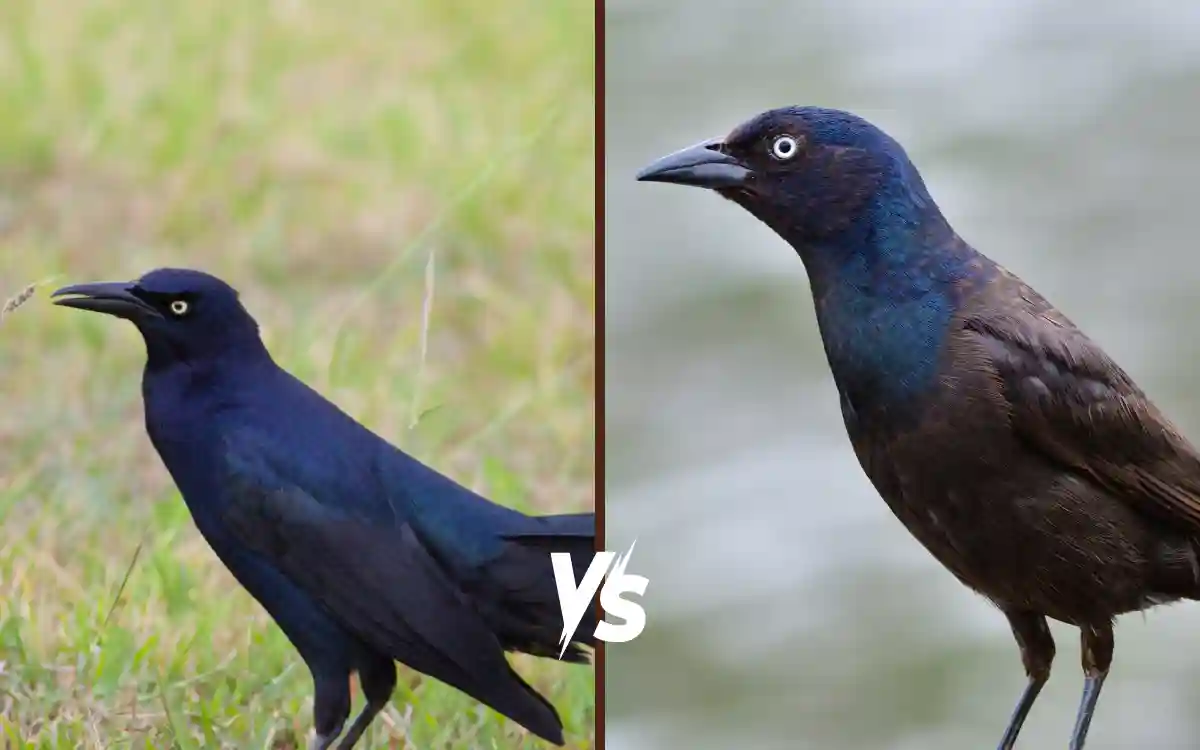
Raven vs Crow vs Blackbird
Not every black bird is a crow or raven.
Grackles, blackbirds, and starlings can also look dark from a distance. Most of them are much smaller than crows and ravens, with slimmer bodies and different voices.
A simple size check helps:
| Bird Type | General Look |
| Raven | Very large, heavy, wedge tail |
| Crow | Large, social, fan or squared tail |
| Grackle | Smaller, long tail, glossy body |
| Blackbird | Smaller, slimmer, often seen in flocks |
| Starling | Compact body, short tail, speckled look in some seasons |
If the bird is huge and croaking, think raven. If it is large and cawing with others, think crow. If it is much smaller and glossy, it may be a grackle or blackbird.
How to Tell a Raven from a Crow Quickly
Use this quick field checklist.
| What You Notice | Likely Bird |
| Very large black bird | Raven |
| Smaller black bird near people | Crow |
| Wedge-shaped tail | Raven |
| Rounded or fan-shaped tail | Crow |
| Deep croaking voice | Raven |
| Sharp “caw-caw” voice | Crow |
| Alone or in a pair | Raven |
| In a noisy group | Crow |
| Soaring or gliding | Raven |
| Steady flapping | Crow |
| Shaggy throat feathers | Raven |
| Smooth throat feathers | Crow |
Common Mistakes When Identifying Ravens and Crows
The biggest mistake is using color alone. Both birds are black, so color does not help much.
Another mistake is judging size without context. A lone crow can look large if nothing is nearby. That is why tail shape and voice are better clues.
People also forget that ravens can appear near towns and crows can visit wild areas. Habitat helps, but it should not be your only clue.
When in doubt, check three things together: tail shape, call, and behavior.
Raven vs Crow Meaning and Symbolism
Ravens and crows have carried strong meanings in stories, folklore, and spiritual traditions for a long time.
Ravens are often connected with mystery, wisdom, transformation, and messages from the unknown. Their deep voice, large size, and habit of appearing in wild places give them a powerful image.
Crows are often linked with intelligence, memory, teamwork, warning, and adaptability. Since they live close to people, many cultures see them as clever watchers of daily life.
These meanings are personal and cultural, not scientific ID clues. For bird identification, focus on the physical signs first.
FAQs
Which is bigger, a raven or a crow?
A raven is bigger. Common Ravens are about 22–27 inches long, while American Crows are about 16–21 inches long. Ravens also have longer wings and heavier bodies.
Do ravens sound like crows?
Not exactly. Ravens usually make deep croaking sounds, while crows make sharper “caw-caw” calls.
Is a raven just a big crow?
No. A raven is not just a large crow. Ravens and crows are related corvids, but they are separate birds with different shapes, calls, flight styles, and behavior.
Are ravens smarter than crows?
Both are very smart. Ravens are often known for puzzle-solving and playful behavior, while crows are known for social learning, memory, and group communication.
Do ravens and crows fight?
They can compete over food or territory. Crows may mob ravens, especially when they see a raven as a threat near nests or feeding areas.
Can ravens and crows live in the same area?
Yes, their ranges can overlap. Even when they live in the same general region, they may use different habitats or behave differently.
Do ravens and crows mate with each other?
No. They are closely related, but they are different species.
Are ravens and crows protected?
In the United States, many native migratory birds are protected under the Migratory Bird Treaty Act. The U.S. Fish and Wildlife Service says the law prohibits taking, killing, capturing, selling, trading, or transporting protected migratory bird species without proper authorization.