34 Shorebirds In Texas With Photo
A small bird racing ahead of the surf is probably a Sanderling. A similar-sized bird picking through coastal mud may take much longer to name. Leg color, bill shape, feeding motion, and habitat often tell you more than plumage alone.
This guide covers 34 common and notable Texas shorebirds. It isn’t a list of every shorebird ever recorded in the state. The official Texas checklist also includes expected species such as the American Oystercatcher, American Golden-Plover, Mountain Plover, and Wilson’s Phalarope, along with several rare visitors.
Texas shorebirds live in more places than beaches. Look for them on tidal flats, flooded fields, lake edges, salt pans, short-grass prairie, and even damp woodland.
1.American Avocet

Scientific name: Recurvirostra americana
Length: 16–20 inches
Texas status: Year-round, with numbers changing by region
Call: Repeated, sharp “wheet” notes
The American Avocet has a black-and-white body, long blue-gray legs, and a thin bill that curves upward. Breeding birds have rusty-orange heads and necks. Winter birds have pale gray heads.
Avocets often feed in groups. They swing their open bills from side to side through shallow water, catching small crustaceans and aquatic insects.
Look for them in coastal lagoons, salt pans, wastewater ponds, and shallow inland wetlands. They can be numerous along the Gulf Coast outside the breeding season.
Similar bird: Black-necked Stilt. The stilt has pink legs, a straight bill, and a black neck and back.
2.Black-necked Stilt
Scientific name: Himantopus mexicanus
Length: 14–16 inches
Texas status: Common breeder and migrant; some winter near the coast
Call: Sharp, repeated “kek-kek-kek”
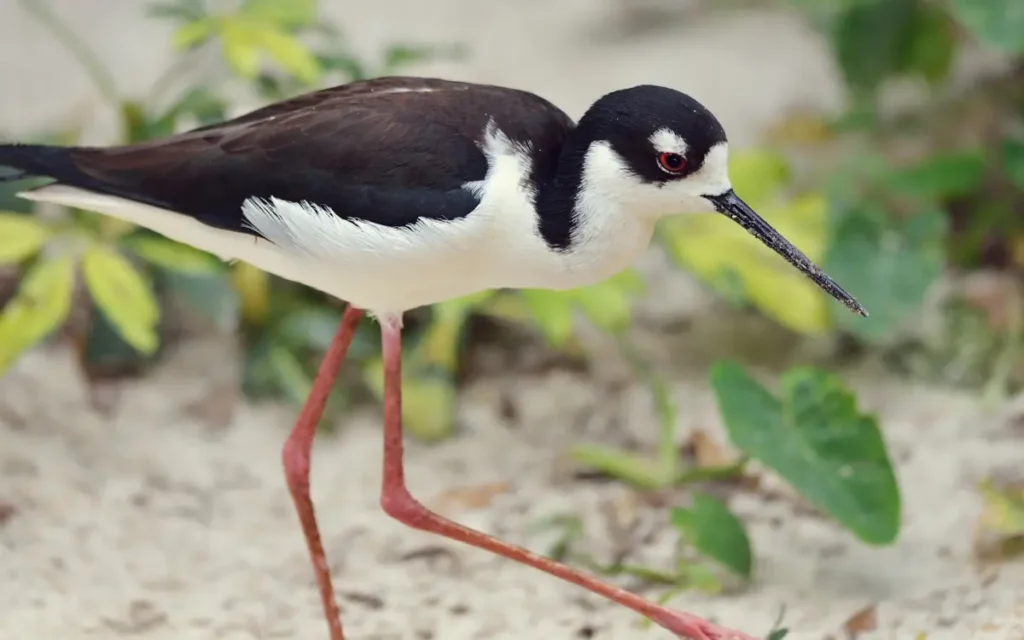
Few Texas shorebirds have longer-looking legs. Black-necked Stilts have thin pink legs, white underparts, black wings, and straight black bills.
They wade through shallow water while picking prey from the surface. A disturbed bird may circle overhead and call loudly, especially when eggs or chicks are nearby.
Freshwater marshes, coastal flats, flooded fields, and treatment ponds are good places to search. Stay back if a pair begins calling or flying around you.
Similar bird: American Avocet. The avocet has blue-gray legs and an upturned bill.
3.Black-bellied Plover

Scientific name: Pluvialis squatarola
Length: 11–12 inches
Texas status: Common coastal migrant and winter visitor
Call: Clear, mournful three-note whistle
Breeding Black-bellied Plovers have black faces and underparts bordered by white. Most Texas birds are seen in gray winter plumage, when their thick bills and large size become more useful ID marks.
In flight, look for black patches where the wings meet the body. Birders often call these black “armpits.” A pale rump and white wing stripe may also be visible.
They feed on beaches, tidal flats, salt marshes, and short coastal grass. Many stand alone or in loose groups.
Similar bird: American Golden-Plover. Black-bellied Plovers are heavier and show black underwings.
4.Semipalmated Plover

The SScientific name: Charadrius semipalmatus
Length: 6.5–7.5 inches
Texas status: Common spring and fall migrant; some winter
Call: Short, rising “chu-weet”
This small plover has one dark breast band, orange or yellow-orange legs, and a compact body. Breeding adults have an orange bill with a black tip. Winter birds have darker bills and softer facial markings.
Semipalmated Plovers use the run-stop-peck feeding pattern typical of their group. They are often mixed with small sandpipers on mudflats.
Look along the Gulf Coast, reservoir edges, flooded fields, and inland ponds during migration.
Similar bird: Piping Plover. A Semipalmated Plover is darker above and has a stronger, more complete breast band.
5.Piping Plover

Scientific name: Charadrius melodus
Length: 6.5–7.5 inches
Texas status: Coastal migrant and winter visitor
Call: Soft, clear piping whistle
Piping Plovers are pale sand-colored birds with white underparts and orange-yellow legs. Breeding adults have a short orange bill with a black tip and a narrow dark collar. Winter birds have dark bills and much fainter collars.
Texas is an important wintering area, but these birds do not normally nest on the Texas coast. They breed farther north and return to Gulf beaches outside the breeding season.
The Piping Plover is federally threatened. Give feeding and resting birds plenty of room, and keep dogs away from posted areas. U.S. Fish and Wildlife Service
Similar bird: Snowy Plover. Snowy Plovers have dark legs and broken dark patches along the sides of the breast.
6.Wilson’s Plover

Scientific name: Anarhynchus wilsonia
Length: 6.5–8 inches
Texas status: Gulf Coast breeder and migrant
Call: Short, whistled “whit”
The thick black bill is the fastest way to identify a Wilson’s Plover. It has gray-brown upperparts, white underparts, and a single dark breast band. Males show a black forehead during breeding season.
Wilson’s Plovers use their heavy bills to catch fiddler crabs and other coastal prey. Watch for them walking across dry sand near mudflats, tidal creeks, and dunes.
The current Texas checklist places this species in Anarhynchus, though older guides may still use Charadrius wilsonia.
Similar bird: Semipalmated Plover. Wilson’s is larger-headed and has a much thicker all-dark bill.
7.Snowy Plover (Charadrius nivosus)
Scientific name: Anarhynchus nivosus
Length: 6–7 inches
Texas status: Local resident, breeder, and migrant
Call: Soft whistled or trilled notes
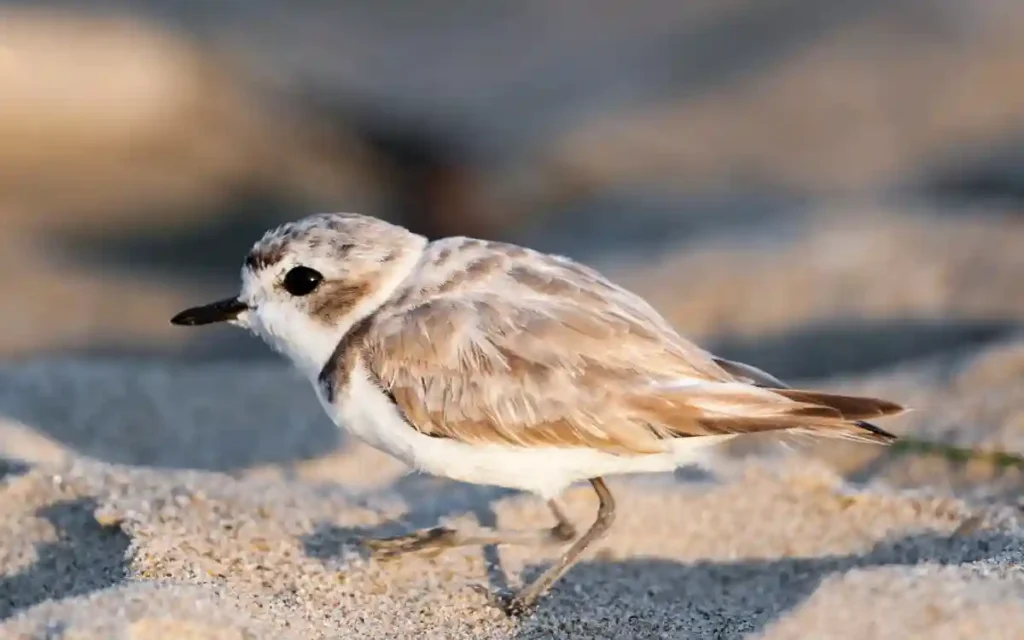
Snowy Plovers are tiny, pale birds with dark legs, short black bills, and incomplete dark patches on the sides of the chest. Their sandy backs can almost disappear against shell-covered beaches.
They prefer open ground with little vegetation. Look on dry beach, salt flats, spoil areas, and the edges of shallow saline water.
Nests are shallow scrapes that are easy to miss. Follow all ropes and signs, and walk near the wet-sand line where beach-nesting birds are less likely to have eggs.
Similar bird: Piping Plover. The Piping Plover has orange-yellow legs and usually looks slightly heavier.
8.Killdeer

Scientific name: Charadrius vociferus
Length: 9–11 inches
Texas status: Common year-round resident
Call: Loud “kill-deer”
Killdeer have brown backs, white bellies, orange rumps, and two black breast bands. They are among the easiest shorebirds for Texas beginners to identify.
Water isn’t required. Killdeer nest on gravel roofs, driveways, construction areas, lawns, and open fields. Their eggs blend closely with stones.
An adult near a nest may drag one wing and act injured. This broken-wing display draws attention away from its eggs or chicks. Move away instead of following it.
Similar bird: Semipalmated Plover. The Killdeer is much larger and has two breast bands.
9.Greater Yellowlegs
Scientific name: Tringa melanoleuca
Length: 11–14 inches
Texas status: Migrant and winter visitor
Call: Usually three or four loud whistled notes
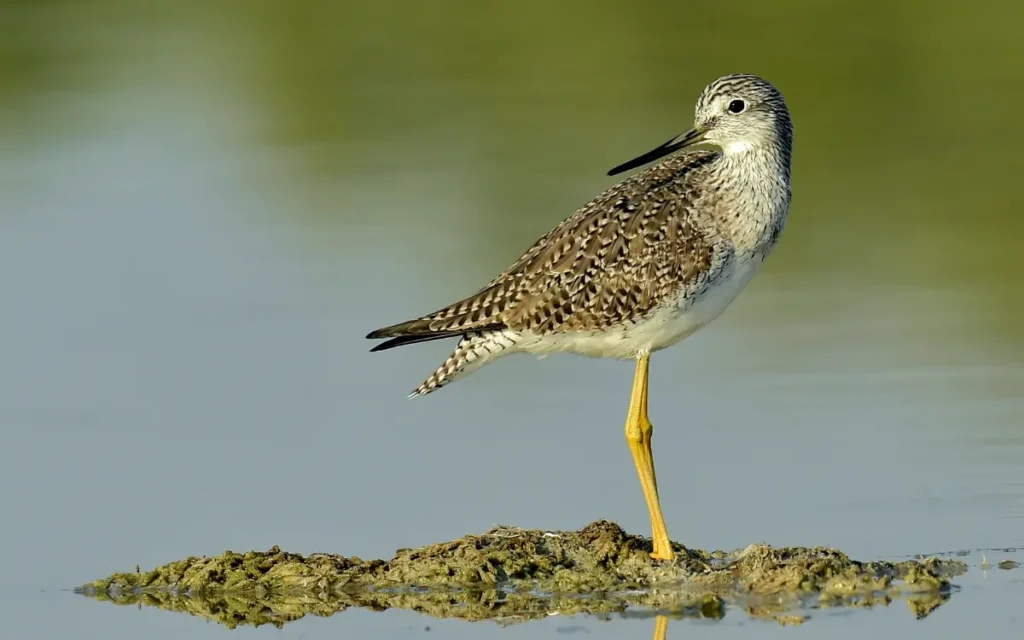
Greater Yellowlegs have long yellow legs, heavily marked gray-brown bodies, and long bills that curve slightly upward. The bill is usually longer than the head.
They feed with quick, forceful movements and may sweep their bills through water while chasing small fish. Their energetic style can look almost frantic.
Look on mudflats, flooded fields, marsh pools, reservoir edges, and shallow coastal water.
Similar bird: Lesser Yellowlegs. Greater Yellowlegs are bulkier, louder, and have longer, slightly upturned bills.
10.Lesser Yellowlegs
Scientific name: Tringa flavipes
Length: 9–11 inches
Texas status: Common migrant; some winter
Call: One or two soft whistled notes
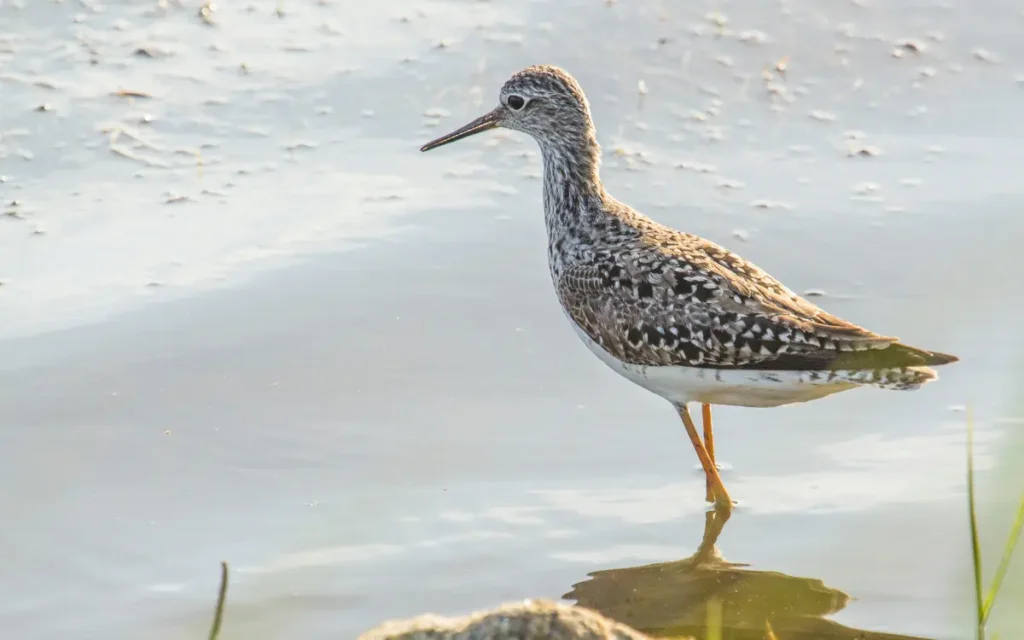
Lesser Yellowlegs have the same bright leg color as Greater Yellowlegs but look slimmer and more balanced. Their thin, straight bills are about the same length as their heads.
They walk through shallow water and pick insects or small aquatic animals from the surface. Flocks are common during migration.
Texas birders can find them around inland ponds, rice fields, marshes, and temporary rain pools.
Similar bird: Greater Yellowlegs. When both species stand together, the size difference is clear. When alone, concentrate on bill thickness and call.
11.Solitary Sandpiper
Scientific name: Tringa solitaria
Length: 7.5–9 inches
Texas status: Spring and fall migrant
Call: High, whistled “peet-WEET”
A bold white eye-ring, dark back covered with small pale spots, and greenish legs identify the Solitary Sandpiper. It repeatedly bobs its head and rear, though usually less strongly than a Spotted Sandpiper.
This bird often feeds alone around shaded woodland pools, drainage ditches, pond margins, and flooded trails. It rarely joins the dense coastal flocks used by many sandpipers.
Watch for a dark rump and barred tail when the bird flies.
Similar bird: Spotted Sandpiper. Solitary Sandpipers have spotted upperparts, longer legs, and a stronger eye-ring.
12.Willet

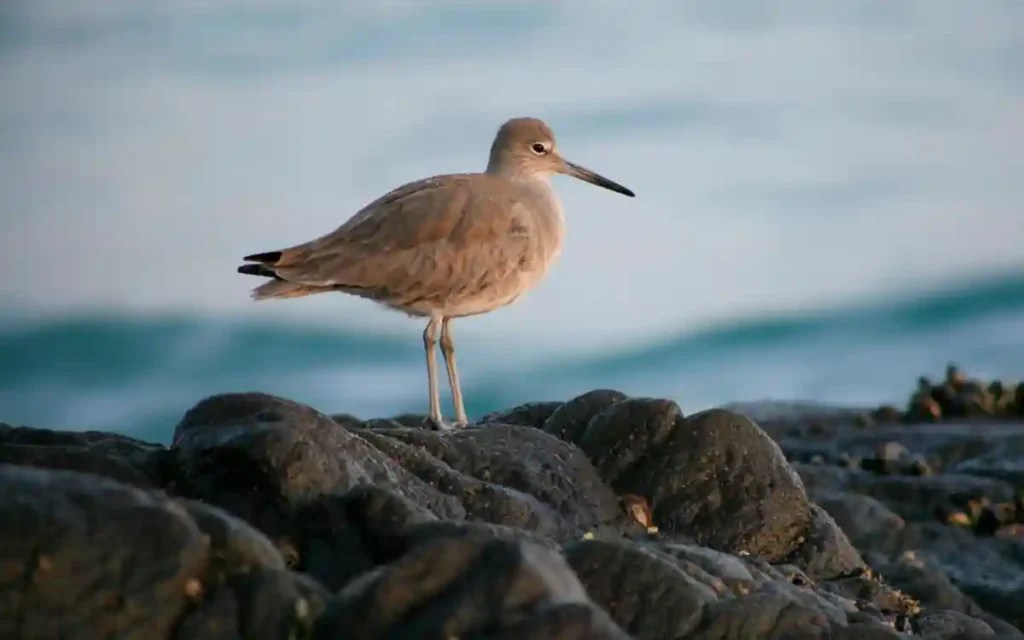
Scientific name: Tringa semipalmata
Length: 13–16 inches
Texas status: Coastal breeder, migrant, and winter visitor
Call: Loud “pill-will-willet”
A resting Willet may look plain gray-brown. Once it opens its wings, broad black-and-white stripes appear and make identification much easier.
Texas receives two forms. Eastern Willets breed along the Gulf Coast and tend to be smaller and darker. Larger, paler Western Willets arrive from inland breeding areas and are common outside summer.
Look on beaches, salt marshes, tidal flats, coastal grass, and bay edges. Willets frequently perch on posts and call from exposed spots.
Similar bird: Greater Yellowlegs. Willets have gray legs, heavier bodies, and bold wing patterns.
13.Spotted Sandpiper

Scientific name: Actitis macularius
Length: 7–8 inches
Texas status: Widespread migrant; some winter and breed locally
Call: Clear, rising “peet-weet”
Spotted Sandpipers constantly tip their rear ends up and down. This teetering motion works throughout the year, including winter when the bird has no spots.
Breeding adults have dark spots across white underparts. Nonbreeding birds have plain white bellies and a gray-brown breast patch that rises in front of the folded wing.
Search along rivers, lakes, concrete channels, rocky banks, and small ponds.
Similar bird: Solitary Sandpiper. The Spotted has shorter legs, plainer upperparts, and a stronger tail-bobbing motion.
14.Upland Sandpiper

Scientific name: Bartramia longicauda
Length: 11–13 inches
Texas status: Mainly a spring and fall migrant
Call: Long, bubbling whistle
The Upland Sandpiper looks out of place in a shorebird list because it prefers grass. It has a long neck, small round head, large dark eye, and thin bill.
Most pass through Texas between northern breeding grounds and South American wintering areas. Look in short-grass prairie, grazed pasture, sod farms, airfields, and open agricultural land.
Birds may stand on fence posts, giving a better view than a sandpiper feeding on mud.
Similar bird: Buff-breasted Sandpiper. The Upland is larger, longer-necked, and more heavily marked.
15.Hudsonian Whimbrel
Scientific name: Numenius hudsonicus
Length: 16–18 inches
Texas status: Common coastal migrant; a few winter
Call: Rapid series of clear whistles
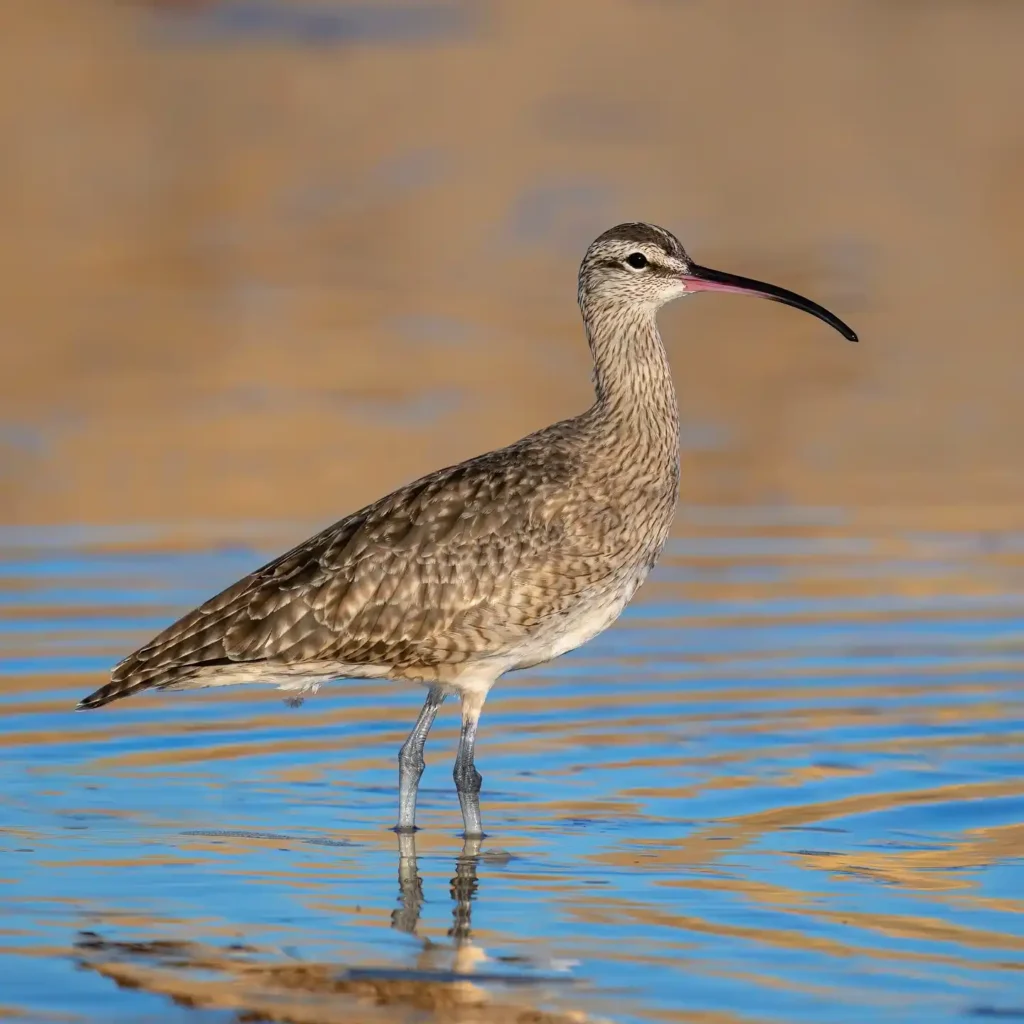
The familiar Texas Whimbrel is now called the Hudsonian Whimbrel following a taxonomic split. Older sources list it as Numenius phaeopus, but the current Texas checklist uses Numenius hudsonicus.
It has a long downcurved bill and bold light-and-dark crown stripes. Whimbrels feed on crabs in coastal areas and insects in grassland.
Spring birds may gather in rice country and coastal prairie before continuing north. Beaches, mudflats, tidal marshes, and grazed fields are good places to search.
Similar bird: Long-billed Curlew. The Whimbrel is smaller and has a striped crown.
16.Long-billed Curlew
Scientific name: Numenius americanus
Length: 20–26 inches
Texas status: Migrant and winter visitor; local breeder in the northwest
Call: Loud, rising cur-LEE whistle
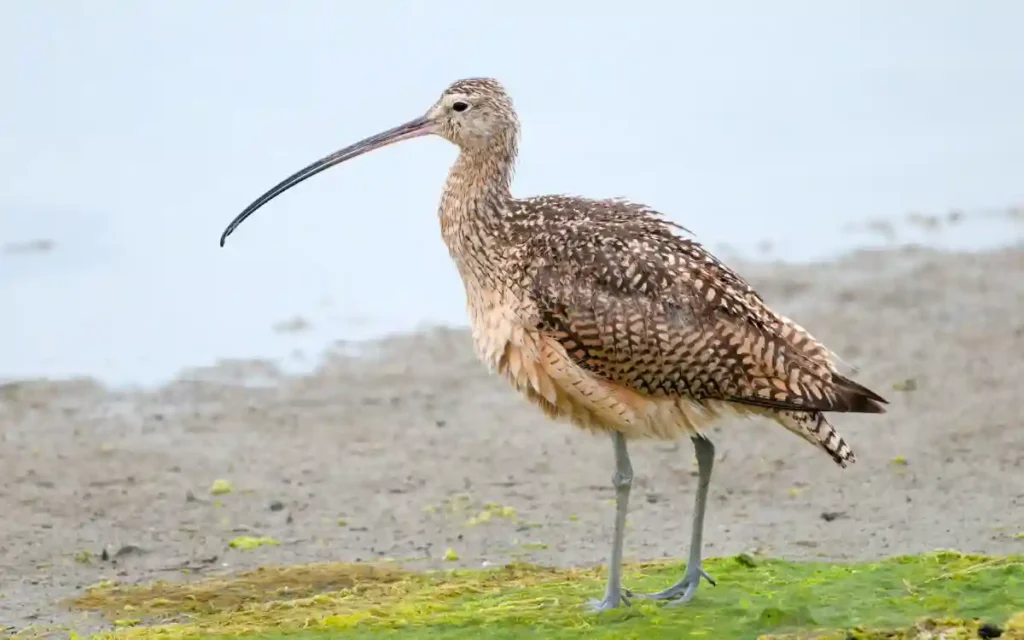
The Long-billed Curlew is North America’s largest shorebird. Its extremely long downcurved bill is hard to mistake, especially on females, which have longer bills than males.
The body is warm buff-brown. Cinnamon underwings are visible in flight.
Along the coast, curlews probe for crabs and worms. Inland birds walk across prairie and pasture while picking insects from the ground. Texas sightings are commonest from fall through spring along the Gulf Coast.
Similar bird: Hudsonian Whimbrel. The curlew is larger, warmer brown, and lacks strong crown stripes.
17.Marbled Godwit

Scientific name: Limosa fedoa
Length: 16–19 inches
Texas status: Common coastal migrant and winter visitor
Call: Nasal “ker-WEEK”
Marbled Godwits are large cinnamon-brown shorebirds with long, slightly upturned bills. The bill has a pink or orange base and a black tip.
They wade through shallow coastal water while probing deep into mud. At high tide, groups may gather on open sand to rest.
The underwings are cinnamon rather than dark, which separates this bird from a Hudsonian Godwit in flight.
Similar bird: Hudsonian Godwit. Marbled Godwits are larger, warmer-colored, and lack a white rump and dark underwings.
18.Hudsonian Godwit

Scientific name: Limosa haemastica
Length: 14–16 inches
Texas status: Scarce migrant, most expected in spring
Call: Nasal, repeated calls
Hudsonian Godwits are uncommon enough that every identification deserves care. Breeding birds have deep reddish underparts, gray backs, and long bills with pink bases. Nonbreeding birds are much grayer.
In flight, look for black underwings, a white rump, and a dark tail. These marks are often more useful than ground plumage.
Shallow freshwater wetlands, flooded fields, and coastal impoundments may attract migrants. Spring generally gives Texas birders a better chance than fall.
Similar bird: Marbled Godwit. The Hudsonian is smaller and shows a white rump with dark underwings.
19.Ruddy Turnstone

Scientific name: Arenaria interpres
Length: 8–10 inches
Texas status: Coastal migrant and winter visitor; some remain through summer
Call: Rapid, rattling notes
Ruddy Turnstones have short orange legs, strong wedge-shaped bills, and bold black-and-white patterns. Breeding birds also have rusty backs.
The name describes how they feed. Turnstones flip shells, stones, seaweed, and beach debris to uncover insects and small marine animals.
Look on jetties, rock groins, shell beaches, piers, and tidal flats. They sometimes feed around discarded bait, though birds should never be encouraged with processed food.
Similar bird: Red Knot. Turnstones have shorter orange legs and a much bolder pattern.
20.Red Knot
Scientific name: Calidris canutus
Length: 9–11 inches
Texas status: Coastal migrant and winter visitor
Call: Soft, low “knut” notes
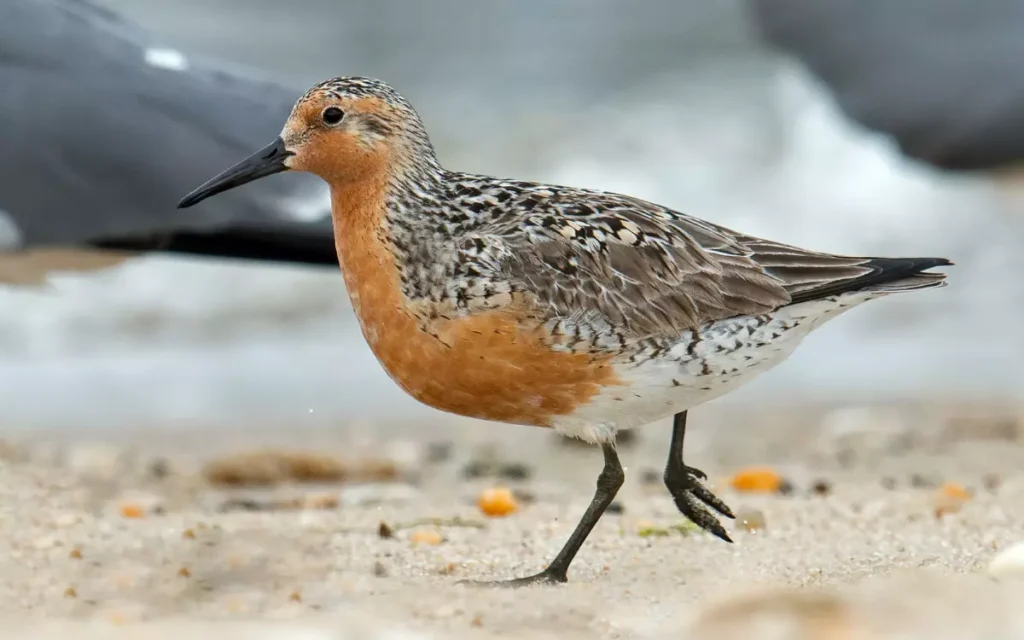
Red Knots are stocky sandpipers with short dark legs, thick necks, and straight black bills. Spring adults may have brick-red faces and underparts. Winter birds are plain gray above and white below.
They feed in flocks on sandy beaches and tidal flats, taking small clams and other marine prey. The rufa Red Knot is federally threatened, not merely “near-threatened.” U.S. Fish and Wildlife Service
Give resting flocks room. Repeatedly forcing migrants to fly uses energy they need for long journeys.
Similar bird: Dunlin. Red Knots are larger and have shorter, straighter bills.
21.Sanderling

Scientific name: Calidris alba
Length: 7–8 inches
Texas status: Common coastal migrant and winter visitor
Call: Short, soft “kip” notes
Sanderlings are the small pale birds running beside incoming waves. Winter birds have light gray backs, white underparts, and black legs. Breeding birds gain rusty tones and darker markings.
Their habit of following waves makes them easy to recognize on open beach. As water retreats, they rush forward to catch exposed prey, then run back before the next wave arrives.
Unlike most sandpipers, Sanderlings lack a hind toe.
Similar bird: Western Sandpiper. Sanderlings are paler, plumper, and usually feed on wave-washed sand.
22.Dunlin

Scientific name: Calidris alpina
Length: 8–9 inches
Texas status: Common fall-through-spring visitor
Call: Low, rough trills
A Dunlin has a fairly long bill that droops near the tip. Breeding adults show rusty backs and a large black belly patch. Texas winter birds are mostly gray, making the bill shape more useful than color.
Large flocks feed on coastal mudflats, often probing more deeply than smaller peeps. Groups may rise and turn together when disturbed.
Dunlins are common along bays, estuaries, marsh edges, and protected tidal flats.
Similar bird: Stilt Sandpiper. Dunlins have shorter legs and a more compact shape.
23.Least Sandpiper

Scientific name: Calidris minutilla
Length: 5–6 inches
Texas status: Common migrant and winter visitor; small numbers year-round
Call: High, rolling “kreee”
The Least Sandpiper is the smallest shorebird in the world. It has yellowish or greenish legs, a thin slightly curved bill, and brown upperparts.
Least Sandpipers often feed along muddy freshwater edges where vegetation begins. They may stay on softer ground while Western and Semipalmated Sandpipers move into more open mud.
Legs can look dark when coated in mud. Size, brown color, and habitat provide backup clues.
Similar bird: Semipalmated Sandpiper. Semipalmateds have black legs and usually look grayer.
24.Western Sandpiper

Scientific name: Calidris mauri
Length: 6–7 inches
Texas status: Common coastal migrant and winter visitor
Call: Thin, high “jeet”
Western Sandpipers have black legs and bills that often droop at the tip. Females average longer-billed than males, which makes some birds much easier to identify than others.
Breeding adults show rusty feathers on the crown and shoulders. Winter birds are pale gray and white.
Large flocks feed across Texas coastal mudflats. Watch for quick probing mixed with surface picking.
Similar bird: Semipalmated Sandpiper. Westerns usually have longer, more drooping bills and may show rusty shoulder feathers.
25.Semipalmated Sandpiper

Scientific name: Calidris pusilla
Length: 5.5–6.5 inches
Texas status: Common spring and fall migrant
Call: Short, husky “churk”
Semipalmated Sandpipers are small gray-brown peeps with black legs and short, blunt-tipped bills. The slight webbing between their toes is difficult to see in normal field conditions.
They feed on mudflats, shallow pond edges, rice fields, and wet agricultural land. Texas is mainly a migration stop; most spend winter farther south.
Bill length varies, so avoid naming a bird from that feature alone. Check body shape, plumage, feeding style, and nearby birds.
Similar bird: Western Sandpiper. A typical Semipalmated has a shorter, straighter bill and less rusty color.
26.Baird’s Sandpiper

Scientific name: Calidris bairdii
Length: 7–8 inches
Texas status: Inland migrant
Call: Low, rolling “krrt”
Baird’s Sandpipers have long bodies and wings that extend beyond the tail while standing. Their backs look scaly because each feather has a pale edge.
They favor drier mudflats, sparse grass beside water, sewage ponds, and inland reservoir edges. Texas sightings are most likely during migration, with fall often bringing juveniles.
The bird usually looks flatter and longer than a Least or Semipalmated Sandpiper.
Similar bird: White-rumped Sandpiper. Both are long-winged, but Baird’s lacks a white rump and usually looks browner.
27.White rumped Sandpiper
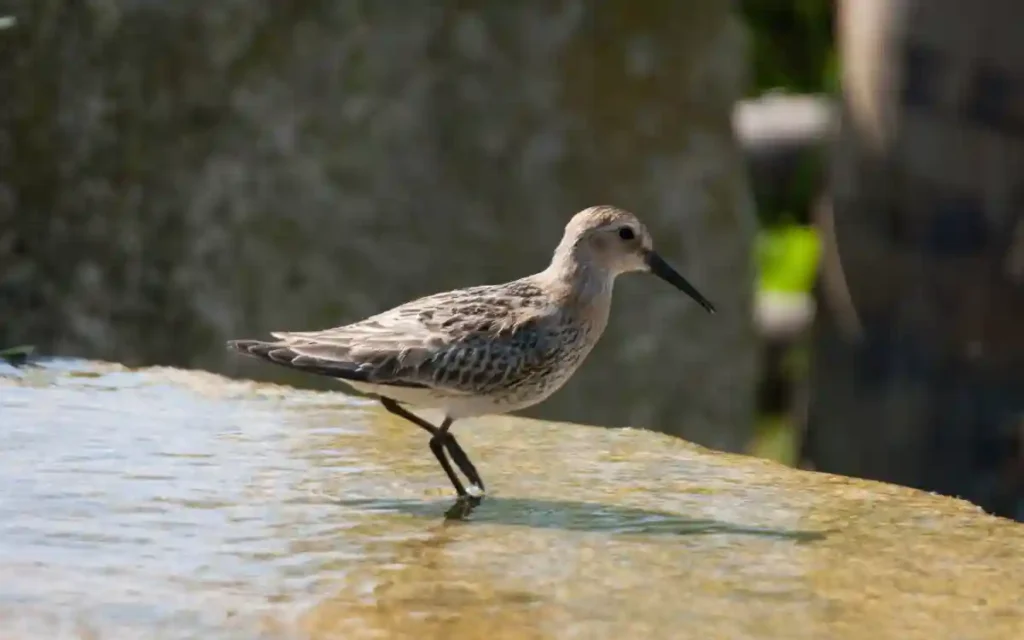
Scientific name: Calidris fuscicollis
Length: 7–8 inches
Texas status: Uncommon migrant, mainly late spring
Call: Thin, high notes
White-rumped Sandpipers are long-winged peeps with streaked flanks, pale eyebrows, and fairly long bills. Folded wings extend beyond the tail.
The white rump is visible when the bird flies, but don’t confuse it with the white sides of the tail shown by several other sandpipers. A clear rear or flight view helps.
In Texas, late April through June is usually a better window than fall. Check freshwater flats and flooded fields with mixed sandpiper flocks.
Similar bird: Baird’s Sandpiper. White-rumped Sandpipers look grayer and have white rumps.
28.Pectoral Sandpiper

Scientific name: Calidris melanotos
Length: 8–9.5 inches
Texas status: Common migrant
Call: Low, hoarse notes; males boom on breeding grounds
A Pectoral Sandpiper has yellowish legs and a heavily streaked chest that stops sharply above a clean white belly. That border is its best field mark.
The bill is medium length with a slightly paler base. Birds walk steadily through shallow water or damp vegetation while picking and probing.
Look in flooded pasture, rice fields, rain pools, marsh edges, and exposed reservoir mud. Fall juveniles often appear especially crisp and neatly patterned.
Similar bird: Least Sandpiper. The Pectoral is much larger and has a sharply divided chest and belly.
29.Stilt Sandpiper

The Stilt Sandpiper has long legs and a slightly curved bill, often feeding in deeper water tScientific name: Calidris himantopus
Length: 8–9 inches
Texas status: Migrant and local winter visitor
Call: Soft, rolling notes
Stilt Sandpipers have long greenish legs, slightly drooping bills, and pale eyebrows. Breeding birds show reddish cheeks and barred underparts. Winter birds are much grayer.
They wade into deeper water than most sandpipers and may feed with repeated probing motions similar to a dowitcher.
Freshwater ponds, flooded fields, shallow marshes, and coastal impoundments are the best places to look.
Similar bird: Long-billed Dowitcher. Stilt Sandpipers are slimmer and often show more obvious pale eyebrows.
30.Buff-breasted Sandpiper

Scientific name: Calidris subruficollis
Length: 7–8.5 inches
Texas status: Migrant, most expected in fall
Call: Quiet ticking notes
This sandpiper has a plain buff face and breast, dark round eye, short bill, and yellowish legs. Its softly patterned appearance is quite different from strongly streaked Pectoral Sandpipers.
Buff-breasted Sandpipers often avoid water. Search short grass, sod farms, overgrazed pasture, airfields, and dry edges near wetlands.
They walk with an upright posture and pick insects from the ground. Small groups can disappear in uneven grass surprisingly quickly.
Similar bird: Upland Sandpiper. The Buff-breasted is much smaller and shorter-necked.
31.Short-billed Dowitcher

Scientific name: Limnodromus griseus
Length: 10–12 inches
Texas status: Coastal migrant and winter visitor
Call: Mellow, repeated “tu-tu-tu”
Both dowitchers have very long bills and feed with rapid up-and-down probing. Despite the name, bill length overlaps so much that it is rarely enough for a safe identification.
Short-billed Dowitchers are more closely tied to saltwater mudflats, estuaries, and coastal marshes. Breeding-plumage birds usually have spotted sides and less heavily barred underparts.
The call is often the best clue. Short-billed gives a mellow series of notes.
Similar bird: Long-billed Dowitcher. Use habitat, plumage, flock behavior, and voice together.
32.Long-billed Dowitcher

Scientific name: Limnodromus scolopaceus
Length: 10–12 inches
Texas status: Migrant and winter visitor
Call: Sharp, single “keek”
Long-billed Dowitchers favor freshwater ponds, flooded fields, wastewater basins, and shallow marshes. They often feed belly-deep with a fast sewing-machine motion.
Breeding adults have heavily barred reddish underparts. Winter birds are gray and can be nearly impossible to separate visually from Short-billed Dowitchers.
Don’t identify one only because its bill looks long. Females of both species have longer bills than males.
Similar bird: Short-billed Dowitcher. A sharp “keek” call strongly favors Long-billed.
33.Wilson’s Snipe
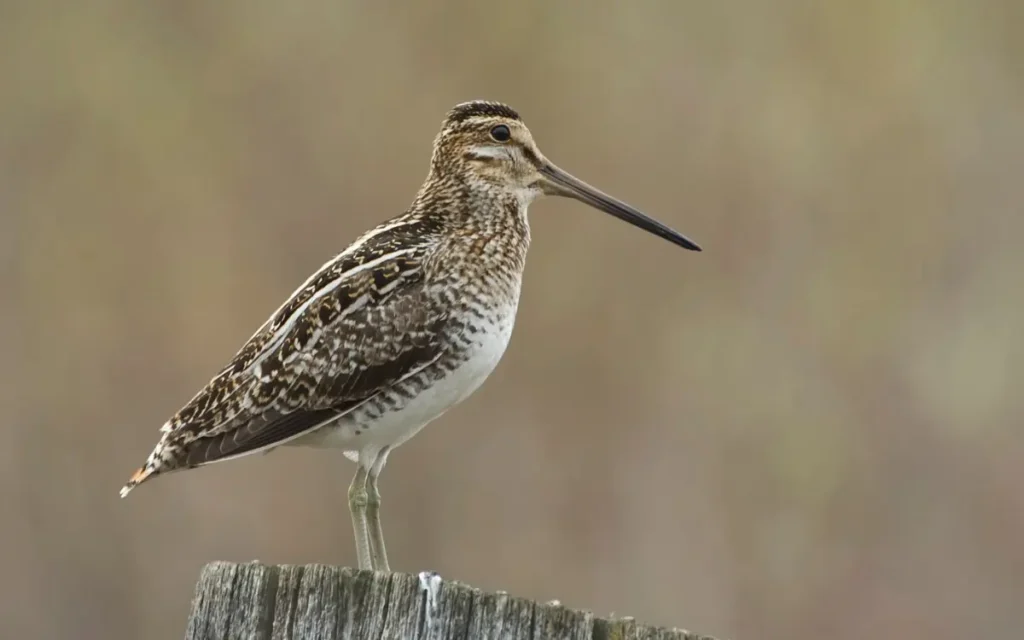
Scientific name: Gallinago delicata
Length: 9–11 inches
Texas status: Common fall-through-spring visitor
Call: Rough “scape” call when flushed
Wilson’s Snipes have striped heads and backs, short legs, round bodies, and extremely long straight bills. Their brown pattern makes them hard to see among wet grass.
A bird may remain still until a person approaches, then burst into the air and fly away in a twisting path. Mark where it lands; it may settle back into cover quickly.
Look in wet pasture, marsh edges, roadside ditches, rice fields, and muddy areas with clumps of vegetation.
Similar bird: American Woodcock. Snipes are slimmer, more strongly striped, and use open wetlands.
34.American Woodcock
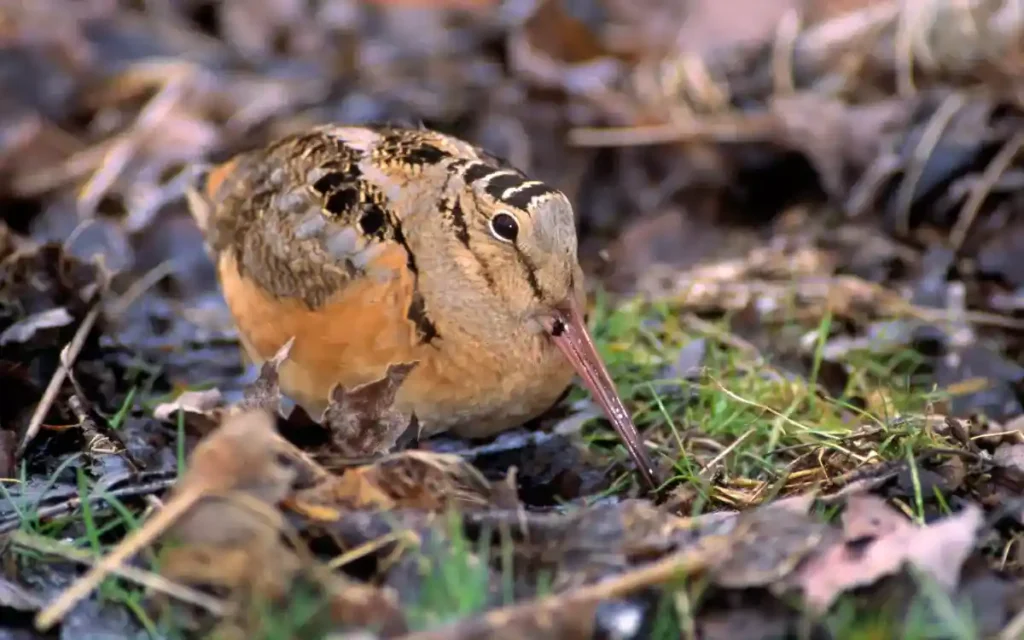
Scientific name: Scolopax minor
Length: 10–12 inches
Texas status: Winter visitor and local breeder, mainly in eastern Texas
Call: Nasal “peent” during courtship
American Woodcocks are round woodland shorebirds with short legs, long bills, and eyes placed high on their heads. Their rusty-brown and gray feathers blend into fallen leaves.
They feed in soft soil by probing for earthworms. Damp thickets, young woodland, stream bottoms, and brushy openings are better habitat than open mudflats.
At dusk in late winter or early spring, males may give nasal calls from open ground before rising into courtship flights.
Similar bird: Wilson’s Snipe. Woodcocks are rounder, shorter-legged, and usually found in woodland.
Greater vs Lesser Yellowlegs
| Feature | Greater Yellowlegs | Lesser Yellowlegs |
| Body | Larger and heavier | Smaller and slimmer |
| Bill | Longer than head; slightly upturned | About head length; straight |
| Feeding | Fast, forceful, sometimes sweeping | More careful picking |
| Call | Usually three or four notes | Usually one or two notes |
| Flock habit | Often alone or in small groups | Frequently joins larger groups |
Size works best when both birds are together. If only one is present, the call and bill proportions are safer clues.
Western vs Semipalmated Sandpiper
| Feature | Western Sandpiper | Semipalmated Sandpiper |
| Bill | Usually longer and droops at tip | Usually short and straighter |
| Breeding color | Often rusty crown and shoulders | Usually less rusty |
| Winter range | Common on Texas coast | Mainly a migrant |
| Feeding | Often probes rapidly | Picks and probes |
| Shape | Front-heavy when long-billed | More compact |
Some individuals overlap. A short-billed male Western Sandpiper can closely resemble a Semipalmated Sandpiper.
Short-Billed vs Long-Billed Dowitcher
| Feature | Short-Billed | Long-Billed |
| Preferred habitat | Coastal saltwater mudflats | Freshwater ponds and fields |
| Call | Mellow three-note series | Sharp single “keek” |
| Breeding flanks | More spotted | More heavily barred |
| Winter ID | Often uncertain | Often uncertain |
| Bill length | Overlaps | Overlaps |
If the bird never calls and the plumage isn’t clear, “dowitcher species” may be the most honest identification.
Other Texas Shorebirds Worth Knowing
The number 34 shouldn’t be read as the state’s full shorebird total. Several expected Texas species aren’t included in the main list:
- American Oystercatcher: Large black-and-white coastal bird with a thick red-orange bill.
- American Golden-Plover: Long-winged migrant found on turf, flooded fields, and mudflats.
- Mountain Plover: Pale plover of short grass and open fields, mainly seen in western Texas.
- Wilson’s Phalarope: Slim shorebird that often spins while feeding on shallow water.
- Red-necked Phalarope: Uncommon migrant, most likely on open ponds during fall.
Texas has also recorded rare shorebirds such as Ruff, Curlew Sandpiper, Purple Sandpiper, Northern Jacana, and Pacific Golden-Plover. These should be treated as rare-bird possibilities, not normal targets. The Texas Parks and Wildlife checklist separates expected birds from review species and accidental records.
Best Places to See Shorebirds in Texas
Bolivar Flats Shorebird Sanctuary
Bolivar Flats near Galveston is one of the strongest locations for wintering and migrating shorebirds. Possible birds include American Avocets, Willets, Piping Plovers, Red Knots, Dunlins, Sanderlings, and several small sandpipers.
Houston Audubon completed protection of the sanctuary’s remaining land in January 2026. The protected area now covers about 1,308 acres. Check the Houston Audubon sanctuary information before visiting.
Anahuac National Wildlife Refuge
Shallow freshwater areas and coastal prairie attract yellowlegs, dowitchers, Pectoral Sandpipers, Stilt Sandpipers, Wilson’s Phalaropes, and Upland Sandpipers.
Water levels affect what you’ll see. A pond with a narrow muddy edge may hold more shorebird species than one filled to the bank.
Brazoria National Wildlife Refuge
Brazoria has salt marsh, freshwater pools, mudflats, and coastal prairie. Avocets, stilts, godwits, dowitchers, and small sandpipers are all possible.
Aransas National Wildlife Refuge
Coastal marshes and tidal flats around Aransas can hold Willets, Long-billed Curlews, Marbled Godwits, plovers, and wintering sandpipers.
You may also see birds from our guide to herons in Texas while checking shallow wetlands.
Mustang Island and Port Aransas
Open beach, tidal flats, jetties, and coastal ponds create several shorebird habitats within a short distance. Sanderlings, Ruddy Turnstones, Snowy Plovers, Willets, and wintering peeps are regular possibilities.
South Padre Island and the Laguna Madre
The Lower Texas Coast is good for plovers, curlews, godwits, stilts, and other saltwater shorebirds. Check quiet flats around falling tide, when feeding habitat becomes exposed.
Inland Lakes and Flooded Fields
You don’t need to reach the Gulf. Reservoir edges, wastewater ponds, rice fields, rain pools, and temporary flooded fields can hold yellowlegs, dowitchers, Least Sandpipers, Pectoral Sandpipers, and Wilson’s Snipes.
Best Time to See Texas Shorebirds
Spring Migration
March through May brings northbound migrants. Late April and May can be especially good for White-rumped Sandpipers, Hudsonian Godwits, Whimbrels, and other long-distance travelers.
Weather and water levels can change the number of birds from one day to the next.
Summer
Wilson’s Plovers, Snowy Plovers, Black-necked Stilts, Eastern Willets, and Killdeer breed in Texas. Other species may be present as nonbreeding birds.
Southbound migration begins earlier than many beginners expect. Shorebirds can start returning in July.
Fall Migration
July through October brings adults followed by juveniles. August and September are strong months for peeps, yellowlegs, Pectoral Sandpipers, Baird’s Sandpipers, and Buff-breasted Sandpipers.
Fresh juvenile feathers may look warmer and more neatly edged than adult plumage shown in field guides.
Winter
The Gulf Coast holds Black-bellied Plovers, Piping Plovers, Sanderlings, Dunlins, Red Knots, Marbled Godwits, Willets, and Long-billed Curlews.
Wilson’s Snipes and both dowitchers can be found in inland wetlands during the cooler months.
Shorebird Watching Without Disturbance
A flock repeatedly taking flight is losing feeding or resting time. Stop approaching when birds begin walking away, raising their heads, calling, or bunching together.
Keep dogs leashed near shorebird areas. Avoid walking through dry upper beach where plovers may nest. Never enter roped nesting zones, even when no adult bird is visible.
Call playback isn’t needed for shorebirds. Patient watching usually reveals more behavior than pushing a bird to respond.
More Texas Birds to Identify
Shorebird habitats overlap with many other Texas bird groups:
- Ducks Found in Texas
- Geese of Texas
- Herons in Texas
- Backyard Birds in Texas
- Owls in Texas
- Hummingbirds in Texas
- Woodpeckers in Texas
- Birds in Texas
Frequently Asked Questions
What are the most common shorebirds in Texas?
Killdeer are widespread throughout the state. Along the Gulf Coast, Willets, Sanderlings, Black-bellied Plovers, Dunlins, Least Sandpipers, Western Sandpipers, and Black-necked Stilts are frequently seen during the right seasons.
How many shorebird species are found in Texas?
Texas has more than the 34 species covered in this guide. The official checklist includes additional expected species as well as rare and accidental records. The exact answer depends on whether extinct, accidental, and offshore species are counted.
What is the best month for shorebirds in Texas?
April and August through September usually bring strong migration variety. Winter is excellent on the Gulf Coast because large numbers of plovers and sandpipers remain there.
What small shorebird runs along Texas beaches?
A pale bird running back and forth with the waves is usually a Sanderling. Western Sandpipers and other peeps may also feed on beaches, but they spend more time probing mud or wet sand.
Which Texas shorebirds have yellow legs?
Greater Yellowlegs and Lesser Yellowlegs have bright yellow legs. Least Sandpipers and Pectoral Sandpipers have yellowish or greenish legs, though mud can make them look darker.
Are Piping Plovers endangered in Texas?
The populations that winter along the Texas coast are protected under the Endangered Species Act. The species is listed as threatened in much of its U.S. range, while the Great Lakes population is endangered.
Is the Red Knot protected?
Yes. The rufa Red Knot is federally listed as threatened. Coastal stopover and wintering areas provide the food and undisturbed resting space it needs.
Do shorebirds live away from the Texas coast?
Many do. Killdeer use fields and gravel areas. Upland and Buff-breasted Sandpipers use grassland. Solitary and Spotted Sandpipers visit inland water, while Wilson’s Snipes hide in wet pasture and marsh edges.
How can I identify a shorebird from a photograph?
Check bill shape, leg color, body proportions, and wing length. Note the location, date, habitat, and feeding action when the image was taken. A single side-view photograph may not show enough for a certain identification.
Why do shorebirds stand on one leg?
Standing on one leg can reduce heat loss because the other leg is tucked into the body feathers. A resting bird may switch legs after some time.
What is the easiest Texas shorebird for beginners to identify?
Killdeer are easy because of their double breast bands and loud calls. Black-necked Stilts, American Avocets, Sanderlings, and Spotted Sandpipers also have clear shapes or behaviors.