20 Ducks in California Identification Guide With Pictures
California is one of the best places in North America to watch ducks. Some species stay throughout the year, while millions more arrive during fall and winter along the Pacific Flyway.
You can find ducks in city ponds, coastal bays, flooded fields, freshwater marshes, mountain lakes, and slow-moving rivers. The fastest way to identify one is to check its bill shape, body pattern, feeding style, and habitat.
This guide covers 20 common and noteworthy ducks found in California, including easy identification marks, seasonal patterns, food, and the best places to look for each species.
Dabbling Ducks vs. Diving Ducks
Dabbling ducks feed near the water’s surface. You may see them tipping forward with their tails pointing up while they reach for plants and small aquatic animals. Mallards, teal, shovelers, pintails, wigeons, and Gadwalls belong to this group.
Diving ducks disappear completely underwater to catch fish, shellfish, insects, or submerged plants. Their legs sit farther back on the body, which helps them swim but can make walking on land look awkward. Buffleheads, scaup, goldeneyes, mergansers, and Ruddy Ducks are diving species.
1. Northern Shoveler
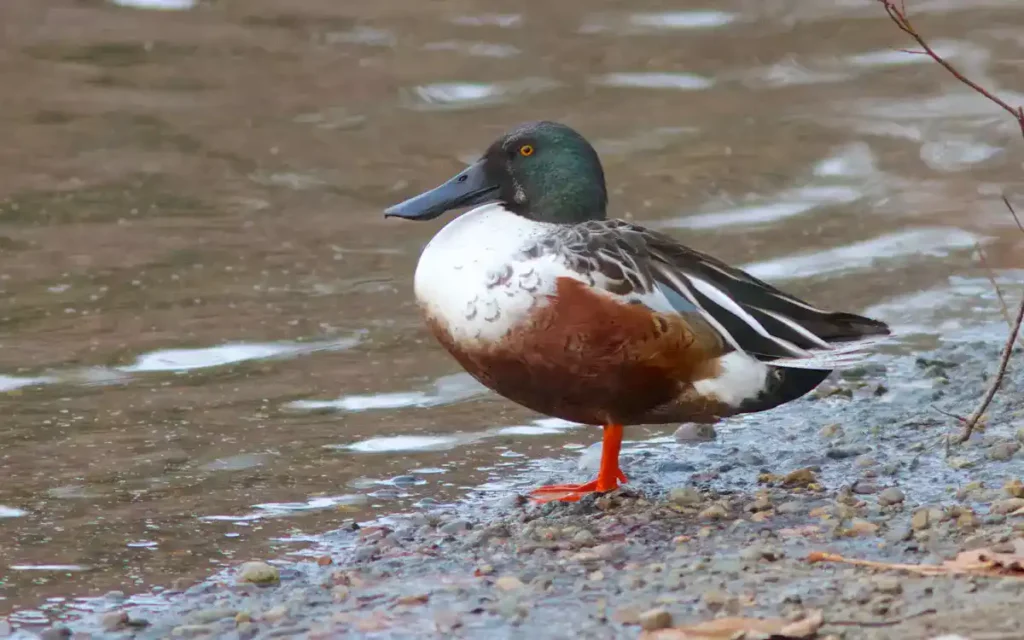
No other common California duck has a bill quite like the Northern Shoveler. Its wide, flat bill looks too large for its head, but it works as a fine filter for collecting food from shallow water.
A breeding male has a dark green head, white chest, rusty sides, yellow eyes, and a black bill. The female is mottled brown with a broad orange-gray bill. Both have pale blue patches on the upper wings.
Shovelers often swim in circles or groups, stirring the water and filtering seeds, plankton, insects, and tiny crustaceans.
- Scientific name: Spatula clypeata
- Length: 17.3–20.1 inches
- Best clue: Oversized spoon-shaped bill
- California status: Common in fall and winter
2. American Wigeon
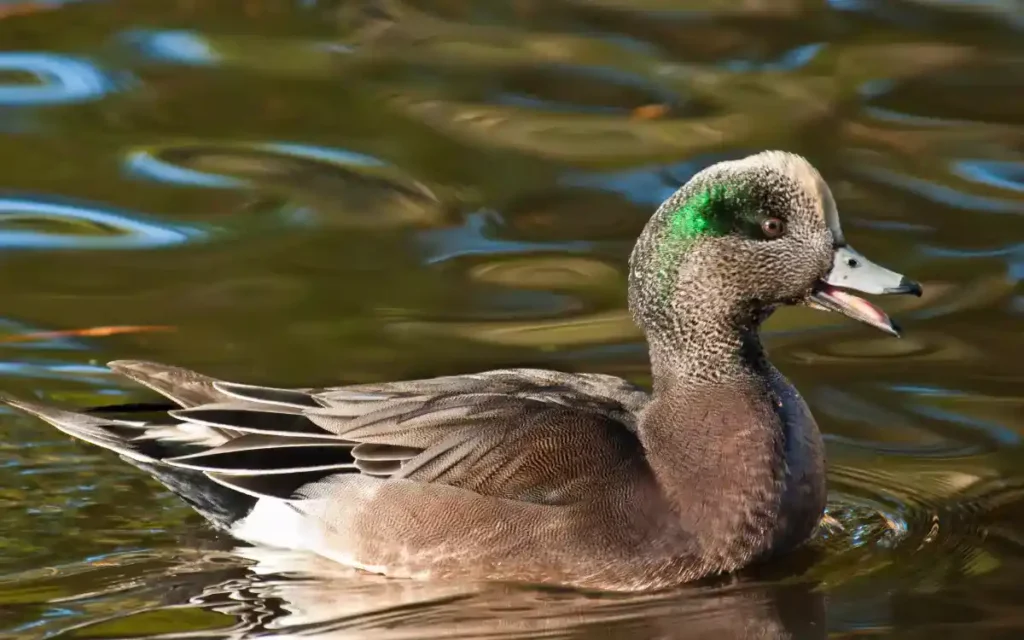
The male American Wigeon has a round head, pale blue bill, white crown, and green patch behind the eye. Females have warm brown bodies with gray-brown heads and dark markings around the eyes.
These ducks eat more grass than many other duck species. Flocks often leave the water to graze on lawns, fields, and short grass near wetlands. On the water, they sometimes follow coots and diving ducks and pick up plants the other birds pull loose.
Listen for the male’s clear, three-part whistling call. Large winter flocks gather in the Central Valley and other wetland areas.
- Scientific name: Mareca americana
- Length: 16.5–23.2 inches
- Best clue: White forehead and green eye patch on the male
- California status: Widespread winter visitor
3. Wood Duck:
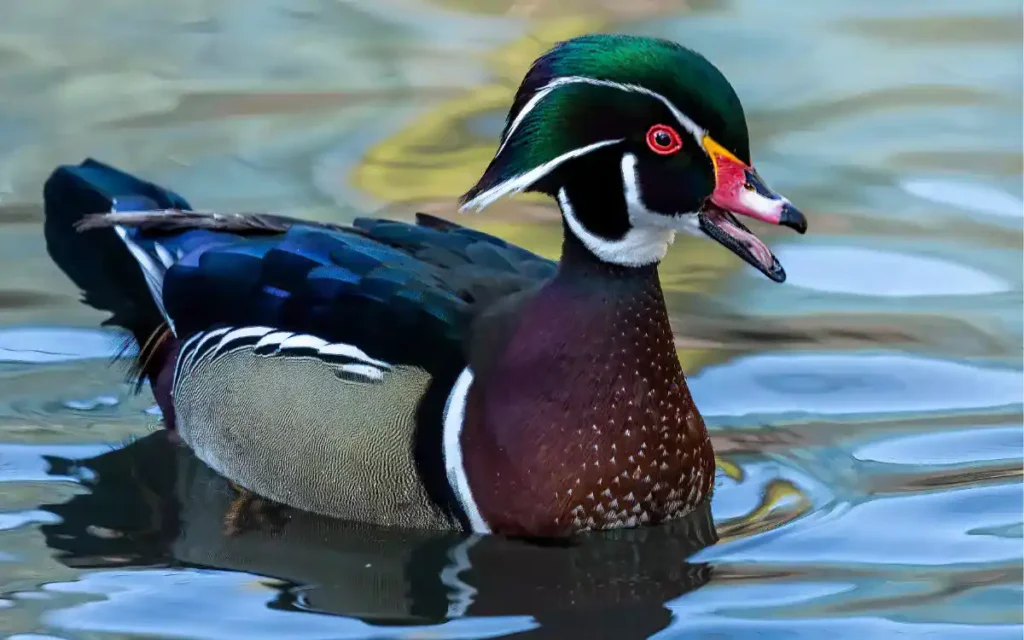
The male Wood Duck has a crested green-and-purple head marked with bold white lines. Its red eye, chestnut breast, and patterned sides give it a look unlike any other California duck.
Females are gray-brown with a teardrop-shaped white patch around the eye. Both sexes have crested heads and long tails.
Wood Ducks live around wooded ponds, swamps, slow rivers, and streams. They nest inside tree cavities and readily use properly placed nest boxes. Soon after hatching, the ducklings jump from the nest cavity and follow their mother to water.
- Scientific name: Aix sponsa
- Length: 18.5–21.3 inches
- Best clue: Crested head and bold facial pattern
- California status: Local year-round resident
4. Green winged Teal
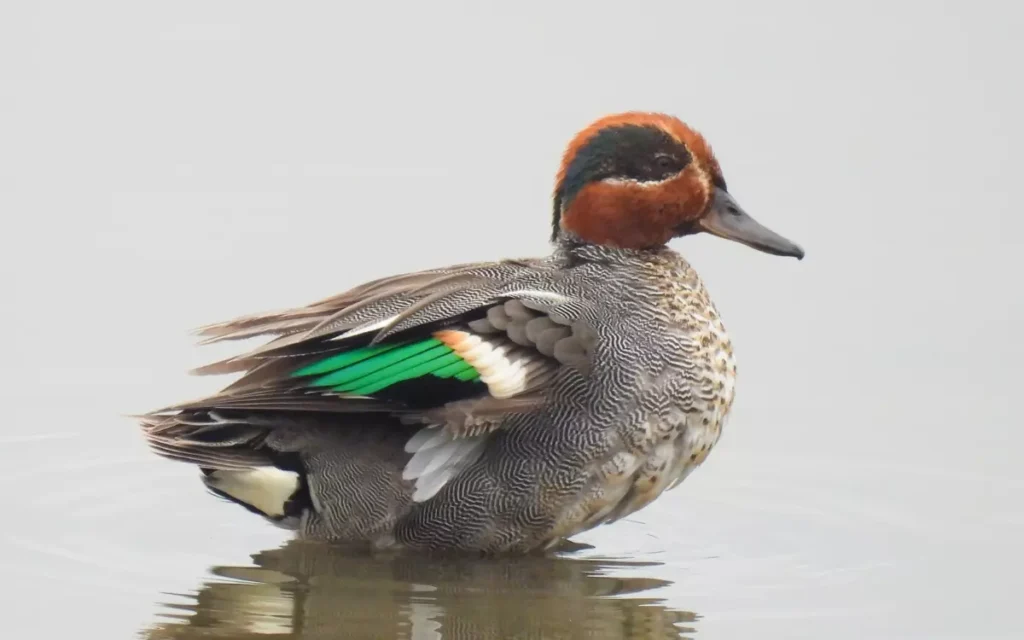
The Green-winged Teal is the smallest dabbling duck regularly seen in North America. Its compact size is often the first useful identification clue.
A male has a chestnut head with a broad green patch through the eye, a spotted tan breast, gray sides, and a vertical white mark near the shoulder.
Females are mottled brown with a dark line through the eye. Both sexes have a green wing patch, though it may be hidden while they are resting.
These quick-flying ducks gather on shallow ponds, mudflats, marsh edges, and flooded fields.
- Scientific name: Anas crecca
- Length: 12.2–15.3 inches
- Best clue: Tiny size and green wing patch
- California status: Common winter visitor
Related article:
5. Cinnamon Teal
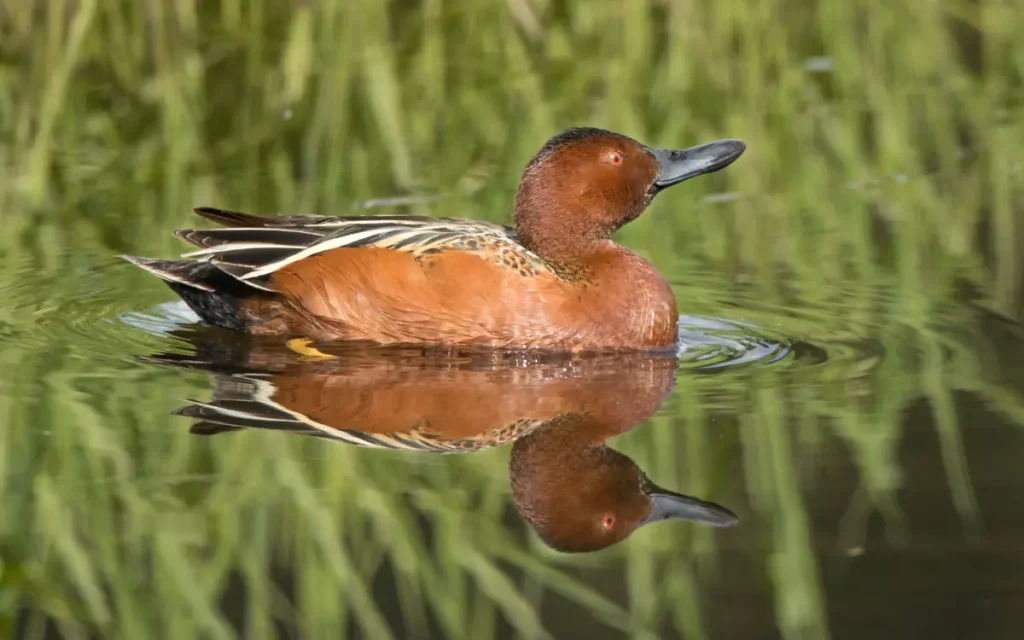
A breeding male Cinnamon Teal is hard to mistake. It has a deep cinnamon-red body, red eyes, and a black bill. Females are brown and much less colorful, but their long dark bills and warmer overall color help separate them from other female teal.
Both sexes show powder-blue patches on the upper wings during flight. These ducks favor shallow freshwater marshes with thick plants around the edges.
California is an important breeding area for Cinnamon Teal. They are most easily found in spring and summer, though some remain during winter.
- Scientific name: Spatula cyanoptera
- Length: 14.2–16.9 inches
- Best clue: Reddish male with red eyes
- California status: Local breeder and year-round resident
6. Gadwall
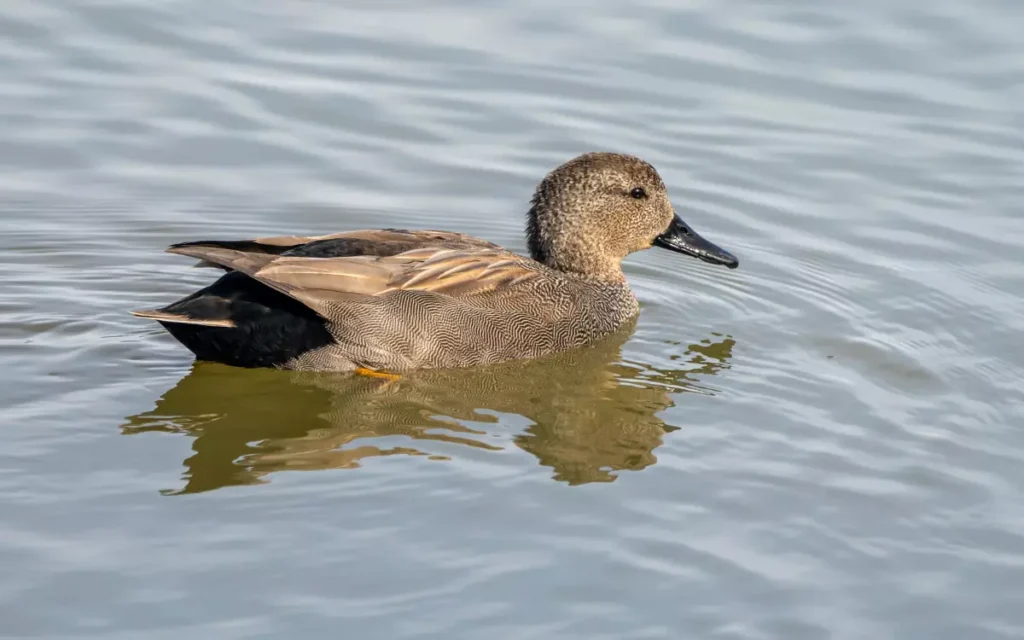
At first glance, a male Gadwall may look plain gray. A closer view shows fine black markings across its chest and sides, a black bill, and a black rear end. A white wing patch is often easiest to see when the bird flies.
Females resemble female Mallards but have a thinner orange-edged bill and a white wing patch instead of a blue one.
Gadwalls feed in shallow wetlands, where they eat leaves, stems, seeds, and aquatic plants. They sometimes steal pieces of vegetation brought to the surface by diving ducks.
- Scientific name: Mareca strepera
- Length: 18.1–22.4 inches
- Best clue: Gray male with a black rear and white wing patch
- California status: Common in winter; some breed in the state
7. Common Goldeneye
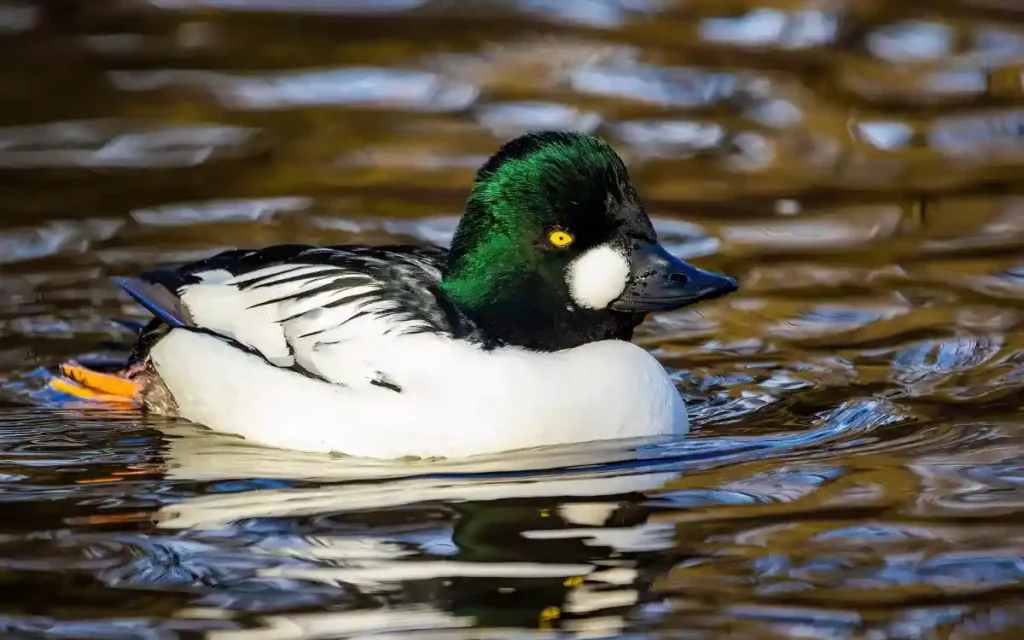
The male Common Goldeneye has a dark green head, yellow eye, white body, and a round white spot between the eye and bill. The female has a chocolate-brown head, gray body, yellow-tipped bill, and pale yellow eye.
These ducks nest in tree cavities across northern forests, well outside most of their California winter range. They may also lay eggs in the nests of other cavity-nesting ducks.
Goldeneyes dive for insects, crustaceans, mollusks, and small fish. Their wings make a sharp whistling sound in flight.
- Scientific name: Bucephala clangula
- Length: 15.8–20.1 inches
- Best clue: Round white cheek spot on the male
- California status: Winter visitor
8. Common Merganser
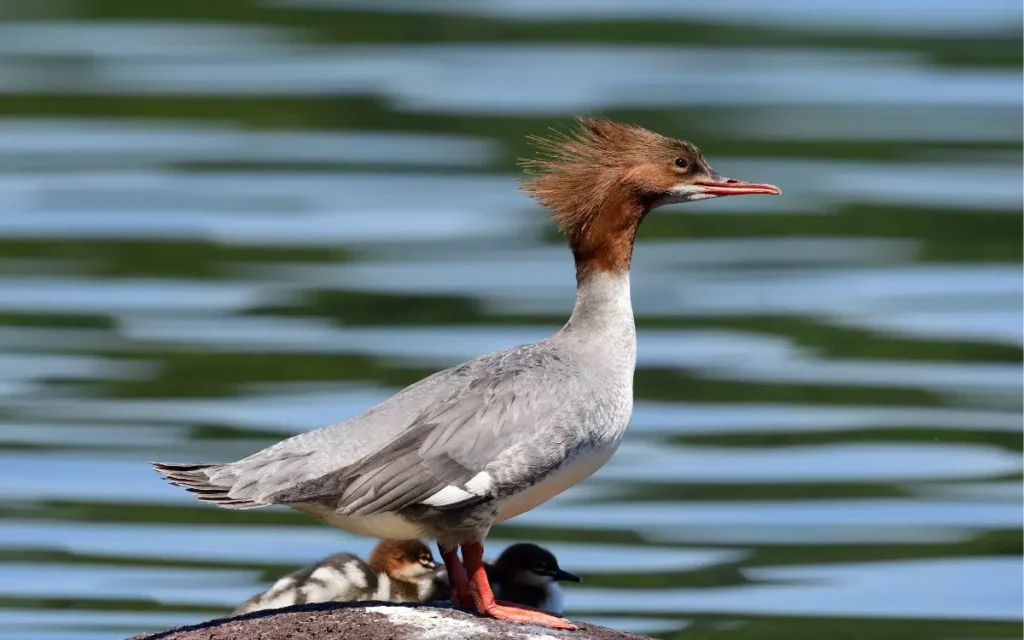
Common Mergansers are long-bodied fish-eating ducks with narrow, red, serrated bills. The tiny tooth-like edges help them grip slippery prey.
A male has a dark green head, red bill, black back, and mostly white body. The female has a rusty crested head, gray body, and a sharply defined white chin.
They prefer clear rivers, mountain lakes, reservoirs, and other waters with healthy fish populations. Females nest in tree cavities, rock openings, and other sheltered spaces.
- Scientific name: Mergus merganser
- Length: 21.3–27.9 inches
- Best clue: Long red bill and streamlined body
- California status: Found year-round in suitable areas; more widespread in winter
Related article: 26 Species of Sparrows in California You can see
10. Barrow’s Goldeneye
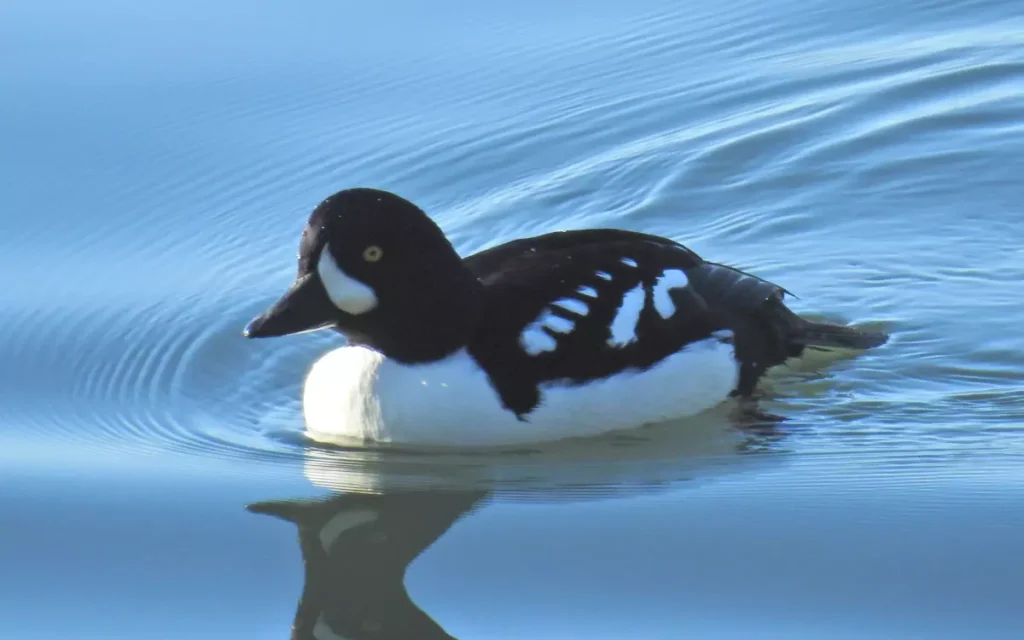
Barrow’s Goldeneye is much less common in California than the Common Goldeneye. Most sightings occur during winter, especially in northern California or around suitable mountain and coastal waters.
A male has a purple-black head with a crescent-shaped white patch in front of the eye. Its back shows a row of white marks. Females have brown heads and gray bodies, making them difficult to separate from female Common Goldeneyes.
Careful birders should check head shape, bill color, and the exact shape of the male’s facial patch.
- Scientific name: Bucephala islandica
- Length: 16.9–19.1 inches
- Best clue: White crescent in front of the male’s eye
- California status: Rare and local winter visitor
11.Bufflehead
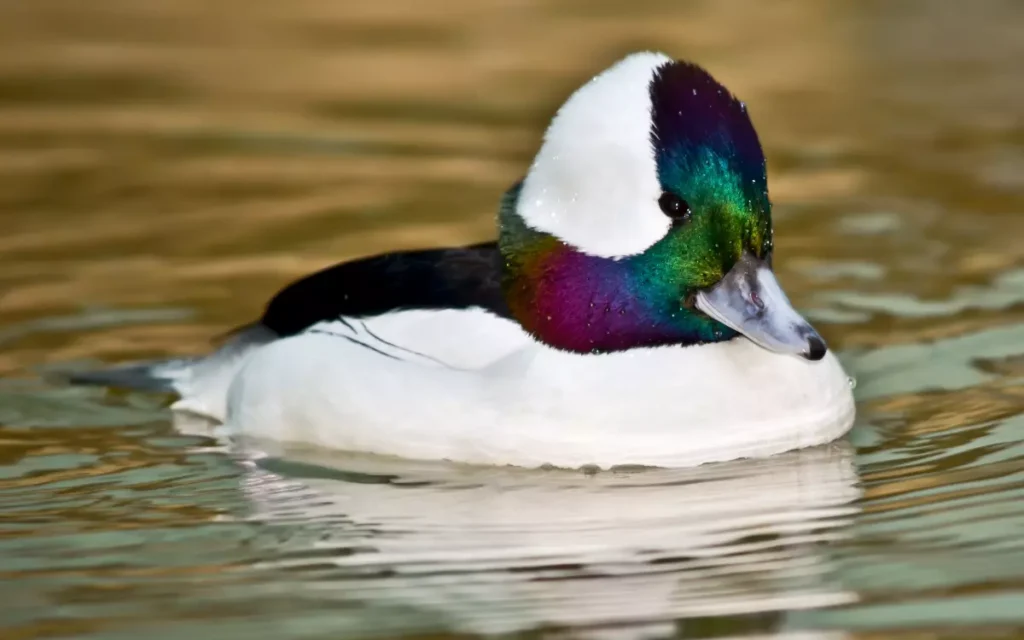
Buffleheads are tiny diving ducks with large, rounded heads. A male appears black and white from a distance, but sunlight can reveal green and purple on its head. A large white patch wraps around the back of the head.
Females are dark gray-brown with a small oval white patch on each cheek. They have short bills and compact bodies.
Buffleheads dive repeatedly for aquatic insects, snails, small crustaceans, and plant material. Look for them on ponds, reservoirs, quiet rivers, marinas, and protected coastal bays.
- Scientific name: Bucephala albeola
- Length: 12.6–15.7 inches
- Best clue: Large white patch on the back of the male’s head
- California status: Common winter visitor
12. Lesser Scaup
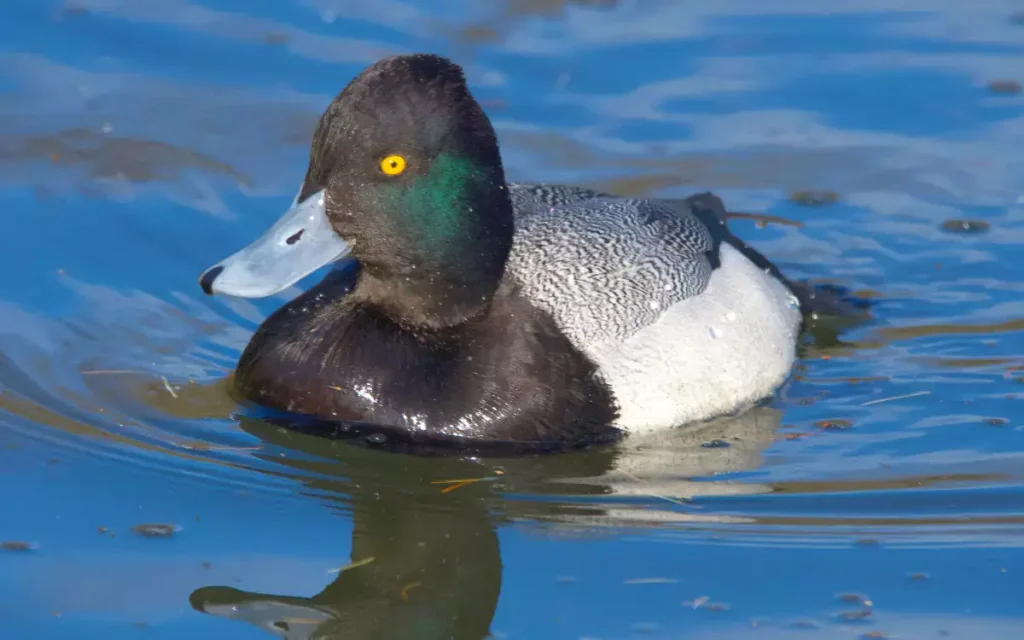
Lesser Scaup are similar to Greater Scaup but are usually smaller and more common on inland lakes and reservoirs.
The male has a black head with a purple sheen, yellow eyes, gray back, and white sides. Its head often looks tall or peaked toward the rear. Females are brown with a white patch at the base of the bill.
When the ducks are flying, the white wing stripe usually fades to gray across the outer wing. Head shape, habitat, and wing pattern are more dependable than head color alone.
- Scientific name: Aythya affinis
- Length: 15.3–18.1 inches
- Best clue: Peaked rear crown and small size
- California status: Common winter visitor
13. Greater Scaup
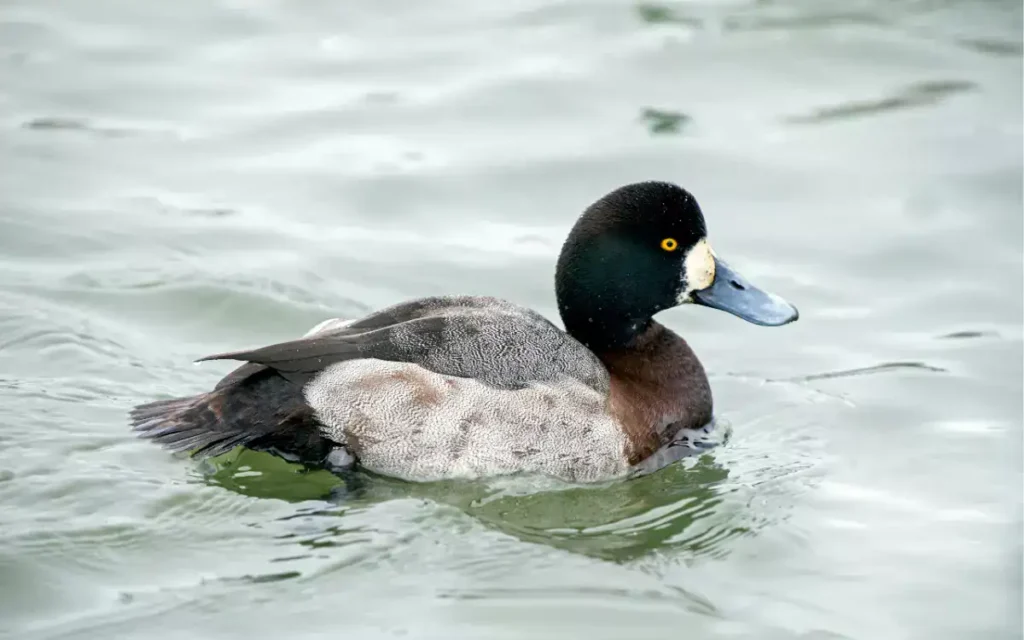
Greater Scaup are medium-sized diving ducks seen mainly on coastal bays and large bodies of water.
Males have black heads with a green sheen, yellow eyes, white sides, and finely barred gray backs. Females are brown with a wide white patch around the base of the bill.
Separating Greater Scaup from Lesser Scaup takes practice. Greater Scaup generally have broader bills, rounder heads, and more white extending along the wings during flight.
- Scientific name: Aythya marila
- Length: 15.3–22.1 inches
- Best clue: Rounded head and broad bill
- California status: Winter visitor, mainly near the coast
14. Ring-necked Duck
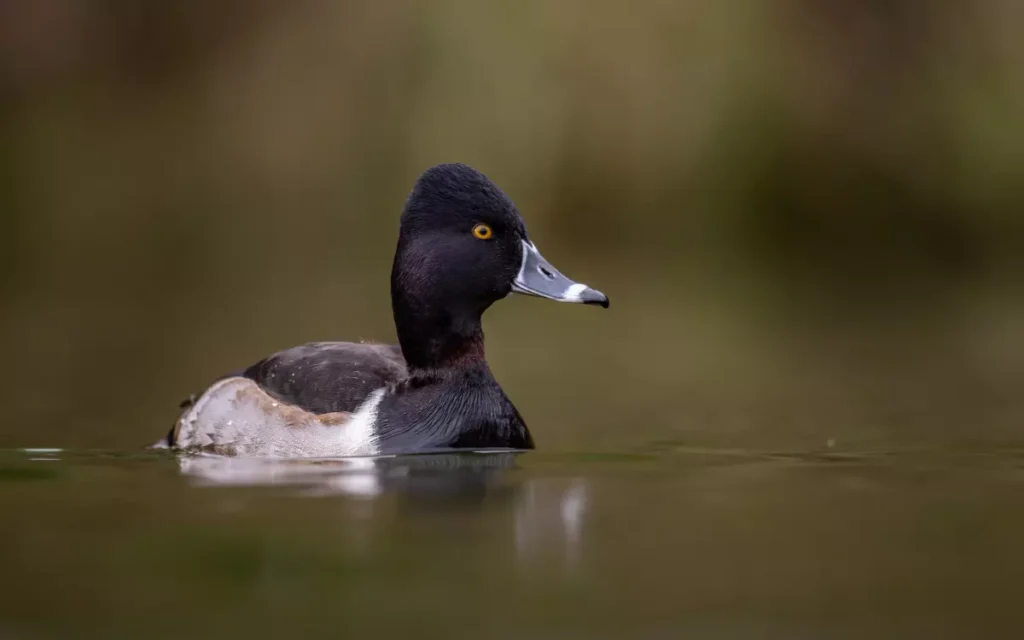
Despite its name, the Ring-necked Duck’s chestnut neck ring is difficult to see. Its bill pattern is far more useful.
The male has a black head, black back, gray sides, yellow eyes, and a gray bill with a white ring near the tip. A second white band sits at the base of the bill. Females are brown with a pale area around the bill and a white eye ring.
The head often looks peaked at the rear rather than smoothly rounded. These ducks favor freshwater ponds, marshes, and small lakes.
- Scientific name: Aythya collaris
- Length: 15.3–18.1 inches
- Best clue: White rings on the bill and peaked head
- California status: Common winter visitor
12. Redhead
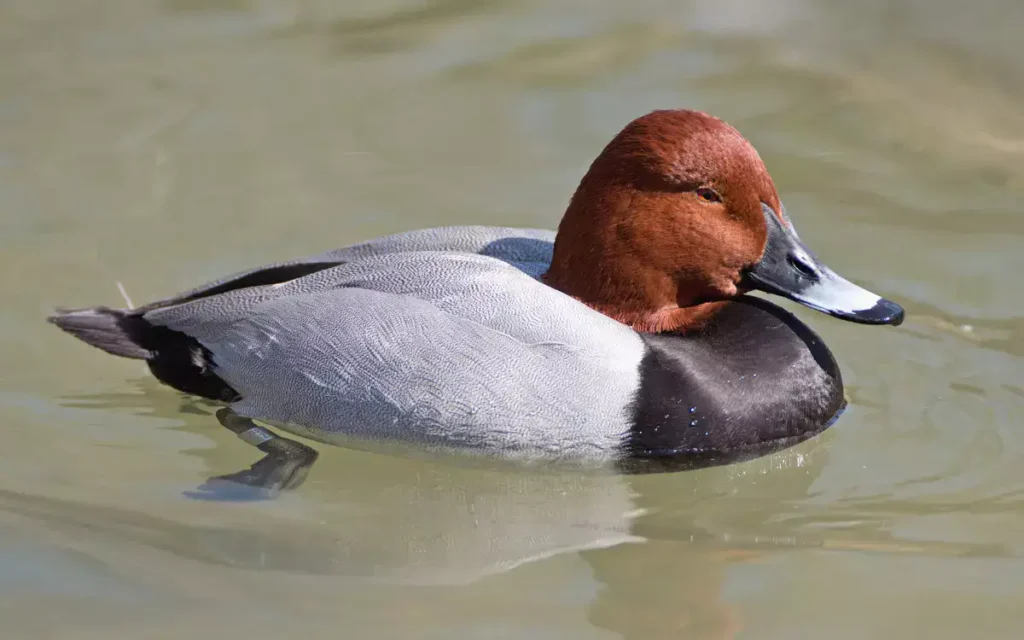
A male Redhead has a round copper-red head, blue-gray bill, black chest, and gray body. It can look similar to a male Canvasback, but its head is rounder and its bill is shorter.
The female is warm brown with a paler face and a bluish bill tipped with black. Redheads often mix with Canvasbacks, scaup, and other diving ducks.
They eat seeds, roots, tubers, snails, and aquatic insects. Some females lay eggs in the nests of other ducks, although they also build and tend their own nests.
- Scientific name: Aythya americana
- Length: 16.5–21.3 inches
- Best clue: Rounded red head and blue-gray bill
- California status: Regular winter visitor
11. Canvasback
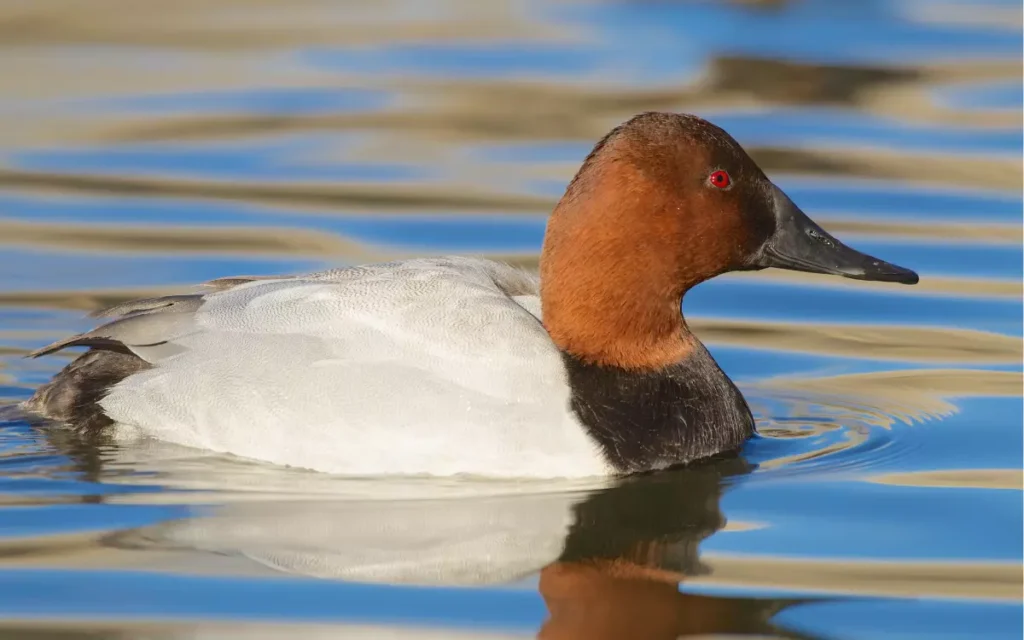
The Canvasback is a large diving duck with a long, sloping forehead that runs smoothly into its bill. A breeding male has a rusty-red head, black chest, pale gray-white back, and red eyes.
Females have the same sloping head shape but are mostly light brown and gray. This head profile is one of the best ways to separate them from Redheads.
Canvasbacks feed by diving for plant tubers, seeds, snails, and other aquatic food. Look for them on broad lakes, reservoirs, freshwater marshes, and sheltered bays.
- Scientific name: Aythya valisineria
- Length: 18.9–22.1 inches
- Best clue: Long black bill and sloping forehead
- California status: Winter visitor
12.Northern Pintail
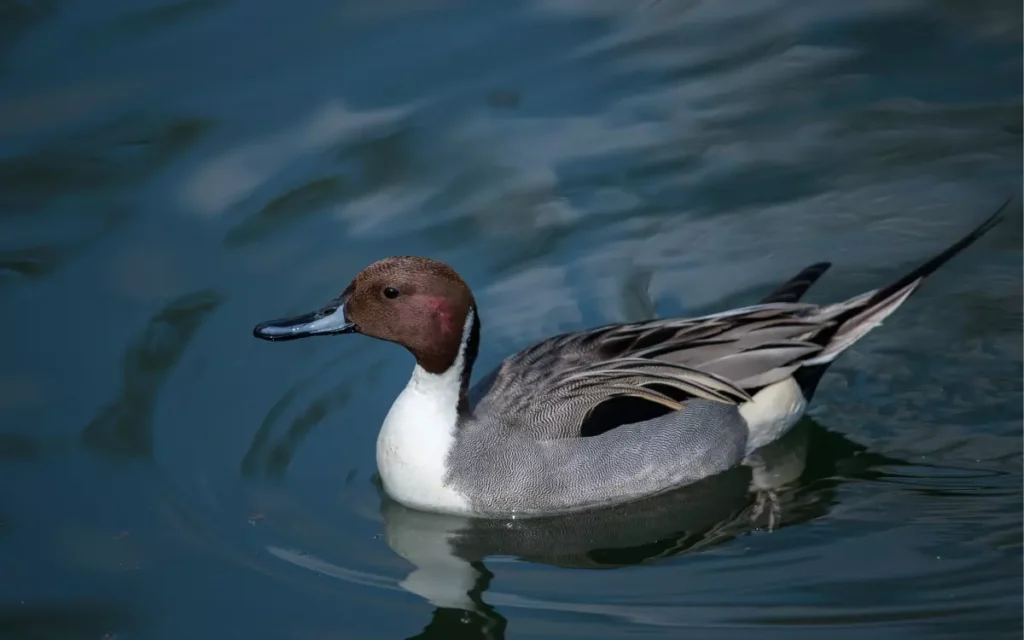
The Northern Pintail is a slim, long-necked duck with pointed wings. A breeding male has a chocolate-brown head, white breast, gray body, and a long black tail. A white stripe runs from the breast up each side of the neck.
Females are patterned brown and have longer, thinner necks than female Mallards. Their pointed tails are shorter than those of males but can still help with identification.
Pintails feed in shallow marshes, flooded fields, rice fields, and estuaries. They eat seeds, aquatic plants, insects, snails, and small crustaceans.
- Scientific name: Anas acuta
- Length: 20.1–29.9 inches
- Best clue: Long neck and sharply pointed tail
- California status: Common fall and winter visitor
13.Mallard
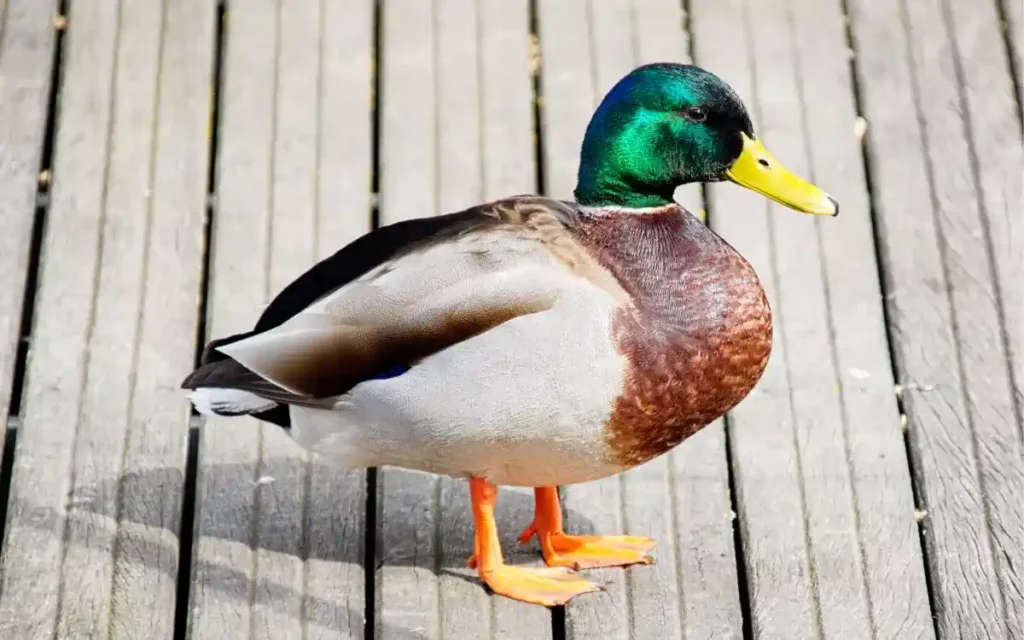
The Mallard is the most familiar duck in California and can be seen throughout the year. It lives in wild wetlands as well as city parks, golf-course ponds, reservoirs, and quiet rivers.
A male has a glossy green head, narrow white neck ring, chestnut breast, yellow bill, and curled black tail feathers. The female is mottled brown with an orange-and-black bill. Both sexes have a blue-purple wing patch bordered by white.
Mallards dabble for seeds, aquatic plants, insects, snails, and other small animals. Many domestic ducks and Mallard hybrids show unusual white, black, or patchy plumage.
- Scientific name: Anas platyrhynchos
- Length: 19.7–25.6 inches
- Best clue: Green-headed male or blue-purple wing patch
- California status: Common year-round resident and winter visitor
14. Common Merganser
Common Mergansers are long-bodied fish-eating ducks with narrow, red, serrated bills. The tiny tooth-like edges help them grip slippery prey.
A male has a dark green head, red bill, black back, and mostly white body. The female has a rusty crested head, gray body, and a sharply defined white chin.
They prefer clear rivers, mountain lakes, reservoirs, and other waters with healthy fish populations. Females nest in tree cavities, rock openings, and other sheltered spaces.
- Scientific name: Mergus merganser
- Length: 21.3–27.9 inches
- Best clue: Long red bill and streamlined body
- California status: Found year-round in suitable areas; more widespread in winter
20. Surf Scoter
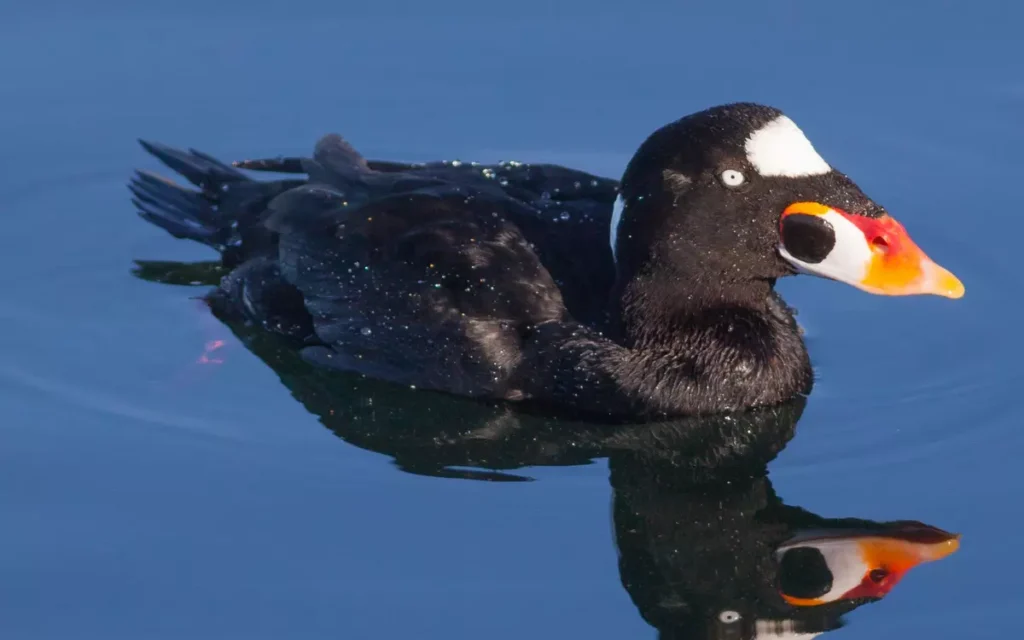
Surf Scoters are dark sea ducks commonly seen along the California coast during winter. They often form large floating flocks beyond beaches, inside bays, and near rocky shorelines.
Adult males are mostly black with white patches on the forehead and back of the neck. Their thick bills are patterned with orange, white, red, and yellow. Females are dark brown with two pale patches on the side of the head.
Surf Scoters dive for mussels, clams, crabs, and other marine animals.
- Scientific name: Melanitta perspicillata
- Length: 18.9–23.6 inches
- Best clue: Bulky colorful bill on the male
- California status: Common coastal winter visitor
Rare Ducks to Watch for in California
California’s location on the Pacific Flyway brings occasional visitors outside their usual range. Birders may find Eurasian Wigeons mixed with American Wigeons or Harlequin Ducks along rocky northern coasts.
Long-tailed Ducks, Tufted Ducks, Smews, and other rare waterfowl have also been recorded, but they should not be presented as common California ducks. Reports of unusual species are worth checking carefully because escaped domestic birds and hybrid ducks can cause confusion.
Where to See Ducks in California
Central Valley Wetlands
The Central Valley holds huge numbers of wintering waterfowl. Wildlife refuges, rice fields, flooded agricultural land, and managed wetlands attract pintails, shovelers, teal, wigeons, Gadwalls, and geese.
Good areas include:
- Sacramento National Wildlife Refuge
- Colusa National Wildlife Refuge
- Gray Lodge Wildlife Area
- Merced National Wildlife Refuge
- San Luis National Wildlife Refuge
San Francisco Bay
The bay and its surrounding marshes attract diving ducks, scoters, scaup, Buffleheads, goldeneyes, and dabbling ducks. Check protected coves, salt ponds, tidal channels, and marina edges.
Southern California Wetlands
Bolsa Chica Ecological Reserve, San Joaquin Wildlife Sanctuary, the Salton Sea area, and coastal lagoons can hold many species during migration and winter.
Mountain Lakes and Rivers
Clear mountain waters are good places to search for Common Mergansers, Wood Ducks, and locally breeding Mallards. Goldeneyes and other diving ducks may appear during the colder months.
City Parks
You do not always need to visit a wildlife refuge. Mallards, Ruddy Ducks, American Wigeons, Ring-necked Ducks, and Buffleheads regularly use urban ponds and park lakes.
Best Time to See Ducks in California
Late fall through early spring is the best period for duckwatching. Migrating waterfowl begin arriving during September and October, and many remain until February or March.
Winter offers the greatest variety because resident birds are joined by ducks from Alaska, Canada, and the northern United States. Spring is better for seeing breeding plumage, courtship behavior, and local nesting species such as Mallards, Wood Ducks, and Cinnamon Teal.
California provides winter habitat for roughly 60% of the waterfowl using the Pacific Flyway, according to the California Department of Fish and Wildlife.
California Duck Identification Tips
Start With the Bill
A Northern Shoveler has an oversized spoon-shaped bill. Mergansers have narrow bills for catching fish, while scaup have broad blue-gray bills.
Watch How It Feeds
A duck tipping its tail upward is probably dabbling. A bird disappearing underwater is a diving duck. Feeding behavior can quickly narrow the choices.
Check the Head Shape
Canvasbacks have sloping foreheads, Ring-necked Ducks have peaked crowns, and Buffleheads have oversized rounded heads.
Use the Habitat
Surf Scoters usually stay in saltwater. Wood Ducks prefer wooded ponds and streams. Northern Pintails and shovelers are more likely in open shallow wetlands.
Do Not Rely Only on Male Plumage
Male ducks can lose their bright breeding colors during late summer. Females, young birds, and eclipse-plumage males require closer attention to bill shape, wing patches, size, and behavior.
How to Watch Ducks Responsibly
Stay on marked trails and give feeding or resting flocks plenty of room. A group that repeatedly swims away, calls, or takes flight is reacting to your presence.
Avoid approaching nests or separating ducklings from their mother. Dogs should remain leashed near wetlands.
Do not feed ducks bread, chips, or processed food. Feeding can crowd birds together, change their normal behavior, and leave uneaten food in the water.
FAQs
What is the most common duck in California?
The Mallard is California’s most familiar and widespread duck. It can be found in natural wetlands, city ponds, lakes, reservoirs, and slow-moving rivers throughout the year.
How many duck species live in California?
More than 25 duck species occur regularly in California, with additional rare visitors recorded from time to time. The exact number seen in one area changes with the season, habitat, and location.
What ducks stay in California all year?
Mallards, Wood Ducks, Ruddy Ducks, Cinnamon Teal, Gadwalls, and Common Mergansers can be found year-round in at least parts of California. Their local numbers and ranges change between seasons.
What ducks come to California in winter?
Northern Pintails, American Wigeons, Green-winged Teal, Buffleheads, scaup, Canvasbacks, goldeneyes, and Surf Scoters are among the ducks that become more widespread during winter.
What is the small black-and-white duck seen in California?
It is often a male Bufflehead. These small diving ducks have dark heads with large white patches at the back. Male Hooded Mergansers can look similar but have longer bodies, larger bills, and fan-shaped crests.
What California duck has a blue bill?
A breeding male Ruddy Duck has a bright blue bill. Male Canvasbacks, Redheads, Ring-necked Ducks, and scaup have paler blue-gray bills.
What duck has a spoon-shaped bill?
The Northern Shoveler has a wide, flat bill shaped like a spoon. It uses comb-like structures along the bill to filter tiny food from shallow water.
Are there wild Wood Ducks in California?
Yes. Wild Wood Ducks live in wooded wetlands, ponds, streams, and river corridors across parts of California. They nest in tree cavities and also use nest boxes.
Are Mandarin Ducks native to California?
No. Mandarin Ducks are native to East Asia. Birds seen in California are usually escaped or released ornamental ducks, although small local populations may survive around parks and residential ponds.
Is it legal to feed ducks in California?
Rules vary by city, park, and wildlife area. Even where feeding is not banned, it is better to let wild ducks find natural food. Bread and processed snacks offer poor nutrition and can pollute ponds.