Mourning Dove Identification
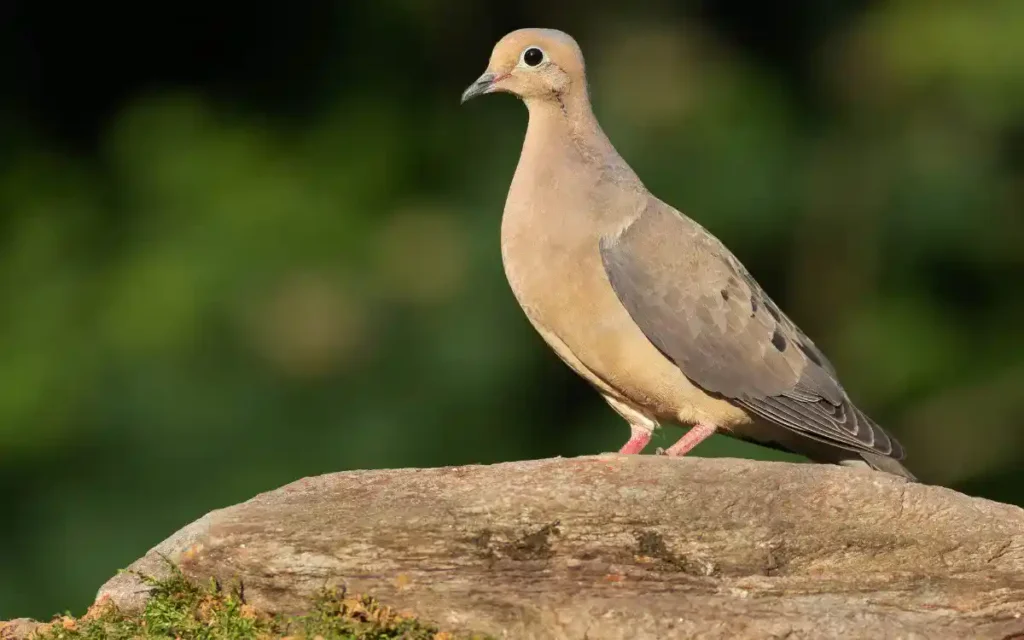
A Mourning Dove is a slim, tan-gray bird with a small head, black spots on its wings, and a long pointed tail edged with white. Its soft, drawn-out cooing and the sharp whistle made by its wings are also useful clues.
Mention that Mourning Doves are found across most of North America in backyards, farms, grasslands, deserts, roadsides, and open woodland. They are often confused with Eurasian Collared-Doves, White-winged Doves, and young pigeons.
Mourning Dove Identification at a Glance
| Feature | Mourning Dove |
| Scientific name | Zenaida macroura |
| Length | 9.1–13.4 inches |
| Wingspan | About 17.7 inches |
| Weight | 3–6 ounces |
| Overall color | Warm tan to gray-brown |
| Head | Small and rounded |
| Bill | Short, thin, and dark |
| Wings | Black spots; sometimes a faint blue-gray patch |
| Tail | Long, narrow, and pointed |
| Eyes | Dark with pale blue skin around them |
| Call | Soft “coo-OO-oo-oo” |
| Habitat | Backyards, fields, farms, roadsides, and open woods |
| Diet | Mostly seeds |
What Does a Mourning Dove Look Like?
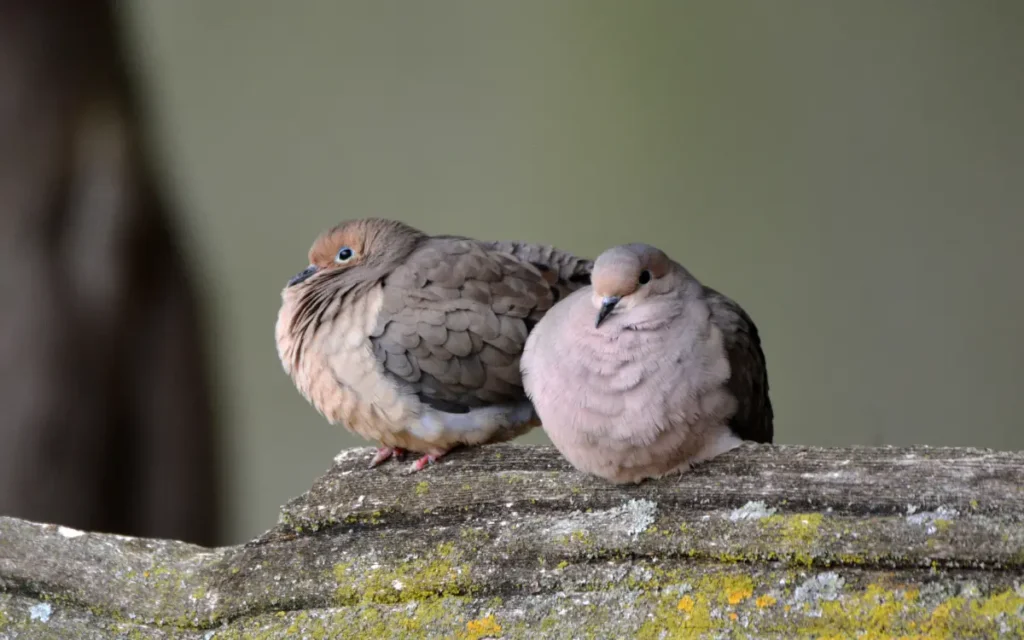
A Mourning Dove has a delicate body, small head, short bill, pointed wings, and a noticeably long tail. Its back and wings are gray-brown, while the chest has a warmer buff or pinkish wash.
Small black spots appear on the folded wings. Another dark mark sits below and behind each eye. In good light, adults may show pale blue skin around the eyes and a faint shine on the sides of the neck.
The long pointed tail is one of the most dependable identification marks. When the dove takes flight, the outer tail feathers show black borders and white tips.
Mourning Dove Size and Shape
Mourning Doves are about the same length as American Robins, but they look slimmer and have much smaller heads.
Their bodies are narrow through the chest and taper toward the tail. When perched, the long tail may make up nearly half of the bird’s visible length.
Mourning Dove Measurements
- Length: 9.1–13.4 inches (23–34 cm)
- Wingspan: About 17.7 inches (45 cm)
- Weight: 3–6 ounces (86–170 g)
Males are usually slightly larger and more colorful than females, but size alone is not a dependable way to tell them apart.
Mourning Dove Colors and Markings
The main colors are soft brown, gray, tan, and buff. These quiet shades help Mourning Doves blend into dry fields, bare soil, tree branches, and roadside vegetation.
Look for four main markings:
- Black spots on the folded wings
- A small dark mark behind the eye
- Pale blue skin around the eye
- White-edged outer tail feathers
The wings may also show a pale blue-gray area near the shoulder. This patch can be hard to see from a distance.
Male Mourning Dove Identification
Male and female Mourning Doves look similar, but an adult male usually has slightly stronger colors.
A male may show:
- A bluish-gray crown
- A warm pink wash across the chest
- Pink or purple shine on the sides of the neck
- Brighter blue skin around the eyes
- A slightly larger body
These differences are easiest to see when a male and female are standing together. Lighting, age, and feather wear can make a single bird difficult to sex.
Female Mourning Dove Identification
A female Mourning Dove is generally browner and less colorful than a male.
She usually has:
- A brown or gray-brown crown
- Little or no pink on the chest
- Less shine on the neck
- A slightly smaller and slimmer body
- The same black wing spots and pointed tail
Female Mourning Doves should not be identified by dull color alone. Young males and adults in poor light can look very similar.
Male vs. Female Mourning Dove
| Feature | Male | Female |
| Crown | Blue-gray | Brown or gray-brown |
| Chest | Noticeable pinkish wash | Pale buff or light brown |
| Neck | Pink and purple shine | Weak or absent shine |
| Eye ring | Brighter pale blue | Duller blue-gray |
| Size | Slightly larger | Slightly smaller |
| Overall appearance | More colorful | More evenly brown |
Juvenile Mourning Dove Identification
A juvenile Mourning Dove looks rougher and more patterned than an adult. Each feather has a pale edge, creating a scaly appearance across the head, breast, and wings.
Young birds may also have:
- Shorter tails
- Buffy tips on the wing feathers
- Less obvious black wing spots
- Darker bills
- Little blue skin around the eyes
- No pink or purple neck shine
The scaly pattern causes young Mourning Doves to be mistaken for Inca Doves or Common Ground Doves. Size and tail length are the best clues. A juvenile Mourning Dove is much larger than a Common Ground Dove.
Mourning Dove Tail Identification
The tail is often the easiest way to confirm a Mourning Dove.
It is:
- Long and narrow
- Sharply pointed in the center
- Edged with white
- Marked with black near the ends of the outer feathers
A perched bird may hold the tail closed, hiding most of the white. The pattern becomes much clearer when the bird spreads its tail to land or turns in flight.
Eurasian Collared-Doves and White-winged Doves have broader, more squared or rounded tails.
Mourning Dove Identification in Flight
A flying Mourning Dove has pointed wings, a streamlined body, and a long tapered tail. Its flight is fast and direct, with quick wingbeats followed by short glides.
Watch for:
- Narrow, pointed wings
- Long, pointed tail
- White outer tail tips
- Quick, twisting turns
- Sharp whistling during takeoff
The whistle is made by air passing over specialized wing feathers. It is not a vocal call. The sound may warn nearby doves when a bird suddenly escapes danger.
Mourning Dove Call Identification
The male Mourning Dove gives a low, hollow call that sounds like:
“Coo-OO-oo-oo.”
The first part may sound like a soft “hoo-AHH,” followed by several quieter notes. Because the call resembles an owl, many people hear it early in the morning and assume an owl is nearby.
Mourning Dove vs. Owl Call
| Feature | Mourning Dove | Owl |
| Sound | Soft, sad cooing | Deeper hoots or calls |
| Time heard | Daytime, dawn, and evening | Usually night, dawn, or dusk |
| Location | Wires, rooftops, and exposed branches | Often hidden in trees |
| Pattern | One strong note followed by softer coos | Pattern changes by owl species |
A Mourning Dove’s call usually sounds smoother and less forceful than an owl’s voice.
Mourning Dove Wing Whistle
When a Mourning Dove takes off, its wings often make a high, sharp whistle. The sound rises and falls with each wingbeat.
This is different from the bird’s cooing song. You are most likely to hear it when a dove suddenly leaves the ground, a feeder, or a roadside perch.
Researchers believe this sound helps alert other doves to possible danger. A faster escape produces a quicker and more urgent wing whistle.
Mourning Dove Behavior
Behavior provides several useful identification clues.
Mourning Doves often:
- Walk across bare ground while bobbing their heads
- Gather seeds beneath bird feeders
- Rest on telephone wires and exposed branches
- Swallow grit to help grind seeds
- Fly away with loud, whistling wings
- Sit quietly in pairs
- Form larger flocks outside the breeding season
They feed mainly on the ground rather than clinging to hanging feeders. A platform feeder or a clean area beneath a feeder is more likely to attract them.
Mourning Dove Habitat
Mourning Doves prefer open or partly open areas with scattered trees. They usually avoid thick, continuous forest.
Common habitats include:
- Residential yards
- Farms and agricultural fields
- Grasslands
- Desert scrub
- Woodland edges
- Roadsides
- Parks
- Open pine woods
- Towns and suburbs
Look for them on utility wires, fences, rooftops, dead branches, and open patches of soil. The Cornell Lab of Ornithology recommends checking wires and bare ground where these doves gather for seeds and grit.
Mourning Dove Range and Migration
Mourning Doves occur across most of the United States, southern Canada, Mexico, and parts of Central America.
They live year-round across much of the southern United States. Birds from northern parts of the range often migrate south during fall and return during spring.
Some individuals remain surprisingly far north during winter when food and sheltered roosting sites are available.
Mourning Dove Diet
Seeds make up nearly all of a Mourning Dove’s diet. The bird commonly eats seeds from grasses, weeds, flowers, crops, and backyard feeders.
Popular foods include:
- Millet
- Cracked corn
- Sunflower hearts
- Milo
- Wheat
- Grass seeds
- Weed seeds
Mourning Doves usually swallow seeds whole and store them in an enlarged part of the throat called the crop. They may then rest in a safe location while digesting the meal.
Mourning Dove Nest Identification
A Mourning Dove nest is a loose, shallow platform made from small twigs. It often looks too weak to hold the eggs and parent, but many nests survive long enough to raise young.
Common nest locations include:
- Horizontal tree branches
- Dense shrubs
- Hanging baskets
- Building ledges
- Gutters
- Roof supports
- Abandoned nests built by other birds
The female usually builds the nest while the male collects and delivers twigs.
Mourning Dove Eggs
Mourning Doves normally lay two plain white eggs. Both parents incubate them, often taking regular shifts.
The male commonly sits during the middle of the day, while the female covers the eggs during the night and early morning.
Mourning Dove Look-Alikes
Mourning Dove vs. Eurasian Collared-Dove
| Feature | Mourning Dove | Eurasian Collared-Dove |
| Body | Slim | Larger and heavier |
| Tail | Long and pointed | Broad and squared |
| Neck | No collar | Black half-collar |
| Wings | Black spots | Plain, darker wingtips |
| Call | Long, sad coo | Repeated three-note coo |
The black collar and squared tail make the Eurasian Collared-Dove fairly easy to separate from an adult Mourning Dove.
Mourning Dove vs. White-winged Dove
| Feature | Mourning Dove | White-winged Dove |
| Body | Slim and delicate | Stocky |
| Wing pattern | Small black spots | Bold white wing stripe |
| Tail | Long and pointed | Shorter and rounded |
| Eye | Dark with pale blue skin | Red eye with blue skin |
| Bill | Dark | Dark with a paler base |
A White-winged Dove’s white wing stripe can often be seen while the bird is perched and becomes unmistakable in flight.
Mourning Dove vs. Rock Pigeon
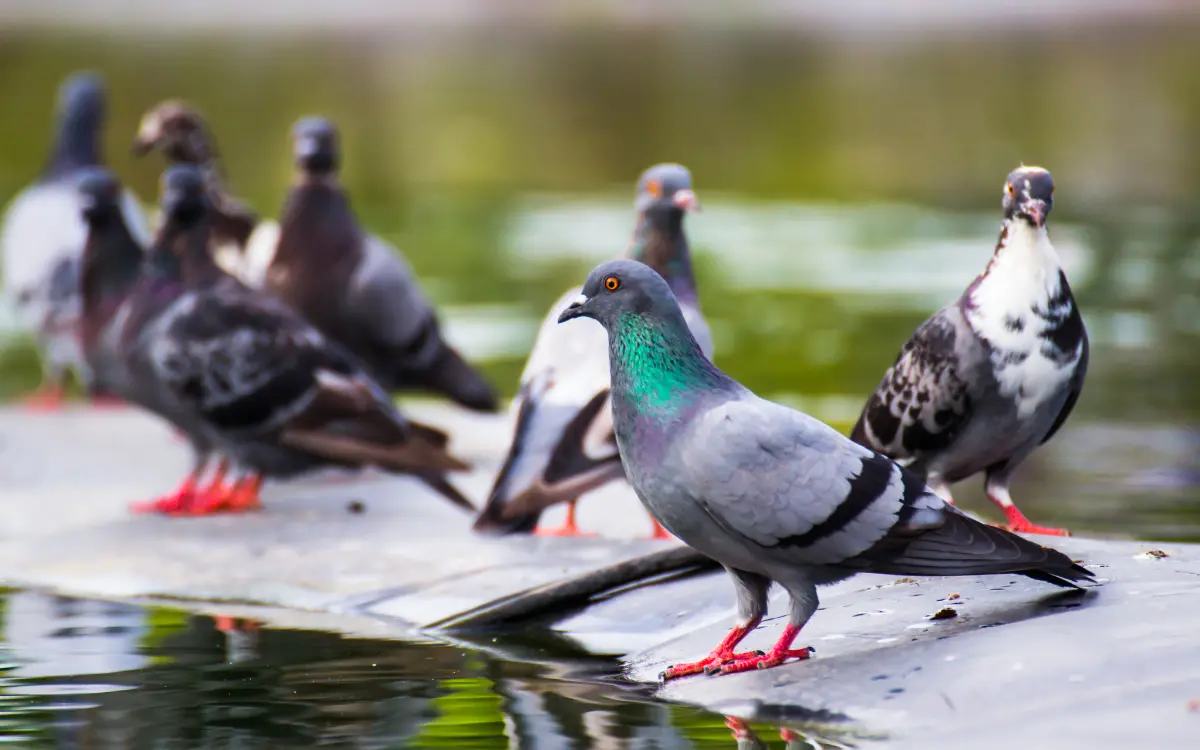
Rock Pigeons are heavier, broader-chested, and shorter-tailed. They usually have thicker bills and more varied plumage.
Mourning Doves lack the Rock Pigeon’s bulky body, broad wings, and typical dark wing bars.
Mourning Dove vs. Common Ground Dove
The Common Ground Dove is much smaller, only about the size of a sparrow. It has a short tail and a scaly pattern across its head and chest.
A juvenile Mourning Dove can also look scaly, but it is larger and has a much longer tail.
Mourning Dove vs. Inca Dove
An Inca Dove is smaller and has a clear scaly pattern covering most of its body. Its wings flash rusty brown when it flies.
A Mourning Dove has a plainer body, scattered black wing spots, and a longer pointed tail.
How to Attract Mourning Doves
Mourning Doves prefer feeding on flat, open surfaces.
To make a yard more inviting:
- Offer millet, cracked corn, or sunflower hearts.
- Use a platform feeder or ground-feeding tray.
- Keep feeding areas dry and clean.
- Leave some open ground below feeders.
- Provide a wide, shallow birdbath.
- Grow native seed-producing grasses and flowers.
- Avoid placing food where cats can hide nearby.
Do not spread more seed than the birds can eat. Old seed and droppings can collect moisture and allow disease-causing organisms to grow.
FAQs
How can I quickly identify a Mourning Dove?
Look for a slim tan-gray body, small head, black wing spots, and a long pointed tail with white edges. Its soft coo and whistling takeoff are also helpful.
What color is a Mourning Dove?
A Mourning Dove is mainly warm tan, gray-brown, and buff. Males may have pink chests, blue-gray crowns, and purple or pink neck feathers.
How do you tell a male from a female Mourning Dove?
Males are usually slightly more colorful, with blue-gray crowns and pinkish chests. Females are more evenly brown. The difference can be hard to see unless both birds are together.
What does a baby Mourning Dove look like?
A young Mourning Dove has pale-edged feathers that create a scaly pattern. It has a shorter tail, dull colors, and little or no blue around the eyes.
What bird looks like a Mourning Dove but is larger?
A Eurasian Collared-Dove looks similar but is larger and paler. It has a black neck collar and a broad, square-ended tail.
What bird looks like a Mourning Dove but has white wings?
The White-winged Dove has a bold white stripe across each wing. It is stockier and has a shorter, more rounded tail.
Why does a Mourning Dove sound like an owl?
Its low, hollow coo resembles an owl’s hoot. The Mourning Dove often sings from an exposed perch during daylight, while most owls call from hidden locations.
Why do Mourning Dove wings whistle?
Air passing across special wing feathers creates the whistle. The sound becomes faster during an urgent escape and may warn nearby doves of danger.
Do Mourning Doves have spots?
Yes. Adults have several small black spots on their folded wings and a dark mark behind each eye.
Are Mourning Doves pigeons?
Mourning Doves and pigeons belong to the same bird family, Columbidae. However, the Mourning Dove is a separate species with a slimmer body and pointed tail.
Where do Mourning Doves sleep?
They usually sleep in trees, shrubs, or sheltered woodland roosts. Their muted feathers help them remain hard to see while resting.
Are Mourning Doves found throughout North America?
They occur across most of the continent. Northern populations are more migratory, while many doves in warmer regions remain year-round.